Explained
Kids' Tool Benches, Explained
After reading, you will understand how to read the age, size, piece count and warning text on a toy workbench listing.
In this guide
Tool bench listings look alike, but the details differ in ways that matter at home. One bench is rated for age 2 and another for 3, one carries a choking hazard line and another says nothing, and sizes range from a tabletop to nearly four feet wide. First-time buyers often compare photos instead of the numbers. This guide explains the terms you will see.
The 30-second version
- Follow the stated age, because the maker sets it based on the small parts in the box.
- Measure the footprint, since listed sizes run from 14.96 inches to 47 inches wide.
- Check for batteries, as some benches list them as required and not included.
- Read the warning text, and if a page has none, check the box.
- Count pieces, not photos, to see what is really included.
The products this guide is about
Our verdict on each, with the full reasoning on the companion review.
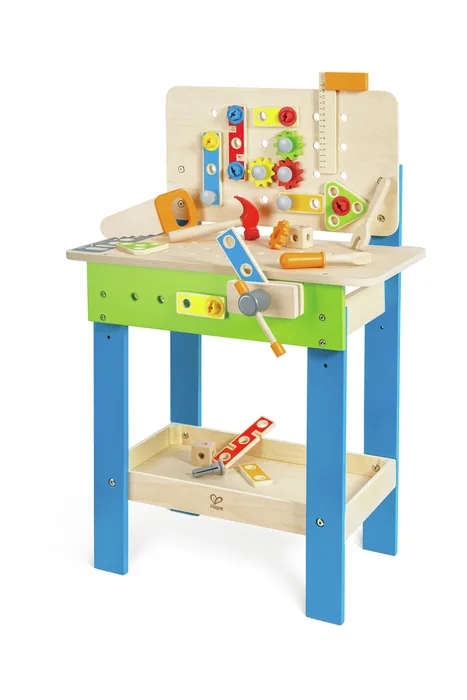
- Buy Hape Master Workbench A wooden bench with 35 parts and adjustable height, built to grow with the child. Amazon
- Buy Little Tikes Tikes Tough Workshop A compact plastic workshop for ages 2 and up with a pegboard, sliding doors and 11 accessories. Amazon
- Buy PlanToys Little Tool Bench A tabletop rubberwood tool bench with a hammer, wrench, spirit level and building pieces.
- It depends Black+Decker Ready to Build Workbench A 50+ piece build-it-yourself bench with a battery drill and miter saw that make sounds. Amazon
- It depends Melissa & Doug Deluxe Pounding Bench A small solid wood pounding bench with 8 non-removable pegs and a mallet for ages 2 and up. Amazon
- Skip Step2 Pro Play Workshop & Utility Bench A very large plastic workshop with a 76 accessory set, a working vise and a battery drill, for ages 3 and up. Amazon
What actually matters
- Stated age - The age grade is the maker's rating for the toy. It reflects small parts and play style, so use it as your starting point.
- Footprint - Width, depth and height decide where the bench lives. A tabletop bench and a standing workshop are different purchases.
- Piece count - The number of parts and accessories shows how much play is in the box. A count of 11 and a count of 76 are not comparable without looking at what the pieces are.
- Batteries - Sound and light features need batteries. Pages may say they are not included, so buy them in advance.
- Assembly - Some benches need adult assembly and others are built as part of play. Allow the time.
- Material - Wood and plastic benches look and feel different. Makers list materials, so read them.
- Small-parts warning - Small nuts, nails and bolts carry warning text on some pages. Where a page is silent, check the box.
The specs, in plain English
Green flags vs red flags
Green flags
- The page states an age grade clearly
- Size and weight are listed
- The accessory list names each tool
- Battery requirements are stated plainly
- Assembly requirements are stated
Red flags
- No age or size anywhere on the page
- A piece count with no list of what the pieces are
- Listed weight that does not fit the product
- Photos that show tools not in the set
- No mention of batteries for a sound or light feature
Who's who: the brands
- Hape - A wooden toy maker whose Master Workbench has adjustable height.
- Little Tikes - Known for plastic pretend-play furniture, including the Tikes Tough Workshop.
- PlanToys - Makes natural wood toys, including the Little Tool Bench from reclaimed rubberwood.
- Melissa & Doug - Makes wooden toys including a Deluxe Pounding Bench and a Wooden Project Workbench.
- Step2 - Makes large plastic playsets such as the Pro Play Workshop.
How to read a listing without getting fooled
Start with the stated age, then the product size, then the list of what is included. Look for a warning line near the specifications, and check for a battery line. If a figure looks odd, such as a weight far too low for the size, treat the listing with caution and check the carton or maker.
How much should you spend?
Prices run from a budget tier for small pounding toys and compact plastic workshops to a premium tier for wooden benches and large workshops. A higher tier does not always mean more pieces, so compare what is in the box and the stated age before deciding.
Questions, answered
Can a two year old use a tool bench?
Only if the maker rates it for that age. Little Tikes states 2+ for its Tough Workshop and Melissa & Doug states 2 and older for its pounding bench. Most other benches here say 3 or 3+. Ignore marketing photos and follow the age printed by the maker.
Are toy tools safe for toddlers?
That depends on the age grade and the small parts. Some pages carry a choking hazard warning and others did not state one on the pages we loaded. Follow the maker's age and supervise play with nuts, bolts and nails.
How do I fit a bench in a small room?
Look at tabletop benches such as the PlanToys Little Tool Bench at 14.96 by 5.51 by 9.06 inches, or the Little Tikes at 15.50 by 21.50 by 31.50 inches. Avoid large workshops that are 47 inches wide.
Can I add tools to a workbench later?
Often yes. Makers like Hape sell sets such as the Fix It tool box, though compatibility is not always stated. Check the maker page before assuming a tool set fits a given bench.
Or jump to the head-to-head: Hape Master Workbench vs Little Tikes Tikes Tough Workshop.