Explained
Inflatable Kayaks, Explained
After reading this, you'll be able to look at any inflatable kayak listing and know whether it's a genuine boat or a glorified pool float - before you spend a dime.
In this guide
Inflatable kayaks now span everything from thin-vinyl pool toys to drop-stitch boats that track almost like hardshells, and the product listings for both use nearly identical language. The specs that actually separate them - hull material, floor construction, tracking aids, and honest load capacity - are buried under marketing terms most first-time buyers have never seen. This guide decodes those terms so the difference is obvious at a glance.
The 30-second version
- Hull material is the single biggest divide: multi-layer or reinforced PVC lasts for years, while thin single-layer vinyl is effectively a seasonal product.
- Tracking aids are not optional: without a skeg, rigid ribs, or a drop-stitch floor, an inflatable zig-zags with every stroke and turns a calm paddle into a workout.
- Multiple air chambers are a safety feature, not a luxury - one puncture should never mean a sinking boat.
- Listed capacity is a ceiling, not a target: load a boat near its maximum and it sits low, catches wind, and paddles badly; buy generous headroom over your body-plus-gear weight.
- Setup and drying time shape how often you paddle: open PVC boats launch in minutes and wipe dry, while fabric-covered designs paddle better but demand patience on both ends.
The products this guide is about
Our verdict on each, with the full reasoning on the companion review.
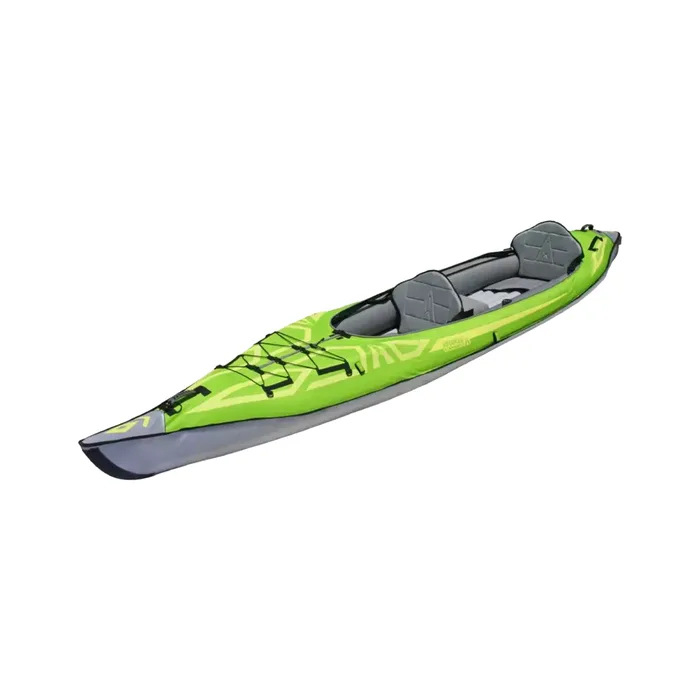
- Buy Advanced Elements AdvancedFrame Convertible (AE1007) The inflatable that paddles most like a real hardshell, thanks to aluminum ribs in the bow and stern, in a 15-foot hull for one or two. Amazon
- Buy Sea Eagle 370 Sport Kayak A do-everything tandem with a huge weight capacity that costs far less than its versatility suggests. Amazon
- It depends AIRE Tributary Strike A self-bailing solo boat built for rivers up to Class III, worth it if moving water is where you paddle. Amazon
- Skip Intex Challenger K1 A tempting entry price, but thin vinyl, poor tracking, and a cramped cockpit make it a short-term boat. Amazon
What actually matters
- Hull material - this decides whether the boat lasts one season or ten. Multi-layer PVC tarpaulin and thick reinforced PVC shrug off gravel launches and scrapes; thin single-layer vinyl (the pool-toy grade) is where puncture and seam-leak reports cluster.
- Tracking - a kayak's ability to go straight. Flat-bottomed inflatables naturally wander between strokes; rigid ribs, a decent skeg, or a high-pressure drop-stitch floor are what keep the bow pointed where you're aiming.
- Air chambers - a real boat has at least two or three separate chambers so a single puncture leaves you floating. A single-chamber design means one leak puts you in the water.
- Load capacity - the honest number matters more than the headline. Performance sags well before you reach the printed maximum, so a rating with comfortable margin over your weight plus gear is what you actually want.
- Setup and drying time - the friction that determines whether the boat gets used. Simple two-chamber open designs inflate in around five minutes; multi-chamber fabric-covered boats take longer to set up and much longer to dry before storage.
- Seat and cockpit design - inflatable seats lose support fast and low seatbacks tire your back within an hour. A supportive high-back seat and a cockpit sized for real adults are the difference between a two-hour tour and a thirty-minute regret.
- What's in the box - pumps, paddles, and seats are bundled with some boats and sold as pricey add-ons with others. Always compare the all-in cost of a ready-to-paddle setup, not the bare hull.
The specs, in plain English
Green flags vs red flags
Green flags
- The listing names a specific hull construction - multi-layer PVC tarpaulin, reinforced fabric with a denier figure, or a drop-stitch floor with a stated PSI.
- Three or more separate air chambers, called out explicitly.
- A removable skeg (or two) included in the box, plus a repair kit.
- A complete package - pump, paddle, seat, and carry bag - so the quoted cost is the real cost of getting on the water.
- A long manufacturer warranty and owner reports that praise customer support after seasons of use.
- Owner reports spanning multiple years that mention gravel launches, sun exposure, and rough handling without failures.
Red flags
- Vague material claims like 'rugged vinyl' or 'heavy-duty' with no layers, fabric, or denier specified - the classic pool-toy tell.
- No skeg, ribs, or drop-stitch floor anywhere in the spec sheet - expect to zig-zag with every stroke.
- A load capacity that barely clears your own body weight once you add a paddle, pump, and a dry bag.
- Glossy studio photos only, with no images of the boat actually being paddled by an adult.
- Recurring owner reports of seam leaks, slow air loss, or seats that collapse within the first season.
- Essential gear - pump, paddle, even the seat - sold separately, quietly inflating the true cost of a 'cheap' boat.
Who's who: the brands
- Advanced Elements - Known for hybrid designs that sew aluminum ribs into the hull - the closest an inflatable gets to hardshell tracking and glide.
- Sea Eagle - A long-running direct-to-consumer maker of tough, high-capacity boats, with a strong reputation for warranties and customer support.
- AIRE - Maker of rafts and inflatable kayaks; its Tributary line covers self-bailing solo and tandem boats built for rivers as well as lakes.
- Intex - A pool-products giant whose ultra-budget kayaks get many people on the water for the first time - but thin vinyl and weak tracking make them short-term boats.
- Sevylor - A veteran inflatable-boat name (part of the Coleman family) sitting between the pool-toy tier and serious boats, popular for casual lake paddling.
How to read a listing without getting fooled
Start with the hull: a listing worth your time names its material precisely - layers, fabric, denier, or a drop-stitch floor with a working PSI. 'Durable vinyl' with no specifics is the pool-toy tell. Next, count the air chambers (three or more is a good sign) and look for a skeg or rigid ribs; if no tracking aid appears anywhere, the glowing 'glides effortlessly' copy is fiction. Check the load capacity against your weight plus roughly the gear you'd realistically carry, and insist on comfortable margin. Then read what's actually in the box - a boat that looks cheap but ships without a pump, paddle, or seat often costs about the same as one that includes everything. Finally, skim long-term owner reports rather than launch-week impressions: tracking complaints, seam leaks, and collapsing seats all show up after a season, not after a weekend.
How much should you spend?
Cost in this category tracks three things: hull material, tracking hardware, and what's bundled in the box. The cheapest tier buys thin single-layer vinyl with minimal tracking - fine for a handful of calm-pond outings, but owner reports consistently show these boats getting replaced within a season, which makes them the most expensive kind of cheap. The value sweet spot is the mid-tier: thick reinforced PVC, multiple chambers, real skegs, and complete packages that include the pump and paddles. Spending beyond that buys genuine on-water performance - rib-framed or drop-stitch hulls that track like hardshells - and it's worth it if you'll paddle regularly and care how the boat feels under you, but overkill if your paddling is a few casual outings a summer. Whatever tier you choose, compare the all-in ready-to-paddle cost, not the bare-hull price.
Questions, answered
Do I need a life jacket (PFD) in an inflatable kayak?
Yes - treat a properly fitting PFD (personal flotation device) as non-negotiable, exactly as you would in a hardshell. U.S. Coast Guard rules require one for each person aboard, and many states require actually wearing it, not just stowing it. Inflatables feel stable, but wind, boat wakes, and cold water surprise even strong swimmers, and an inflatable that loses air offers nothing to cling to. Wear your PFD at all times on the water, check the weather before launching, avoid paddling alone in cold conditions, and tell someone your route and return time.
Are inflatable kayaks safe, or do they puncture and sink?
A well-built one is genuinely safe. Quality boats use tough multi-layer PVC that owners report scraping over rocks for years, and - critically - multiple independent air chambers, so a single puncture leaves the other chambers holding you afloat while you paddle to shore. The risk concentrates in the cheapest tier: thin single-layer vinyl punctures far more readily, and a single-chamber design has no backup. Check the chamber count before anything else, and carry the repair kit.
Will an inflatable kayak actually go straight, or will I zig-zag everywhere?
It depends entirely on the tracking hardware. A flat-bottomed inflatable with no fin yaws left and right with every stroke - that's physics, not your technique. A decent removable skeg tames most of it on calm water; rigid ribs or a high-pressure drop-stitch floor get you close to hardshell behavior. If a listing shows no skeg, ribs, or drop-stitch floor, assume the boat wanders and budget your patience accordingly.
How long do setup, pack-down, and drying really take?
Simple open two-chamber boats are quickest - around five minutes with a good pump - while multi-chamber and fabric-covered designs take noticeably longer. The step everyone underestimates is drying: open PVC wipes down in minutes, but fabric-covered hulls hold water and need real drying time before storage. Packing a damp boat is the fast track to mildew and delamination, so budget time after the paddle, not just before it.
Is a cheap inflatable kayak a good way to try the sport?
Sometimes, but the math rarely favors the very cheapest boats. Owner reports on budget vinyl kayaks follow a consistent arc: fun for the first few outings, then frustration with tracking, seat support, and durability, then an upgrade - which means paying twice. If you genuinely might paddle only once or twice a summer, a budget boat limits your downside. If you already know you love being on the water, starting one tier up almost always proves cheaper in the end.
Can I take an inflatable kayak on rivers or choppy water?
Within reason. Tough high-capacity PVC boats handle mild rivers and light chop well, and a few are even rated by their makers for moderate whitewater with the right skills and safety gear. Rib-framed hulls cope best with wind. But budget flat-hulled boats are calm-water craft, full stop - wind and current push them around faster than you can correct. Match the boat's build to the water you'll actually paddle, and when in doubt, stay protected and close to shore.
Or jump to the head-to-head: Advanced Elements AdvancedFrame Convertible (AE1007) vs Sea Eagle 370 Sport Kayak.