

Outdoors & Fitness
The Best Inflatable Kayaks: 4 Compared (and One to Skip)
We compared four inflatable kayaks from Advanced Elements, Sea Eagle, AIRE and Intex on tracking, durability, setup, and comfort.
The short version
If you want an inflatable kayak that actually paddles well, the Advanced Elements AdvancedFrame Convertible is the one to buy: its aluminum bow and stern ribs deliver tracking and glide the others can't match, solo or tandem, at the cost of 52 pounds and slower setup. The Sea Eagle 370 Sport Kayak is the best value - a tough, three-person-rated tandem whose huge capacity and complete packages outweigh its slower, wind-prone hull. The AIRE Tributary Strike is a legitimate pick for a specific buyer: AIRE rates it for rivers up to Class III and makes it self-bailing, but that wetter floor, a solo cockpit and a 300-pound limit make it a 'depends' for lake paddlers. Skip the Intex Challenger K1 - the thin vinyl, cramped cockpit, and constant course corrections mean most owners outgrow it almost immediately, and spending a little more buys a dramatically better boat. Best for: paddlers who value performance (AdvancedFrame), families and gear-haulers on a budget (Sea Eagle 370), and solo river runners (Tributary Strike).
Our picks at a glance
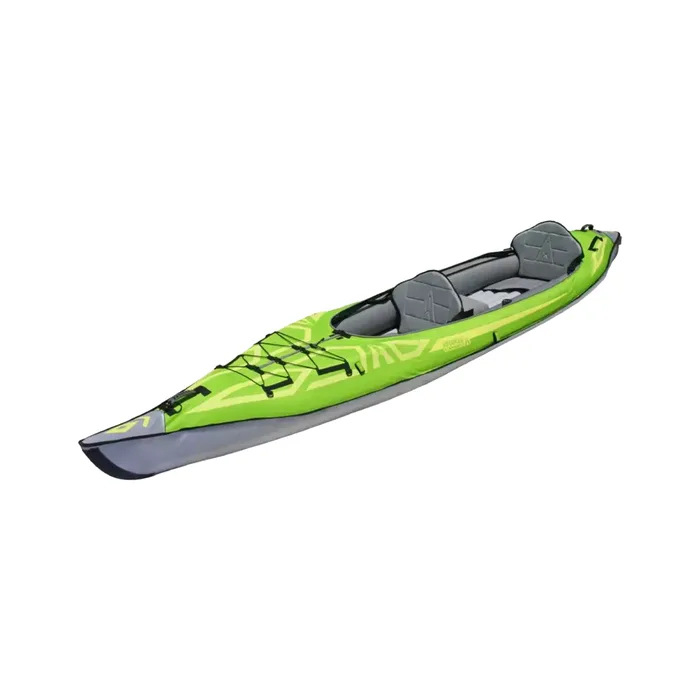
- Advanced Elements AdvancedFrame Convertible (AE1007) - Buy. The inflatable that paddles most like a real hardshell, thanks to aluminum ribs in the bow and stern, in a 15-foot hull for one or two.
- Sea Eagle 370 Sport Kayak - Buy. A do-everything tandem with a huge weight capacity that costs far less than its versatility suggests.
- AIRE Tributary Strike - It depends. A self-bailing solo boat built for rivers up to Class III, worth it if moving water is where you paddle.
- Intex Challenger K1 - Skip. A tempting entry price, but thin vinyl, poor tracking, and a cramped cockpit make it a short-term boat.
The verdict in 30 seconds
What mattered most
- Style
- Length
- Hull weight
- Load capacity
- Tracking & glide
- Setup & pack-down
Inflatable kayaks have quietly become good enough that most recreational paddlers no longer need a roof rack or a garage full of plastic. But the category spans everything from pool-toy vinyl to drop-stitch boats that genuinely track like hardshells, and the price tags don't always tell you which is which. We synthesized independent testing and thousands of owner reports on four widely available models - from a true budget starter to a frame-reinforced tourer - and the verdicts split cleanly: two are worth buying, one depends on how you'll use it, and one is best skipped by anyone who plans to paddle more than a few times a season.
The inflatable that paddles most like a real hardshell, thanks to aluminum ribs in the bow and stern, in a 15-foot hull for one or two.
Best for: Paddlers who want genuine touring performance, solo or with a partner, from a boat that fits in a car trunk.
- Built-in aluminum ribs at bow and stern plus a skeg tracking fin give it the best tracking and glide of any boat in this group
- Three layers of material for puncture resistance and a 550 lb maximum capacity
- Paddles solo or tandem with two adjustable high-back seats, and optional decks convert the open deck to a closed one
- Advanced Elements lists it at 52 lbs, and this version ships without a pump
- Multiple chambers and a fabric cover mean slower setup and much slower drying than open designs
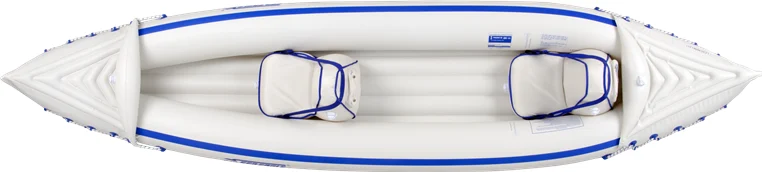
A do-everything tandem with a huge weight capacity that costs far less than its versatility suggests.
Best for: Couples, families, or gear-hauling solo paddlers who want one affordable boat that does a bit of everything.
- Massive capacity - rated for three people or 650 pounds, enough for one paddler plus camping gear
- 36-gauge PolyKrylar hull with twin rear skegs; owners report it handles lakes and mild rivers with ease
- Packages include seats, paddles, and pump, and the maker backs it with a three-year warranty and strong support reputation
- Wide, high-sided hull catches wind and is noticeably slower than the AdvancedFrame
- Inflatable floor flexes underfoot; taller paddlers find the included seats short on back support
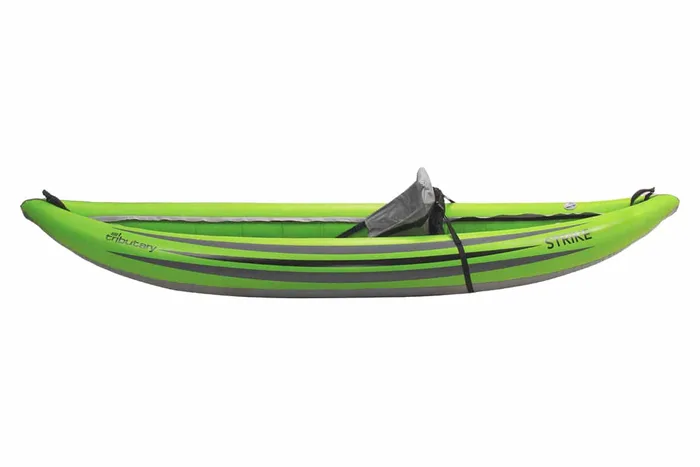
A self-bailing solo boat built for rivers up to Class III, worth it if moving water is where you paddle.
Best for: Solo paddlers who run rivers and want a boat that drains itself in rapids.
- AIRE pitches it at calm lakes, Class I and II rivers and Class III whitewater, and lists it as self-bailing
- 1000-denier PVC shell over urethane AIREcell bladders, in 3 chambers
- Tributary 5 year limited warranty, the longest stated here
- A self-bailing floor drains through by design, so on flat water you sit in a wetter boat than a closed-floor kayak
- Solo only: 10 ft 3 in, 16 in of interior width, and a 300 lb load capacity, at a stated 30 lbs
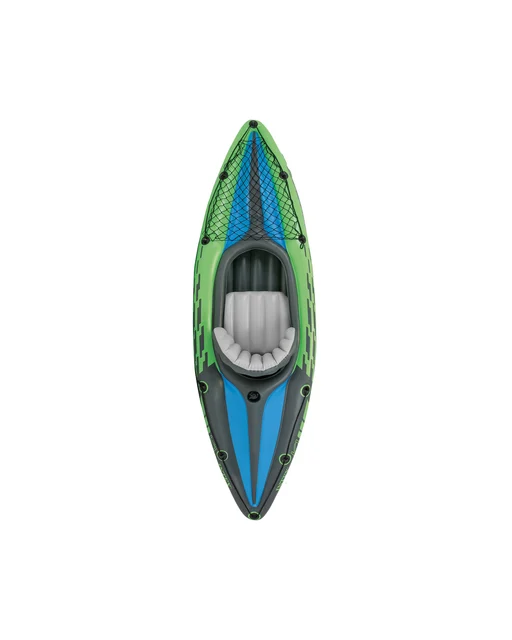
A tempting entry price, but thin vinyl, poor tracking, and a cramped cockpit make it a short-term boat.
Best for: Only the strictest budgets and the calmest ponds - most buyers outgrow it within a season.
- Complete kit - paddle, pump, and skeg included - at a fraction of what the others cost
- Light, compact, and genuinely easy to inflate for a first taste of kayaking
- Pool-toy-grade vinyl; owner reports of punctures and seam leaks are far more common than for the other three
- Zig-zags noticeably between strokes, and the low inflatable seat loses support quickly
- Enclosed cockpit is tight for larger adults, and the 220-pound capacity is the lowest here
| Criteria | Advanced Elements AdvancedFrame Convertible (AE1007) Top pick Buy it Buy | Sea Eagle 370 Sport Kayak Buy it Buy | AIRE Tributary Strike It depends Buy | Intex Challenger K1 Skip it Buy |
|---|---|---|---|---|
| Best for | Paddlers who want genuine touring performance, solo or with a partner, from a boat that fits in a car trunk. | Couples, families, or gear-hauling solo paddlers who want one affordable boat that does a bit of everything. | Solo paddlers who run rivers and want a boat that drains itself in rapids. | Only the strictest budgets and the calmest ponds - most buyers outgrow it within a season. |
| Price tier | $$$ · premium | $$ · mid-range | $$$ · premium | $ · budget |
| Style | Sit-inside, solo or tandem | Open tandem (1 to 3 paddlers) | Self-bailing solo | Enclosed-cockpit solo |
| Length | 15 ft | 12 ft 6 in | 10 ft 3 in | 9 ft |
| Hull weight | 52 lbs | 32 lbs | 30 lbs | Not published |
| Load capacity | 550 lbs | 650 lbs | 300 lbs | 220 lbs |
| Tracking & glide | Best in class (aluminum ribs, skeg) | Good with twin rear skegs | River hull; AIRE claims flatwater tracking | Poor - zig-zags noticeably |
| Setup & pack-down | Slowest; cover dries slowly | Moderate; larger hull to pump | 3 chambers; drains itself on the water | Fast, but fiddly skeg and seat |
| Durability reputation | Excellent (three-layer rip-stop/PVC) | Excellent (36-gauge PolyKrylar) | 1000-denier PVC, urethane bladders | Weak (thin vinyl) |
| Price tier | $$$ · premium | $$ · mid-range | $$$ · premium | $ · budget |
Which one is right for you?
- Paddlers who want genuine touring performance, solo or with a partner, from a boat that fits in a car trunk. Buy it Advanced Elements AdvancedFrame Convertible (AE1007)
- Couples, families, or gear-hauling solo paddlers who want one affordable boat that does a bit of everything. Buy it Sea Eagle 370 Sport Kayak
- Solo paddlers who run rivers and want a boat that drains itself in rapids. It depends AIRE Tributary Strike
- Only the strictest budgets and the calmest ponds - most buyers outgrow it within a season. Skip it Intex Challenger K1
How we judged the field
We don’t run our own lab. Instead, we synthesized independent testing of current inflatable kayaks with large volumes of aggregated owner reports - the long-term feedback that shows up only after boats have spent seasons being dragged up gravel banks, left inflated in the sun, and stuffed wet into car trunks. Four criteria mattered most: on-water performance (tracking, glide, and wind behavior), durability (hull material, seam quality, and puncture reports), livability (setup time, seat comfort, portability, and drying), and honest value - what you actually get for each step up in price tier. Availability has shifted: the solo AdvancedFrame AE1012 and Aquaglide’s Deschutes 110 are no longer sold new by their makers, so this comparison uses the AdvancedFrame Convertible and the AIRE Tributary Strike, both listed in stock on their makers’ stores.
Advanced Elements AdvancedFrame Convertible (AE1007)
Buy itThe AdvancedFrame has been the answer to “which inflatable actually paddles well?” for years, and the Convertible keeps the formula in a longer hull: built-in aluminum ribs define the bow and stern, and a skeg tracking fin helps it hold a line, so it tracks and glides in a way no purely inflatable boat in this group can match. At 15 feet long with a 32-inch beam, it paddles solo or tandem, and optional single or double decks turn the open deck into a closed one.
The boat is built like it means it, too - three layers of material (polyester rip-stop over PVC tarpaulin) for puncture resistance, two adjustable high-back padded seats, and a 550-pound maximum capacity.
The trade-offs are weight, cost and patience. Advanced Elements lists it at 52 pounds, the pump is not included in this version, and a covered, multi-chamber design takes longer to set up and dry than an open PVC boat. If your paddling style is spontaneous ten-minute launches, that friction is real. If your style is planned half-day outings, solo or with a partner, the AdvancedFrame rewards you every stroke.
Sea Eagle 370 Sport Kayak
Buy itThe Sea Eagle 370 is the group’s utility player. It’s 12 feet 6 inches of 36-gauge PolyKrylar rated to carry a remarkable 650 pounds - up to three people, or one paddler with a dog and a weekend of camping gear. Twin rear skegs keep it surprisingly well-mannered for a wide, buoyant hull, and owners report it shrugging off lakes, bays, and mild rivers alike. The manufacturer’s three-year warranty and well-regarded customer service come up repeatedly and positively in owner reports, which is not something you can say for most budget-adjacent boats.
It is not a performance kayak. The high side tubes catch wind, the inflatable floor flexes under bigger paddlers, and independent testing finds it slower and less precise than the AdvancedFrame. Taller users often upgrade the included inflatable seats. But the complete packages - seats, paddles, pump, and bag in the box - mean the all-in cost undercuts the AdvancedFrame by a wide margin while carrying up to three people, one more than the AdvancedFrame Convertible. As a first serious inflatable, it’s the easiest recommendation here.
AIRE Tributary Strike
It dependsThe Tributary Strike is the river boat in this group. AIRE pitches it at calm lakes, Class I and II rivers and Class III whitewater, and lists it as self-bailing, so water that comes over the side drains out through the floor instead of pooling around you. It is 10 feet 3 inches long and 37 inches wide, with a 1000-denier PVC shell over urethane AIREcell bladders in three chambers, and AIRE covers it with a Tributary 5 year limited warranty, the longest stated in this comparison.
So why “it depends”? The same features that help in rapids cost you on a lake. A self-bailing floor lets water in and out by design, so on flat water you sit in a wetter boat than a closed-floor kayak. It is solo only, with 16 inches of interior width, a 300-pound load capacity and a stated weight of 30 pounds, and it sits at a premium price. If your paddling means moving water, it is the strongest fit here. If it means lakes and long flat crossings, the AdvancedFrame Convertible tracks better and keeps you drier.
Intex Challenger K1
Skip itThe Challenger K1 is the boat most people find first, because its price is a rounding error next to everything else here and the kit includes an 86-inch aluminum paddle, a pump, and a removable skeg. As a literal toe-in-the-water purchase it works: it inflates quickly, it floats, and on a glassy pond it’s fun.
The problems surface with use. The hull is vinyl, and owner reports of punctures and seam leaks are far more common than for any other boat in this comparison. The flat hull zig-zags between strokes even with the skeg fitted, the low inflatable seat loses back support within an hour, and the enclosed cockpit that looks sporty in photos is cramped for larger adults - with a 220-pound capacity that’s the lowest of the group. The consistent arc in owner reports is enthusiasm, then frustration, then an upgrade. Unless your budget is truly fixed at the bottom of the market, put the money toward the Sea Eagle 370 and skip the middle step.
Advanced Elements AdvancedFrame Convertible (AE1007) vs Sea Eagle 370 Sport Kayak: which should you buy?
This comes down to what “better” means for you. The AdvancedFrame is the better kayak: its rib-frame bow slices where the Sea Eagle’s blunt tubes push, it holds a line in wind, and paddlers who care about the feel of the boat under them will notice the difference on every outing. It’s also the more comfortable boat for long days, with two adjustable high-back seats and optional closed decks.
The Sea Eagle 370 is the better purchase for more households. It costs meaningfully less, arrives as a complete package with paddles and pump, and its 650-pound, three-person rating stretches further than the Convertible’s 550 pounds and two seats. Owners also give Sea Eagle’s warranty and support consistently high marks, which matters for a boat you’ll fold, stuff, and occasionally scrape for years.
Buy the AdvancedFrame Convertible if the on-water experience is the point. Buy the Sea Eagle 370 if the boat needs to serve two people, a tight budget, or both.
What to look for
- Hull material over marketing. Multi-layer PVC tarpaulin or a heavy-gauge hull material lasts; thin vinyl is a seasonal product.
- Tracking aids. Rigid ribs, drop-stitch floors, or at minimum a decent skeg - without one of these, expect to zig-zag.
- Multiple air chambers. A safety essential: one puncture should not mean a sinking boat.
- Real capacity, not listed capacity. Load a boat near its maximum and performance sags; buy comfortable headroom over your body-plus-gear weight.
- What’s in the box. Pumps, paddles, and seats are included in some packages and pricey add-ons in others - compare the all-in cost.
- Drying and storage. Fabric-covered boats need drying time before packing; open PVC wipes down fast. Match this to how you’ll actually use it.
Our final take
The inflatable kayak market in 2026 rewards buyers who match the boat to their honest paddling pattern. The Advanced Elements AdvancedFrame Convertible (AE1007) is our pick because it delivers the thing inflatables historically lacked - real on-water performance - with durability that owner reports back up year after year. The Sea Eagle 370 Sport Kayak is the runner-up and the smarter buy for families and budgets, trading refinement for capacity, toughness, and a complete kit at a friendlier price. The AIRE Tributary Strike earns a conditional recommendation for solo river paddlers who accept a wetter, self-bailing floor as the price of a boat rated up to Class III. And the Intex Challenger K1, for all its low-price appeal, is the boat that owner reports keep telling us gets replaced - the most expensive kind of cheap. Whatever you paddle, wear a PFD, check the wind, and leave the water wanting one more hour: that’s the sign you bought the right boat.
Questions, answered
Do I need a life jacket in an inflatable kayak?
Yes - treat a PFD (personal flotation device) as non-negotiable, exactly as you would in a hardshell. U.S. Coast Guard rules require a properly fitting PFD for each person aboard, and many states require wearing it, not just carrying it. Inflatable kayaks are stable, but wind, boat wakes, and cold water can surprise even strong swimmers. As a general water-safety note: wear your PFD at all times on the water, check the weather before launching, avoid paddling alone in cold conditions, and let someone know your route and return time.
Are inflatable kayaks durable, or do they puncture easily?
Quality matters enormously here. The AdvancedFrame's three-layer rip-stop and PVC tarpaulin and the Sea Eagle 370's 36-gauge PolyKrylar hull have strong long-term reputations - owners report years of scraping over rocks and oyster beds without failure, and multiple air chambers mean a single puncture won't sink you. The Tributary Strike pairs a 1000-denier PVC shell with urethane bladders and a 5 year limited warranty. Thin vinyl boats like the Intex Challenger K1 are the exception: puncture and seam-leak reports are far more common, which is a big part of why it's our skip.
How long does it take to inflate and set up an inflatable kayak?
The Intex and Sea Eagle land in the middle at roughly ten minutes, and the Tributary Strike has three chambers to fill. The AdvancedFrame takes the longest because of its multiple chambers and fabric cover, and it also needs the most drying time before you pack it away. Whatever you buy, budget extra time after paddling: packing a wet boat leads to mildew.
Can inflatable kayaks handle rivers, wind, and choppy water?
Within reason. The Sea Eagle 370 is forgiving in moving water - owners use it on mild rivers, and the manufacturer rates it as suitable up to Class III whitewater with appropriate skill and safety gear. The AdvancedFrame handles chop and light wind best thanks to its rigid frame and lower profile. The AIRE Tributary Strike is the one built for it: AIRE rates it for Class I to III rivers and makes it self-bailing. The Challenger K1 is a calm-water boat: it is short, it gets pushed around by wind, and its flat hull makes it hard to hold a line in any current.
Is a cheap inflatable kayak a good way to try the sport?
It can be, but the math rarely favors the cheapest option. Owner reports on the Challenger K1 follow a consistent arc: fun for the first few outings, then frustration with tracking, seat support, and durability - followed by an upgrade. If you're genuinely unsure you'll paddle more than twice a summer, a budget boat limits your downside. If you already know you love being on the water, starting with the Sea Eagle 370 costs more upfront and almost always proves cheaper than buying twice.
Deciding between the top two? See our head-to-head: Advanced Elements AdvancedFrame Convertible (AE1007) vs Sea Eagle 370 Sport Kayak.
More in Outdoors & Fitness
Inflatable Kayaks, Explained Plain-English guide → Advanced Elements AdvancedFrame Convertible (AE1007) vs Sea Eagle 370 Sport Kayak Head-to-head →  The Best Inflatable Paddle Boards: 4 Compared (and One to Skip)
  The Best Insulated Food Jars: 4 Compared (and One to Skip)
  The Best Insulated Water Bottles: 4 Compared (and One to Skip)
  The Best Life Jackets (PFDs): 4 Compared (and One to Skip)