Explained
Heated Insoles, Explained
After reading, you'll understand how to read a heated insole listing, what runtime numbers really mean, and whether an insole suits your boots.
In this guide
Heated insole listings pack a lot into a few lines: a temperature, an hour count, and a claim that they fit all boots. First-time buyers often compare the headline runtime without noticing it was measured on the lowest setting. Others buy an insole that adds thickness to a boot that has none to spare. Knowing a few terms makes the spec sheet much easier to judge.
The 30-second version
- Runtime depends on the setting, so a single hour figure usually describes the lowest heat.
- Built-in batteries avoid a cable, but external packs can be larger and swappable.
- A heat zone under the toes is common, so check what the maker actually says is heated.
- Trimming is normal, but follow the cut lines and avoid the power cord.
- Ski boot suitability is a separate claim, so look for the maker to name ski or snowboard boots.
The products this guide is about
Our verdict on each, with the full reasoning on the companion review.
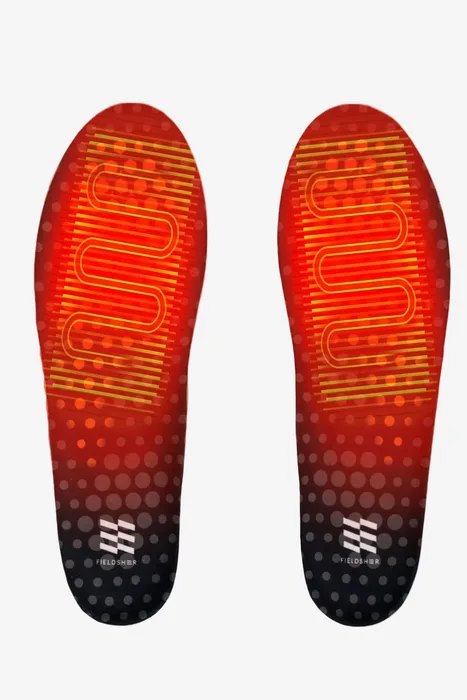
- Buy Fieldsheer (Mobile Warming) Premium BT Wireless Heated Insoles The most fully specified insole in the field: built-in 2200 mAh battery, four heat levels, and phone control through the maker's app.
- Buy ActionHeat Rechargeable Heated Insoles with Remote (AH-INS-LI-01) A key-fob remote, three heat settings, and a stated runtime at every setting at a lower tier than the Bluetooth options.
- It depends Therm-ic Heat Flat + C-Pack 1300B Bundle A very thin trim-to-fit insole that the maker says fits all snow boots and ski boots, powered by external Bluetooth battery packs.
- Skip ActionHeat AA Battery Heated Insoles (AH-INS-AA) A low-spec disposable-battery insole whose maker page leans on vague claims and gives only a 2+ hour runtime.
What actually matters
- Battery capacity (mAh) - This number tells you how much energy the battery holds. Not every maker publishes it, so a listing that does is easier to compare.
- Runtime by setting - Heat output drives battery drain. A table listing hours at each setting is more useful than one hour figure.
- Control method - Remotes and phone apps let you adjust without removing a boot. On-insole buttons work as a backup.
- Heat zones - Many insoles heat under the toes only. Check whether the maker describes the zone or only says 'heating panels'.
- Trim to size - Most heated insoles cut to fit. Marked cut lines show where it is safe, and some makers warn about the power cord.
- Cable routing - Insoles with external batteries run a cord up the heel to a pack on the calf. Self-contained ones avoid this.
- Boot suitability - Makers who name ski or snowboard boots have at least considered the tighter fit. 'Fits all footwear' is a weaker claim.
The specs, in plain English
Green flags vs red flags
Green flags
- The maker lists battery capacity and a runtime for each setting.
- The maker describes the heat zone and how to trim the insole.
- The product page names the boots it fits, including ski or snowboard boots.
- A wireless remote or app is offered, with an on-insole button as a backup.
- Care and charging instructions are clearly stated.
Red flags
- Only one runtime figure is given with no setting attached.
- Claims like 'highest UL ratings' appear with no certificate or number.
- The product page and collection page disagree about heat settings.
- Batteries are not included and runtime is a couple of hours.
- The page says 'fits all footwear' with no mention of boot volume.
Who's who: the brands
- Fieldsheer (Mobile Warming) - Sells battery-heated apparel and insoles with an app-based control system.
- ActionHeat - Offers both rechargeable and AA-powered insoles with simple remotes or buttons.
- Therm-ic - Known for ski boot heating systems built around C-Pack batteries.
- Lenz - A European maker of heat soles and lithium packs sold through its European shop.
- Hotronic - Makes foot-heating systems for ski and snowboard boots.
How to read a listing without getting fooled
Start with the battery line: is it built in, and does the maker give mAh? Then look for runtime, and check whether it is given at each heat level or only once. Next find the heat zone and the control method. Finally read the fit section, which should say whether the insole trims to size and, ideally, name the boots it fits. If a listing leans on phrases like 'highest ratings' or 'warms your core' without a number or certificate, treat that as marketing, not a spec.
How much should you spend?
Budget insoles tend to use disposable AA cells and give a short runtime with few controls. Mid-range models are usually rechargeable with a remote and a runtime table. Premium models add app control, higher stated capacity, or ski-specific fitting, and some use external battery packs that raise the total. The best value is usually a rechargeable model whose maker publishes runtime for each setting.
Questions, answered
Will heated insoles make my boots feel tighter?
They can, because the heater and the battery wiring add some thickness. Makers describe their insoles as thin, but none of the pages we read gave a thickness figure. If your boots are already snug, try the boot on with the insole before a full day. Remove the stock insole first so you are not stacking two.
How do I charge heated insoles?
For built-in battery models, you charge through a cable connected to the insole itself. For external packs like Therm-ic's, you charge the packs separately. Fieldsheer lists USB-C charging in 3+ hours, and ActionHeat includes a dual micro-USB cable.
Can I wash heated insoles?
Check the maker's care notes. Fieldsheer says spot clean only, dry flat, and not to fully submerge or wring them. It also says to dry them fully before turning them on. Treat other brands the same way unless their page says otherwise.
Do heated insoles replace heated socks?
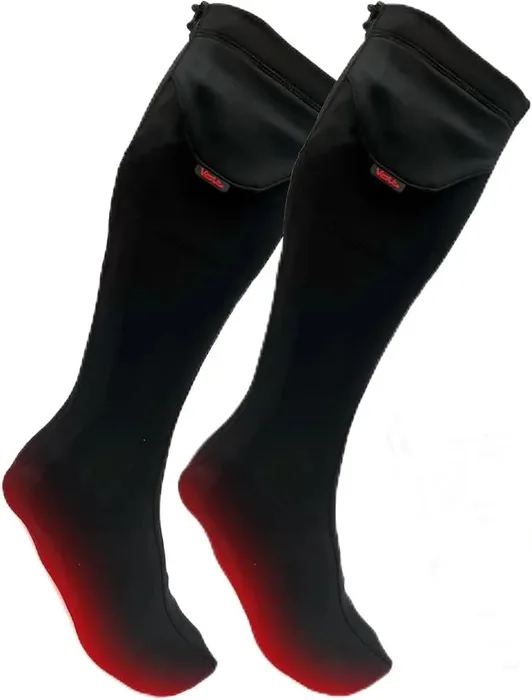
They heat a different area. Insoles warm the sole of the foot, usually under the toes, while heated socks wrap more of the foot. See our heated socks review for that approach, or our rechargeable hand warmers review if your hands get cold first.
Or jump to the head-to-head: Fieldsheer (Mobile Warming) Premium BT Wireless Heated Insoles vs ActionHeat Rechargeable Heated Insoles with Remote (AH-INS-LI-01).