Explained
Golf Bags, Explained
After reading this you will know which bag type fits how you actually play, and how to read a spec sheet without getting fooled by pocket counts and marketing photos.
In this guide
Golf bags look like a simple category until you start comparing spec sheets, and then you hit a wall of divider counts, strap systems, and pocket lists that all sound impressive. The single biggest mistake buyers make is picking a bag style that doesn't match how they get around the course, since a beautiful bag built for a quick nine is miserable strapped to your back for 18 holes, and a loaded cart bag is a burden the moment you have to carry it.
The 30-second version
- Match the bag to your legs, not your budget. whether you walk, ride, or push a trolley decides the bag type before any other spec matters.
- More ways means less digging. a full divider top keeps clubs separated so they pull out cleanly instead of clattering together.
- Weight compounds over 18 holes. a pound saved on the empty bag is a pound you are not carrying for the whole round, on top of clubs, balls, and rain gear.
- Pocket count is a headline, not the whole story. layout and reachability matter more than how many pockets a bag lists.
- Water resistant and waterproof are not the same promise. one sheds a light shower, the other protects gear through a soaked round.
The products this guide is about
Our verdict on each, with the full reasoning on the companion review.
- Buy Sun Mountain E-4.5 VLO Stand Bag The do-everything stand bag: fourteen full-length dividers, and a base that sits securely on a cart when you ride.
- Buy Ping Hoofer 14 Stand Bag The organizer's carry bag: the most pockets and the most dependable stand system in the group. Amazon
- It depends Titleist Cart 14 Bag An excellent cart bag with forward-facing pockets, but only if you ride or push every round. Amazon
- Skip Vessel Sunday IV Stand Bag A gorgeous premium Sunday bag, but too limited and too costly to be most people's everyday bag.
What actually matters
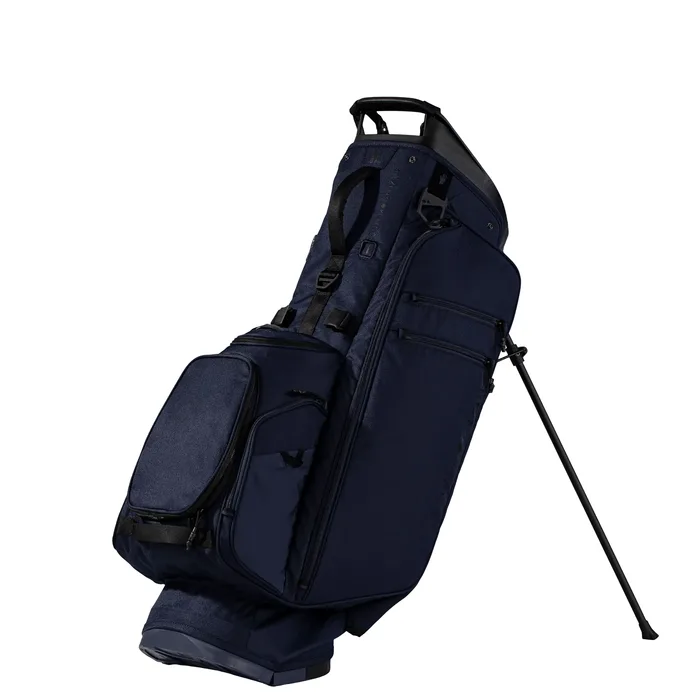
- Bag type decides everything else: a stand bag has legs and straps for walking, a cart bag is shaped to ride, and a Sunday bag is a stripped-down carrier for short rounds.
- Way count (the number of full-length club dividers) determines how organized your set stays and how easily clubs pull free without tangling.
- Empty vs loaded weight matters because manufacturer specs list the bag alone, not the added weight of 14 clubs, a dozen balls, and a rain jacket.
- Strap system is what you actually feel on your shoulders; a padded dual strap distributes weight far better than a single sling for anyone walking more than a few holes.
- Pocket layout should be judged by what's reachable while the bag is on your back or strapped to a cart, not by the total number printed in the listing.
- Leg and base design affects how reliably a stand bag balances on slopes, wet turf, and cart paths without tipping.
- Fabric and hardware quality determine whether a bag survives years of loading, dragging, and rain or starts fraying and sagging after a season or two.
The specs, in plain English
Green flags vs red flags
Green flags
- Bag type clearly matches your actual habit: stand bag for walkers, cart bag for riders, Sunday bag only as a second bag.
- Full-length dividers advertised, not just a divided top opening.
- Both empty and approximate loaded weight are discoverable, not just one flattering number.
- Padded dual strap with an adjustable, X-shaped or similar leg system that owners describe as stable on slopes.
- Pocket layout described with specifics (valuables pocket, apparel pocket, beverage sleeve) rather than just a total count.
- Established brand with a multi-year track record in golf bags specifically, not a general sporting-goods label.
Red flags
- Listing leans entirely on pocket count with no mention of divider structure or strap comfort.
- No weight figure listed, or only a vague 'lightweight' claim with no number.
- Single carry handle only with no stand legs, marketed as suitable for walking.
- Marketing photos show the bag glamorously staged but no detail shots of the divider top or strap padding.
- Fabric described only as 'premium' or 'durable' without naming the material (e.g. denier polyester count).
- Waterproof claims with no mention of sealed seams or coated fabric, which usually means water resistant at best.
Who's who: the brands
- Sun Mountain - Known for well-balanced stand bags built around all-day carry comfort, with VLO models that also sit securely on a cart.
- Ping - Builds carry bags with a reputation for durable stand systems and deep, well-organized pocket layouts.
- Titleist - Makes cart-focused bags designed around forward-facing pockets and accessibility while strapped to a cart.
- Vessel - A premium maker of stylish, minimalist bags, especially compact Sunday bags with upscale materials.
- Callaway - Wide range spanning budget-friendly carry bags through tour-style stand and cart bags.
- TaylorMade - Golf equipment maker that also produces stand and cart bags built to visually match its club lines.
How to read a listing without getting fooled
Start by finding the bag type before anything else, since a stand bag, cart bag, and Sunday bag solve different problems and no spec elsewhere on the listing changes that. Next check the way count and confirm it means full-length dividers, not just a divided top opening, since some listings blur that distinction. Look for both an empty weight and any note about loaded weight; a bag that's light empty can still feel heavy once you add a full set and accessories. Read the pocket list for specifics rather than counting it as one big number, since a bag with fewer, well-placed pockets often beats one with many pockets crammed into awkward spots. Finally, look past staged marketing photos for close-up shots of the strap padding, leg hinges, and stitching, which tell you more about long-term durability than any glamour shot.
How much should you spend?
What drives cost in golf bags is mostly materials and engineering in the strap and leg system, plus brand reputation for durability. Entry-level bags cut corners on padding and use simpler leg mechanisms that can feel wobbly on slopes; mid-range bags from established brands usually nail the fundamentals of weight, organization, and comfort without extra flourishes. Spending more buys you premium fabrics, extra pocket refinement (insulated sleeves, velour lining), and sometimes lighter materials that shave real weight off a loaded bag. Spending the most typically buys style and prestige materials like synthetic leather and carbon-fiber legs, which matter if you want a standout second bag but add little functional benefit over a well-built mid-range carry bag for your primary set. The sweet spot for most golfers sits in the middle: a bag from a brand with a track record in stand bags specifically, with a genuine full-length divider top and a padded dual strap.
Questions, answered
What is the difference between a stand bag, a cart bag, and a Sunday bag?
A stand (or carry) bag has retractable legs and a dual strap so you can walk the course and set it upright anywhere. A cart bag has no legs and is shaped to sit on a motorized cart or push trolley, with pockets facing forward for easy access while strapped in. A Sunday bag is a lightweight, minimalist carrier for a quick nine or the range, holding fewer clubs and less gear. Pick based on how you actually get around, not on looks.
Do I need a full 14-way divider top?
It helps but isn't essential. A full 14-way top gives every club its own channel so irons stay separated and pull out cleanly, which matters most if you carry a complete set and value fast, tangle-free access. Fewer dividers save weight and cost but let clubs cluster together. For a half set or a range bag, a simpler top works fine.
How much does a loaded bag actually weigh compared to the listed spec?
Manufacturer weight specs almost always describe the empty bag. Once you add 14 clubs, a dozen balls, tees, a rangefinder, and rain gear, a bag can gain several pounds beyond its listed figure. If you're choosing between two bags with similar empty weights, the one with a better strap system will feel noticeably lighter loaded, since comfort depends as much on how weight is distributed as on the raw number.
Can I use a cart bag if I sometimes walk the course?
You can, but it's uncomfortable. Cart bags have no stand legs and typically just a single carry handle, so carrying one any real distance gets tiring fast and it can't stand upright on its own. If you ride or push for most rounds and only occasionally walk a short one, a cart bag is fine. If you walk regularly, a stand bag is the better fit.
Is a premium Sunday bag worth buying as my only bag?
Usually not. Sunday bags are built minimal on purpose, which is exactly what makes them light and easy for a quick round, but that same minimal top gets cramped once you load a full 14-club set plus a day's gear. They work best as a second bag for short rounds, the range, or a par-3 course, alongside a full-size stand or cart bag for regular play.
What should I look for in the strap and leg system?
Look for a padded dual strap that spreads weight across both shoulders rather than a single sling, since that's the single biggest factor in carry comfort over 18 holes. For legs, look for a wide, stable stance (often described as X-shaped or similar) that owners report holds steady on slopes and uneven turf, not just flat driving-range ground.
Or jump to the head-to-head: Sun Mountain E-4.5 VLO Stand Bag vs Ping Hoofer 14 Stand Bag.