Explained
Golf Laser Rangefinders, Explained
After reading this, you'll be able to look at any rangefinder listing and know whether it will actually lock the flag, whether you can read the number, and whether the extras are worth paying for.
In this guide
A laser rangefinder does one job: you aim it at the flag, press a button, and get an exact yardage. What trips up first-time buyers is that every model claims the same one-yard accuracy, so the marketing shifts to jargon - PinSeeker, slope, JOLT, plays-like distance - that sounds decisive but is hard to compare. The real differences live in lock reliability, display readability, and a handful of features you'll either use every round or never touch.
The 30-second version
- Accuracy is table stakes. Makers that publish accuracy typically quote about a yard, so don't buy on accuracy claims; and compare lock speed, display quality, and features instead.
- Flag lock is the spec that matters most. The most common rangefinder mistake is ranging the trees behind the green - a good pin-lock mode with vibration or visual confirmation prevents it.
- Display type decides real-world usability. A red or dual-color OLED stays readable in dim morning light and against dark tree lines; a basic black LCD washes out exactly when you need it.
- Slope needs an off switch. Slope-adjusted yardages are great for practice but banned in most competitions, so look for a fast, visible way to disable them.
- Extras are only worth it if you'll use them. GPS green distances, app pairing, and watch integration add real value for some golfers and pure cost for others - be honest about which you are.
The products this guide is about
Our verdict on each, with the full reasoning on the companion review.
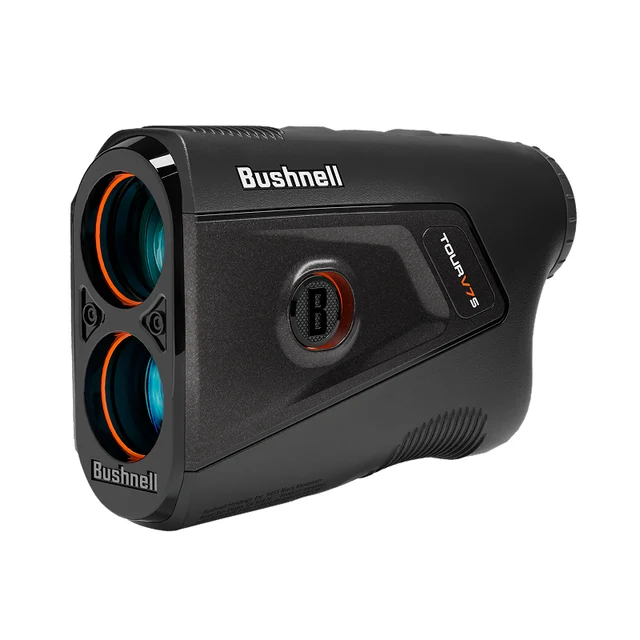
- Buy Bushnell Tour V7 Shift Bushnell's latest Tour laser, with a dual-color OLED that makes slope numbers instantly readable - the new benchmark under the flagship tier. Amazon
- Buy Precision Pro Titan Elite A rugged, feature-stacked laser with app-linked GPS green distances and USB-C recharging that undercuts the big names. Amazon
- It depends Garmin Approach Z30 A lightweight, beautifully built laser that becomes genuinely special only if you already wear a Garmin golf watch. Amazon
- Skip Gogogo Sport GS24 Laser Golf Rangefinder A cheap, popular laser with an LCD display, where the slope-off switch and cart magnet only come on the pricier MTL version. Amazon
What actually matters
- Flag lock and confirmation - the device must reliably grab the pin instead of the background, and tell you unmistakably when it has, via vibration, a flashing ring, or both. This is the single biggest quality gap between models.
- Display readability - you'll range flags in early-morning gloom, bright glare, and against dark backgrounds; illuminated red or OLED displays stay legible where non-illuminated black LCDs disappear.
- Slope with a legal toggle - slope adds elevation-adjusted 'plays-like' yardage, which is the most useful feature in daily play but must be switchable off (ideally visibly) for tournaments.
- Effective pin-lock range - not the headline maximum range, but the distance at which the unit reliably locks a thin flagstick; better models grab pins meaningfully farther out.
- Battery style - USB-C rechargeable suits frequent players who don't want to buy cells; CR2 disposables suit occasional golfers because they hold charge for months to a year and swap in seconds.
- Build and weather sealing - a rubber-armored or metal body with a real waterproof rating survives cart bumps and rain; a cart magnet keeps the laser usable instead of buried in a bag pocket.
- Ecosystem features - some lasers show GPS front/center/back-of-green distances in the viewfinder or beam readings to a watch; valuable if you'll pair the app, dead weight if you won't.
The specs, in plain English
Green flags vs red flags
Green flags
- Pin lock with both vibration and a visual confirmation cue, so there's no ambiguity about what you ranged
- An illuminated red or dual-color OLED display rather than a plain black LCD
- Slope with an external, visible on/off switch or tournament indicator
- A real IP rating (IPX6 or better) and a rubber-armored or metal body
- A built-in cart magnet - owners rank it among the most-used features on any modern laser
- Stated flag-lock range of roughly 400 yards or more, not just a big headline maximum
Red flags
- A non-illuminated black LCD, which washes out in dim light and against dark tree lines
- Only a huge maximum-range figure with no separate flag or pin-lock range quoted
- Slope buried in a menu with no visible way to prove it's disabled in competition
- No vibration or visual lock confirmation - you're left guessing whether you hit the flag or the shed behind it
- A years-old design still at near-original price while newer rivals add OLED, recharging, and better lock for similar money
- Core features that only work after pairing a companion app you have no intention of using
Who's who: the brands
- Bushnell - The category benchmark, with PinSeeker flag lock, JOLT vibration confirmation and switchable slope, at premium prices.
- Precision Pro - The value challenger - packs app-linked GPS green distances, USB-C recharging, and IP67 waterproofing (Titan Elite) into lasers that undercut the big names.
- Garmin - The ecosystem play - beautifully built lasers that integrate with Garmin golf watches and the Garmin Golf app, best for golfers already wearing one.
- Gogogo Sport - A budget laser brand whose GS24 lists an LCD display and reserves the slope-off switch and cart magnet for its MTL version.
- Nikon - The optics specialist - Coolshot lasers are known for exceptionally clear, bright glass and stabilization, with fewer golf-specific app extras.
- Blue Tees - A direct-to-consumer budget brand offering slope, magnets, and decent displays at low prices.
How to read a listing without getting fooled
Start by setting aside the accuracy claim - most makers quote plus-or-minus one yard, and modern lasers generally agree within a yard or two, so it tells you little. Next, separate the headline maximum range (measured on big reflective targets) from the flag-lock range, which is the number that describes real use; if a listing only quotes the big figure, assume the pin range is modest. Check what kind of lock confirmation you get: vibration plus a visual cue is best, vibration alone is fine, nothing is a warning sign. Then look at the display - the word 'OLED' or 'red display' means readable in all light, while an unqualified 'LCD' usually means unlit and hard to read in gloom. Confirm slope exists and, just as important, how it turns off - an external switch or indicator beats a menu setting. Finally, treat GPS, app, and watch features as a separate purchase decision: they're genuinely useful if you'll set them up, and pure markup if you won't.
How much should you spend?
Price in this category buys three things: lock speed and reliability, display quality, and connected extras - not accuracy, which is effectively identical across the field. Entry-level lasers do the basic job in good light, but the cheapest models cut exactly the corners that hurt on the course: dim unlit displays and shorter, less consistent pin lock. The value sweet spot sits in the mid-tier, where you get illuminated displays, dependable lock with vibration confirmation, slope with a legal switch, solid weather sealing, and often rechargeable batteries or GPS extras thrown in. Spending up to the premium tier buys the fastest, most decisive lock and the most readable displays - worth it for serious and frequent players who want zero friction, less so for occasional golfers. The flagship tier above that mostly adds image stabilization and brand cachet with diminishing returns. Spend more only if you play often enough to feel the difference in lock speed and readability; skip paying extra for ecosystem features tied to a watch or app you don't own or won't use.
Questions, answered
Laser rangefinder or GPS watch - which should I buy first?
A laser gives an exact distance to the flag or any target you can see; GPS gives mapped front, middle, and back-of-green distances even when the green is hidden. Most golfers get more from a laser first because precision to the pin drives club selection. Some current lasers blur the line by showing GPS green distances in the viewfinder or relaying readings to a watch, which can make one device cover both jobs.
Is slope legal in tournaments?
Slope-adjusted distances are not allowed in most competitions, though distance measurement itself usually is. That's why a visible, quick way to disable slope matters - some models use an external slider, others a tournament mode with an indicator light officials can see. Always check the local rules of your event; some club competitions restrict distance devices entirely.
How accurate are golf rangefinders, really?
Modern lasers are genuinely accurate - claims of about plus-or-minus one yard hold up, and independent testing finds current models agree with each other within a yard or two on a locked flag. The practical differences are how fast a unit locks, how far away it reliably grabs a thin flagstick, and whether you can read the number in bad light. Buy on those, not on the accuracy spec.
Do I need image stabilization?
It's a genuine comfort feature - it steadies the viewfinder image so shaky hands find the flag faster - but it lives mostly in the most expensive flagship models. Good pin lock with clear confirmation solves the same problem for most golfers at a lower cost. Consider it a luxury for players who struggle to hold the target, not a requirement.
Rechargeable USB-C or CR2 batteries - which is better?
It's a trade-off, not a ranking. USB-C models recharge like a phone and typically run dozens of rounds per charge, but a dead battery mid-trip needs a cable and time. CR2 models run months to a year on one cell, and a spare in the bag swaps in seconds - but you have to keep buying cells. Frequent players tend to prefer USB-C; occasional players like CR2's long shelf life.
Is a built-in cart magnet actually useful?
More than most buyers expect. A magnet lets the laser snap to the cart frame so it's in your hand in one motion instead of buried in a bag pocket, and owners consistently rank it among the features they'd never give up. Nearly every current model includes one - just don't trust it on rough cart paths, which is what cases are for.
Or jump to the head-to-head: Bushnell Tour V7 Shift vs Precision Pro Titan Elite.