Explained
Flashlights, Explained
After reading this you'll understand what a flashlight's specs actually promise, which numbers are marketing, and how to pick a light that performs the way its box implies.
In this guide
Buying a flashlight looks simple until you hit a wall of numbers: lumens, candela, meters, IP68, CRI, 21700, ANSI FL1. The single thing that trips people up is trusting the big lumen figure on the front of the box, which is a burst the light holds for seconds before it dims to protect itself from heat. Once you know which specs are honest and which are noise, the whole category gets easy.
The 30-second version
- Sustained output beats peak. The huge "turbo" lumen number lasts seconds before the light steps down; the brightness it holds after that is what you actually live with.
- Five- and six-figure lumen claims are fake. A handheld LED physically can't make anywhere near "990,000 lumens," so any such number is a signal to walk away, not a feature.
- The battery decides the experience. A removable rechargeable cell with USB-C gives the most output and lets you carry a charged spare, while AA lights trade peak brightness for batteries you can buy anywhere.
- Ratings you can read are a trust signal. Reputable brands publish IP water ratings, drop ratings, and ANSI FL1 numbers; no-name lights leave them off because the hardware wouldn't pass.
- Match the beam to the job. Wide flood for close-up work, focused throw for distance, or a balanced beam if you want one light to do a bit of everything.
The products this guide is about
Our verdict on each, with the full reasoning on the companion review.
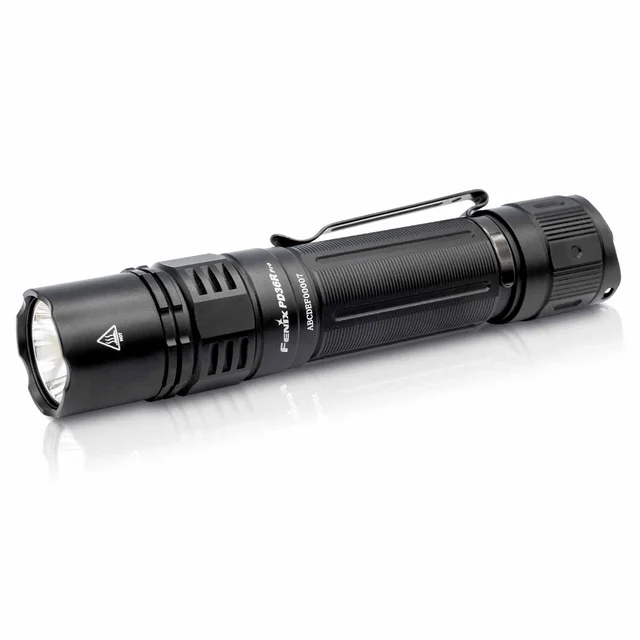
- Buy Fenix PD36R Pro One rechargeable light that genuinely does everything, with a real removable battery and honest sustained output.
- Buy ThruNite Archer 2A Pro A cheap, simple, genuinely reliable light that runs on AA batteries you already own, no charging cable required.
- It depends Fenix PD40R V3.0 A premium wide-flood powerhouse that is superb for close-range work light but more size, cost, and turbo drop-off than most people need.
- Skip Generic / no-name Anjoet "990,000-Lumen Tactical" Zoom Flashlight (no-name import) The archetypal fake-lumen "military tactical" light: an impossible number on the box and a cheap emitter behind it.
What actually matters
- Sustained output and runtime — how bright the light stays after turbo drops, and for how long, matters far more than the headline lumen figure you'll see for only a few seconds.
- Beam type (flood vs throw) — a wide flood lights a broad area up close for garage and workbench tasks; a focused throw reaches farther for spotting things across a yard or trail.
- Battery and charging — a removable 18650 or 21700 lithium-ion cell with built-in USB-C is the most flexible; AA lights are the most convenient for a rarely-touched backup.
- Water and impact ratings — an IP or IPX water rating plus a drop rating (in meters) tell you whether the light survives rain, puddles, and being dropped on concrete.
- User interface — a simple, quick way to reach on/off and the modes you use most, without cycling through a dozen settings in the dark.
- Build and brand support — an aluminum body, decent seals, and an established brand with a real warranty are part of what you're paying for.
- Size and carry — a slim pocket/EDC light rides with you every day; a chunky duty light trades pocketability for more output and runtime.
The specs, in plain English
Green flags vs red flags
Green flags
- Published sustained output and runtime, not just a single giant turbo number.
- A removable, name-brand rechargeable cell (18650 or 21700) and/or built-in USB-C charging.
- Stated IP or IPX water rating and a drop rating in meters, ideally with ANSI FL1 figures.
- A named, reputable emitter and an established brand with a real warranty and parts support.
- A clear, simple interface described in the listing (which buttons do what, how many modes).
- Honest lumen figures in the hundreds to low thousands for a household or duty light.
Red flags
- Five- or six-figure lumen claims like '90,000' or '990,000 lumens' — physically impossible and the category's clearest tell.
- 'Military,' 'tactical,' or 'army-grade' branding with a no-name seller and no real specs behind it.
- No IP/IPX rating, no drop rating, and no mention of ANSI FL1 testing.
- Ships with an unprotected or mystery-brand battery, or hides what cell it uses.
- A zoom head sold as the headline feature — it wastes light and makes a blocky, uneven beam.
- No named brand, no warranty, and reviews that mention early dimming or failure.
Who's who: the brands
- Fenix - Established maker of reliable everyday and duty lights with honest sustained output and removable USB-C cells; our review's top pick and 'depends' both come from here.
- ThruNite - Value-focused brand known for simple, dependable lights, including AA models that never leave you battery-less; the review's budget buy.
- Olight - Popular consumer brand with polished designs, magnetic charging, and easy interfaces; strong on convenience and everyday carry.
- Nitecore - Broad lineup from tiny keychain lights to high-output throwers, plus well-regarded chargers and batteries.
- Streamlight - Long-standing brand favored for work and duty use, built rugged and simple over flashy.
- Sofirn / Wurkkos - Budget enthusiast brands offering a lot of honest output and features for the money, popular with flashlight hobbyists.
How to read a listing without getting fooled
Start at the sustained figure, not the front-of-box number: look for the brightness the light holds after turbo steps down and how long it lasts, and mentally ignore the giant peak. Check whether the maker cites ANSI FL1 testing, an IP or IPX water rating, and a drop rating in meters — if those are absent, assume nothing was tested. Confirm the battery: a removable, name-brand 18650 or 21700 with USB-C is ideal, and a light that hides its cell or ships an 'unprotected' one is a warning. Separate lumens (total light) from candela or beam distance (how far it throws) so you pick the beam shape your tasks need. Finally, if the listing leans on words like 'military' and 'tactical' and a five-figure lumen claim instead of real, testable specs, that's the fake-lumen genre — close the tab.
How much should you spend?
You do not need to spend at the top of the range to get a genuinely good light. The value sweet spot is a reputable mid-priced rechargeable with a removable cell, honest sustained output, and published water and drop ratings — it covers the house, car, garage, and outages without compromise. A simple AA light from a known brand costs little and makes an excellent always-ready backup you can own several of. Spending more buys you higher sustained output, longer runtime, better beam control, and stronger build, which is worth it if you'll use the light hard or want one to reach far; it is not worth it just to chase a bigger peak-lumen number. The one place cheap truly costs you is the no-name 'tactical' lights: the money buys an impossible number, a weak emitter, and no support, so the least expensive option is almost always the worst value.
Questions, answered
Are those 990,000-lumen 'tactical' flashlights real?
No. A handheld LED light can't produce anywhere near that much output — for reference, a strong household or duty light is measured in the hundreds to low thousands of lumens. Those listings inflate the number by orders of magnitude behind a cheap emitter that overheats and dims. Treat any five- or six-figure lumen claim as a reason to walk away.
How many lumens do I actually need?
Far fewer than the marketing suggests, because sustained output matters more than the peak. A light that holds a few hundred lumens steadily handles dog walks, the garage, and power outages, and a sustained figure around a thousand lumens is plenty for almost any household task. Look at how bright the light stays after turbo steps down, not the turbo number itself.
What's the difference between lumens and candela or throw?
Lumens measure total light coming out; candela measures how concentrated the beam is in one direction, which is what determines how far it reaches (beam distance in meters). A high-lumen flood can light a whole room up close but not throw far, while a high-candela light punches a tight beam across a yard. Pick based on whether you need broad close-up light or reach.
Rechargeable lithium-ion or AA batteries?
Both are fine; it depends on your habits. A rechargeable 18650 or 21700 light with USB-C gives the most output and runtime, and a removable cell lets you carry a charged spare. AA lights give up some peak output but run on batteries you can buy anywhere and store for years, which is ideal for a backup you rarely touch. Either way, avoid lights built around unprotected, no-name cells.
What do IP68, IPX8, and drop ratings mean?
IP and IPX ratings describe water resistance — an IPX8 or IP68 light is rated for submersion, which is what you want for rain or a dropped-in-a-puddle scenario. An impact or drop rating (quoted in meters) tells you how far the light can fall onto a hard surface and keep working. Reputable brands publish and stand behind these numbers under the ANSI FL1 standard; no-name lights usually leave them off.
Do I need a high-CRI light?
Only if color accuracy matters to you. High-CRI lights (often 90 and up) render skin tones and material colors more truthfully, which helps for detail work, inspection, or photos, at the cost of a little raw brightness. For general household, garage, and outdoor use, a standard-CRI light is perfectly fine — it's a nice-to-have, not a must.
Or jump to the head-to-head: Fenix PD36R Pro vs ThruNite Archer 2A Pro.