Explained
Fixed Blade Knives, Explained
After reading, you'll understand tang construction, what a steel and HRC pairing tells you, and how grind and sheath match a knife to a job.
In this guide
A fixed blade is the simplest knife there is, which means there is nowhere for a bad specification to hide. Steel, hardness, length, thickness, grind, tang and sheath cover essentially everything, and a maker that publishes all seven has designed a tool. One that publishes a photograph and a price has designed a product.
The 30-second version
- Full tang is non-negotiable in a knife you intend to work, and makers who have it say so.
- A steel name needs a hardness figure, because the same alloy performs differently depending on heat treat.
- The grind decides the job, hollow for slicing, full flat for general use, thick for batoning.
- The sheath decides whether it gets carried, and Kydex against leather is a real choice, not a finish.
- Blade length is what the law is written against, so check local carry rules before buying.
The products this guide is about
Our verdict on each, with the full reasoning on the companion review.
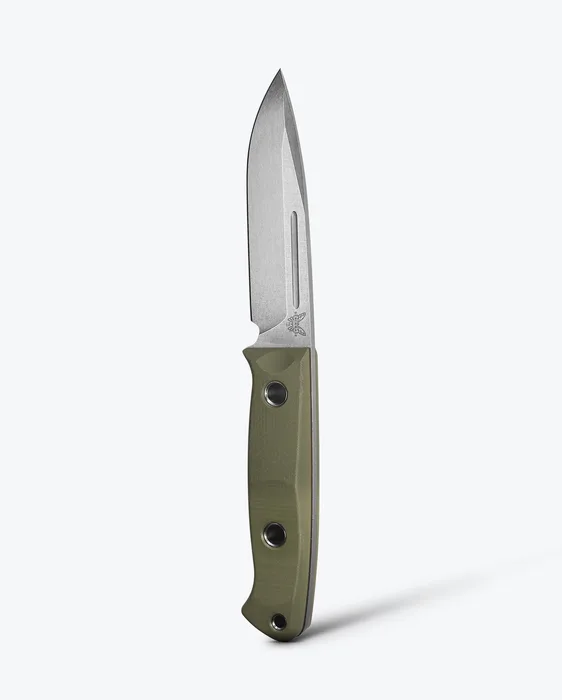
- Buy Benchmade Bushcrafter 163-1 The best steel, the right length and a leather sheath with a ferro rod loop.
- Buy CIVIVI Fixed Blade Elementum C2105A A complete published specification, a Kydex sheath and a proper tactical clip, for very little money.
- It depends Spyderco Bow River FB46GP A custom maker's trailing-point hunting design, built to a budget and sharpened easily.
- Skip Gerber StrongArm The best-selling fixed blade in the country, sold with the softest steel here and no dimensions at all.
What actually matters
- Blade steel and hardness - the alloy and the HRC it is run at. CPM-S30V at 58-60 HRC holds an edge a long time and resists sharpening; 420HC gives up edge retention and comes back in seconds on a simple stone.
- Tang - how far the blade steel extends into the handle. Full tang runs the whole length and width; partial or rat-tail tangs are lighter and far weaker under lateral load.
- Blade length - typically 3.5 to 4.5 inches for a general-purpose knife. Longer helps with batoning and large game; shorter is more controllable for detail work.
- Blade stock thickness - how thick the steel is at the spine, measured in millimetres or fractions of an inch. It is the number that predicts whether a knife splits wood or wedges in it.
- Grind - how the blade is tapered to the edge. Hollow is concave and slices superbly, full flat tapers from the spine and is the all-rounder, saber and scandi leave thickness behind the edge for strength.
- Blade shape - drop point for general use with a strong tip, trailing point for skinning and filleting, clip point for piercing. It narrows the knife's usefulness more than most buyers expect.
- Sheath - Kydex is moulded, drains, retains by friction and mounts anywhere; leather is quiet and comfortable and holds moisture; MOLLE systems carry in the most positions.
The specs, in plain English
Green flags vs red flags
Green flags
- The steel is named and a hardness range is given.
- Blade length and blade stock thickness are both published.
- Full tang is stated explicitly.
- The grind is named rather than only shown in a photograph.
- The sheath material and its mounting options are described.
Red flags
- A best-selling knife with no blade length on its product page.
- Steel named with no hardness figure, particularly a budget stainless.
- No mention of the tang anywhere in the listing.
- Sheath described only as included.
- Toughness claimed with no thickness or weight to support it.
Who's who: the brands
- Benchmade - Oregon maker of premium folders and fixed blades, with a lifetime warranty and a free sharpening service across the range.
- CIVIVI - Value line from WE Knife, known for publishing complete specifications on inexpensive D2 and Nitro-V knives with Kydex sheaths.
- Spyderco - Colorado company that licenses custom designs, including Phil Wilson's Bow River, and produces them at accessible prices.
- Gerber - Portland brand with a wide hardware and outdoor retail presence, best known in fixed blades for the StrongArm and its multi-mount sheath.
- ESEE - American maker of thick, simple carbon steel fixed blades with a no-questions warranty, widely used in bushcraft and survival.
How to read a listing without getting fooled
Find the steel and its hardness in the same sentence, and treat a steel name without an HRC figure as half a claim, especially on budget stainless. Then look for blade length and blade stock thickness together, because that pairing tells you what geometry the knife actually has: a long blade on thin stock is a slicer, a shorter blade on thick stock is a splitter. Confirm full tang is stated rather than implied. Read the grind next and match it to your work, since a hollow grind and a batoning brief are a contradiction. Then look at the sheath properly, because it decides whether the knife is on your belt or in a drawer, and note whether it drains, how it mounts and whether anything useful like a ferro rod loop comes with it. Finally, check the blade length against the carry rules where you live, which are usually written against exactly that number.
How much should you spend?
Fixed blades span budget to flagship and the money maps onto steel, manufacturing origin and warranty rather than onto usefulness. The budget tier now buys a genuinely good knife: real tool steel, full tang, G10 scales and a Kydex sheath are all available there, which was not true a decade ago, and it is the sensible place to start if you are not sure how much you will use it. The mid-range buys a licensed custom design or a better stainless with a more comfortable handle. The flagship tier buys powder-metallurgy steel, domestic manufacture, a leather sheath and a warranty that outlives the owner, and for a knife that will be worked hard for years that is a rational purchase. The genuinely poor value is a mass-market knife at budget prices with soft steel and no published dimensions, because the alternatives at the same money now publish everything.
Questions, answered
How do I stop a leather sheath damaging the blade?
Dry both before they go away together. Leather absorbs moisture and holds it against the steel, and the tanning chemicals in cheap leather can accelerate corrosion. It is rarely a problem with a fully stainless blade like S30V, and it is a real one with a semi-stainless tool steel like D2. Wipe the blade, let the sheath dry fully away from heat, and wipe a little light oil on the blade before storage.
Is a serrated edge worth having on a fixed blade?
Only for rope, webbing and fibrous material, and it costs you everywhere else. Serrations keep cutting long after they lose their fine edge, which is why they appear on rescue knives, and they are much harder to sharpen properly at home. For general outdoor use, food prep and any job where a clean cut matters, a plain edge is the right default. Gerber offers the StrongArm both ways, which makes it an easy choice to get wrong.
Can I use a fixed blade in the kitchen?
You can, and it will be worse than a kitchen knife at it. Outdoor fixed blades are thicker behind the edge than any chef's knife, so they wedge in dense vegetables rather than slicing through. The hollow-ground CIVIVI is the closest to usable of this group. For camp cooking any of them is fine, and for a real kitchen buy a kitchen knife.
What sharpening gear do I need?
Match it to the steel. Soft stainless like 420HC or 8Cr13MoV comes back on almost anything, including a simple pocket stone at camp. D2 wants a diamond or ceramic surface to cut efficiently. CPM-S30V really wants diamond, and it is slow work on anything else, which is why Benchmade's free sharpening service is a genuine part of the value on the Bushcrafter. Whatever you use, keep the angle consistent, which matters more than the abrasive.
Or jump to the head-to-head: Benchmade Bushcrafter 163-1 vs CIVIVI Fixed Blade Elementum C2105A.