Explained
Electronic Chess Boards, Explained
After reading, you'll understand how electronic boards sense pieces, which platforms they reach, and which specs decide whether one suits you.
In this guide
First-time buyers often assume every smart board works with every chess site on every phone, and that is not true. Some boards list Lichess but not Chess.com, some list Chess.com only on Android, and some put advanced online play behind a membership. Board size is easy to misjudge from photos. A few spec lines tell you most of what you need.
The 30-second version
- Confirm your platform and phone, because support for Chess.com and Lichess varies by board and sometimes by iOS or Android.
- Know your sensing type, since full piece recognition knows each piece while move recognition tracks changes from a known position.
- Check square size and king height, as a travel board and a club-size board feel very different under your hand.
- Prefer a stated play time, because a battery capacity alone does not tell you how long a session lasts.
- Read the subscription terms, since some boards tie advanced features or warranty to a paid plan.
The products this guide is about
Our verdict on each, with the full reasoning on the companion review.
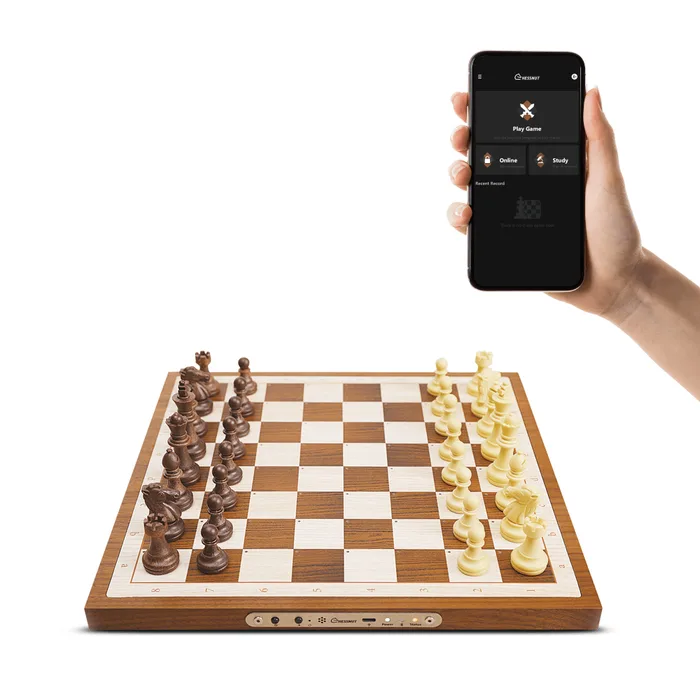
- Buy Chessnut Air A portable board that knows which piece is on every square and plays on both Chess.com and Lichess.
- Buy Millennium eONE (M841) The value board, with automatic move recognition, long battery life, offline engines and the longest guarantee here.
- It depends DGT Pegasus A full-feel board with 40 mm squares and weighted pieces, built around Lichess rather than Chess.com.
- Skip Particula GoChess Lite Modern A well-featured board whose advanced online play and ongoing warranty depend on a subscription that auto-renews.
What actually matters
- Platform support - The board is only as useful as the sites it reaches. Check for Chess.com, Lichess and any app you already use.
- Phone compatibility - Some integrations run only on Android or only through a specific app. Match the board to the phone you own.
- Piece recognition - A board that knows each piece can load positions and catch errors. Move-only sensing works but relies on a correct starting setup.
- Square size - Club sets usually have bigger squares than travel boards. Compare square size or overall board size against a set you like.
- Piece weight and king height - Heavier, taller pieces feel more like a real set. Light pieces on a small board suit travel better.
- Battery life - A stated runtime tells you whether it lasts an evening or a weekend. USB-C charging is convenient if your other devices use it.
- Warranty and subscriptions - Electronics fail, so a clear multi-year warranty is valuable. Avoid boards where the warranty depends on renewing a membership.
The specs, in plain English
Green flags vs red flags
Green flags
- The maker names each supported platform and the phone types it works on.
- A stated battery play time, not just a capacity.
- Board size, square size or king height listed in text.
- A clear warranty length on the product page.
- Spare queens included for promotions.
Red flags
- Platform support described only as mainstream chess platforms with no names.
- Key online features behind a membership that auto-renews.
- A warranty that depends on keeping a subscription.
- Specifications shown only in images, or contradicting each other on the same page.
- No price or stock information on the maker's own page.
Who's who: the brands
- Chessnut - Known for app-connected boards with full piece recognition, from portable to robotic models.
- Millennium - A chess computer maker known for standalone chess computers and value e-boards.
- DGT - A maker known for electronic chess boards and chess clocks.
- Particula - The maker of GoChess boards, known for lit squares and coaching features tied to its app.
How to read a listing without getting fooled
Start with the platform line and check for the exact site you play on, plus any note about Android or iOS. Then read how the board senses pieces: full piece recognition is stated plainly when present, so treat silence as move-only or unknown. Look for board size, square size and king height in text, not just in a graphic. Find the battery runtime and charging port. Finally, scroll to the warranty and any membership section, and note anything that renews automatically or ties support to a paid plan.
How much should you spend?
Electronic chess boards fall into three rough tiers. Budget boards, like the Millennium eONE, tend to be compact and focus on sensing, LEDs and app connections. The mid-range tier, where the Chessnut Air, DGT Pegasus and GoChess Lite sit, adds larger boards, piece recognition or coaching features. Premium boards add wooden construction, built-in screens or self-moving pieces. Within any tier, factor in subscriptions: a board that needs a paid plan for full online play costs more over time than its sticker suggests.
Questions, answered
Can I use an electronic board as a normal chess set?
Yes. The pieces and board work like any set when nothing is connected. Chessnut also describes the Air as working as a traditional board without connectivity. You lose the online and engine features until you pair it again.
Are electronic chess boards good for beginners?
They can be, especially with an app that offers adjustable AI levels and hints. Lights that show moves help new players follow a game. Make sure the board reaches the site a beginner will use, and avoid paying for coaching features you may not need.
What happens if a piece is knocked over mid-game?
Boards with full piece recognition can usually detect the mismatch because they know which piece belongs on each square. Move-only boards may need you to restore the position by hand before play continues. Check the app's guide for how it handles corrections.
Do I need extra queens?
They are useful, since a promotion otherwise needs an upside-down rook or a piece from another set. The Chessnut Air, Millennium eONE, DGT Pegasus and GoChess Lite Modern all list extra queens in the box. On boards that recognise pieces, a proper queen also keeps the board's tracking accurate.
Or jump to the head-to-head: Chessnut Air vs Millennium eONE (M841).