Explained
Electric Nail Drills, Explained
After reading, you'll understand how to compare nail drills on more than the biggest RPM number on the box.
In this guide
Most first-time buyers shop nail drills by top speed, because that is the number printed largest. Yet the same 30,000 RPM label can sit on very different machines, and torque, the figure that hints at working power, is often missing. Terms such as cordless and professional can also mean less than they seem. A few minutes with the spec sheet will tell you more than the headline number.
The 30-second version
- Top speed is a ceiling, not a working speed, so fine control low on the dial matters more.
- Torque is the missing spec, and a maker that prints it in Ncm gives you something real to compare.
- Cordless rarely means cable-free, since most rechargeable drills connect a handpiece to a separate box.
- Bit fit depends on shank size, and 3/32 is the size named by makers such as Medicool and Kupa.
- Missing specs are information, because a listing with no RPM or torque leaves you nothing to compare.
The products this guide is about
Our verdict on each, with the full reasoning on the companion review.
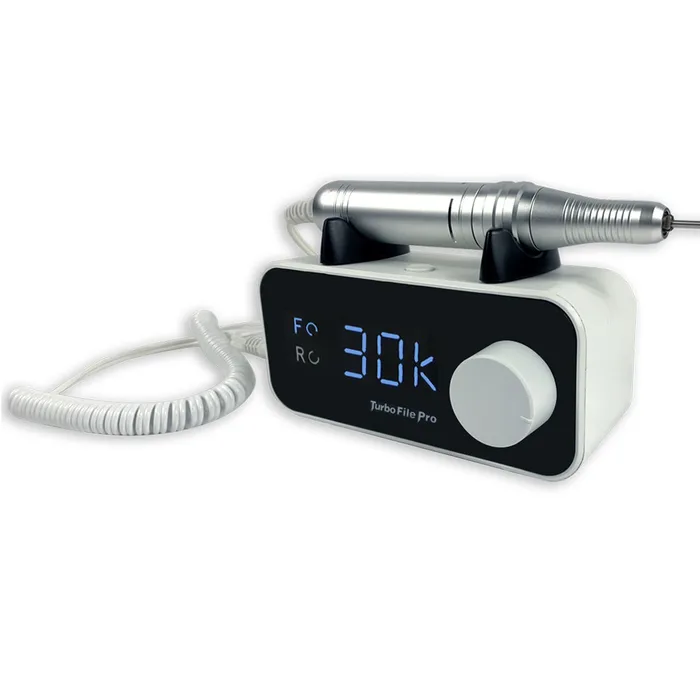
- Buy Medicool TurboFile Pro A corded 30,000 RPM desktop e-file with a published 2.0 Ncm torque rating and a light handpiece. Amazon
- Buy MelodySusie SC320F Rechargeable Nail Drill A budget-tier rechargeable 30,000 RPM drill with stepless speed, a 4000mAh battery and several kit options. Amazon
- It depends DND Gel DND Portable Nail Drill A brushless 35,000 RPM cordless unit from a gel brand, with a large screen and 10 hours of stated battery life.
- It depends Kupa Manipro Passport Next Complete A professional-minded cordless e-file with a 5 oz handpiece, charging dock, belt clip and one-year warranty.
- It depends Beurer MP 64 Manicure/Pedicure Set A slow, gentle all-in-one pen for natural nails and hard skin, with 10 attachments and a 3-year guarantee.
- Skip PELCAS 10-Speed Nail File with LCD A budget pen file sold as professional, with no RPM on its listing and a 3W rated working power. Amazon
What actually matters
- Speed range - RPM tells you how fast the bit can spin. Look for a drill that controls well at low speed, since a high maximum alone says little about daily use.
- Torque - This describes how well the bit keeps turning under resistance. It is rarely published, so treat a printed figure as a mark in a drill's favor.
- Power source - Mains units have no battery to manage but stay near an outlet. Rechargeable boxes move around more easily but depend on battery life.
- Handpiece weight - You hold this part throughout a manicure. Lighter usually means less fatigue, so compare published ounces where you can find them.
- Speed control - Stepless or variable control lets you find a precise speed. Fixed steps are simpler but give you fewer choices.
- Rotation direction - Forward and reverse lets you work both sides of a nail and helps left-handed users. It is common, so it should not command a premium.
- Disclosure - Published contents, shank size and warranty show what you are actually buying. Pages that omit them push the risk onto you.
The specs, in plain English
Green flags vs red flags
Green flags
- A torque figure printed in Ncm
- A stated shank size such as 3/32
- A published handpiece weight
- A full contents list that names what is in the box
- A warranty term stated in plain words
Red flags
- No RPM stated anywhere on the listing
- Professional claims with a very low rated power
- Spec lists with obvious errors
- One tool pitched at nails, skin and pets alike
- Round claims such as 200 percent more power with no baseline
Who's who: the brands
- Medicool - A long list of e-files, from the TurboFile Pro to the Pro Power range, with comparison charts covering weight and RPM.
- Kupa - Known for its Manipro systems, built with professional nail technicians in mind.
- MelodySusie - A nail tool brand with a wide range of rechargeable drills and kits, from pens to clip-on boxes.
- DND Gel - A gel polish brand that also sells a brushless portable drill and its own bits.
- Beurer - A German health and personal care brand whose manicure sets run at low speeds and include sapphire attachments.
How to read a listing without getting fooled
Start with the numbers and check how each one is described. A figure such as 30,000 RPM is a maximum, so look for how the speed is controlled below that. Next, search the page for torque; if you find only the words high torque, treat it as a claim, not a spec. Check the contents list for bits and sanding bands, since some premium drills ship without them. Read the word cordless closely, then look at photos to see whether a cable runs from a box to the handpiece. Finally, compare the text against the image panels, because some makers keep specs only in pictures, and some listings contradict themselves.
How much should you spend?
At the $ · budget tier you can find capable rechargeable drills, but disclosure gets thin and listings need closer reading. The $$ · mid-range tier is where most home users should look, including well-documented corded desktop units and gentle low-speed sets with long guarantees. The $$$ · premium tier covers salon-style portables with brushless motors or complete charging systems. These make sense for techs and committed hobbyists, though price does not guarantee better documentation, and some still leave out bits or torque.
Questions, answered
What is the difference between a nail drill and an e-file?
In home use, the terms usually refer to the same kind of tool. Makers use both words for a powered handpiece that spins a bit against the nail. Medicool calls its products electric files, while MelodySusie calls its products nail drills. Compare the specs and ignore the label.
Why do so few listings publish torque?
We cannot say why any one maker leaves it out, but the result is plain: buyers get a speed figure and little else. Medicool prints a 2.0 Ncm rating for the TurboFile Pro, which makes it easy to compare. Others use phrases such as high torque with no number. When you see only words, ask the seller for the figure.
Does a professional label mean a drill is better?
Not by itself, since the word has no fixed standard on a listing. One budget pen in our review calls itself professional while listing 3W of rated power. Some truly pro tools go the other way, and Kiara Sky's portable drill listing says for professional use only. Read the specs and any use restrictions, not the label.
Do I need a dust collector or dust cap?
It depends on how much filing you do and where you do it. The Beurer MP 64 includes a nail dust cap, the PELCAS file includes a clear dust shield, and MelodySusie offers a kit with a nail dust collector. Filing gel and acrylic creates fine dust, so a collector can help with regular work. Follow the maker's guidance on cleaning and setup.
Or jump to the head-to-head: Medicool TurboFile Pro vs MelodySusie SC320F Rechargeable Nail Drill.