

Office & WFH
The Best Standing Desk Converters: 4 Compared (and One to Skip)
We compared four current desktop risers on lift feel, stability, keyboard tray, weight capacity and how much desk they eat.
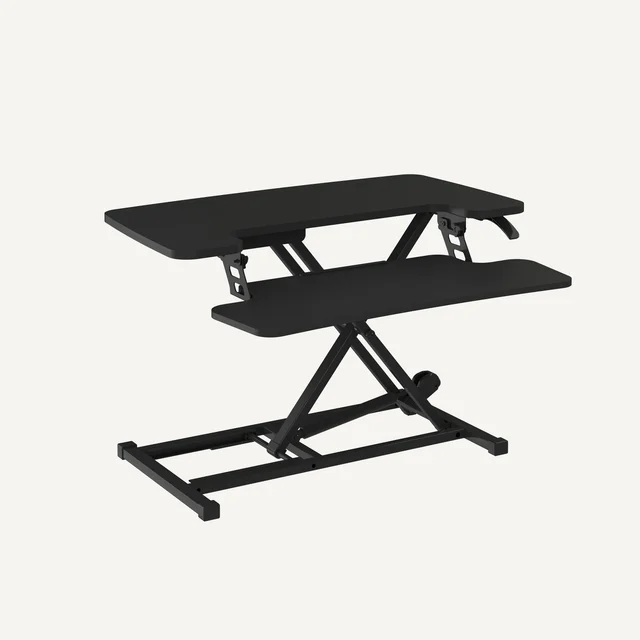
The short version
Standing desk converters let you add sit-stand movement to the desk you already have, but stability, keyboard-tray ergonomics and footprint separate the good ones from the frustrating ones. The FlexiSpot M7 is our overall pick, pairing a smooth one-hand gas-spring lift and a removable keyboard tray with a 37.4 lb rating. The VariDesk Pro Plus 36 is the sturdiest and easiest to set up, though it is pricey and space-hungry. The FEZIBO 36-inch is a reasonable budget choice for a single-monitor setup but sways once fully loaded. The long-serving Ergotron WorkFit-T is stable and fully assembled, but it asks a premium price for a 25 by 9 inch keyboard tray and a 51.2 lb frame, so most buyers should skip it. Best for: anyone who wants standing-desk benefits without replacing their current desk.
Our picks at a glance
- FlexiSpot M7 Series (35") Standing Desk Converter - Buy. The best all-round balance of surface size, one-hand lift and a removable tray at a fair price.
- VariDesk Pro Plus 36 - Buy. The most rock-solid, zero-assembly riser here, if you can live with the footprint and the price.
- FEZIBO 36" Standing Desk Converter - It depends. A capable budget riser that is fine for light setups but reveals its price when you load it up.
- Ergotron WorkFit-T - Skip. Stable and fully assembled, but a premium price buys a narrow keyboard tray and the heaviest frame here.
The verdict in 30 seconds
What mattered most
- Lift mechanism
- Stability at standing height
- Keyboard tray
- Weight capacity
- Desk footprint
- Setup
A standing desk converter sits on the desk you already own and lifts your monitor and keyboard to standing height, so you skip the cost and upheaval of a full electric desk. The catch is that a riser lives or dies on stability, keyboard-tray ergonomics and how much of your desk it swallows. We lined up four models you can actually buy in 2026: two we would spend our own money on, one budget pick that depends on your setup, and one long-running favorite whose small keyboard tray, weight and price make it hard to recommend today.
The best all-round balance of surface size, one-hand lift and a removable tray at a fair price.
Best for: Most people who want a stable, spacious riser without paying premium-brand prices.
- Gas-spring lift raises and lowers one-handed, with a braced X-lift that the maker says protects against sudden drops
- Wide two-tier top with a genuinely removable keyboard tray for flexibility
- Rated for 37.4 lb, with built-in monitor mount support
- Needs a desk at least 25.6 inches deep, so it is no space-saver on a shallow desk
- Reviewers note a faint shimmy at maximum height under a full dual-monitor load
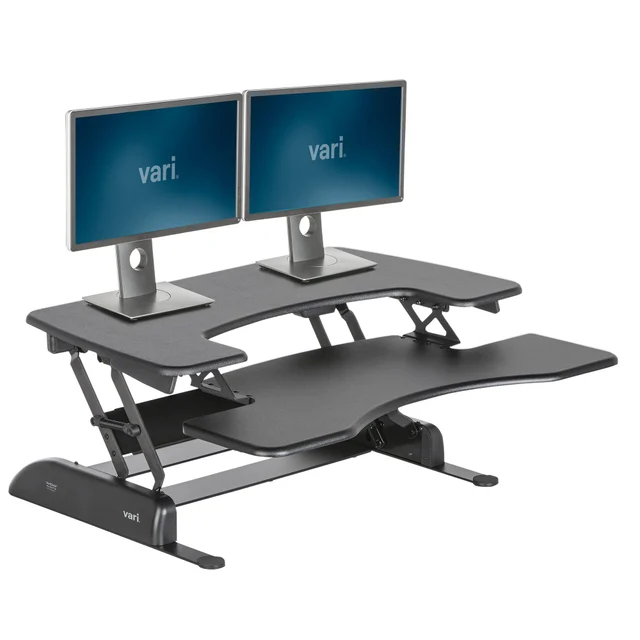
The most rock-solid, zero-assembly riser here, if you can live with the footprint and the price.
Best for: Buyers who prize stability and a no-tools setup over saving money or floor space.
- Arrives fully assembled and lifts on a spring-assisted mechanism with eleven locking heights
- Weighted base with dual stability bars, which owners often describe as among the most stable in the class
- Broad 36-inch two-tier surface that comfortably carries two monitors
- Large, deep platform that needs a desk at least 25.75 inches deep
- Fixed two-tier layout means the keyboard cannot drop below desk level for taller users
- Heavy, and priced well above comparable risers
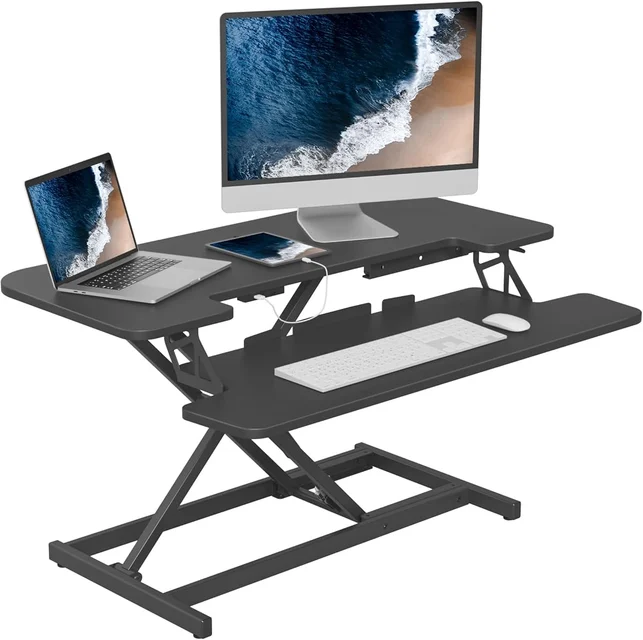
A capable budget riser that is fine for light setups but reveals its price when you load it up.
Best for: Budget-minded buyers with a lighter, single-monitor workstation.
- Pneumatic gas-spring lift with squeeze handles that is easy to operate for the money
- Wide dual-tier surface with room for a monitor plus peripherals
- Handles a single monitor or a monitor-and-laptop pairing without complaint
- Owners report noticeable sway at full standing height once two monitors are aboard
- The keyboard tray is not removable, so the deep two-tier footprint is always present
- Owners say the surfaces and hardware feel a step below the premium brands
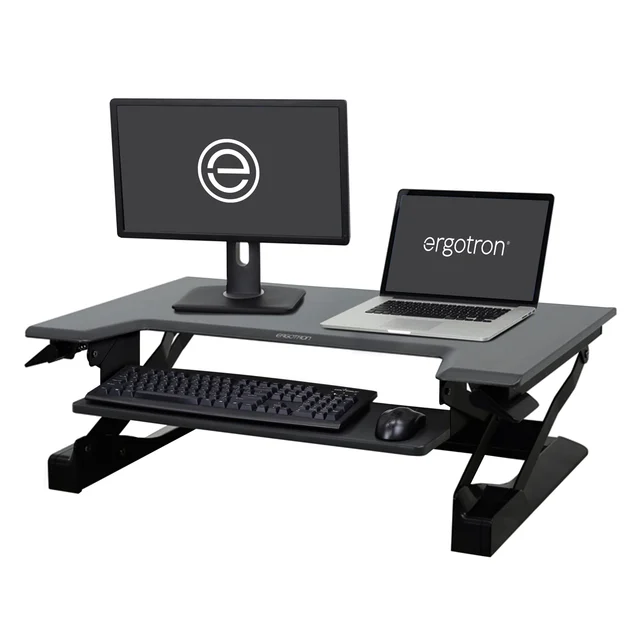
Stable and fully assembled, but a premium price buys a narrow keyboard tray and the heaviest frame here.
Best for: Shoppers with a shallower desk who want a fully assembled riser and can live with a compact keyboard and mouse area.
- Moves straight up and down, which Ergotron says gives no sway, tip or height-drop even when you lean on the surface
- Ships fully assembled, fits desks from 24 inches deep, and carries a five-year warranty
- Simple hand-brake height adjustment anywhere in its range
- Keyboard tray is 25 by 9 inches with a recommended maximum keyboard width of 18 inches, against the M7's 34.6-inch tray
- The tray is fixed 4.5 inches below the worksurface and moves with it, so keyboard height cannot be set separately
- Weighs 51.2 lb, roughly twice the M7 35-inch, and monitor mounts are sold as accessories
- Premium pricing for a medium surface rated 10 to 35 lb
| Criteria | FlexiSpot M7 Series (35") Standing Desk Converter Top pick | VariDesk Pro Plus 36 | FEZIBO 36" Standing Desk Converter | Ergotron WorkFit-T |
|---|---|---|---|---|
| Verdict | Buy it | Buy it | It depends | Skip it |
| Best for | Most people who want a stable, spacious riser without paying premium-brand prices. | Buyers who prize stability and a no-tools setup over saving money or floor space. | Budget-minded buyers with a lighter, single-monitor workstation. | Shoppers with a shallower desk who want a fully assembled riser and can live with a compact keyboard and mouse area. |
| Price tier | $$ · mid-range | $$$ · premium | $ · budget | $$$ · premium |
| Lift mechanism | Gas-spring X-lift, one-hand | Spring-assisted, dual handles, 11 stops | Pneumatic gas-spring, squeeze handles | Straight vertical lift, hand-brake levers |
| Stability at standing height | Very good; braced X-lift | Excellent; weighted base | Good low, some sway when tall | Maker states no sway or tip |
| Keyboard tray | Wide, fully removable | Fixed lower tier, no drop-below | Wide lower tier, not removable | 25 x 9 in, fixed 4.5 in below surface |
| Weight capacity | 37.4 lb - 35 lb | Check listing | 10-35 lb | - |
| Desk footprint | Needs 25.6-inch-deep desk | Needs 25.75-inch-deep desk | Deep two-tier | Fits 24-inch-deep desk; 51.2 lb |
| Setup | Some setup | None; fully assembled | Some setup | None; ships fully assembled |
| Warranty | 5-year frame, 3-year gas spring - Lifetime limited | Check listing | 5 years | - |
| Price tier | $$ · mid-range | $$$ · premium | $ · budget | $$$ · premium |
Which one is right for you?
- Most people who want a stable, spacious riser without paying premium-brand prices. Buy it FlexiSpot M7 Series (35") Standing Desk Converter
- Buyers who prize stability and a no-tools setup over saving money or floor space. Buy it VariDesk Pro Plus 36
- Budget-minded buyers with a lighter, single-monitor workstation. It depends FEZIBO 36" Standing Desk Converter
- Shoppers with a shallower desk who want a fully assembled riser and can live with a compact keyboard and mouse area. Skip it Ergotron WorkFit-T
How we judged the field
We do not run our own lab. Instead we synthesize independent testing, long-term expert write-ups and aggregated owner reports, then weigh them against the specifications each manufacturer publishes. For desktop risers, five things decided the ranking:
- Lift mechanism and feel - how smoothly the unit rises, whether it holds position, and how much effort it takes.
- Stability at standing height - the single most common complaint, since a tall platform on a desk can sway when you type.
- Keyboard tray - width, whether it removes, and whether it can sit low enough for good wrist posture.
- Weight capacity and surface size - enough for one or two monitors plus peripherals.
- Footprint - how much desk depth and width the riser consumes when parked in the sitting position.
We treated price only as a tier, and we favored models that are current and genuinely buyable in 2026 over discontinued cult favorites.
FlexiSpot M7 Series (35”) Standing Desk Converter
Buy itThe M7 is the model we would point most people toward. Its gas-spring lift rises and lowers with one hand and locks anywhere in the range, and the braced X-lift frame keeps things reassuringly steady through most of the travel. The 35-inch upper deck is roomy, and unlike several rivals the keyboard tray fully detaches, which lets you tune the layout or reclaim space. It is rated for 37.4 pounds and has built-in monitor mount support. It is not a space-saver, though: FlexiSpot lists a minimum desk depth of 25.6 inches for the 35-inch model. Reviewers report a faint shimmy at the very top of its height range under a heavy dual-monitor setup, but for the money the balance of stability, size and features is the best on this list.
VariDesk Pro Plus 36
Buy itIf your priority is a platform that simply does not move, the Pro Plus 36 earns its keep. It arrives fully assembled, lifts on a spring-assisted mechanism with dual handles and eleven height settings, and rides on a weighted base with dual stability bars that owners often describe as among the most planted in the category. It is rated for 35 pounds and carries a lifetime limited warranty. The wide 36-inch two-tier top swallows two monitors easily. The trade-offs are real: it is heavy, it eats a large, deep chunk of desk (Vari lists a minimum desk depth of 25.75 inches), the fixed tiers mean the keyboard cannot drop below desk height for taller users, and it sits at a clear premium. For buyers who value rock-solid feel and a no-tools setup over price and space, it is worth it.
FEZIBO 36” Standing Desk Converter
It dependsThe FEZIBO is the value play. Its pneumatic gas-spring lift with squeeze handles is easy to operate, the dual-tier surface is wide, and it handles a single-monitor or monitor-plus-laptop workstation. For a single-monitor or monitor-plus-laptop workstation it does the job at a budget price. The reason it lands at “it depends” rather than a clear buy is that owners report noticeable sway at full standing height once two monitors are loaded, the keyboard tray does not remove so the deep two-tier footprint is permanent, and owners say the surfaces feel a rung below the premium brands. Right setup, right price, real compromises.
Ergotron WorkFit-T
Skip itThe WorkFit-T is a good product that has been overtaken on value. It moves straight up and down on hand-brake levers, which Ergotron says gives no sway, tip or height-drop even when you lean on it, it ships fully assembled, and it fits desks from 24 inches deep, the shallowest requirement here, with a five-year warranty. The problem is what the premium price buys. The keyboard tray is 25 by 9 inches with a recommended maximum keyboard width of 18 inches, which leaves little room for a mouse, where the FlexiSpot M7 35-inch tray is 34.6 by 12.2 inches. The tray is fixed 4.5 inches below the worksurface, so you cannot set keyboard height separately from screen height. It weighs 51.2 lb, roughly twice the M7, it is rated for 10 to 35 lb, and monitor mounts are sold as accessories. Unless a shallow desk or a fully assembled unit matters more than keyboard space, your money goes further elsewhere.
FlexiSpot M7 vs VariDesk Pro Plus 36: which should you buy?
These are the two we would actually own, and the choice comes down to what you are optimizing for. The VariDesk is the more stable and the more convenient out of the box: it is fully assembled and its weighted frame barely flinches. But it is expensive and space-hungry, and its fixed tiers limit keyboard height. The FlexiSpot matches it on the fundamentals that matter day to day, adds a removable keyboard tray and a slightly higher weight rating, all for a mid-range rather than premium price. If your budget is generous and you never want to think about assembly, take the VariDesk. For nearly everyone else, the FlexiSpot M7 delivers most of the stability for less money.
What to look for
- A lift that holds anywhere - a one-hand gas-spring or spring-assisted lever should stop and stay at any height without creeping.
- Stability under your real load - check owner reports for sway at full extension with the number of monitors you actually use.
- Keyboard-tray depth and height - a lower tray that removes gives the best ergonomics and flexibility; confirm it can sit low enough for your height.
- Footprint versus your desk - measure desk depth first; deep risers can push monitors uncomfortably far away.
- Weight capacity headroom - leave margin above your monitor and peripheral weight rather than buying at the limit.
- Setup and warranty - fully assembled units save hassle, and a longer frame warranty signals confidence.
Our final take
A converter is the low-friction way to add standing time to a desk you like, and the field is strong enough that most buyers will be happy. The FlexiSpot M7 is the smart default: stable, spacious, easy to lift and flexible thanks to its removable tray, at a fair price. Step up to the VariDesk Pro Plus 36 if a very steady platform and a zero-assembly setup matter more than cost or footprint. The FEZIBO 36-inch is a sensible budget choice for a lighter, single-monitor desk, provided you accept some wobble and a permanent two-tier footprint. And while the Ergotron WorkFit-T remains stable and arrives fully assembled, its narrow keyboard tray, 51.2 lb weight and premium price make it one to skip for all but owners of shallow desks who need a no-assembly riser.
Questions, answered
Are standing desk converters as stable as a full standing desk?
No riser is quite as planted as a good four-legged electric desk, because a converter is a tall platform balanced on a desk surface. That said, the best models here feel solid at typing height. Independent testing and owner reports consistently rank heavier, weighted-base designs such as the VariDesk and the straight-lift Ergotron as the steadiest, while lighter budget risers show more sway at full extension.
Do I need a deep desk for a converter?
Often, yes. Converters occupy real depth because the keyboard tray extends toward you and the frame needs a stable base behind it. The FlexiSpot M7 35-inch, for example, lists a minimum desk depth of 25.6 inches and the VariDesk Pro Plus 36 lists 25.75 inches, while the Ergotron WorkFit-T fits desks from 24 inches deep. Measure your available depth before buying.
Should I choose a manual spring lift or an electric converter?
For most people a spring or gas-assisted lift is fine: it raises with one hand in a couple of seconds and never needs a power outlet. Electric converters remove the physical effort and are worth it if you have limited arm strength or a very heavy monitor load, but they cost more and add cables. All four models compared here use manual gas-spring or spring-assisted lifts.
Will a converter hold two monitors?
The 35- and 36-inch models here are wide enough for two standard monitors or a monitor-and-laptop combination. The FlexiSpot M7 35-inch is rated for 37.4 pounds and the VariDesk Pro Plus 36 for 35 pounds, which covers typical displays. Reviewers note that stability at full standing height is where a dual-monitor load tells: heavier-framed risers stay steady, while lighter budget units can wobble.
How high should the keyboard sit for good ergonomics?
Your elbows should rest at roughly a 90-degree angle with wrists straight while standing, which usually means the keyboard tray sitting a little below the monitor deck. Two-tier converters like these place the keyboard on a lower shelf to help. Be aware that some designs cannot drop the keyboard below desk level, including the VariDesk, and the Ergotron fixes its tray 4.5 inches below the worksurface, so keyboard height cannot be set separately.
Deciding between the top two? See our head-to-head: FlexiSpot M7 Series (35") Standing Desk Converter vs VariDesk Pro Plus 36.
More Office & WFH reviews
 The Best Trackball Mice: 4 Compared (and One to Skip)
  The Best Under-Desk Ellipticals: 4 Compared (and One to Skip)
  The Best Under-Desk Footrests: 4 Compared (and One to Skip)
  The Best USB-C Docking Stations: 4 Compared (and One to Skip)
  The Best Vertical Mice for Wrist Comfort: 4 Compared (and One to Skip)
  The Best Under-Desk Walking Pads: 4 Compared (and One to Skip)