

Baby & Family
The Best Model Rocket Kits: 4 Compared (and One to Skip)
We compared Estes' Tandem-X and Alpha III launch sets, the Roto Rocket STEM kit and a stomp-launched foam rocket set on build, altitude, recovery and what's actually in the box.
The short version
The Estes Tandem-X is the model rocket starter set to buy: two rockets, a pad and a controller for $45 (engines separate). The Alpha III is the classic single-rocket alternative at $40. The Roto Rocket is the it-depends pick for its helicopter recovery at $69. Skip the Stomp Rocket space set - air-powered foam rockets are a toy, not a model rocket kit.
Our picks at a glance
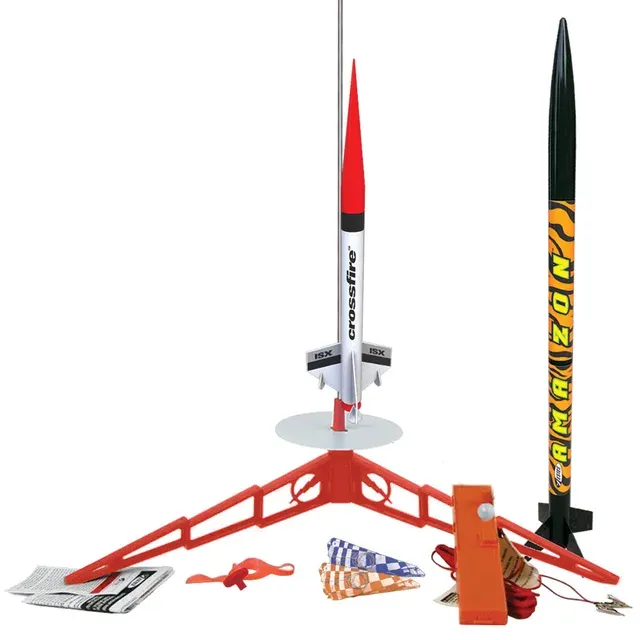
- Estes Tandem-X Launch Set - Buy. Two rockets and a full launch system in one box - a 30-inch beginner build plus a 1,150-foot intermediate rocket for $45.
- Estes Alpha III Launch Set - Buy. The rocket that's launched generations - a fast-building beginner set with pad and controller for $40.
- Estes Roto Rocket STEM Kit - It depends. A beginner rocket that comes down like a helicopter - rotor recovery instead of a parachute, for $69.
- Stomp Rocket Space Collection by Stomp Rocket - Skip. Foam NASA-styled rockets launched by stomping a bladder - a fun toy that is not a model rocket kit.
The verdict in 30 seconds
What mattered most
- What it is
- Altitude
- Build level
- Recovery
- Engines needed
- Price class
A model rocket kit is the gift with a launch day: build it, set it on the pad, push the button and watch 600 feet of altitude earn its keep. The trap is the word "kit" - some boxes are real model rocketry with engines and recovery systems, and some are foam toys sold next to them. We compared two Estes starter sets, a helicopter-recovery STEM kit and a stomp-rocket toy.
Two rockets and a full launch system in one box - a 30-inch beginner build plus a 1,150-foot intermediate rocket for $45.
Best for: The first-time rocketeer gift: everything needed to launch (plus engines and a field) for under fifty dollars.
- Two rockets in the box: the 30-inch Amazon (beginner, about an hour to build, 600+ ft on C6-5) and the Crossfire ISX (intermediate, up to 1,150 ft on C6-7).
- Porta-Pad II launch pad and Electron Beam push-button controller included - the launch system, not just the rockets.
- Parachute recovery on both rockets - launch, recover, relaunch, the real model-rocketry loop.
- $45 for two rockets plus the pad is the best entry value in model rocketry - the classic starter gift.
- Engines not included - it needs Estes A/B/C motors, controller batteries and basic building supplies bought separately.
- Recovery means chasing: a 1,150-foot flight drifts far, so it wants a big open field, not a backyard.
- The beginner Amazon is plastic-finned and basic - the real fun is in the Crossfire's speed.
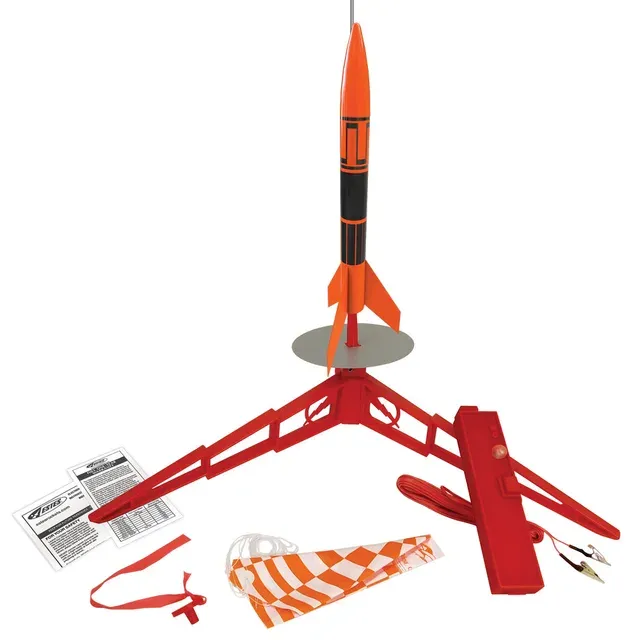
The rocket that's launched generations - a fast-building beginner set with pad and controller for $40.
Best for: The simplest possible first launch - one proven rocket, one pad, one button, for the youngest new flyer.
- The Alpha III is the most proven beginner rocket ever sold - the first in Estes' Beginner series, simple and reliable.
- Quick, easy assembly meant for a first build - streamlined design, minimal parts, fast to the pad.
- Launch pad and Electron Beam controller included - the full launch system in one box.
- $40 is the cheapest complete launch set here - the classic "first rocket" gift.
- One rocket, not two - the Tandem-X's second rocket is worth the extra $5 for most gift-buyers.
- Engines, batteries and building supplies still sold separately.
- Lower ceiling than the intermediate rockets - it's a first rocket, not a fast one.
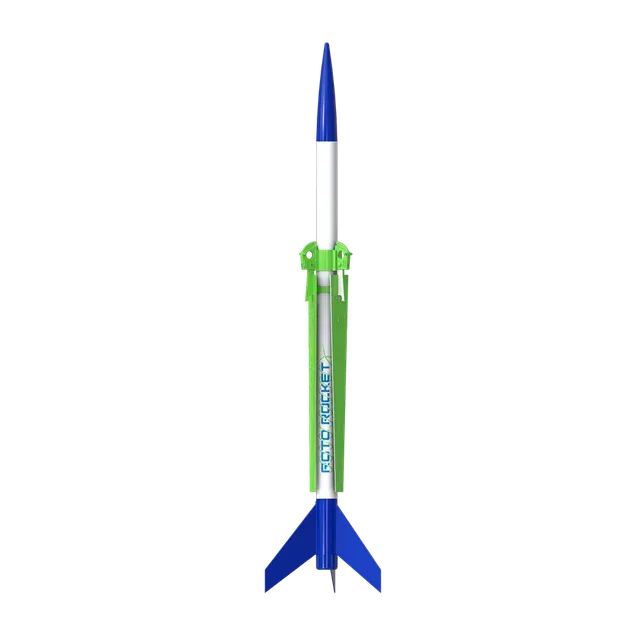
A beginner rocket that comes down like a helicopter - rotor recovery instead of a parachute, for $69.
Best for: A kid who's flown a parachute rocket and wants something different - the recovery flight is the show.
- Unique helicopter recovery: after peak, it descends in a spinning spiral on rotor blades - a different flight from every parachute rocket.
- Beginner-friendly build and launch on C6-3 or C5-3 engines to about 500 feet.
- The STEM framing is real - the rotor recovery demonstrates autorotation in a way a parachute can't.
- A memorable second kit for a kid who's flown a basic rocket - the recovery is a party trick.
- $69 is premium-priced for a beginner rocket - you're paying for the recovery gimmick.
- Check the box carefully - some versions are the rocket only, with pad and engines sold separately.
- The rotor mechanism is more fragile than a parachute system - harder landings mean repairs.
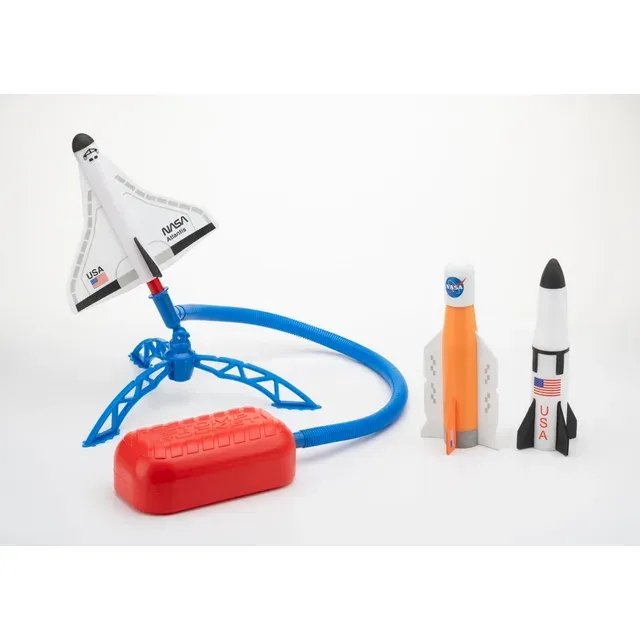
Foam NASA-styled rockets launched by stomping a bladder - a fun toy that is not a model rocket kit.
Best for: Little kids (5-7) who want to launch something right now. For a kid who asked for a model rocket kit, buy an Estes set - this is a different product.
- Three foam NASA-styled rockets plus an adjustable launch stand - genuinely fun outdoor play for little kids.
- Air-powered, so no engines, no fire risk and no FAA-adjacent rules - safe for ages 5+.
- $30 and fully reusable - stomp, retrieve, stomp again.
- It's not a model rocket kit - nothing to build, no engine, no recovery system, no rocketry.
- Foam rockets on air power arc up and tumble down - there's no altitude performance or skill to grow into.
- Bought by gift-givers who searched "rocket kit" and found a toy - if the kid wanted real rocketry, this misses it.
- Cheap bladder and stand wear out fast with rough stomping.
| Criteria | Estes Tandem-X Launch Set Top pick | Estes Alpha III Launch Set | Estes Roto Rocket STEM Kit | Space Collection by Stomp Rocket |
|---|---|---|---|---|
| Verdict | Buy it | Buy it | It depends | Skip it |
| Best for | The first-time rocketeer gift: everything needed to launch (plus engines and a field) for under fifty dollars. | The simplest possible first launch - one proven rocket, one pad, one button, for the youngest new flyer. | A kid who's flown a parachute rocket and wants something different - the recovery flight is the show. | Little kids (5-7) who want to launch something right now. For a kid who asked for a model rocket kit, buy an Estes set - this is a different product. |
| Price tier | $$ · mid-range | $ · budget | $$ · mid-range | $ · budget |
| What it is | 2 rockets + pad + controller | 1 rocket + pad + controller | Helicopter-recovery rocket | Air-powered foam toys |
| Altitude | 600 to 1,150 ft | Beginner altitude | About 500 ft | Up to ~200 ft (air) |
| Build level | Beginner + intermediate | Beginner, fast assembly | Beginner build | No build - toy |
| Recovery | 12-in parachute | Parachute | Rotor / helicopter | Tumble-down foam |
| Engines needed | Estes A/B/C (separate) | Estes engines (separate) | C6-3 / C5-3 (separate) | None - stomp power |
| Price class | $45 | $40 | $69 | $30 |
| Real model rocketry | Yes | Yes | Yes | No - outdoor toy |
Which one is right for you?
- The first-time rocketeer gift: everything needed to launch (plus engines and a field) for under fifty dollars. Buy it Estes Tandem-X Launch Set
- The simplest possible first launch - one proven rocket, one pad, one button, for the youngest new flyer. Buy it Estes Alpha III Launch Set
- A kid who's flown a parachute rocket and wants something different - the recovery flight is the show. It depends Estes Roto Rocket STEM Kit
- Little kids (5-7) who want to launch something right now. For a kid who asked for a model rocket kit, buy an Estes set - this is a different product. Skip it Stomp Rocket Space Collection by Stomp Rocket
How we judged the field
A model rocket kit promises a launch day: build it, set it on a pad, push a button, watch it climb and recover. The category is dominated by Estes - they invented it - and the real choice is which starter set, plus the one thing gift-buyers get wrong: buying a stomp toy thinking it’s a kit. We compared two Estes launch sets, a helicopter-recovery STEM kit and an air-powered foam rocket set on build, altitude, recovery and what’s actually in the box.
The Tandem-X is the starter set to beat: two rockets and a full launch system for $45. The beginner “Amazon” stands 30 inches, builds in about an hour on plastic fins, and reaches 600+ feet on a C6-5 engine. The intermediate “Crossfire ISX” is a sleeker 15.6-inch rocket that punches to 1,150 feet on a C6-7. Both come down on a 12-inch parachute, and the Porta-Pad II pad plus Electron Beam controller handle the launch.
The caveat every buyer needs: engines aren’t included - add Estes A/B/C motors, controller batteries and basic supplies. And a 1,150-foot rocket drifts, so it wants a real field. As a first gift that delivers two rockets and the system to fly them, nothing beats it.
The Alpha III is rocketry’s first rocket - the original Estes Beginner kit that’s introduced hundreds of thousands to launch day. It’s a streamlined, lightweight, easy-to-assemble single rocket with a launch pad and Electron Beam controller for $40.
It’s the simplest complete set here: one proven rocket, one pad, one button. The honest limit is the single rocket - the Tandem-X’s second rocket is worth the extra $5 for most gifts - and engines are still separate. For the youngest new flyer or the simplest possible first launch, it’s the classic for a reason.
The Roto Rocket earns its STEM billing with an unusual recovery: instead of a parachute, it descends in a spinning spiral on rotor blades - helicopter-style autorotation. It’s a beginner-friendly build flying on C6-3 or C5-3 engines to about 500 feet.
Whether $69 is right depends on the kid. The rotor recovery is genuinely different - a party trick that demonstrates autorotation a parachute can’t - but it costs more than the Tandem-X’s two rockets, the recovery mechanism is more fragile than a parachute, and some versions sell pad and engines separately. For a kid who’s already flown a basic rocket, it’s the interesting second kit.
The Space Collection is three foam NASA-styled rockets on an adjustable stand, launched by stomping an air bladder for $30. It’s genuinely fun outdoor play for little kids - stomp, launch, chase, repeat - and safe at ages 5+ with no engine.
But it isn’t a model rocket kit. There’s nothing to build, no engine, no recovery system, no rocketry - foam rockets arc up on air and tumble down. The gift-buyer who searches “rocket kit” and lands here delivers the wrong product to a kid who wanted to build and launch a real model. It’s a good toy; it’s not a kit.
Tandem-X vs Alpha III: which should you buy?
Both are complete Estes launch sets with pad and controller. The Tandem-X gives you two rockets - a beginner build and a faster intermediate - for $45; the Alpha III gives you the classic single beginner rocket for $40.
The Tandem-X is the better gift for $5 more - two rockets means a second launch day and a faster rocket to grow into. The Alpha III is the pick when simplicity is the point.
What to look for
- “Launch set” vs “rocket kit”: a launch set includes the pad and controller; a rocket kit alone won’t launch without them. Buy the set for a first gift.
- Engines are separate: every Estes set needs A/B/C motors and batteries bought separately - budget $10-15 extra.
- Skill level on the box: Beginner/Easy-to-Assemble builds in about an hour; Intermediate takes longer. Start with the beginner build.
- Recovery matters: parachute recovery is standard and durable; rotor recovery is a show but fragile.
- You need a field: a 600-1,000 foot flight drifts hundreds of feet on wind - plan for open space, not a backyard.
- Toy vs kit: air-powered foam rockets are toys; a model rocket is built, engined and recovered. Check the box for which you’re buying.
Our final take
The Estes Tandem-X is the model rocket gift to buy - two rockets and a full launch system for $45, plus engines and a field. The Alpha III is the classic single-rocket alternative at $40. The Roto Rocket is the it-depends pick for a kid who’s flown before and wants the helicopter recovery. Skip the stomp-rocket space set - it’s a foam toy, not a kit. Buy the launch set, pack the engines, and give a launch day.
Questions, answered
What age is a model rocket kit for?
Launch sets suit about 10 and up with adult supervision - the build involves glue and assembly, and launch day needs an adult at the controller. Younger kids can help build and press the button, but the FAA-adjacent rules and open-field requirement mean an adult owns the process.
Do model rocket kits come with engines?
No - engines are sold separately (Estes A/B/C motors), and controllers need batteries. A launch set includes the pad and controller but not the motors, so budget about $10-15 extra for a multi-pack of engines plus batteries before the first launch.
Where can you fly a model rocket?
A big open field away from trees, power lines, dry grass and buildings - school athletic fields or parks are the classic spots. A 600-foot flight drifts on wind, so the field needs to be a few hundred feet wide minimum. Check local rules - some jurisdictions treat model rockets as regulated devices.
What skill level for a first rocket kit?
Beginner/Easy-to-Assemble kits (the Alpha III, Tandem-X's Amazon) build in about an hour with minimal parts - that's the right first rocket. Intermediate kits (the Crossfire ISX) take longer and fly higher. Start with the beginner rocket in a set, then graduate to the intermediate one.
Stomp rocket vs model rocket - what's the difference?
A stomp rocket is air-powered: foam rockets launched by stomping a bladder, no build and no engine - a backyard toy for little kids. A model rocket is built from a kit, launched on a real motor from a pad and recovered by parachute - a hobby with a learning curve. They're different gifts entirely.
Deciding between the top two? See our head-to-head: Estes Tandem-X Launch Set vs Estes Alpha III Launch Set.
More Baby & Family reviews
 The Best Nursery Blackout Curtains and Blinds: 4 Compared (and One to Skip)
  The Best Nursery Gliders and Rocking Chairs: 4 Compared (and One to Skip)
  The Best Nursery Humidifiers: 4 Compared (and One to Skip)
  The Best Nursing Pillows: 4 Compared (and One to Skip)
  The Best Pack 'n Plays: 4 Compared (and One to Skip)
  The Best RC Cars for Gifts: 4 Compared (and One to Skip)