

Audio & Headphones
Karaoke Microphones: Which to Buy and Which to Skip
Six karaoke microphones compared: two all-in-one Bluetooth mics with built-in speakers and four wireless mic pairs that plug into a speaker you already own, judged on connection, battery, range and what comes in the box.
The short version
The BONAOK Q37 is the best karaoke microphone for most people who want one self-contained mic: a 6W speaker, separate mic, echo and music volume controls, and a stated 5 to 10 hours of singing, all for a budget price. If you already own a speaker with a microphone input, the Phenyx Pro PDP-2-2H is the pick: two digital wireless handhelds, a rechargeable plug-in receiver and both 1/4-inch and 3.5 mm connection options. The Ikarao MICBOX PRO suits buyers who want rechargeable mics and a UV cleaning case and will pay premium money for them. The Gemini GMU-M200 brings rechargeable mics to budget money but has a short 3.5 hour receiver, and the Amazmic is a kids' toy mic for ages 3 to 12. Skip the TONOR TW-820: it costs more than the Phenyx, needs AA batteries in both mics and TONOR lists it as incompatible with phones, laptops and AV receivers. Best for: one-person singing anywhere (BONAOK Q37), adding wireless mics to a party speaker (Phenyx Pro PDP-2-2H), premium rechargeable pair (Ikarao MICBOX PRO).
Our picks at a glance
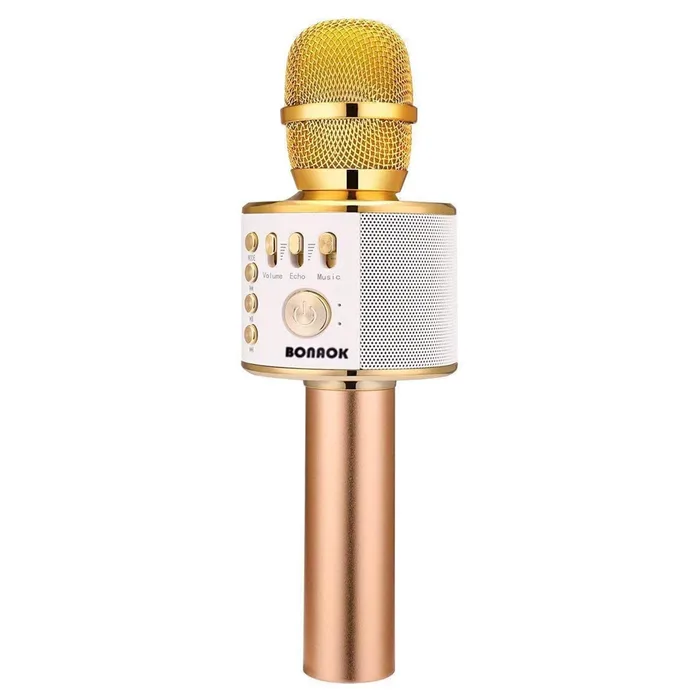
- BONAOK Q37 Wireless Bluetooth Karaoke Microphone - Buy. A handheld mic with a built-in 6W speaker that plays your phone's backing track over Bluetooth and mixes your voice on top.
- Phenyx Pro PDP-2-2H Dual Digital Wireless Microphone System - Buy. Two digital wireless handhelds and a pocket-size rechargeable receiver that plugs straight into a speaker's mic input.
- Ikarao MICBOX PRO Wireless Microphone System - It depends. A rechargeable two-mic system with a 2.4 GHz plug-in receiver and a storage case that runs a UV cleaning cycle.
- Gemini Sound Gemini GMU-M200 UHF Dual Wireless Microphone System - Buy. Two rechargeable UHF handhelds and a pocket-size receiver with a 1/4-inch plug, all charged over USB-C.
- Amazmic Kids Karaoke Microphone - It depends. A light-up handheld karaoke mic and speaker aimed at kids aged 3 to 12, with voice-changer modes.
- TONOR TW-820 Dual Wireless Microphone - Skip. A metal UHF two-mic system with a tabletop receiver that costs more than the Phenyx and asks more of you.
The verdict in 30 seconds
What mattered most
- Type
- Mics in box
- Connection
- Stated range
- Mic power
- Receiver power
Karaoke microphones come in two very different shapes. One is the all-in-one handheld that pairs with your phone over Bluetooth and plays the backing track through a speaker built into the mic. The other is a wireless pair with a small receiver that plugs into the mic input of a party speaker or karaoke machine. We compared two handhelds from BONAOK and Amazmic against wireless pairs from Phenyx Pro, Ikarao, Gemini Sound and TONOR, using only what each maker publishes.
A handheld mic with a built-in 6W speaker that plays your phone's backing track over Bluetooth and mixes your voice on top.
Best for: Anyone who wants to sing along to a phone anywhere without a separate speaker.
- BONAOK publishes a full spec list: 6W speaker output, 365 g weight, 2 hours to charge and 5 to 10 hours of singing.
- Mic volume, echo and music volume each have their own control, so you can balance voice against track without touching the phone.
- It also works as a Bluetooth speaker and recorder, connects by cable as well as Bluetooth and plays songs from a microSD card up to 32GB.
- One mic means one singer; duets need a second unit.
- A 6W speaker built into the mic is fine for a living room but will not fill a big party.
- The microSD card is not included and BONAOK does not state the Bluetooth version.
- BONAOK sells many similar handheld models, so check for Q37 in the listing title.
Own the BONAOK Q37 Wireless Bluetooth Karaoke Microphone? Tell us how it held up.
Thanks. Counted, and shown once enough owners have weighed in.
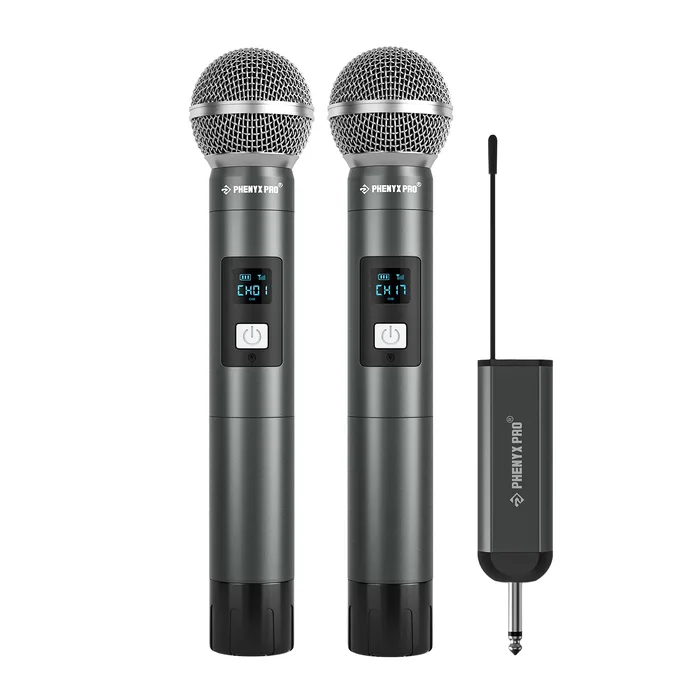
Two digital wireless handhelds and a pocket-size rechargeable receiver that plugs straight into a speaker's mic input.
Best for: Owners of a party speaker or karaoke machine with a mic input who want two reliable wireless mics.
- Phenyx Pro states 48 kHz/24-bit digital transmission with a 2.5 ms delay, so your voice stays in time with the track.
- The receiver charges over USB-C and the box includes an angled 1/4-inch TS adapter plus a 6.35 mm to 3.5 mm adapter, so it fits most mic inputs.
- The 900MHz version offers 15 frequency groups with one-tap selection and a stated 200 ft line-of-sight range.
- Phenyx Pro rates the receiver at 5.5 hours for the two-mic PDP-2, shorter than a long party.
- The handheld mics run on AA batteries rather than built-in rechargeables.
- It needs a speaker, karaoke machine or mixer with a mic input; it cannot play music by itself.
Own the Phenyx Pro PDP-2-2H Dual Digital Wireless Microphone System? Tell us how it held up.
Thanks. Counted, and shown once enough owners have weighed in.
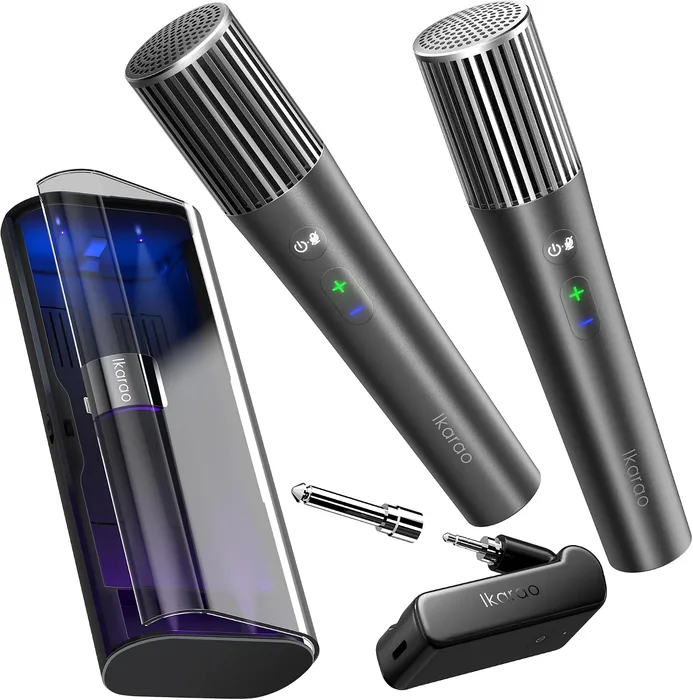
A rechargeable two-mic system with a 2.4 GHz plug-in receiver and a storage case that runs a UV cleaning cycle.
Best for: Hosts who sing often, share mics with lots of guests and want rechargeable mics with a clean storage case.
- Each mic has a built-in 1500 mAh battery rated for up to 20 hours, so there are no AA batteries to buy.
- The receiver supports both 6.35 mm and 3.5 mm connections and Ikarao lists JBL PartyBox speakers among compatible gear.
- The case runs a 60-second UV cycle when closed, which helps when mics are passed around a party.
- It costs the most here by a wide margin.
- Ikarao states it is not compatible with phones, tablets or TVs.
- The receiver is rated for up to 8 hours, well short of the mics' 20.
- 2.4 GHz shares airspace with Wi-Fi and Bluetooth, and the stated range is 100 ft against 200 ft for the Phenyx.
Own the Ikarao MICBOX PRO Wireless Microphone System? Tell us how it held up.
Thanks. Counted, and shown once enough owners have weighed in.
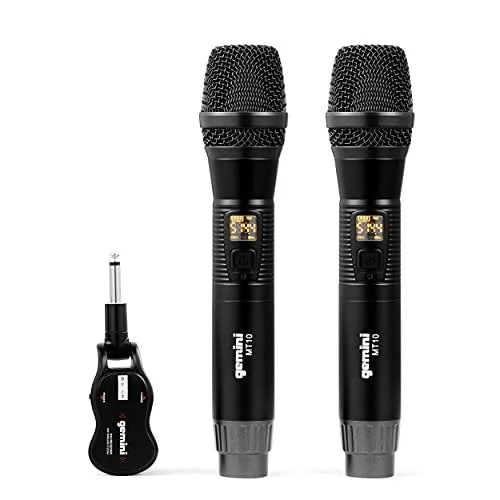
Two rechargeable UHF handhelds and a pocket-size receiver with a 1/4-inch plug, all charged over USB-C.
Best for: Buyers who want rechargeable wireless mics at budget money and will plug the receiver into USB-C power for long sessions.
- Gemini's spec table lists 1200 mAh rechargeable mic batteries rated for about 10 hours, and the batteries are user-replaceable.
- Volume and frequency selection sit on each mic, with an LED display showing channel, frequency and battery.
- Gemini publishes a full spec table: cardioid dynamic mics, 20 Hz to 18 kHz response, under 0.6% distortion and a range over 50 meters.
- The receiver is rated for only about 3.5 hours per charge, the shortest of the plug-in receivers here.
- Receiver output is a 1/4-inch jack and no 3.5 mm adapter is listed in the box.
- One of Gemini's own product images says 4 hours of playtime, which does not match the 10 hour mic figure in its spec table.
- The mic bodies are ABS plastic rather than metal.
Own the Gemini Sound Gemini GMU-M200 UHF Dual Wireless Microphone System? Tell us how it held up.
Thanks. Counted, and shown once enough owners have weighed in.
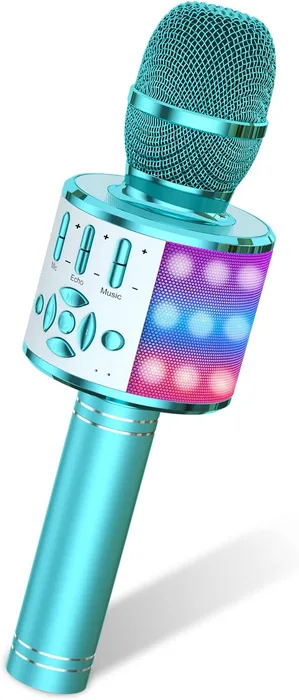
A light-up handheld karaoke mic and speaker aimed at kids aged 3 to 12, with voice-changer modes.
Best for: Parents buying a first karaoke mic for a young child.
- Amazmic states Bluetooth 5.0 with a range up to 33 ft and pairing in about two seconds.
- Four voice-changer modes and LED lights that react to music are what younger kids actually enjoy.
- It plays from Bluetooth, a TF card or a cable, and Amazmic rates it for 4 to 6 hours per charge.
- Amazmic does not publish the speaker's output power, so there is no way to compare loudness.
- Battery life is shorter than the BONAOK Q37's stated 5 to 10 hours.
- It is sold as a toy for ages 3 to 12, not as an adult karaoke mic.
Own the Amazmic Kids Karaoke Microphone? Tell us how it held up.
Thanks. Counted, and shown once enough owners have weighed in.
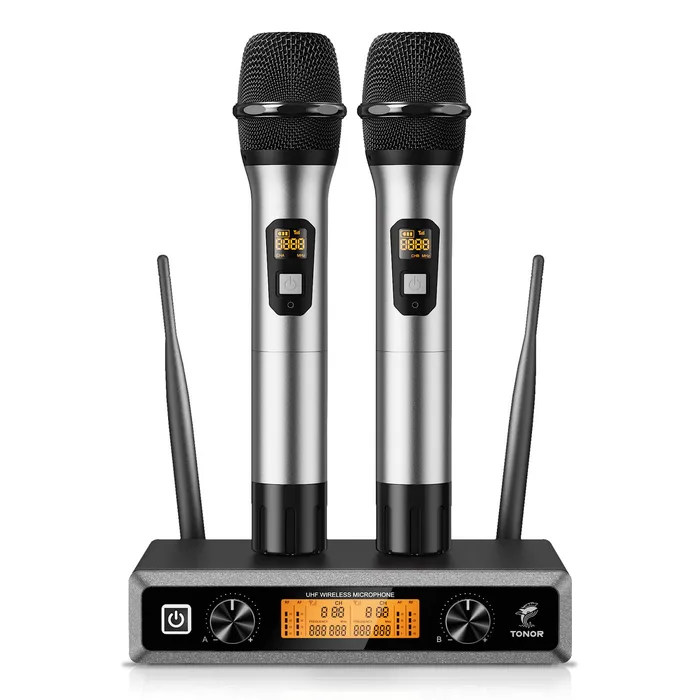
A metal UHF two-mic system with a tabletop receiver that costs more than the Phenyx and asks more of you.
Best for: Few home karaoke buyers; it suits a fixed PA setup with a 1/4-inch input better than a living room.
- TONOR states a 60 m open-space range and 15 adjustable frequencies per mic.
- The all-metal mics have steel mesh grilles, and the receiver has a separate volume control for each mic.
- Mics and receiver pair automatically when switched on.
- TONOR states it is not compatible with laptops, iPads, cellphones or AV receivers, which rules out routing through a home theater receiver.
- Each mic needs two AA batteries, and none are included.
- The box lists only a 6.35 mm cable, with no 3.5 mm adapter for the many speakers that use one.
- It sits a price tier above the Phenyx Pro PDP-2-2H, which adds a rechargeable receiver and both adapters.
Own the TONOR TW-820 Dual Wireless Microphone? Tell us how it held up.
Thanks. Counted, and shown once enough owners have weighed in.
| Criteria | BONAOK Q37 Wireless Bluetooth Karaoke Microphone Top pick Buy it Buy | Phenyx Pro PDP-2-2H Dual Digital Wireless Microphone System Buy it Buy | Ikarao MICBOX PRO Wireless Microphone System It depends Buy | Gemini GMU-M200 UHF Dual Wireless Microphone System Buy it Buy | Amazmic Kids Karaoke Microphone It depends Buy | TONOR TW-820 Dual Wireless Microphone Skip it Buy |
|---|---|---|---|---|---|---|
| Best for | Anyone who wants to sing along to a phone anywhere without a separate speaker. | Owners of a party speaker or karaoke machine with a mic input who want two reliable wireless mics. | Hosts who sing often, share mics with lots of guests and want rechargeable mics with a clean storage case. | Buyers who want rechargeable wireless mics at budget money and will plug the receiver into USB-C power for long sessions. | Parents buying a first karaoke mic for a young child. | Few home karaoke buyers; it suits a fixed PA setup with a 1/4-inch input better than a living room. |
| Price tier | $ · budget | $ · budget | $$$ · premium | $ · budget | $ · budget | $$ · mid-range |
| Type | All-in-one handheld with speaker | Wireless pair + plug-in receiver | Wireless pair + plug-in receiver | Wireless pair + plug-in receiver | All-in-one handheld with speaker (kids) | Wireless pair + tabletop receiver |
| Mics in box | 1 | 2 | 2 | 2 | 1 | 2 |
| Connection | Bluetooth (10 m), cable, microSD | 900MHz digital UHF | 2.4 GHz | UHF, on-mic frequency selection | Bluetooth 5.0 (33 ft), TF card, cable | UHF, 15 frequencies per mic |
| Stated range | 10 m (Bluetooth) | 200 ft line of sight | 100 ft | Over 50 m | 33 ft (Bluetooth) | 60 m open space |
| Mic power | Rechargeable, 5-10 hours | AA batteries | Rechargeable 1500 mAh, up to 20 hours | Rechargeable 1200 mAh, about 10 hours | Rechargeable, 4-6 hours | AA batteries (not included) |
| Receiver power | No receiver | Rechargeable, 5.5 hours | Rechargeable, up to 8 hours | Rechargeable 500 mAh, about 3.5 hours | No receiver | Not stated |
| Output to speaker | Built-in 6W speaker | 1/4-inch TS, 3.5 mm adapter included | 6.35 mm and 3.5 mm | 1/4-inch jack | Built-in speaker (power not published) | 6.35 mm cable |
| Plays music by itself | Yes | No | No | No | Yes | No |
Which one is right for you?
- Anyone who wants to sing along to a phone anywhere without a separate speaker. Buy it BONAOK Q37 Wireless Bluetooth Karaoke Microphone
- Owners of a party speaker or karaoke machine with a mic input who want two reliable wireless mics. Buy it Phenyx Pro PDP-2-2H Dual Digital Wireless Microphone System
- Buyers who want rechargeable wireless mics at budget money and will plug the receiver into USB-C power for long sessions. Buy it Gemini Sound Gemini GMU-M200 UHF Dual Wireless Microphone System
- Hosts who sing often, share mics with lots of guests and want rechargeable mics with a clean storage case. It depends Ikarao MICBOX PRO Wireless Microphone System
- Parents buying a first karaoke mic for a young child. It depends Amazmic Kids Karaoke Microphone
- Few home karaoke buyers; it suits a fixed PA setup with a 1/4-inch input better than a living room. Skip it TONOR TW-820 Dual Wireless Microphone
How we judged the field
Five things decide whether a karaoke mic is a good buy. First is how it connects: an all-in-one handheld pairs with a phone and plays through its own speaker, while a wireless pair needs a speaker or karaoke machine with a mic input. Second is power, both for the mics and for any plug-in receiver, because a dead receiver ends the night as surely as a dead mic. Third is range and interference resistance, which is where UHF, 900MHz digital and 2.4 GHz systems differ. Fourth is what comes in the box, especially the adapters that decide whether it fits your speaker’s jack. Fifth is how many people can sing at once.
The field splits cleanly. All-in-one handhelds are cheap, self-contained and limited by a small built-in speaker. Wireless pairs sound only as good as the speaker you plug them into, but with a good party speaker they are far louder and allow duets. We picked two handhelds and four pairs across budget, mid-range and premium tiers, and left out karaoke machines and party speakers, which our karaoke machines and party speakers reviews already cover.
BONAOK Q37 Wireless Bluetooth Karaoke Microphone
Buy itThe BONAOK Q37 is the classic all-in-one karaoke mic, and it earns the top spot because BONAOK actually publishes what it is. The page lists a 6W speaker, an aluminium alloy body weighing 365 g, 2 hours to charge and 5 to 10 hours of singing, plus a 10 m Bluetooth range. You pair your phone, open a karaoke app or video, and the mic plays the track through its speaker while mixing your voice on top. Separate controls for mic volume, echo and music volume let you fix the balance on the mic itself, and it doubles as a Bluetooth speaker and recorder. It also takes a microSD card up to 32GB, though you supply the card, and it connects by cable if Bluetooth lag bothers you. The trade-off is physics: 6W in a handheld body suits a bedroom, a car or a small gathering, not a crowd, and one mic means one singer. BONAOK sells many lookalike models, so confirm Q37 when you order. It is for anyone who wants to sing to a phone anywhere, with nothing else to set up.
Phenyx Pro PDP-2-2H Dual Digital Wireless Microphone System
Buy itThe Phenyx Pro PDP-2-2H is the pick if you already own a party speaker or karaoke machine with a mic input. It is two handheld cardioid dynamic mics and a small receiver that plugs straight into the speaker’s 1/4-inch jack, with an angled TS adapter and a 6.35 mm to 3.5 mm adapter in the box. Phenyx Pro states 48 kHz/24-bit digital transmission with a 2.5 ms delay and uses the 900MHz band, away from crowded 2.4 GHz Wi-Fi, with 15 frequency groups and one-tap selection on the mic. The stated line-of-sight range is 200 ft, far more than a living room needs. The receiver charges over USB-C from a 1500 mAh battery, but Phenyx rates it at 5.5 hours with both mics running, so charge it before a long night. The mics run on AA batteries, included in US shipments. Each mic also has a mute function. It is for anyone with a capable speaker who wants two dependable wireless mics without paying premium money.
Ikarao MICBOX PRO Wireless Microphone System
It dependsThe Ikarao MICBOX PRO is the polished option, and the price reflects it. Each handheld has a 30 mm cardioid dynamic capsule and a built-in 1500 mAh battery rated for up to 20 hours, so you never buy AA cells. Ikarao states a signal-to-noise ratio above 75 dB, under 1% distortion and DSP that reduces handling thumps when mics are passed between guests. The storage case runs a 60-second UV cycle when closed, a real plus for mics shared around a party. The 2.4 GHz receiver accepts both 6.35 mm and 3.5 mm connections and works with karaoke machines, PA speakers, mixers and JBL PartyBox speakers, per Ikarao. The limits are worth knowing: the receiver is rated for 8 hours against the mics’ 20, the stated range is 100 ft, and Ikarao says plainly it does not work with phones, tablets or TVs. It costs the most here. It is for frequent hosts who value rechargeable mics and hygiene over price.
Gemini Sound Gemini GMU-M200 UHF Dual Wireless Microphone System
Buy itThe Gemini GMU-M200 puts rechargeable mics within reach of a budget buyer. You get two cardioid dynamic handhelds and a pocket-size receiver with a 1/4-inch plug, and the mics pair automatically out of the box. Everything charges over USB-C with the included cable. Gemini’s spec table lists 1200 mAh mic batteries rated for about 10 hours, and they are user-replaceable when they wear out, which matters for anything rechargeable. Volume and frequency selection sit on each mic, with an LED display showing channel, frequency and battery level. Gemini publishes more figures than most at this price: 20 Hz to 18 kHz response, under 0.6% distortion and a range over 50 meters. The weak point is the receiver, rated at about 3.5 hours on its 500 mAh battery, so keep it on a USB-C charger for long nights. One of Gemini’s own images also claims 4 hours of playtime, at odds with its spec table. It is for buyers who want rechargeable wireless mics without paying premium money.
Amazmic Kids Karaoke Microphone
It dependsThe Amazmic Kids Karaoke Microphone is a toy first and a microphone second, and that is fine for its audience. Amazmic aims it at ages 3 to 12, with LED lights that react to the music and four voice-changer modes, which younger kids tend to love more than vocal clarity. It pairs over Bluetooth 5.0 with a stated range of 33 ft, plays from a TF card or a cable, and Amazmic rates it at 4 to 6 hours per charge with more than 20 days of standby. Echo reverb is built in. What Amazmic does not publish is the speaker’s output power, so you cannot compare loudness with the BONAOK Q37, and its rated battery life is shorter than the BONAOK’s 5 to 10 hours. Adults who want a karaoke mic for themselves should look at the Q37 instead. It is for parents buying a first, inexpensive karaoke mic for a young child, where lights and silly voices matter more than specs.
TONOR TW-820 Dual Wireless Microphone
Skip itThe TONOR TW-820 is a capable UHF system on paper, with a stated 60 m open-space range, 15 adjustable frequencies per mic and all-metal mics with steel mesh grilles. The receiver gives each mic its own volume control, and pairing is automatic. The problem is fit and value for home karaoke. TONOR states it is not compatible with laptops, iPads, cellphones or AV receivers, which closes off routing it through a home theater setup. Each mic needs two AA batteries that are not included, and the box lists only a 6.35 mm cable, so a speaker with a 3.5 mm input needs an adapter you buy separately. Meanwhile it sits a tier above the Phenyx Pro PDP-2-2H, which adds a rechargeable receiver, digital transmission and both adapters in the box. It can make sense on a fixed PA system with a 1/4-inch input. For a living room karaoke night, the Phenyx or the Gemini does the same job for less.
Sources
Specs in this review come from these pages.
- BONAOK, Q37 Wireless Bluetooth Karaoke Microphone product page (bonaok.com)
- Phenyx Pro, PDP-2 Dual Digital Portable Wireless Microphone System product page (phenyxpro.com)
- Ikarao, MICBOX PRO Wireless Microphone System product page (ikarao.com)
- Gemini Sound, GMU-M200 UHF Dual Wireless Microphone System product page (geminisound.com)
- Amazmic, Kids Karaoke Microphone product page (amazmic.com)
- TONOR, TW-820 Dual Wireless Microphone product page (tonormic.com)
BONAOK Q37 Wireless Bluetooth Karaoke Microphone vs Phenyx Pro PDP-2-2H Dual Digital Wireless Microphone System: which should you buy?
The BONAOK Q37 and the Phenyx Pro PDP-2-2H solve different problems, so the choice comes down to what you already own. The Q37 is a complete karaoke setup in one hand: phone, mic and a 6W speaker. It needs nothing else and goes anywhere, but one mic and a small speaker cap it at casual, close-up singing. The Phenyx gives you two mics and nothing to play them through, so it only makes sense with a speaker or karaoke machine that has a mic input.
If you have no speaker with a mic jack, buy the Q37, or two of them for duets. If you own a party speaker or karaoke machine with a 1/4-inch or 3.5 mm mic input, buy the Phenyx: two singers through a real speaker will sound fuller and louder than any built-in speaker, and the stated 2.5 ms delay keeps voices in time. If you plan to sing weekly and hate buying batteries, the Ikarao MICBOX PRO is the upgrade from the Phenyx.
Who should buy which
- Solo singer with only a phone: the BONAOK Q37 Wireless Bluetooth Karaoke Microphone. Its built-in 6W speaker and separate echo and volume controls make it a complete setup in one hand.
- Party speaker owner: the Phenyx Pro PDP-2-2H Dual Digital Wireless Microphone System. Two digital wireless mics plug into the speaker’s mic input with both 1/4-inch and 3.5 mm adapters included.
- Frequent host who shares mics: the Ikarao MICBOX PRO Wireless Microphone System. Rechargeable mics rated for 20 hours and a UV cleaning case suit weekly karaoke with many guests.
- Budget buyer who hates AA batteries: the Gemini Sound Gemini GMU-M200 UHF Dual Wireless Microphone System. Its mics are rechargeable over USB-C and rated for about 10 hours, at a budget price.
- Parent of a young child: the Amazmic Kids Karaoke Microphone. Voice-changer modes and reactive LED lights are made for ages 3 to 12.
What to look for
- Mic input on your speaker: A wireless pair needs a speaker, karaoke machine or mixer with a 1/4-inch or 3.5 mm mic input; most small Bluetooth speakers lack one.
- Adapters in the box: Check whether a 6.35 mm to 3.5 mm adapter is included, since receivers often ship with only a 1/4-inch plug.
- Receiver battery life: On plug-in systems the receiver can die before the mics, so compare its rated hours, not just the mics’.
- Wireless band: UHF and 900MHz systems avoid the crowded 2.4 GHz band shared by Wi-Fi and Bluetooth, which matters most in busy apartment buildings.
- Separate echo and volume controls: On all-in-one mics, independent mic, echo and music controls let you balance voice and track without the phone.
- Published specs: Prefer listings that state speaker output, battery hours and range; a missing number is often a weak one.
Our final take
For most people the BONAOK Q37 is the karaoke mic to buy: one budget-priced handheld with a published 6W speaker, separate echo and volume controls and a stated 5 to 10 hours of singing. If a party speaker or karaoke machine with a mic input already sits in your living room, skip the built-in-speaker category and get the Phenyx Pro PDP-2-2H for two digital wireless mics and the adapters to fit. The Ikarao MICBOX PRO is the premium rechargeable upgrade, the Gemini GMU-M200 a budget rechargeable pair, and the Amazmic a fun first mic for small kids. Pass on the TONOR TW-820, which costs more than the Phenyx and asks you to supply batteries and adapters.
Questions, answered
Can I plug wireless karaoke mics into my TV?
Usually not directly. Most TVs have no microphone input, and Ikarao states its MICBOX PRO is not compatible with TVs, while TONOR lists its TW-820 as incompatible with AV receivers. The working route is to play the lyrics video on the TV and plug the mic receiver into a speaker, soundbar or karaoke machine that has a 1/4-inch or 3.5 mm mic input. If you want a screen and mics in one box, a karaoke machine is the simpler buy, and our karaoke machines review covers those.
Are all-in-one Bluetooth karaoke mics loud enough for a party?
For a small room, yes; for a crowd, no. The BONAOK Q37 is rated at 6W, which is a fraction of what a party speaker puts out, and Amazmic does not publish a figure at all. They work best for one or two people singing close by. For a bigger group, a wireless pair into a party speaker with a mic input is the better setup.
Why do my all-in-one karaoke mic and phone sometimes fall out of sync?
Bluetooth audio adds a small delay, and different phones and apps handle it differently. The backing track comes from the phone over Bluetooth while your voice goes straight to the built-in speaker, so any lag shows up as the music trailing your voice. A cable connection, which both the BONAOK Q37 and Amazmic support, removes the Bluetooth leg. Wireless pairs avoid this because the mic signal is mixed in the speaker, and Phenyx Pro states a 2.5 ms delay for the PDP-2.
Rechargeable mics or AA batteries?
Rechargeable mics like the Ikarao MICBOX PRO and Gemini GMU-M200 are convenient until they go flat mid-party with no quick fix. AA mics like the Phenyx Pro and TONOR let you swap in fresh batteries in seconds, but you have to buy them, and TONOR does not include any. If you sing weekly, rechargeables save money over time. For occasional parties, AA mics with a spare set on hand are the safer choice.
Will a wireless mic pair work with any Bluetooth speaker?
Only if the speaker has a wired microphone or line input. Most small portable Bluetooth speakers have no mic input at all, so there is nothing to plug the receiver into. Party speakers and karaoke machines usually have a 1/4-inch mic jack, and many have reverb controls for it. Check for that jack before buying a wireless pair; if your speaker lacks one, an all-in-one handheld like the BONAOK Q37 is the way to go.
Deciding between the top two? See our head-to-head: BONAOK Q37 Wireless Bluetooth Karaoke Microphone vs Phenyx Pro PDP-2-2H Dual Digital Wireless Microphone System.
More in Audio & Headphones
Karaoke Microphones, Explained Plain-English guide → BONAOK Q37 Wireless Bluetooth Karaoke Microphone vs Phenyx Pro PDP-2-2H Dual Digital Wireless Microphone System Head-to-head →  The Best Volume-Limited Kids' Headphones: 4 Compared (and One to Skip)
 The Best Microphone Boom Arms: 4 Compared (and One to Skip)
 The Best Microphone Shock Mounts: 4 Compared (and One to Skip)
 The Best MIDI Keyboard Controllers: 4 Compared (and One to Skip)