

Outdoors & Fitness
The Best GPS Running Watches for 2026
We compared four GPS running watches sold in 2026 on accuracy, battery, display, and coaching to find the honest pick for most runners, plus one to skip.
The short version
The COROS Pace 4 is the pick for most runners: dual-frequency GPS, the longest battery here, and a light AMOLED watch at a modest price. The Garmin Forerunner 265 is the runner-up, trading endurance for a deeper coaching platform, contactless pay, and offline music. Step up to the Forerunner 970 only if you want Garmin's maps, ECG and the deepest metrics. Skip the Polar Pacer, whose respected training software is held back by a memory-in-pixel screen and no listed dual-frequency GPS, which budget rivals now beat.
Our picks at a glance
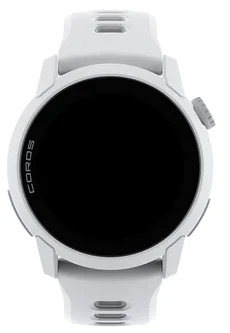
- COROS Pace 4 - Buy. Dual-frequency GPS and long battery in a light AMOLED watch that undercuts everything comparable.
- Garmin Forerunner 265 - Buy. The most complete guided-training watch here, with AMOLED, music, and contactless pay, but modest battery.
- Garmin Forerunner 970 - It depends. The flagship with on-watch maps, ECG, and the deepest metrics, at a premium most runners can skip.
- Polar Pacer - Skip. Respected Polar training software held back by a dim single-band, memory-in-pixel design.
The verdict in 30 seconds
What mattered most
- GPS accuracy
- Display
- GPS battery
- On-watch maps
- Guided training
- Value tier
A GPS running watch lives on your wrist for years, so the trade-offs that matter are the ones you feel over months of training: satellite accuracy, battery endurance, screen legibility, and how much real coaching the software adds. We synthesized independent expert testing and long-term owner reports on watches sold new in 2026. Below are three we recommend for different runners, and one we think most people should pass over.
Dual-frequency GPS and long battery in a light AMOLED watch that undercuts everything comparable.
Best for: Runners who want accurate data and the longest battery without paying for extras.
- Dual-frequency multiband GPS held its own against pricier watches in independent testing
- COROS rates it for 41 GPS hours in All Systems mode, and it weighs 40 g with the silicone band (32 g with nylon)
- Smaller app ecosystem than Garmin's, and COROS lists no contactless payments
- Music controls for your phone, but COROS does not list onboard music storage
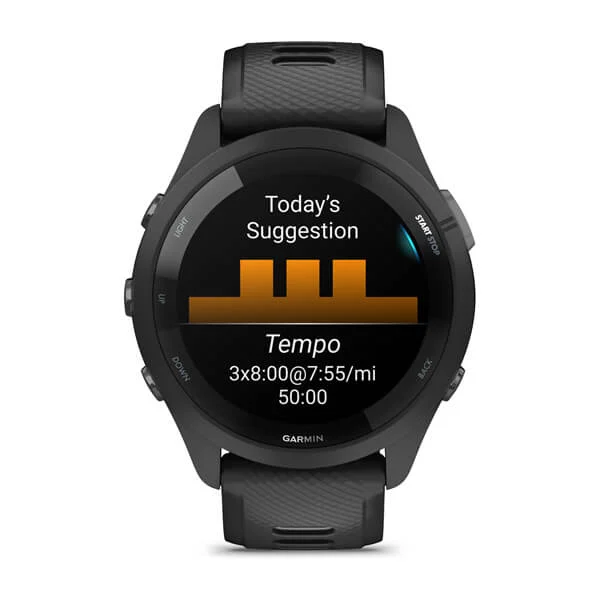
The most complete guided-training watch here, with AMOLED, music, and contactless pay, but modest battery.
Best for: Runners who want daily coaching and phone-free music, and charge weekly.
- Training Readiness, daily suggested workouts, and HRV status give clear day-to-day guidance
- AMOLED touchscreen, Garmin Pay contactless payments, and offline music included
- Up to 14 hours in multiband mode (20 in GPS-only), the shortest battery in this group
- No built-in maps, while the cheaper COROS has them
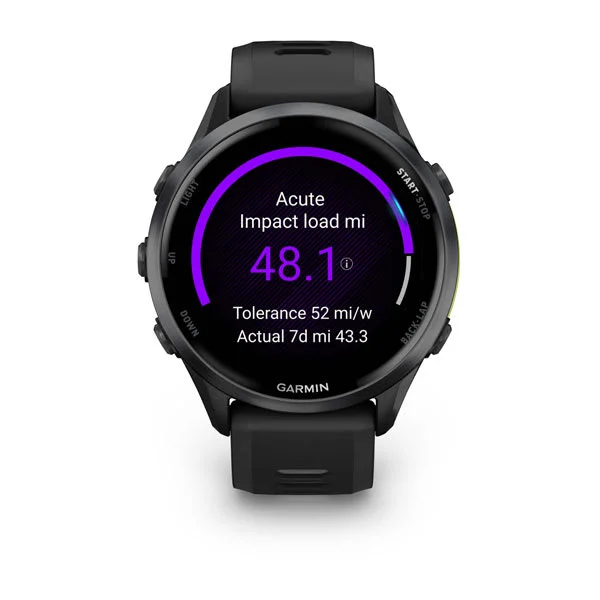
The flagship with on-watch maps, ECG, and the deepest metrics, at a premium most runners can skip.
Best for: Runners who also hike or race long and want maps and metrics on the wrist.
- Preloaded road and trail maps with Trendline popularity routing
- Sapphire lens, ECG app, LED flashlight, and running tolerance plus running-economy metrics (economy needs a compatible accessory)
- Premium tier that most road runners will not need
- Up to 26 hours in GPS-only mode and 21 with multiband, well short of the COROS
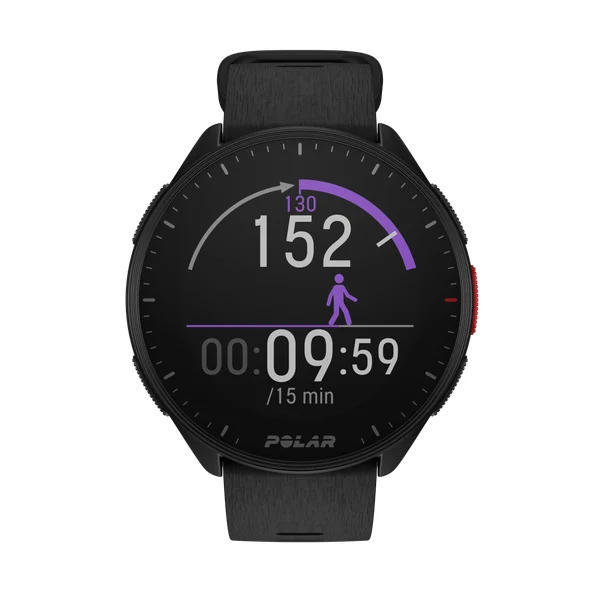
Respected Polar training software held back by a dim single-band, memory-in-pixel design.
Best for: Few new buyers, given better-value rivals at the same tier.
- Training Load Pro and Running Program rest on respected recovery science
- Light, simple, buttons-only interface
- Dim, small memory-in-pixel display that looks dated indoors and at night
- Polar does not list dual-frequency GPS, which the rivals here all have
| Criteria | COROS Pace 4 Top pick | Garmin Forerunner 265 | Garmin Forerunner 970 | Polar Pacer |
|---|---|---|---|---|
| Verdict | Buy it | Buy it | It depends | Skip it |
| Best for | Runners who want accurate data and the longest battery without paying for extras. | Runners who want daily coaching and phone-free music, and charge weekly. | Runners who also hike or race long and want maps and metrics on the wrist. | Few new buyers, given better-value rivals at the same tier. |
| Price tier | $$ · mid-range | $$$ · premium | $$$$ · flagship | $$ · mid-range |
| GPS accuracy | Dual-frequency multiband | Multiband GNSS | Multiband GNSS | Dual-frequency not listed |
| Display | 1.2-inch AMOLED touch | 1.3-inch AMOLED touch | 1.4-inch AMOLED, sapphire | 1.2-inch memory-in-pixel |
| GPS battery | Up to 41 hrs (All Systems) | Up to 14 hrs multiband, 20 GPS-only | Up to 21 hrs multiband, 26 GPS-only | Up to 32 hrs |
| On-watch maps | Landscape and topo maps | No maps | Preloaded road and trail maps | No maps |
| Guided training | Solid, app-based | Deep, on-watch | Deepest, on-watch | Good but dated |
| Value tier | Budget-friendly | Mid-range | Premium | Entry-level |
Which one is right for you?
- Runners who want accurate data and the longest battery without paying for extras. Buy it COROS Pace 4
- Runners who want daily coaching and phone-free music, and charge weekly. Buy it Garmin Forerunner 265
- Runners who also hike or race long and want maps and metrics on the wrist. It depends Garmin Forerunner 970
- Few new buyers, given better-value rivals at the same tier. Skip it Polar Pacer
How we judged the field
We read across independent expert testing and long-term owner reports for GPS running watches sold new in 2026, then weighed the trade-offs that actually change how a watch feels over months of training: satellite accuracy, battery endurance, display legibility, and how much genuine coaching the software provides. We did not run our own lab. Where reviewers and owners disagreed, we leaned toward the consensus that held up across many runs and many wrists. Every watch here is in production and widely available. We also included one model we think most runners should pass over, because a fair comparison needs a floor as well as a ceiling.
Two themes shaped the ranking. First, multiband (dual-frequency) GPS has become the dividing line between watches that hold a clean line through city streets and tree cover and watches that wander. Second, battery endurance and screen type trade against each other: an always-on AMOLED panel looks sharper but drains faster than the older memory-in-pixel screens it replaced.
COROS Pace 4
Buy itThe Pace 4 is the value benchmark this year. It pairs dual-frequency multiband GNSS with a 1.2-inch AMOLED touchscreen and weighs 40 grams with the silicone band (32 g with nylon), light enough to forget on long runs. In independent testing its GPS track held up against watches costing far more, and battery is the differentiator: COROS rates it for 41 GPS hours in All Systems mode and up to 19 days of daily use, so a marathon block rarely needs a mid-week charge.
What we liked more: the accuracy-to-weight-to-endurance balance is hard to fault at this tier, and the added microphone enables spoken Voice Pins for marking points on a route. It also shows landscape and topo maps on the watch. What we liked less: the COROS software ecosystem is smaller than Garmin’s, and COROS lists no contactless payments. For a runner who wants precise data without fuss, those omissions are easy to accept.
Garmin Forerunner 265
Buy itThe Forerunner 265 is the most complete guided-training experience here. Its 1.3-inch AMOLED touchscreen is crisp, and the platform layers Training Readiness, daily suggested workouts, HRV status, and race predictions into a coherent picture that tells you not just what you did but what to do next. It also adds the conveniences the COROS lacks: Garmin Pay contactless payments and offline music, so you can leave your phone at home.
What we liked more: no other watch at this level turns training data into day-to-day guidance as clearly. What we liked less: battery is the weak point, at up to 14 hours in multiband mode (20 in GPS-only), the shortest in this group, and unlike the Pace 4 it has no built-in maps. Runners who charge weekly and value coaching over endurance will not mind; ultra-distance runners will.
Garmin Forerunner 970
It dependsThe Forerunner 970 is the flagship, and it earns a qualified recommendation rather than a blanket one. It has preloaded road and trail maps with Trendline popularity routing, and it adds hardware the others lack: a sapphire crystal lens, the Garmin ECG app, a built-in LED flashlight, and metrics including Running Tolerance and Running Economy (the latter with a compatible accessory). The 1.4-inch AMOLED is the largest in the group.
What we liked more: maps plus the deepest metric set make it the most capable single device for runners who also hike or race long. What we liked less: it sits at a premium tier, and its battery is rated for up to 26 hours in GPS-only mode and 21 with multiband, about half the Pace 4’s figure. Most runners do not need its extras badly enough to justify the jump. Those who do will find little else that matches it.
Polar Pacer
Skip itThe Pacer is the one to pass over, and not because Polar’s fundamentals are poor. Its Training Load Pro and Running Program tools rest on genuinely respected recovery science, and the watch is light and simple. The problem is the hardware around that software. The display is a 1.2-inch memory-in-pixel panel that reads well in bright sun but looks dim and dated indoors and at night, and the usable screen is small inside a thick bezel. Polar does not list dual-frequency GPS, which every other watch here has, and that matters most in cities and under tree cover. Polar rates it for up to 32 hours in performance training mode.
What we liked more: Polar’s recovery guidance and the uncluttered, buttons-only interface. What we liked less: a dim package that a similarly priced rival now beats on screen, satellite modes, and endurance alike. When a similarly priced watch offers dual-frequency GPS and an AMOLED display, the Pacer is hard to justify as a new purchase.
COROS Pace 4 vs Garmin Forerunner 265: which should you buy?
This is the decision most runners will actually face. The two watches share dual-band accuracy and an AMOLED screen, so the split comes down to endurance and ecosystem. The Pace 4 lasts far longer between charges and costs less, and its GPS was at least the equal of the Garmin in independent testing. The Forerunner 265 answers with a deeper, better-integrated training platform, contactless payments, and offline music.
Choose the Pace 4 if you want the longest battery, the lightest watch, and accurate data without a large feature stack. Choose the Forerunner 265 if you want a watch that interprets your training and tells you how hard to go tomorrow, and you are willing to charge it weekly and pay more for that. Neither is a wrong answer; they serve different priorities.
What to look for
Start with battery. If you train for long events or dislike frequent charging, endurance narrows the field quickly. Next, decide whether you want guidance or just data: Garmin’s platform coaches, while COROS mostly measures and leaves interpretation to you. Consider whether you genuinely need a flagship’s extras; most road runners do not. Finally, weigh the screen. AMOLED is easier to read indoors and looks sharper, but the older memory-in-pixel panels are built for direct sun and use less power. Match those four levers to your training and the right watch usually picks itself.
Our final take
The COROS Pace 4 is our overall pick because it delivers multiband accuracy, the longest endurance in this group, and a light frame at a price that undercuts everything comparable. The Garmin Forerunner 265 is the runner-up for anyone who wants coaching rather than raw numbers. Step up to the Forerunner 970 only if on-watch maps and the deepest metrics matter to you. And skip the Polar Pacer: the software deserves better hardware than it ships with.
Questions, answered
Do I really need dual-frequency (multiband) GPS?
Yes for most runners in cities or under tree cover. Multiband tracks two satellite frequencies at once, which reduces the wandering and corner-cutting that single-band watches show near tall buildings. On open roads the gap shrinks, and multiband is now common on mid-range watches.
Which watch lasts longest for long races?
The COROS Pace 4 lasts longest in this group, rated for 41 hours in All Systems GPS mode. The Garmin Forerunner 970 is rated for up to 21 hours with multiband (26 GPS-only) and the Forerunner 265 up to 14 hours with multiband (20 GPS-only). For ultras, the Pace 4 is the safest single-charge choice.
Are AMOLED screens worth it over the older memory-in-pixel type?
It depends on where you run. AMOLED is brighter and easier to read indoors and at night, which is why most 2026 watches use it. Memory-in-pixel panels, like the Polar Pacer's, are built for bright conditions and use less power, but look dim otherwise.
Can these watches store music and make contactless payments?
Only the Garmin models here. The Forerunner 265 and 970 both offer music storage and Garmin Pay, so you can leave your phone at home and tap to pay. The COROS Pace 4 and Polar Pacer can control music on your phone, but neither lists onboard music storage or contactless payments.
Deciding between the top two? See our head-to-head: COROS Pace 4 vs Garmin Forerunner 265.
More Outdoors & Fitness reviews
 The Best Grip Socks for Pilates and Barre: 4 Compared (and One to Skip)
  The Best Guy Lines: 4 Compared (and One to Skip)
  The Best Hammock Straps: 4 Compared (and One to Skip)
  The Best Handheld GPS Units: 4 Compared (and One to Skip)
  The Best Headlamps of 2026: Honest Picks for Trail, Camp, and Everyday
  The Best Heart Rate Monitors: 4 Compared (and One to Skip)