

Outdoors & Fitness
The Best Climbing Chalk: 4 Compared (and One to Skip)
We compared four climbing chalks on form factor, the composition each brand actually publishes, package sizes, and whether they are usable at gyms that restrict loose chalk.
The short version
Friction Labs Secret Stuff Liquid Chalk is the best overall because liquid is the one form with published measurements showing it cuts gym dust to roughly the level of banning chalk outright, and because the listing names its alcohol content across three formulas including a zero-alcohol gel. Metolius Super Chalk is the value pick: listed as 100 percent magnesium carbonate, sold from a 2.5 oz bag up to a 12 lb box, and chemically the same thing the premium brands sell. The Black Diamond Eco Gold Refillable Chalk Shot is a good ball if your gym mandates one or you want a tidy bag, but the peer-reviewed gym measurements found chalk balls did not meaningfully reduce airborne dust, so do not buy it for air quality. Friction Labs loose chalk is the skip: pleasant to use, sold at a large premium on purity claims the company has not published test data for, and its own FAQ says the three textures grip the same. The honest summary is that chalk is close to a commodity and the real decision is form factor plus your gym's policy. Best for: climbers who want one product that is allowed everywhere, plus a cheap bulk bag for the days loose chalk is fine.
Our picks at a glance
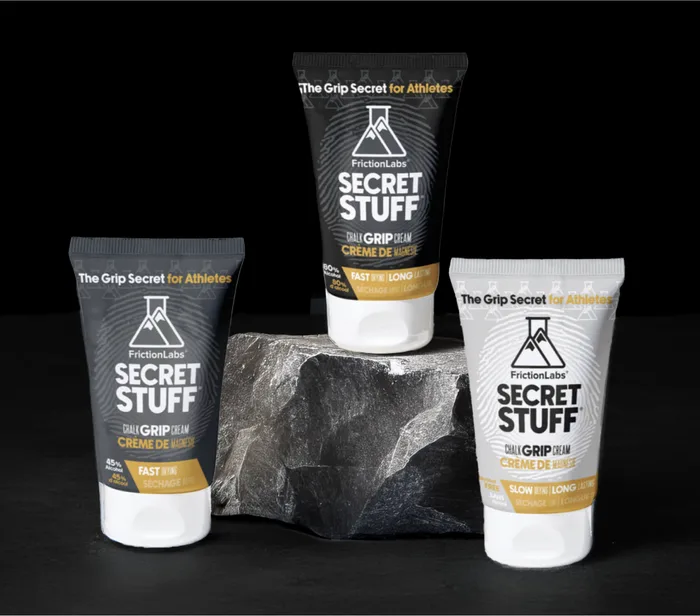
- Friction Labs Secret Stuff Liquid Chalk - Buy. The chalk that works under every gym policy we checked, and one of the few liquids that tells you exactly how much alcohol is in the tube.
- Metolius Super Chalk - Buy. The plain, well-documented magnesium carbonate that makes it hard to justify paying several times more for the same mineral.
- Black Diamond Eco Gold Refillable Chalk Shot - It depends. A refillable chalk ball that keeps your bag clean, as long as you are not buying it believing it protects the air.
- Friction Labs Loose Chalk (Unicorn Dust, Gorilla Grip, Bam Bam) - Skip. Pleasant chalk sold at a steep premium on purity claims the company has not published the test data for.
The verdict in 30 seconds
What mattered most
- Form
- Stated composition
- Drying agent or carrier
- Added scent
- Package sizes
- Usable where loose chalk is banned
Climbing chalk is magnesium carbonate, and past a certain point one bag of it is very much like another. What genuinely differs is the form it comes in, because that is what decides whether you can use it at your gym, how much dust you put in the air, and how your skin holds up over a season. So this comparison spends less time on brand claims and more time on form factor, published composition, and the gym rules that quietly make the decision for you. Four products, four different ways of getting the same mineral onto your hands.
The chalk that works under every gym policy we checked, and one of the few liquids that tells you exactly how much alcohol is in the tube.
Best for: Anyone whose gym restricts loose chalk, or who wants one product that is accepted everywhere they climb.
- Sold in three formulas the listing names by alcohol content: 45 percent isopropyl, 80 percent ethyl, and a 0 percent alcohol gel.
- Liquid chalk is the form with the strongest published evidence for cutting airborne dust in a climbing gym.
- The alcohol-free gel gives dry-skinned climbers a way to comply with a liquid-only policy without stripping their hands.
- Friction Labs does not publish the tube volume or a full ingredient list on the product page.
- The alcohol formulas pull moisture out of skin, so most climbers use them as a base layer rather than for a whole session.
- Costs noticeably more per application than loose magnesium carbonate from a bag.
- The germ-killing claim on the 80 percent version is about hygiene, not grip, and is easy to misread as a performance benefit.
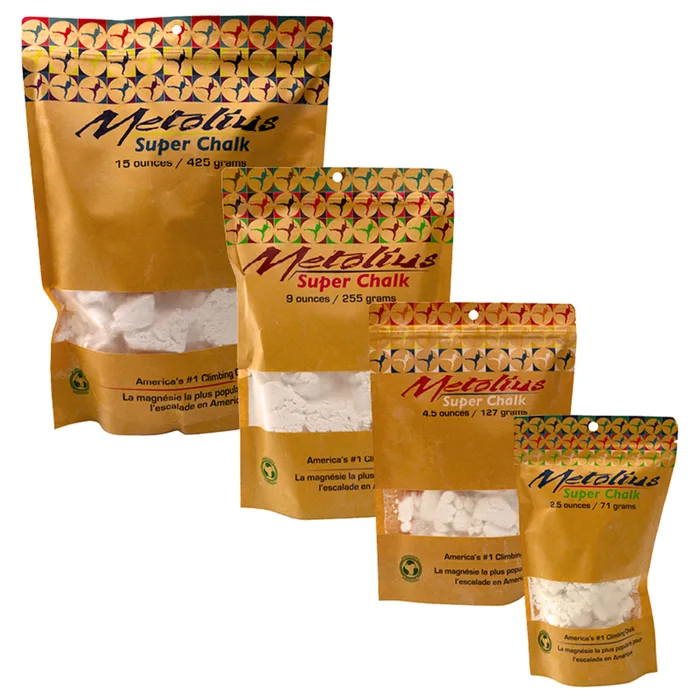
The plain, well-documented magnesium carbonate that makes it hard to justify paying several times more for the same mineral.
Best for: Climbers whose gym still allows loose chalk and who would rather buy in bulk than pay for a brand story.
- Spec panel lists it as 100 percent magnesium carbonate with no additives named.
- Bags in 2.5 oz (70 g), 4.5 oz (127 g), 9 oz (255 g) and 15 oz (425 g), plus 3 lb and 6 lb buckets and a 12 lb box.
- The bulk sizes make it cheap to keep a chalk bag, a home board and a crag bucket all topped up.
- Loose powder, so it is the first form a gym restricts when it tightens its chalk policy.
- Metolius calls it the number one selling brand of climbing chalk in America without publishing data behind that.
- One grind only, with no chunky or ultra-fine option listed.
- The panel gives composition but no purity assay or particle-size figure.
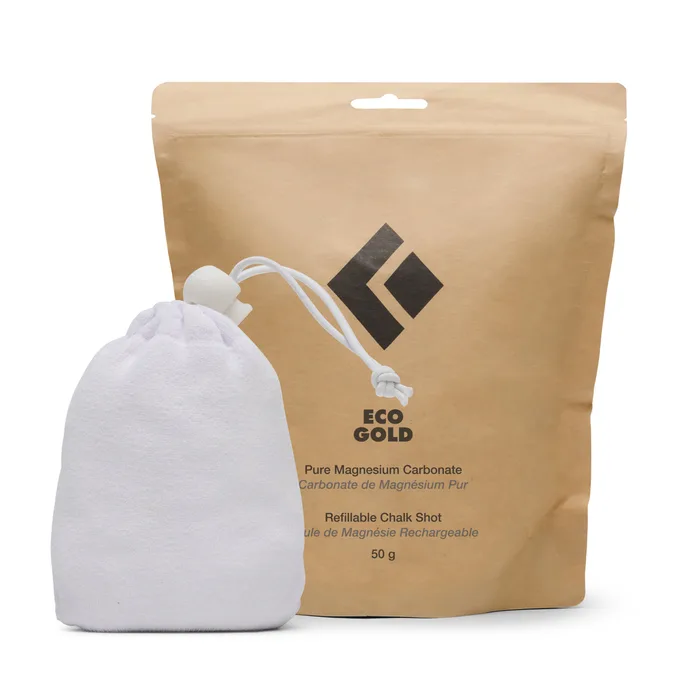
A refillable chalk ball that keeps your bag clean, as long as you are not buying it believing it protects the air.
Best for: Climbers at a gym that specifically mandates a ball, or anyone who hates spills and will actually refill it.
- A 50 g refillable ball listed as 100 percent magnesium carbonate, country of origin Bulgaria.
- Black Diamond states the magnesium carbonate is recovered as a byproduct of desalination rather than mined.
- Refillable construction and a biodegradable bag mean you are not throwing out a sealed sock every few months.
- Peer-reviewed gym measurements found chalk balls did not significantly reduce airborne particle mass compared with plain powder.
- Black Diamond's own copy calls Eco Gold chalk dust-free, which is difficult to square with a powder.
- 50 g is a small quantity if you climb several times a week.
- A ball meters chalk slowly, which annoys climbers who want a heavy coat fast.
Amazon had no buyable listing for this when we last checked. The link still works if it returns.
Check price on Amazon Read our detailed assessment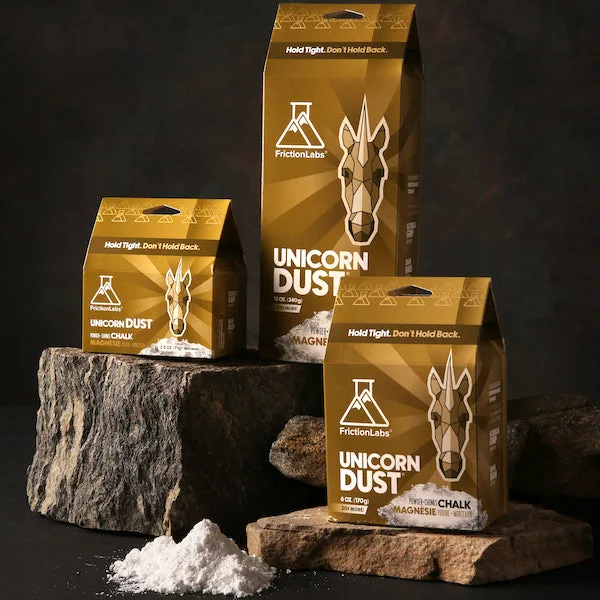
Pleasant chalk sold at a steep premium on purity claims the company has not published the test data for.
Best for: Climbers who have already used cheap chalk for years, know they want a specific chunk size, and do not mind paying for it.
- Three clearly defined textures: Unicorn Dust is powder plus chunks, Gorilla Grip is chunky, Bam Bam is super chunky.
- Sold in 2.5 oz, 6 oz and 12 oz recyclable boxes, made in Colorado.
- A three-texture sample pack exists if you want to find out which grind you prefer.
- The company's own FAQ says all three blends deliver the same grip and that the choice is texture preference.
- Its claim that rival chalks contain impurities, drying agents, heavy metals and fillers is not backed by published test data.
- It is loose powder, so it is restricted at exactly the same gyms as the cheap loose chalk.
- The published research disagrees on whether chalk improves friction at all, which weakens any brand-level performance claim.
| Criteria | Secret Stuff Liquid Chalk Top pick | Super Chalk | Eco Gold Refillable Chalk Shot | Loose Chalk (Unicorn Dust, Gorilla Grip, Bam Bam) |
|---|---|---|---|---|
| Verdict | Buy it | Buy it | It depends | Skip it |
| Best for | Anyone whose gym restricts loose chalk, or who wants one product that is accepted everywhere they climb. | Climbers whose gym still allows loose chalk and who would rather buy in bulk than pay for a brand story. | Climbers at a gym that specifically mandates a ball, or anyone who hates spills and will actually refill it. | Climbers who have already used cheap chalk for years, know they want a specific chunk size, and do not mind paying for it. |
| Price tier | $$ · mid-range | $ · budget | $ · budget | $$$ · premium |
| Form | Liquid | Loose powder | Chalk ball, refillable | Loose powder |
| Stated composition | Magnesium carbonate in an alcohol or gel base | 100% magnesium carbonate | 100% magnesium carbonate | Magnesium carbonate, purity not published |
| Drying agent or carrier | 45% isopropyl, 80% ethyl, or 0% alcohol gel | None listed | None listed | None listed |
| Added scent | None listed | None listed | None listed | None listed |
| Package sizes | One tube size per formula, volume not published | 2.5, 4.5, 9 and 15 oz bags; 3 and 6 lb buckets; 12 lb box | 50 g ball | 2.5, 6 and 12 oz boxes |
| Usable where loose chalk is banned | Yes, liquid is the usual exception | No | Usually, balls are the other common exception | No |
| Refillable or reusable | No, single tube | Not applicable, bulk powder | Yes, refillable ball | Not applicable, bulk powder |
| Texture options | Not applicable | One grind listed | Not applicable | Three grinds |
Which one is right for you?
- Anyone whose gym restricts loose chalk, or who wants one product that is accepted everywhere they climb. Buy it Friction Labs Secret Stuff Liquid Chalk
- Climbers whose gym still allows loose chalk and who would rather buy in bulk than pay for a brand story. Buy it Metolius Super Chalk
- Climbers at a gym that specifically mandates a ball, or anyone who hates spills and will actually refill it. It depends Black Diamond Eco Gold Refillable Chalk Shot
- Climbers who have already used cheap chalk for years, know they want a specific chunk size, and do not mind paying for it. Skip it Friction Labs Loose Chalk (Unicorn Dust, Gorilla Grip, Bam Bam)
How we judged the field
Five things decide whether a chalk is right for you, and brand is not one of them. First, form: loose, block, ball or liquid, because that is what determines where you can legally use it. Second, what the manufacturer actually states about composition, since climbing chalk is magnesium carbonate and any brand that will not put a composition on the page is asking for trust it has not earned. Third, whether there is a drying agent or a carrier, which for liquid chalk means alcohol and for your skin means a real trade-off. Fourth, package sizes, because the cost difference between a boutique 2.5 oz box and a bulk bucket is the largest number in this category. Fifth, gym policy compatibility, which is the constraint most buyers discover after they have already bought.
The field splits cleanly by form rather than by quality. Loose powder is the default and the cheapest, block chalk is the same mineral pressed, chalk balls are powder in a permeable sock, and liquid chalk is magnesium carbonate suspended in alcohol or gel. Differences between reputable brands inside any one of those groups are small, and we found no published head-to-head testing that establishes a meaningful performance gap. So we picked one strong example of the forms that matter most: a well-documented liquid, a bulk loose chalk, a refillable ball, and a premium loose chalk that shows what you get and do not get when you pay several times the going rate.
Friction Labs Secret Stuff Liquid Chalk
Buy itSecret Stuff earns the top spot for what it solves rather than what it adds. Liquid chalk is magnesium carbonate carried in alcohol or gel: you rub in a small amount, it flashes off in about ten seconds, and what remains is a thin bonded film instead of a cloud. That matters because it is the form with the strongest published evidence behind it. A 2012 study that measured seven different chalk-use scenarios inside climbing gyms found an ethanol suspension brought airborne particle mass down to roughly the same level as banning chalk entirely, while block chalk, sieved chalk and chalk balls did not. Friction Labs also does something most brands skip: it names the alcohol. Original is 45 percent isopropyl, Hygienic is 80 percent ethyl, and there is a 0 percent alcohol gel for people whose skin splits in winter. The tube volume and a full ingredient list are still absent from the listing, which is a fair complaint for a premium product. For anyone juggling gym rules and skin, it is the safest single purchase here.
Metolius Super Chalk
Buy itSuper Chalk is the value pick and the honest baseline against which everything else should be judged. The spec panel lists it as 100 percent magnesium carbonate with no additives named, and the size ladder is the real argument for it: 2.5 oz (70 g), 4.5 oz (127 g), 9 oz (255 g) and 15 oz (425 g) bags, plus 3 lb and 6 lb buckets and a 12 lb box aimed at gyms and home walls. That range lets you keep a small bag in the pack, a bucket by the board, and stop thinking about chalk. Texture is a single grind, so if you have already decided you want big chunks or ultra-fine powder you will be looking elsewhere. Metolius calls it the number one selling brand of climbing chalk in America, a marketing claim with no published data behind it, and the panel gives composition without a purity assay. None of that changes the part that matters: this is the same mineral the expensive brands sell, in a much bigger bag.
Black Diamond Eco Gold Refillable Chalk Shot
It dependsThe Eco Gold Refillable Chalk Shot is a 50 g ball listed as 100 percent magnesium carbonate, country of origin Bulgaria, packed in a biodegradable bag, and Black Diamond states the mineral is recovered as a byproduct of desalination rather than mined. As a chalk ball it does the tidy-bag job well, and the refillable design means you are not binning a sealed sock every couple of months. It lands on depends because of the reason most people buy a ball in the first place. Gyms hand down ball-only rules on air-quality grounds, but the 2012 gym measurements found balls produced no significant reduction in airborne particle mass compared with plain powder, and the authors wrote that promoting them as an exposure-reduction measure was not supported by their results. Black Diamond’s copy for this product also calls Eco Gold chalk dust-free, which is an odd thing to say about a powder. Buy this because your gym requires a ball or because you hate spills, not because you believe it is cleaning the air.
Friction Labs Loose Chalk (Unicorn Dust, Gorilla Grip, Bam Bam)
Skip itFriction Labs loose chalk is genuinely nice to use and still the one to skip. It comes in three well-defined textures, Unicorn Dust as powder plus chunks, Gorilla Grip as chunky and Bam Bam as super chunky, sold in 2.5 oz, 6 oz and 12 oz recyclable boxes made in Colorado. The problem is the gap between the premium and the evidence. The company’s own FAQ says all three blends deliver the same grip and that choosing between them is texture preference, which is a fair admission and also removes the performance argument. Its central claim, that rival chalks contain impurities, drying agents, heavy metals and fillers when tested, comes without published test data anyone can read. Behind all of it sits a literature that cannot agree whether chalk improves friction at all: one lab study found a decrease, another a clear increase, a third no difference in friction but longer hangs. Pay the premium only if you already know which chunk size you want.
Sources
Specs in this review come from these pages.
- Weinbruch et al., Dust exposure in indoor climbing halls, Journal of Environmental Monitoring (2008) (pubmed.ncbi.nlm.nih.gov)
- Weinbruch et al., Reducing dust exposure in indoor climbing gyms, Journal of Environmental Monitoring (2012) (pubmed.ncbi.nlm.nih.gov)
- Li, Margetts and Fowler, Use of chalk in rock climbing: sine qua non or myth?, Journal of Sports Sciences (2001) (pubmed.ncbi.nlm.nih.gov)
- Amca et al., The effect of chalk on the finger-hold friction coefficient in rock climbing, Sports Biomechanics (2012) (pubmed.ncbi.nlm.nih.gov)
- Kilgas et al., The Effect of Magnesium Carbonate (Chalk) on Geometric Entropy, Force, and Electromyography During Rock Climbing, Journal of Applied Biomechanics (2016) (pubmed.ncbi.nlm.nih.gov)
- Climbing Wall Association, Chalk Dust Mitigation and Source Control (cwapro.org)
Friction Labs Secret Stuff Liquid Chalk vs Metolius Super Chalk: which should you buy?
Secret Stuff and Super Chalk are not really competing for the same job, which is why we recommend both. Secret Stuff is the one that travels: it is accepted under the chalk policies we found, it produces very little airborne dust, and it doubles as a hand cleaner between problems. Super Chalk is what you use when nobody is stopping you, and it is dramatically cheaper per gram in the bulk sizes. A lot of climbers end up running both, liquid as a morning base layer and loose powder for top-ups, which is exactly the pattern the dust research would predict is sensible.
Choose Secret Stuff first if you climb mostly indoors, if your gym has any restriction on loose chalk, or if you share a car and a rope bag with people who resent chalk dust in everything. Choose Super Chalk first if you climb mostly outdoors or at a gym with no chalk policy, if you refill a chalk bag often, or if you simply want the largest amount of magnesium carbonate for the smallest outlay. If your skin cracks in winter, take the alcohol-free version of the liquid and keep the loose chalk for warmer months.
What to look for
- Check your gym’s policy first: it decides the form factor for you, and a bag of loose chalk you cannot use indoors is money wasted.
- Look for a stated composition: reputable brands print magnesium carbonate on the spec panel, and a page that says nothing about what is inside is telling you something.
- Treat texture as preference, not performance: chunky, fine and blended grinds feel different in the hand, and no published testing shows one grips better than another.
- Buy the bulk size if loose chalk is allowed: the price per gram gap between a boutique box and a bucket is the biggest number in this category.
- Match the alcohol content to your skin: 45 and 80 percent formulas dry hands hard, so look for an alcohol-free gel if yours already splits.
- Be sceptical of dust-free claims on powder: measurements in real climbing gyms show loose chalk in any grind, including balls and blocks, keeps particles in the air.
Our final take
Buy the form, not the brand. Climbing chalk is magnesium carbonate, the reputable brands are selling the same mineral, and the published research cannot even agree on whether chalk raises friction or lowers it. What it does reliably is manage sweat, and what varies between products is where you are allowed to use them and what they do to your skin. So get a liquid chalk you can use anywhere, keep a cheap bulk bag of loose powder for the days your gym does not care, and put the money you saved into a hand cream and a decent brush. If a chalk is asking for a large premium on purity claims it has not published, that is the one to leave on the shelf.
Questions, answered
Does chalk actually improve grip, or is that just what climbers believe?
The evidence is genuinely mixed, which surprises most climbers. A 2001 study in the Journal of Sports Sciences tested chalked and unchalked fingertips against sandstone, granite and slate and found chalk decreased the coefficient of friction, arguing that magnesium carbonate dries skin until it is less compliant and leaves a slippery granular layer. A 2012 Sports Biomechanics study using a tilting hangboard reached the opposite conclusion, reporting a significant increase in friction coefficient of 18.7 percent on limestone and 21.6 percent on sandstone. A 2016 Journal of Applied Biomechanics study split the difference: no measurable change in friction coefficient, muscle activity or body position, but climbers hung on for longer with chalk, 62.9 seconds against 49.3 seconds. The practical reading is that chalk clearly manages sweat, and the friction benefit is real for some climbers on some rock but is not the large, settled effect the marketing implies.
My gym says no loose chalk. What am I actually allowed to use?
In practice, liquid chalk or a chalk ball, and the policy is common enough that the Climbing Wall Association has published guidance on it for gym operators. Their write-up notes that many facilities ask members not to use loose chalk and to use chalk balls or liquid chalk instead. The awkward part is that only one of those two options is supported by measurement. A 2012 study that tested seven different chalk-use scenarios inside climbing gyms found that a suspension of magnesium carbonate in ethanol, which is what liquid chalk is, produced airborne particle mass similar to prohibiting chalk entirely. Block chalk, plain powder, chalk sieved to 2 to 4 mm and chalk balls all failed to significantly reduce dust. So check whether your gym requires a ball specifically or simply bans loose chalk, because if liquid is permitted it is the option that actually does what the policy is trying to do.
Is climbing chalk the same stuff as blackboard chalk?
No, and the difference is not cosmetic. Climbing chalk is a magnesium compound, and when researchers put airborne particles from climbing gyms under a scanning electron microscope with X-ray microanalysis they found virtually all of them were hydrated magnesium carbonate hydroxide, the material also sold as magnesia alba. Classroom and sidewalk chalk is calcium-based instead. Magnesium carbonate is used because it is a strong moisture absorber, which is the entire point: it is pulling sweat off your fingertips rather than adding a gritty layer that grips. That also explains why chalk does nothing useful for hands that are already bone dry, and why a climber with naturally dry skin often does better with less chalk rather than more.
Is breathing chalk dust in an indoor gym bad for me?
It is a real exposure, and the honest answer is that nobody has measured the health outcome. Researchers measuring nine indoor climbing halls found mean PM10 typically in the range of 200 to 500 micrograms per cubic metre, rising to between 1,000 and 4,000 during busy periods, with PM2.5 of 30 to 100 and peaks up to 500. For scale, the US ambient 24-hour standard for PM10 outdoors is 150 micrograms per cubic metre and 35 for PM2.5, though those are outdoor air standards rather than indoor occupational limits. Under US workplace rules magnesium carbonate is not listed by name and would fall under particulates not otherwise regulated, at 15 milligrams per cubic metre total and 5 respirable. The Climbing Wall Association's own coverage quotes a pulmonary physician saying there is no published data on the specific health effects of humans breathing in magnesium carbonate. Treat that as an open question, not a settled danger, and raise any breathing symptoms with a clinician rather than a chalk brand.
Why do people say liquid chalk dries out your hands, and how should you use it?
Because the carrier is usually alcohol. Friction Labs sells its liquid chalk in a 45 percent isopropyl version and an 80 percent ethyl version, and alcohol at those concentrations strips skin oils along with the sweat. That is why the common approach is to use liquid as a base layer at the start of a session, let it dry for roughly ten seconds, and then top up with loose chalk or a ball during the session rather than reapplying liquid over and over. If your skin is already splitting, look for an alcohol-free formula: Friction Labs sells a 0 percent alcohol gel version aimed at arid conditions and sensitive skin. Moisturising after a session matters more than which chalk you bought.
Deciding between the top two? See our head-to-head: Friction Labs Secret Stuff Liquid Chalk vs Metolius Super Chalk.
More Outdoors & Fitness reviews
 The Best Climbing Harnesses: 4 Compared (and One to Skip)
  The Best Rock Climbing Shoes: 4 Compared (and One to Skip)
  The Best Composters: 4 Compared (and One to Skip)
  The Best Hard Coolers of 2026: Value vs. Premium, and One to Skip
  The Best Cornhole Sets: 4 Compared (and One to Skip)
  The Best Dartboards: 4 Compared (and One to Skip)