

Outdoors & Fitness
The Best Climbing Harnesses: 4 Compared (and One to Skip)
We compared four current sit harnesses on the things that actually matter: EN 12277 certification, published weight, gear loop layout, leg loop adjustability, and what each maker says about wear and retirement.
The short version
The Petzl Adjama is our pick for most climbers who go outside, because it pairs DOUBLEBACK adjustable leg loops with five gear loops and a rear accessory loop at 385 g in size M. The Black Diamond Momentum is the value choice at 350 g with trakFIT adjustable leg loops, four gear loops and a haul loop, and it does the same job for a lot less. The Edelrid Ace suits the ice and alpine climber who wants light weight plus five gear loops and a red wear indicator woven into the waist belt strap, but its leg loops are fixed. We would skip the Black Diamond Zone: at 347 g it is no lighter than the Momentum, its leg loops do not adjust, and it costs far more. Whatever you buy, note the date of manufacture, because Petzl, Black Diamond and Edelrid all cap textile harness life at 10 years from that date. Best for: climbers who want an honest read on fit, adjustability and when a harness has to be retired.
Our picks at a glance
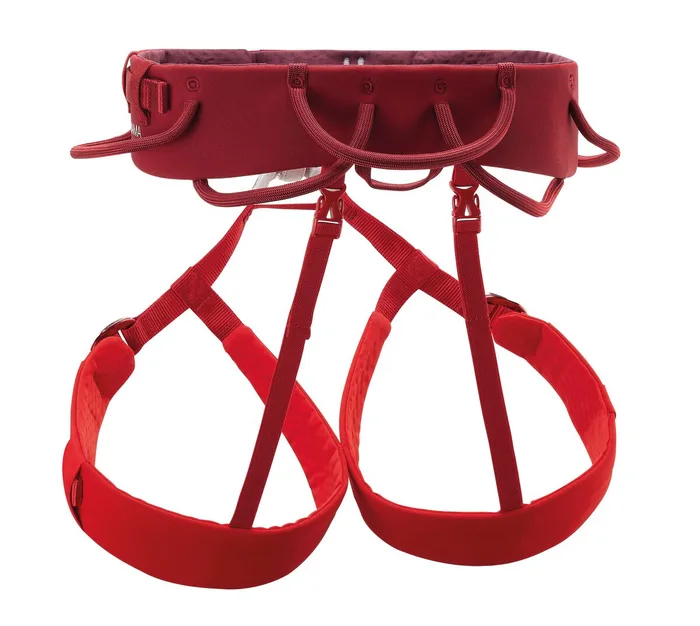
- Petzl Adjama - Buy. The all-round trad and multi-pitch harness that adjusts at the legs and racks a serious amount of gear.
- Black Diamond Momentum Harness - Buy. The cheapest harness here that still gives you adjustable leg loops, four gear loops and a haul loop.
- Edelrid Ace - It depends. A light, breathable harness with five gear loops and a built-in red wear indicator, held back by fixed leg loops.
- Black Diamond Zone Harness - Skip. A premium seamless sport harness that weighs the same as Black Diamond's own budget model and adjusts less.
The verdict in 30 seconds
What mattered most
- Certification
- Maker's stated weight
- Adjustable leg loops
- Gear loops
- Tie-in point wear indicator
- Belay loop
A climbing harness is life-safety equipment, and it is one of the few pieces of gear where the manufacturer tells you exactly when to throw it away. Almost every harness a recreational climber buys is an EN 12277 Type C sit harness, and the meaningful differences between them are fit, adjustability, how much gear they carry, and how the tie-in points are protected against rope wear. We pulled the specification sheets, instruction booklets and inspection procedures published by Petzl, Black Diamond and Edelrid and compared four harnesses on what those documents actually state. This article is not instruction: buying the right harness does not replace learning to tie in, check a partner, and inspect your own gear from someone qualified to teach it.
The all-round trad and multi-pitch harness that adjusts at the legs and racks a serious amount of gear.
Best for: Climbers who move between the crag, multi-pitch routes and cold weather on one harness.
- Certified CE EN 12277 Type C and UIAA, with the type printed on the harness label.
- DOUBLEBACK adjustable leg loops handle bare legs in summer and layers in winter.
- Five gear loops plus a rear accessory loop, and Petzl publishes weight for every size.
- At 385 g in size M it is heavier than a dedicated sport or alpine harness.
- Petzl does not list a wear indicator on the current Adjama tie-in points.
- No published belay loop strength rating, only the EN 12277 Type C certification.
- Waist range starts at 71 cm, so smaller climbers are pushed to other Petzl models.
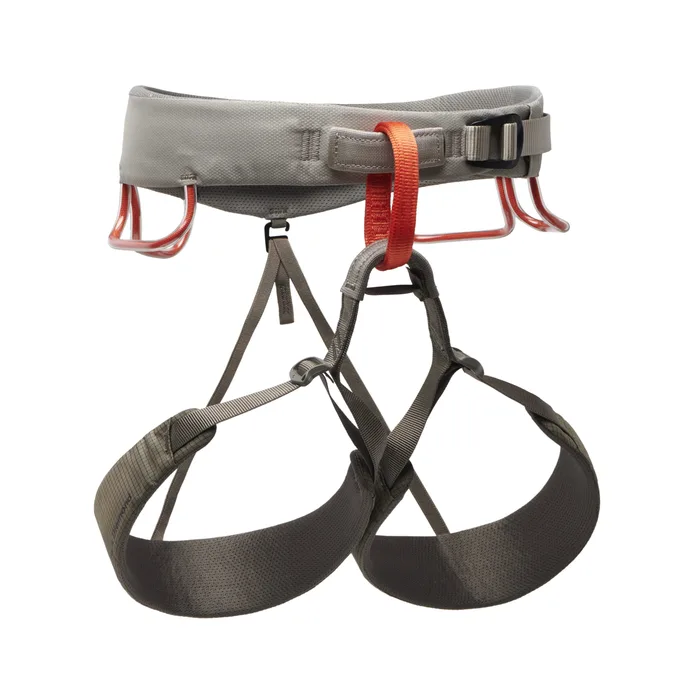
The cheapest harness here that still gives you adjustable leg loops, four gear loops and a haul loop.
Best for: A first harness, or a second harness for the gym, that you will not feel bad about retiring.
- Black Diamond's harness instructions certify it as an EN 12277:2015+A1:2018 Type C sit harness.
- trakFIT adjustable leg loops and a pre-threaded Speed Adjust waist buckle.
- 350 g listed weight and the widest size range in this group, XS to XXL.
- One fewer gear loop than the Adjama or the Ace, which shows on a full trad rack.
- Black Diamond publishes a single weight figure rather than a per-size table.
- No wear indicator in the tie-in points, so you are judging wear by eye.
- Two-year warranty, shorter than Petzl's three-year guarantee.
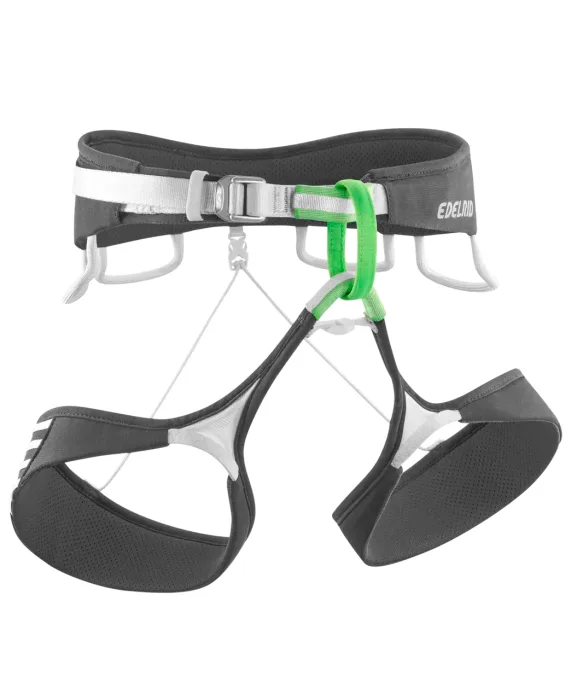
A light, breathable harness with five gear loops and a built-in red wear indicator, held back by fixed leg loops.
Best for: Ice and alpine climbers who climb in consistent layers and want the wear indicator.
- Certified EN 12277 Type C and UIAA 105, both listed on Edelrid's own specification panel.
- A red wear indicator is woven into the waist belt strap, and Edelrid says to retire the harness once it shows.
- 274 g in size M with five gear loops and two ice screw clip attachment points.
- Leg loops are not adjustable, so winter layers and body changes are a real problem.
- Sizing runs XS to L only, which leaves out larger climbers entirely.
- Minimal padding means less comfort on long hanging belays than a padded all-rounder.
- No published belay loop strength figure, only the EN 12277 Type C certification.
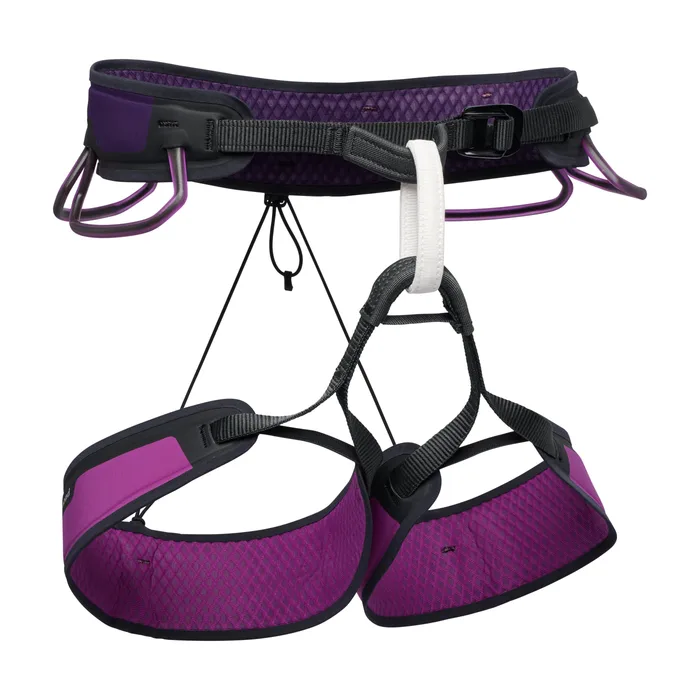
A premium seamless sport harness that weighs the same as Black Diamond's own budget model and adjusts less.
Best for: Only the sport climber who has tried one on, loves the seamless feel, and never climbs in layers.
- Seamless laminated construction with no stitching to catch or press on the hips.
- Patented seamless Dyneema Infinity belay loop that does not shift when you hang on it.
- Same EN 12277 Type C certification as every other harness in Black Diamond's line.
- 347 g against the Momentum's 350 g, so the premium buys you no weight saving.
- Black Diamond lists no leg loop adjustment, which rules it out for layered or cold weather climbing.
- Black Diamond does not publish a gear loop count for it.
- Size range is S to XL only, narrower than the Momentum's XS to XXL.
| Criteria | Adjama Top pick | Momentum Harness | Ace | Zone Harness |
|---|---|---|---|---|
| Verdict | Buy it | Buy it | It depends | Skip it |
| Best for | Climbers who move between the crag, multi-pitch routes and cold weather on one harness. | A first harness, or a second harness for the gym, that you will not feel bad about retiring. | Ice and alpine climbers who climb in consistent layers and want the wear indicator. | Only the sport climber who has tried one on, loves the seamless feel, and never climbs in layers. |
| Price tier | $$ · mid-range | $ · budget | $$ · mid-range | $$$ · premium |
| Certification | CE EN 12277 Type C, UIAA | EN 12277:2015+A1:2018 Type C | EN 12277 Type C, UIAA 105 | EN 12277:2015+A1:2018 Type C |
| Maker's stated weight | 385 g in size M | 350 g | 274 g in size M | 347 g |
| Adjustable leg loops | Yes, DOUBLEBACK buckles | Yes, trakFIT | No, elastic risers only | No |
| Gear loops | Five plus rear accessory loop | Four plus haul loop | Five plus two ice clip mounts | Count not published |
| Tie-in point wear indicator | Not listed | Not listed | Red indicator in waist belt strap | Not listed |
| Belay loop | Sewn loop, no rating published | Sewn loop, no rating published | Dyneema and polyamide central ring, no rating published | Seamless Dyneema Infinity loop, no rating published |
| Size range | S to XL, waist 71 to 100 cm | XS to XXL | XS to L | S to XL |
| Maker's stated lifespan | 10 years from manufacture | 10 years from manufacture | 10 years in use, 14 years unused | 10 years from manufacture |
Which one is right for you?
- Climbers who move between the crag, multi-pitch routes and cold weather on one harness. Buy it Petzl Adjama
- A first harness, or a second harness for the gym, that you will not feel bad about retiring. Buy it Black Diamond Momentum Harness
- Ice and alpine climbers who climb in consistent layers and want the wear indicator. It depends Edelrid Ace
- Only the sport climber who has tried one on, loves the seamless feel, and never climbs in layers. Skip it Black Diamond Zone Harness
How we judged the field
Five things decide whether a harness is right for you. First, certification: it should carry EN 12277 with the type printed on the label, and the CE mark with a four digit notified body number, because under the EU PPE Regulation that mark is what evidences compliance and a notified body has to be involved for equipment in this class. Second, fit and adjustability, because a harness that does not sit above your hip bones or that you cannot snug down is the wrong harness at any price. Third, the tie-in points and belay loop, which is where rope friction eats a harness and where any damage ends its life on the spot. Fourth, gear carrying, meaning how many loops there are and where they sit. Fifth, the maker’s published lifespan and retirement criteria, which are specific, written down, and ignored by most buyers.
The field splits three ways. All-round harnesses have adjustable leg loops, four or five gear loops and enough padding for hanging belays. Sport and performance harnesses drop the leg buckles and some padding to save weight and bulk. Alpine and ski harnesses go further still, with thin webbing and openable leg loops. We picked one strong all-rounder from Petzl, the value all-rounder from Black Diamond, a light performance harness from Edelrid that carries a genuinely useful wear indicator, and one premium sport harness that we think most people are better off not buying.
Petzl Adjama
Buy itPetzl lists the Adjama as CE EN 12277 Type C and UIAA, in four sizes from S to XL covering a 71 to 100 cm waist and 46 to 66 cm leg loops, at 370, 385, 410 and 435 g respectively. The gear carrying is the reason to buy it: two large rigid front loops for clipping quickdraws and cams, two flexible rear loops angled forward so they clear a pack, one large centre rear loop for belay station kit, and a rear accessory loop for a chalk bag or tag line. The leg loops adjust with DOUBLEBACK buckles, so the same harness works over shorts and over softshell pants. Petzl’s FRAME construction spreads load between waist belt and legs rather than concentrating it. The trade-off is weight and bulk: this is not the harness you take on a speed ascent, and Petzl does not list a wear indicator on the current version, so tie-in inspection is on you. For a climber with one harness and varied plans, it is the most complete option here.
Black Diamond Momentum Harness
Buy itThe Momentum is Black Diamond’s volume harness, and the reason to take it seriously is that it gives up very little. Black Diamond’s harness instruction sheet certifies its harnesses as EN 12277:2015+A1:2018 Type C sit harnesses, and the Momentum’s own listed weight is 350 g across a size range of XS to XXL, the widest here. You get trakFIT adjustable leg loops, a pre-threaded Speed Adjust waist buckle that removes the double-back step, four pressure-molded gear loops, an adjustable rear elastic riser, and a haul loop. Dual Core Construction puts webbing around the outside of the frame with a supportive centre insert, which is why it stays tolerable at a hanging belay. What you give up against the Adjama is one gear loop, a per-size weight table, and a year of warranty. The tie-in points have no wear indicator. If your budget is the binding constraint, or you want a second harness to leave in the gym bag, this is the one.
Edelrid Ace
It dependsThe Ace is Edelrid’s light performance harness, certified EN 12277 Type C and UIAA 105 on Edelrid’s own specification panel, at 237, 250, 274 and 285 g in sizes XS to L. The 3D Vent Lite construction uses polyester and Dyneema straps over a stable mesh, which breathes well and stays flexible without foam. It carries five gear loops plus two ice screw clip mounts, which is more racking capacity than most harnesses at this weight. The genuinely useful feature is the red wear indicator woven into the waist belt strap: Edelrid’s rule is that once excessive wear exposes the red fibres, the harness is finished. The tie-in points get an HMPE and polyamide abrasion protector. The catch is the leg loops, which do not adjust and only carry elastic risers, and the XS to L sizing. If you climb ice and alpine routes in consistent layers, that is a fair trade. If you are buying one harness to cover everything, it is not.
Black Diamond Zone Harness
Skip itThe Zone is a well-built harness that most people should not buy. Black Diamond builds it with seamless laminated construction, Contour Edge leg loops and waist band, injection overmolded gear loops, and their patented seamless Dyneema Infinity belay loop, which really does stop the belay loop twisting when you hang on it. It carries the same EN 12277 Type C certification as the rest of the line. The problem is what you pay for. Its listed weight is 347 g against the Momentum’s 350 g, so there is no weight saving at all. The leg loops do not adjust, which rules out layered and cold weather climbing. The size range is S to XL, narrower than the Momentum. Black Diamond describes large-capacity gear loops but does not publish a gear loop count for it. Unless you have tried it on and specifically want the seamless feel for redpoint burns, the Momentum does more for far less.
Sources
Specs in this review come from these pages.
- Edelrid - EN 12277 harness standard summary (PDF) (avs.edelrid.com)
- UIAA - Safety Standards, including UIAA 105 Harnesses (theuiaa.org)
- Black Diamond - Momentum Harness product page and harness instructions (blackdiamondequipment.com)
- Petzl - PPE inspection procedure, sport harnesses (PDF) (petzl.com)
- Edelrid - General instructions for use, harnesses to EN 12277 (PDF) (avs.edelrid.com)
- European Commission - Personal protective equipment (Regulation (EU) 2016/425) (single-market-economy.ec.europa.eu)
Petzl Adjama vs Black Diamond Momentum Harness: which should you buy?
The Adjama and the Momentum are the same kind of harness aimed at different budgets. Both are EN 12277 Type C, both have adjustable leg loops, both are comfortable enough to hang in. The Adjama gives you a fifth gear loop and a rear accessory loop, a per-size weight table so you know what you are actually carrying, a three-year guarantee against Black Diamond’s two, and a slightly more refined waist belt that spreads load better on long days. The Momentum gives you a haul loop, a pre-threaded waist buckle that is genuinely faster and harder to get wrong, and a size range that runs two sizes wider at both ends.
Choose on what you will do with it. If your plan involves trad, multi-pitch, or anything where you rack more than a dozen quickdraws, the Adjama’s extra loops earn their keep and you will notice the difference at a hanging belay. If you are mostly sport climbing, gym climbing, or top-roping, the Momentum does the same job and leaves money for shoes and a rope. Neither choice is a compromise on safety, because the certification and the retirement rules are identical. Try both on in a shop, hang in each one for a few minutes, and buy the one that does not press anywhere.
What to look for
- EN 12277 and the type: the label should state the standard and the type, and for adult sit harnesses that means Type C, with a CE mark and a four digit notified body number.
- Date of manufacture: it is on the label inside the waist belt, and it starts the clock on a lifespan that Petzl, Black Diamond and Edelrid all cap at 10 years for textiles.
- Adjustable leg loops: buckles at the legs let one harness work over shorts and over winter layers, and fixed loops only fit a narrow band of thigh sizes.
- Tie-in point protection: look for a sacrificial abrasion protector over the tie-in webbing, and better still a wear indicator that turns red when the harness is done.
- Gear loop layout: count them, but also check that the front pair are stiff enough to clip one-handed and the rear pair sit clear of a pack’s hip belt.
- Hang test before you commit: all three makers tell you to hang in the harness somewhere safe before use, because a size that feels fine standing up can pinch badly under load.
Our final take
Buy the Petzl Adjama if you want one harness that handles the crag, multi-pitch routes and cold weather, and the Black Diamond Momentum if you want most of that for a lot less. The Edelrid Ace is a smart pick for ice and alpine climbers who like the red wear indicator and can live with fixed leg loops. Skip the Black Diamond Zone, which asks premium money for no weight saving over the Momentum and less adjustability. Then do the part that matters more than the purchase: write down the date of manufacture, inspect the tie-in points and belay loop before every use, and get proper instruction from someone qualified. A harness is life-safety equipment, and no product here prevents injury on its own.
Questions, answered
What does EN 12277 Type C actually mean?
EN 12277 is the European standard for mountaineering harnesses, titled Mountaineering equipment - Harnesses - Safety requirements and test methods. It splits harnesses into four types. Type A is a full body harness that fits around the torso and thighs as a minimum. Type B is the same idea but rated for people weighing up to 40 kg, which is the children's category. Type C is the sit harness, a waist belt with leg loops that supports the body in a sitting position, and it is what almost every adult climber buys. Type D is a chest harness that fits around the chest and under the armpits, and Edelrid's summary of the standard is explicit that a Type D must only be used in combination with a Type C.
How long can I keep using a harness?
All three makers here publish a hard ceiling. Petzl states a maximum lifetime of up to 10 years from the date of manufacture for plastic and textile products. Black Diamond's harness instructions say to retire the harness when it fails inspection or when it reaches its maximum lifespan of 10 years after the date of manufacture, even if unused and properly stored, and that the clock runs from manufacture rather than from the date of sale. Edelrid publishes two numbers: a maximum useful life of 10 years given proper use and no detectable wear, and a maximum service life of 14 years with optimum storage and no use at all. Find the date on the label inside the waist belt before you buy.
When do I have to retire a harness immediately, regardless of age?
Petzl says to retire a product that has been subjected to a major fall or load, that fails inspection, that you have any doubt about, or whose full usage history you do not know. Black Diamond says to retire the harness after a serious fall or if you have any doubts about its dependability, and adds that if a harness needs disinfecting you should retire it rather than expose it to harsh chemicals. Edelrid lists damaged webbing edges or pulled fibres, visible damage or abrasion on the seams, melting burns, discolouration, strong furriness of the webbing, chemical contact, or a hard fall load with a fall factor above 1. Any damage to the tie-in points or the belay loop ends the harness. Retired gear should be destroyed so nobody uses it again.
What is a wear indicator and which harnesses have one?
It is a coloured thread built into the load-bearing webbing so that abrasion reveals it before the webbing is dangerously thin. Edelrid describes it as webbing with an internal wear indicator made of red polyester fibres, and says that when excessive wear makes the red thread visible the product should be replaced. Their harness manual is blunter: if red fibres become visible on the tie-in point abrasion protector, remove the harness from use. Petzl's inspection procedure for sport harnesses notes that certain models carry a red wear indicator on the lower tie-in point and that the harness should be retired if the indicator is visible. Not every harness has one, so on models without it you inspect the tie-in webbing yourself for holes, cut threads and fraying.
Do I need adjustable leg loops?
You do if the amount of clothing under the harness changes. Adjustable leg loops let you loosen for winter layers, a puffy or softshell, and tighten back down for a summer session in shorts. They also cover the case where your thighs and waist are not the same relative size as the maker assumed. Fixed leg loops save a little weight and remove two buckles, which is why sport and alpine racing harnesses use them, but they only fit a narrow band of leg circumferences. If you climb year round outdoors, or you are buying one harness to do everything, adjustable is the safer default. If you only ever climb indoors in the same clothes, fixed is fine.
Deciding between the top two? See our head-to-head: Petzl Adjama vs Black Diamond Momentum Harness.
More Outdoors & Fitness reviews
 The Best Rock Climbing Shoes: 4 Compared (and One to Skip)
  The Best Composters: 4 Compared (and One to Skip)
  The Best Hard Coolers of 2026: Value vs. Premium, and One to Skip
  The Best Cornhole Sets: 4 Compared (and One to Skip)
  The Best Dartboards: 4 Compared (and One to Skip)
  The Best Disc Golf Sets: 4 Compared (and One to Skip)