Explained
Office Storage Carts, Explained
After reading this you will know which of the two rolling storage formats your desk needs, and which three specs decide whether it still works in two years.
In this guide
Rolling office storage looks like one category and is really two. One format is a closed, lockable drawer unit that tucks under the desk; the other is an open tray cart that lives beside it. Almost every regret in this category traces back to two things: buying the wrong format for what you are storing, and never measuring the gap under the desk before ordering.
The 30-second version
- Height decides more than any other number. A unit either clears the underside of your desk or it becomes floor furniture, and listings rarely say which.
- Format follows contents. Open trays for things you grab hourly, closed drawers for things you file and forget.
- Drawer mechanism beats drawer count. Ball-bearing steel glides keep a loaded drawer usable; plastic sliding on plastic racks and sticks.
- Casters are where cheap units fail. Small press-in wheels are the most common complaint in the whole category, and at least two of them should lock.
- A lock is either essential or dead weight. Decide before you shop, because it is the single biggest driver of what you will pay.
The products this guide is about
Our verdict on each, with the full reasoning on the companion review.
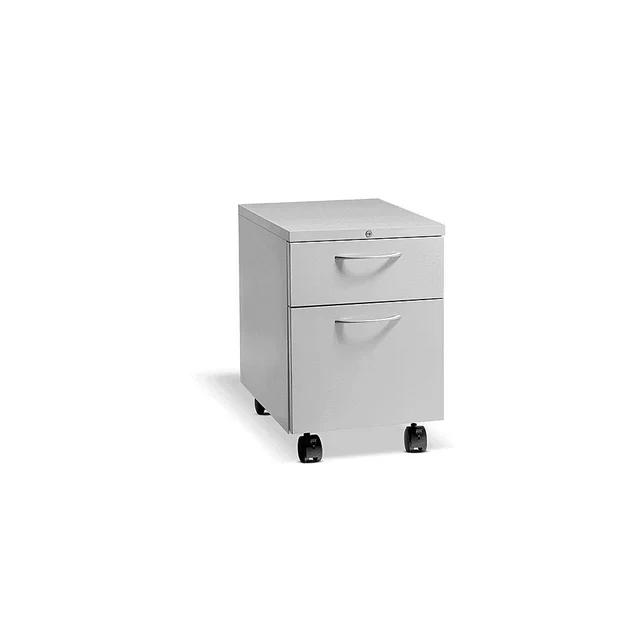
- Buy HON Flagship 2-Drawer Mobile Pedestal A commercial-grade steel pedestal that locks, rolls under a desk, and swallows letter files without complaint.
- Buy IKEA RÅSKOG Utility Cart The default answer for open, grab-it-fast desk overflow, and it has stayed the default for a decade for good reason.
- It depends Safco Onyx Mesh Mobile File Cart Three mesh drawers that take hanging folders on a cart light enough to carry, with all the compromises that implies. Amazon
- Skip Sterilite Wide 3 Drawer Cart Cheap, roomy, and the first thing in the room to sag, stick, and shed a caster. Amazon
What actually matters
- Under-desk clearance. Measure from the floor to the underside of the desk apron, then subtract about an inch for casters and carpet. If you use a sit-stand desk, measure at its lowest setting. Most fixed desks leave roughly two feet of clearance, which rules out anything taller than a short pedestal.
- Drawer suspension. This is the mechanism the drawer rides on. Ball-bearing steel glides stay smooth when a drawer is full of paper. Molded plastic channels feel fine empty and bind once loaded, especially on a floor that is not perfectly level.
- Casters and wheel stems. Wheel diameter decides whether the unit rolls over carpet and door thresholds or fights them. How the wheel attaches matters just as much: bolted or socketed stems stay put, press-in stems work loose and pop out under load.
- Security. Only closed steel units tend to lock, and most that do use a single lock core securing all drawers at once. Open trays, mesh drawers, and translucent plastic drawers hide nothing from anyone in the room or on a video call.
- Load rating and material. Paper is heavy, and a rating is only meaningful next to what you actually plan to store. Powder-coated or welded steel carries weight without flexing; molded plastic sags and racks, which is what turns a cheap unit into a stuck-drawer problem.
- Footprint versus dead space. A unit that tucks under the desk costs you no floor area at all. A beside-the-desk cart adds a real footprint, which is the deciding factor in a small room where the desk is already against a wall.
- Assembly reality. Some units arrive nearly built, some need full assembly where squaring the panels correctly determines whether the drawers bind later. If you dislike fiddly builds, favor the units that ship mostly assembled.
The specs, in plain English
Green flags vs red flags
Green flags
- The listing states an overall height, and that height leaves room under your desk with an inch to spare
- Drawer suspension is described specifically as ball-bearing or steel glide rather than just "smooth-gliding"
- At least two casters lock, and the wheels are a reasonable diameter rather than tiny hard nubs
- Steel construction, welded or powder-coated, on any unit expected to hold paper
- A meaningful warranty, especially one that covers the moving parts rather than just the finish
- Owner reports that span years rather than weeks, mentioning the unit still working rather than just arriving intact
Red flags
- The main selling point is drawer count or total volume, with nothing said about how the drawers move
- No overall height listed, or dimensions given only for the drawers
- Push-in caster stems, which show up repeatedly in owner complaints about wheels popping out on carpet
- Molded plastic frames marketed for office use, when the same product is sold elsewhere as closet storage
- "Lockable" claimed for a unit with open trays or a single flimsy latch that secures nothing
- Reviews clustering around stuck or binding drawers, which usually means the frame flexes under load
Who's who: the brands
- HON - Commercial office furniture maker; its steel pedestals are the reference point for lockable under-desk storage.
- IKEA - Best known here for a compact open steel utility cart, rated 40 lb in total, that has been the default beside-the-desk answer for over a decade.
- Safco - Office accessory specialist with a strong line of light mobile file carts, including mesh drawers that take hanging folders.
- Sterilite - Household plastics brand. Its rolling drawer carts are genuinely good closet and craft storage, and are frequently sold into office use they are not built for.
- Lorell - Value-focused office furniture line; steel pedestals at lower prices than contract brands, with more variation in glide quality.
- Vertiflex and similar cart specialists - Makers of light utility and file carts aimed at classrooms and shared offices, where portability matters more than security.
How to read a listing without getting fooled
Start at the dimensions, not the features. Find the overall height and compare it to the clearance you measured under your desk; if the listing does not publish a height, treat that as an answer in itself. Next, look for how the drawers move. Vague phrasing like "smooth-gliding drawers" usually means plastic channels, while ball-bearing suspension gets named explicitly because it costs more to build. Then check the casters: look for the number that lock and how the wheels attach, since press-in stems are a known weak point. Read the load rating against something real, because a rating that sounds generous stops sounding generous once you picture a drawer of paper. Be skeptical of drawer volume as a headline number; large drawers are cheap to mold and hard to make work under load. Finally, scan owner reports for what they say about the second year rather than the first week. Arrival condition tells you about packaging. Sticking drawers and lost wheels tell you about the design.
How much should you spend?
This category splits into three price bands, and the jumps between them buy specific things rather than general quality. The bottom band is plastic drawer carts and light utility carts. For supplies, cables, and anything you reach for constantly, that band is genuinely enough, and a good open steel cart from it can outlast units costing several times more. The middle band buys light steel file carts: hanging-file capability and easy portability, but rarely a lock and rarely under-desk height. The top band is commercial steel pedestals, and what the premium actually buys is three things, a lock, ball-bearing glides, and a height that tucks under the desk. That premium is worth paying if you handle documents you would not want a guest, housemate, or client to read, and it is worth nothing if the unit is holding chargers. The most expensive mistake is not buying cheap, it is buying the wrong format, since a pedestal bought for supplies leaves its file drawer empty and an open cart bought for paperwork leaves folders stacked on the desk anyway. If you are furnishing a desk for the first time and can only buy one thing, the cheaper open cart is the safer bet, because it fits more uses and stays useful after you add a pedestal later.
Questions, answered
How do I know if a cart will fit under my desk?
Measure from the floor to the underside of the desk apron, which is the frame or panel just below the desktop, not the desktop itself. Subtract about an inch so the unit clears without scraping. Fixed-height desks usually leave somewhere around two feet of clearance, which means anything taller than a short pedestal will not tuck. On a sit-stand desk, measure at the lowest setting you actually use, not the highest.
Do I really need a lock?
It depends entirely on the contents. Tax records, client contracts, medical paperwork, and anything with account numbers on it make a lock the difference between storage and security, and in practice that means a steel pedestal. If the unit is holding cables, notebooks, and stationery, a lock is dead weight and the money is better spent on wheels, capacity, or a second cart.
Are plastic rolling drawer carts ever the right choice?
Yes, for closets, craft rooms, and garages holding light bulky items. The problem in an office is load and geometry. A wide plastic drawer full of paper flexes, and with no steel runners the drawer racks in its opening and sticks, especially on an uneven floor. Owner reports across retailers also flag casters that pop out of their sockets. If you already own one and it works, keep it. Do not buy one expecting it to survive daily desk-side use.
What should I look for in the wheels?
Diameter and locking. Wheels under roughly an inch and a half fight carpet and catch on thresholds. How the wheel attaches matters just as much: bolted or socketed stems stay seated, press-fit stems work loose over time and are the most common failure in the category. Two locking casters is the practical minimum, because an unlocked unit rolls away the moment you lean on it.
Open cart or closed pedestal if I can only pick one?
Open cart if your work is mostly digital and the unit is holding tools and supplies you reach for constantly. Closed pedestal if paper still moves through your desk and you share the space with housemates, kids, or clients. The failure mode is predictable in both directions, so answer the contents question first and let the format follow.
Does a deep drawer automatically hold files?
No. A drawer can be deep enough for folders and still lack the rails they hang from, in which case folders slump forward and you lose most of the usable space. Look for the phrase hanging file compatible or a stated letter or legal size. Also check which paper size your files use, since a letter-width drawer will not take legal folders.
Or jump to the head-to-head: HON Flagship 2-Drawer Mobile Pedestal vs IKEA RÅSKOG Utility Cart.