Explained
Hydration Bladders, Explained
After reading, you'll understand which reservoir features actually control mould, taste and drying time, and which ones are marketing.
In this guide
First-time buyers shop hydration bladders on capacity and price, which are the two least interesting numbers on the page. What trips people up is that the failure they will actually experience is not a burst seam but a smell, and nothing on a typical listing tells you how hard the thing will be to wash. The vocabulary does not help either, since every brand has its own trademarked name for the same three or four ideas. Learn the four that matter and the listings become readable.
The 30-second version
- Cleanability beats capacity, because almost every reservoir that gets thrown away is thrown away over mould or taste, not leaks.
- A wide opening is only half of it, since a bag that collapses shut while it dries stays wet no matter how far it opened.
- A hose quick-disconnect is a cleaning feature, not a convenience feature, because without one most people never clean the tube.
- Antimicrobial additives protect the plastic, which is the basis of the US treated articles exemption, and is not the same as protecting your water.
- Freezing and drying are the whole routine, so a partly filled bladder in the freezer between trips beats any additive on the market.
The products this guide is about
Our verdict on each, with the full reasoning on the companion review.
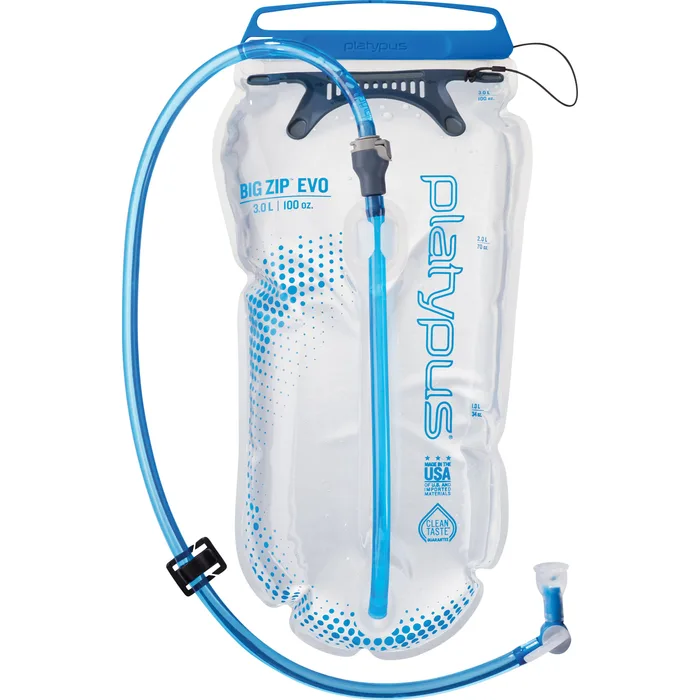
- Buy Platypus Big Zip EVO 3L Reservoir The most cleanable design here, with a full-width slide seal, a baffle that keeps the walls apart while it dries, and a hose that comes off high on the bag. Amazon
- Buy HydraPak Velocity 3L Reservoir The lightest way to solve the drying problem, because HydraPak says you can turn it fully inside out and put it on the dishwasher's top shelf. Amazon
- It depends Source Widepac Premium 3L Reservoir Light, slide-sealed and built around a low-maintenance promise that is either the best thing about it or the reason to walk away. Amazon
- Skip CamelBak Crux 3L Reservoir A well-built, well-supported reservoir whose only opening is a screw cap, which is exactly the wrong design if cleaning is what you care about. Amazon
What actually matters
- Fill opening type - The difference between a slide seal that exposes the entire top edge and a screw cap you reach through with a brush is the single biggest driver of how often you will actually clean the thing. Everything else about the bag is easier to live with than a bad opening.
- Drying structure - Something has to hold the two walls of the bag apart while air moves through it, whether that is a semi-rigid baffle, a slider used as a prop, or a reservoir that turns inside out. Without it, a rinsed bag is still a wet bag.
- Quick-disconnect with shutoff - A connector that lets the tube off a full reservoir without spilling means the tube gets brushed, and it also lets you swap in an insulated tube or an inline filter. Makers who put it high on the bag rather than at the bottom save you a wrestling match.
- Bite valve teardown - The valve lives in a shoulder-strap pocket picking up dust and sweat, so it needs to separate into a silicone sheath, a post and the on/off body. A valve moulded as one sealed lump is a valve you can only rinse.
- Dishwasher wording - This varies by brand, not by category. HydraPak states its reservoirs go on the top shelf fully reversed, Platypus directs you to hand wash, and CamelBak tells you to check your specific reservoir first, so read the actual sentence rather than assuming.
- Film material and taste - Reservoirs are made from polyurethane, polyethylene or thermoplastic polyurethane films, sometimes co-extruded in layers, and the polymer is what a taste-free claim rests on. It also gets overwhelmed by residue if the bag has been stored with liquid in it.
- Hanger compatibility - Reservoirs hang from a clip, hook or loop inside your pack's sleeve, and the makers list which pack brands their universal hanger works with. Getting this wrong means the bag slumps to the bottom of the sleeve and sits in its own dregs.
The specs, in plain English
Green flags vs red flags
Green flags
- The maker publishes a real cleaning and drying procedure with steps, not just a line saying wash before first use.
- The listing shows the top opening fully open, wide enough that a hand obviously fits.
- There is a named quick-disconnect on the tube and the description mentions an auto shutoff or leakproof separation.
- The bite valve is described as disassembling into parts, or replacement sheaths and posts are sold separately.
- The material statement is specific about the film and about BPA, BPS and phthalates rather than saying safe plastic.
Red flags
- The only stated fill opening is a cap, with no mention of how you are supposed to dry the inside.
- An antimicrobial is claimed to keep your water fresh or prevent mould, with no named technology and no test method.
- The brand sells a dedicated dryer or prop accessory that the reservoir clearly needs to function as advertised.
- The listing promises you will not need to clean it, which contradicts the advice most other makers in the category give.
- There is no stated weight, no stated dimensions and no material list, which usually means the listing was written from a photo.
Who's who: the brands
- CamelBak - The default name in the category, built around the Crux reservoir line, the Big Bite valve and a deep catalogue of replacement tubes, valves and cleaning accessories.
- HydraPak - Known for reservoirs that turn fully inside out, and its cleaning guide states outright that its reservoirs are dishwasher safe on the top shelf when fully reversed.
- Platypus - The Cascade Designs hydration brand, best known for the Big Zip slide-seal reservoirs and certified taste-free materials, with the 3L made in the USA of US and imported materials.
- Source - An Israeli maker whose Widepac slider closure, Glass-Like film and Grunge-Guard additive are built around a low-maintenance, low-cleaning pitch.
- Osprey - Sells its own Hydraulics reservoirs to fit its packs; check its product pages for the closure and connector details.
How to read a listing without getting fooled
Start at the bottom of the listing, not the top. Find the stated weight, the stated dimensions and the material line, because a listing that has all three was written from a spec sheet and a listing that has none was written from a photograph. Then look for the four words that matter: how the top closes, whether anything holds it open, whether the tube disconnects, and whether the valve comes apart. Trademarked names are not obstacles here, since SlideLock, Slide-Seal and Widepac closure are the same idea and Plug-N-Play, Quicklink and SQC are the same idea. Finally, go and find the brand's cleaning page rather than the product page, because that is where the honest information lives: it will tell you whether a dishwasher is allowed, what temperature the film tolerates, and how many accessories the design quietly assumes you own.
How much should you spend?
Budget reservoirs generally get you the capacity and a working bite valve, and that is where the design compromises show up, usually as a cap-only opening and no way to separate the tube. Mid-range is where the category gets genuinely good: a wide or slide-seal opening, a quick-disconnect with a shutoff, a lockable valve and a published cleaning procedure are all available at this tier, and this is where most people should shop. Premium buys structure and materials rather than more features, meaning stiffer baffles and backer plates, certified taste-free films with explicit BPA, BPS and phthalate statements, and in some cases domestic manufacturing. The thing worth noticing is that price does not track cleanability: some of the more expensive reservoirs in this category are the harder ones to dry, and one of the easiest to clean sits in the middle of the range. Budget separately for a tube brush, because you will want one regardless of what you buy.
Questions, answered
How often should I clean a hydration bladder?
Rinse and dry after every use with plain water, and do a full soapy clean any time you have carried anything other than water. CamelBak's guidance is to clean more thoroughly after flavoured or electrolyte drinks, before long storage, or whenever you notice a taste, odour or residue. Sugar is the accelerant, so a single ride with sports mix left in overnight can undo months of good habits.
What size reservoir should I get?
Three litres is the default for a full day of hiking or riding and is the size most packs are built around, which is why we compared 3L versions here. Two litres is plenty for shorter outings and sits flatter in a small pack. Bear in mind that a bigger bag is a bigger surface to dry, so if you routinely only fill it halfway you are cleaning more bladder than you need.
Can I put sports drink or electrolytes in a bladder?
Yes, but the cleaning obligation changes immediately. Makers across the category single out flavoured and electrolyte drinks as the thing that leaves residue in places you overlook, and Source suggests lemon juice as a natural alternative to chemical cleaners. If you use mix often, a reservoir with a fully opening top and a detachable tube stops being a luxury. Many people keep one bag for water and one for mix for exactly this reason.
Is it worth buying the brand's own cleaning kit?
A tube brush is worth owning no matter what you buy, since there is no other way to reach inside a narrow drink tube. A full kit with a reservoir brush, tablets and a dryer is worth it if your reservoir's design genuinely requires it, which is mostly the cap-only designs. If you find yourself needing three accessories to keep a bag from smelling, that is a signal about the bag rather than about your cleaning technique.
Or jump to the head-to-head: Platypus Big Zip EVO 3L Reservoir vs HydraPak Velocity 3L Reservoir.