Explained
Ice Melt, Explained
After reading, you'll understand how to read an ice melt page for its ingredient, temperature rating, pet and concrete claims, and coverage.
In this guide
Ice melt bags lead with friendly names and colors, but the useful facts are on the product page and safety data sheet. First-time buyers often compare bag weight and miss that two products can behave very differently in the cold. Others assume a pet-friendly label means harmless. A few minutes with the spec lines saves a lot of repeat spreading.
The 30-second version
- Read the ingredient first, because sodium, calcium and magnesium chloride are not interchangeable.
- Treat the stated temperature as a ceiling, since a product listed at 25F will not help on a single-digit morning.
- Pet-friendly is a comparison, and the page usually says safer than plain salt rather than harmless.
- Silence on concrete is not safety, so check the label and safety data sheet.
- Look for a coverage figure, since it tells you how many jugs or bags the job takes.
The products this guide is about
Our verdict on each, with the full reasoning on the companion review.
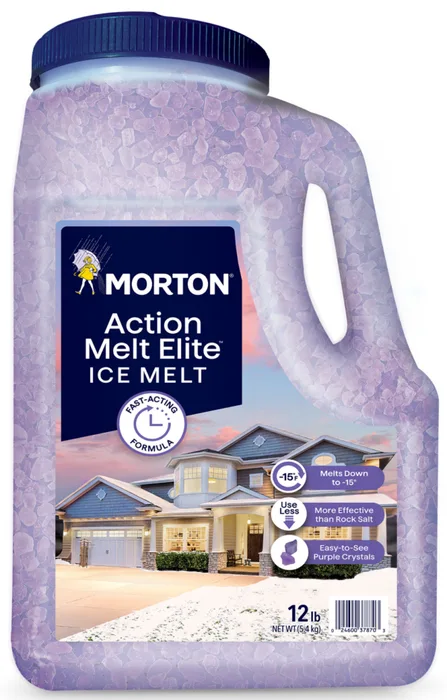
- Buy Morton Action Melt Elite Ice Melt A purple-dyed three-ingredient blend that Morton rates to -15F and lists with a stated coverage figure.
- Buy Scotwood Industries Road Runner Ice Melt A blend of calcium chloride, magnesium chloride and sodium chloride that names every ingredient and rates to -15F.
- It depends Morton Safe-T-Pet Ice Melt Morton's salt- and chloride-free melter with a veterinarian-recommended claim, rated to 10F.
- Skip Scotwood Industries Scotwood De-Icing Salt Plain sodium chloride rock salt that its own page says works best in milder winters.
What actually matters
- Active ingredient - This is the chemical doing the melting. A page that names it lets you compare products honestly.
- Stated temperature - This is the lowest temperature the maker says the product works to. Below it, expect little help.
- Pet claim - Look at the exact wording. Safer than plain salt is a narrower statement than pet safe.
- Concrete statement - Some pages say nothing. That leaves you with the label and safety data sheet.
- Coverage rate - A square footage per jug or bag figure lets you budget quantity. Without it you are estimating.
- Pack size - Jugs are easy to carry and bags and pails are better for large areas. Choose by the area you clear.
- Safety data sheet - The maker links it from the product page, and it is where ingredients are usually listed in full.
The specs, in plain English
Green flags vs red flags
Green flags
- The page names the active ingredients.
- A lowest temperature is printed and fits your climate.
- A coverage figure is given in square feet.
- Pet claims are worded with a clear comparison.
- A safety data sheet is linked.
Red flags
- No ingredient is named anywhere on the page.
- The only stated temperature is warm, such as 25F.
- The page says it works best in milder conditions.
- There is no coverage figure and no guidance on amount.
- A pet-safe claim appears with no supporting detail.
Who's who: the brands
- Morton Salt - Sells Safe-T-Salt Rock Salt, Safe-T-Pet and Action Melt Elite in its home ice melt range.
- Scotwood Industries - Lists 15 packaged ice and snow melt products on its site, from De-Icing Salt to magnesium chloride pellets.
- Road Runner - Scotwood's own line, including Ice Melt, Ice Melt BP and Pet Friendly.
- Scotts Eco-Blend - Listed on Scotwood's packaged page with a note that it is eco-friendly compared to traditional salt when used as directed.
How to read a listing without getting fooled
Open the product page, not just the bag front. Find the ingredient line, then the stated temperature, then any pet or plant statement and note whether it compares to plain salt. Check for a coverage figure and see how it is worded as approximate or exact. Last, open the safety data sheet link. If a page leaves a line blank, treat that as unknown rather than good.
How much should you spend?
Plain rock salt sits at the budget tier, blends with stated low-temperature ratings land in the middle, and small pet-focused jugs tend to be the premium tier. Cost per treated square foot matters more than cost per bag, which is why a printed coverage figure helps. Buying larger bags or a pail usually lowers cost for big areas, while a small jug makes sense for a short walk.
Questions, answered
Can I mix ice melts?
The product pages here do not address mixing. A blend is made by the maker in a set formula, and mixing at home changes that. If you want a different behavior, pick a different product rather than combining them. Check the label if you have leftover product from another brand.
Should I shovel before spreading?
Makers describe these products as melting ice and snow, and a thinner layer gives the product less to work through. Clearing loose snow first is a common sense step that cuts the amount you need. Follow the label for application directions on your specific product.
Why does the same product say different numbers in different places?
Marketing text, image captions and spec lines can disagree. For example, Morton's Action Melt Elite page gives about 355 square feet in copy and 365 in image text. When numbers clash, trust the copy and the safety data sheet, and treat any figure as approximate.
Is a pet-friendly melter safe to eat?
No product page here says so. Morton's claim is that Safe-T-Pet is safer than plain salt and less irritating to paws, not that it is safe to ingest. If a pet eats ice melt, contact a veterinarian. Store bags and jugs where pets and children cannot reach them.
Or jump to the head-to-head: Morton Action Melt Elite Ice Melt vs Scotwood Industries Road Runner Ice Melt.