Explained
Dollhouses, Explained
After reading, you'll understand how to read a dollhouse listing and which specs decide whether it fits your child and your room.
In this guide
Dollhouse listings mix marketing with a few useful numbers. First-time buyers often miss that furniture and dolls may be sold separately, that scale decides what fits, and that an age grade of 3 and up usually comes with a small-parts warning. The product photo can also hide how big the house really is.
The 30-second version
- Read the age and warning text, because a 3 and up grade can come with a choking hazard statement.
- Use listed dimensions, not photos, since the same house can look larger or smaller depending on the shot.
- Check what is in the box, as some houses include furniture and others are an empty shell.
- Match scale to the dolls you own, because a house made for 12 inch dolls will not suit tiny figures.
- Expect assembly, and look for a stated time or instructions before you commit.
The products this guide is about
Our verdict on each, with the full reasoning on the companion review.
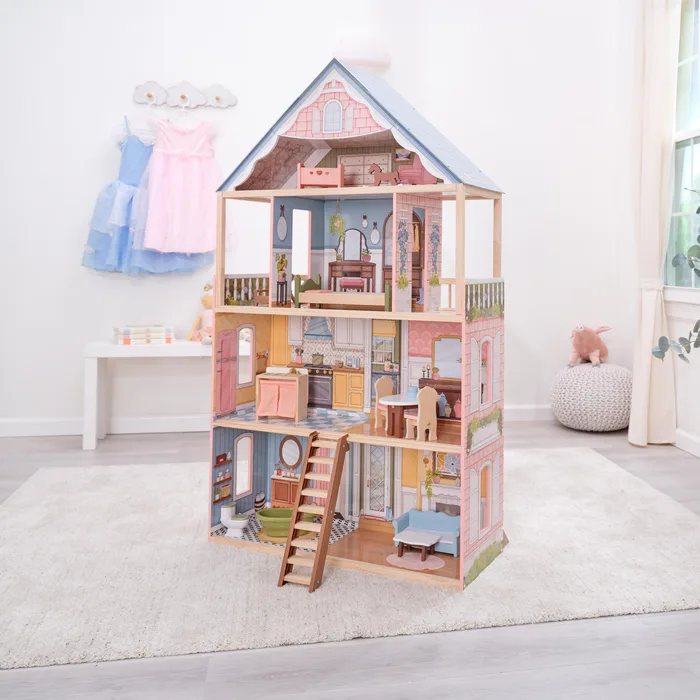
- Buy KidKraft Charlotte Dollhouse A tall four-level wooden house with six rooms, two balconies and a 15 piece accessory set. Amazon
- Buy Melissa & Doug Wooden Multi-Level Dollhouse A three-level, five-room wooden house that ships with 19 pieces of wooden furniture and needs no batteries. Amazon
- Buy PlanToys Victorian Dollhouse A 1:12 scale rubberwood house with three floors that works with the rest of the PlanToys range.
- It depends Hape All Season House (Furnished) A furnished open-plan wooden house with three levels, six rooms and 36 parts. Amazon
- It depends Tender Leaf Toys Dovetail House A large six-room house with removable roof panels, opening windows and printed plywood floors, sold without furniture. Amazon
- Skip Mattel (Barbie) Barbie DreamHouse Dollhouse 2026 (JKG84) A big plastic Barbie house with 65+ pieces, but batteries, dolls and the wheelchair are all extra and the page gives no size.
What actually matters
- Age grade - This is the maker's stated minimum age. It is not a developmental promise, so read it with any warning text.
- Small-parts warning - Many houses with accessories carry a choking hazard warning for children under 3. Copy it from the page and follow it.
- Scale - This is the ratio of the house to real life, such as 1:12. It decides which dolls and furniture fit.
- Footprint and height - Listed dimensions tell you whether it fits a corner or a shelf. Tall houses need wall space.
- Included pieces - Furniture, accessories and dolls may or may not be included. The page should say which.
- Material - Wood, plywood, MDF and plastic behave differently. The maker's materials list tells you what you are buying.
- Assembly - Some houses list a time and some do not. A long assembly is worth knowing before a gift day.
The specs, in plain English
Green flags vs red flags
Green flags
- The page lists dimensions and weight.
- The age grade is stated clearly.
- The page says what is in the box.
- A scale or doll size is stated.
- Care instructions or test reports are linked.
Red flags
- No dimensions are published.
- Furniture is unclear or not listed.
- Batteries are needed but not supplied.
- The page says colors or decorations may vary.
- The page shows out of stock with no clear seller.
Who's who: the brands
- KidKraft - Known for tall wooden dollhouses with built-in furniture and accessories.
- Melissa & Doug - Known for wooden pretend-play toys and furnished houses.
- PlanToys - Makes rubberwood toys and a dollhouse range in 1:12 scale.
- Hape - Makes wooden role-play toys, including open furnished houses.
- Tender Leaf Toys - Makes design-led wooden dollhouses with furniture sold separately.
How to read a listing without getting fooled
Start with the dimensions and the age line, then look for the box contents. If a page lists furniture, count the pieces. If it says sold separately, add that to the real cost. Check scale or doll size, then look for warnings and battery needs. Where a number is missing, treat it as unknown and look for it on the box or from the seller.
How much should you spend?
Budget dollhouses are usually small play sets. Mid-range houses add height, rooms and some furniture. Premium houses are often plain shells sold without furniture, so the final cost grows. Compare what is in the box before comparing tiers.
Questions, answered
What does scale mean on a dollhouse?
Scale is the ratio between the house and real life. At 1:12, one inch stands for one foot. It tells you which dolls and furniture will fit. PlanToys states this scale, while other makers here do not.
Do I need to buy furniture separately?
Sometimes. Melissa & Doug lists 19 pieces and Hape lists a furnished house, but Tender Leaf says furniture is sold separately. Read the box contents before you buy.
Why do some pages list two sizes?
Some pages list a product size and a package size, or an assembled size and a flat size. The Melissa & Doug page lists two different product figures. Use the assembled figure for floor planning and confirm with the seller.
Are wooden dollhouses safer than plastic?
The material alone does not decide safety. Read the maker's age grade and any warning text, and look for linked test reports. PlanToys links ASTM and EN71 reports.
Or jump to the head-to-head: KidKraft Charlotte Dollhouse vs Melissa & Doug Wooden Multi-Level Dollhouse.