Explained
Cribs, Explained
After reading this, you'll know exactly which crib specs matter, which are marketing, and how to judge any crib listing in about two minutes.
In this guide
A crib is the rare purchase where the safety floor is set by law: every new full-size crib sold in the US must meet the same federal standard, so your money buys materials, longevity, and convenience - not extra safety. What trips people up is the jargon layered on top: 3-in-1 versus 5-in-1 conversion claims, mattress-height counts, wood-versus-engineered-wood construction, and emissions certifications. This guide decodes all of it in plain English.
The 30-second version
- Safety is standardized, so every new crib sold in the US meets the same federal rules - spend your attention on materials and longevity instead.
- Conversion claims are marketing math: a '5-in-1' crib whose kits are sold separately (or discontinued) can end up less useful than a '3-in-1' with the toddler kit in the box.
- Solid wood beats engineered wood for the parts that take daily stress - it resists the loosening, cracking, and chipping that owner reports flag most often.
- The finish matters as much as the frame, because babies chew crib rails; look for a low-emissions certification or truly unfinished wood, and treat reports of chipping paint as disqualifying.
- Never buy a crib made before 2011, when drop-side cribs were banned and the federal standard was toughened - this is the one hard rule of secondhand crib shopping.
The products this guide is about
Our verdict on each, with the full reasoning on the companion review.
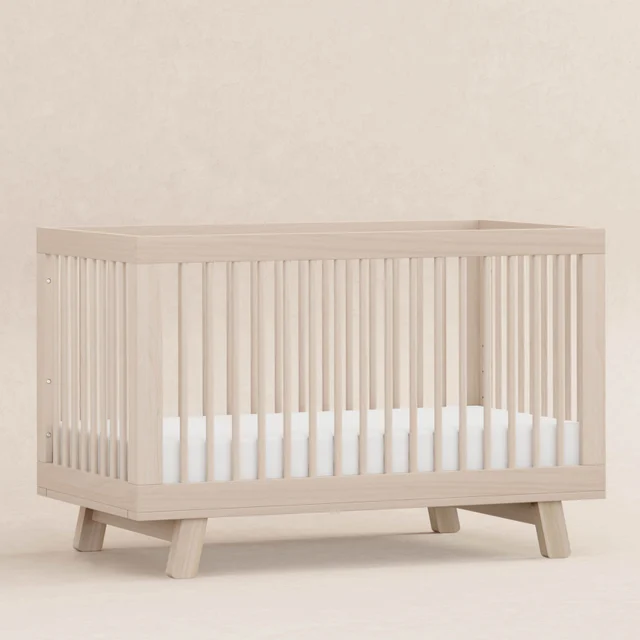
- Buy Babyletto Hudson 3-in-1 Convertible Crib The design-forward convertible that includes its toddler conversion kit in the box - the rare crib that looks premium and plans ahead. Amazon
- Buy DaVinci Kalani 4-in-1 Convertible Crib The long-running value champion: solid pine, GREENGUARD Gold, and a path all the way to a full-size bed. Amazon
- It depends IKEA Sniglar Crib An honest, ultra-affordable slab of untreated solid beech - brilliant if you want simple, limiting if you want features.
- Skip Graco Benton 5-in-1 Convertible Crib Fast to assemble and cheap, but recurring owner reports of chipping paint on a product a baby chews on are disqualifying. Amazon
What actually matters
- Current safety compliance - every new full-size crib sold in the US must meet the federal standard (16 CFR 1219), so a compliant budget crib is just as safe on day one as a premium one; what varies is everything else.
- Frame material - solid wood (pine, beech) in the structure holds screws tight and survives years of shaking, while engineered wood and particleboard are where owner reports of wobble and stripped fasteners cluster.
- Conversion honesty - what's actually in the box versus sold separately. An included toddler rail makes the age-two transition free; a promised conversion whose parts are separate, discontinued, or incompatible is worth nothing.
- Mattress heights - more mattress positions (three or four versus two) mean less back strain with a newborn and finer control as your baby grows; all cribs must reach a safe lowest position for a standing child.
- Finish safety - a low-emissions certification like GREENGUARD Gold means the paint or stain was screened for chemical off-gassing; bare unfinished wood is the other clean answer, with nothing to chip into a teething mouth.
- Mattress fit - the crib's interior must hold a standard crib mattress snugly, with no more than a two-finger gap at the edges; a loose fit is a genuine hazard, not a cosmetic flaw.
- Practical logistics - assembled width (some cribs won't fit through a doorway once built), assembly complexity, and weight if you'll ever move it between rooms.
The specs, in plain English
Green flags vs red flags
Green flags
- Toddler conversion kit included in the box, not sold separately
- Solid wood named explicitly in the structural frame (e.g., solid New Zealand pine or beech), not just 'wood construction'
- GREENGUARD Gold or equivalent low-emissions certification - or genuinely unfinished, untreated wood
- Four (or at least three) mattress heights listed with clear specs
- Long owner-report track record praising sturdiness after months of daily use, not just easy assembly
- Manufacturer sells and clearly lists compatible conversion kits for that exact model
Red flags
- Recurring owner reports of paint or finish chipping - on a product babies chew, that's disqualifying, not cosmetic
- A high 'n-in-1' number where the conversion pieces are sold separately, hard to find, or listed as incompatible by the brand's own accessories
- Secondhand cribs made before 2011, drop-side hardware, or any crib with missing/replaced non-original parts
- Vague materials language ('wood and wood products') that hides particleboard in the frame
- Owner reports of wobble, loosening bolts, or rails that flex after a few months
- Only two mattress positions on a crib marketed as a long-term convertible
Who's who: the brands
- Babyletto - Design-forward modern cribs in solid pine with GREENGUARD Gold certification; known for including the toddler conversion kit in the box.
- DaVinci - A related brand to Babyletto and the long-running value name - traditional styling, solid pine, and conversion paths that run all the way to a full-size bed.
- IKEA - The minimalist budget answer; its untreated solid-beech crib is a favorite of low-tox households, trading conversion features and extra mattress heights for bare simplicity.
- Graco - A big baby-gear name whose budget cribs promise many conversion stages, but owner reports on finish durability and kit compatibility deserve a close read before buying.
- Delta Children - One of the highest-volume US crib makers, spanning budget to mid-range; quality varies by line, so judge each model on materials and owner reports rather than the badge.
How to read a listing without getting fooled
Start with the material line and refuse vagueness: 'solid New Zealand pine frame' is an answer, 'wood and engineered wood products' is a dodge. Next, audit the conversion claim - find the exact list of what ships in the box, then search the brand's accessories for the conversion kit for that specific model; if the kit is separate, unpriced, or the brand's own rails list the model as incompatible, mentally downgrade the 'n-in-1' number. Check the mattress-height count (stated as a number, not 'adjustable'), and confirm a low-emissions certification on any painted or stained crib. Finally, read the critical owner reports from six-plus months of ownership, not week-one reviews: chipping finish, loosening hardware, and vanished conversion kits only show up with time. Ignore safety superlatives in marketing copy - every new crib clears the same federal bar, so 'exceeds safety standards' tells you almost nothing.
How much should you spend?
Because safety is federally standardized, paying more does not make a compliant crib safer - it buys solid wood instead of engineered wood, a nicer finish, more mattress positions, included conversion hardware, and a design you'll enjoy for years. The value sweet spot is the mid-range: solid-wood construction, a low-emissions certification, and a real conversion path, at a meaningful step below premium designer pricing. Spending up to premium is worth it when the toddler kit comes included and the design matters to you daily; it's not worth it for safety claims or brand prestige alone. At the budget end, the honest play is bare unfinished solid wood with no conversion features, which sidesteps finish-quality risk entirely - the trap is the budget convertible whose painted finish and separately-sold kits generate the most owner complaints. If you plan multiple kids or want one frame to last into grade school, a mid-range convertible with a full-size-bed path usually delivers the lowest cost per year of use.
Questions, answered
What actually makes crib sleep safe, whichever crib I buy?
The guidance is consistent and doesn't depend on price: keep the crib bare - just a firm, flat mattress that fits snugly (no more than a two-finger gap at the edges) covered by a fitted sheet, with no blankets, pillows, bumpers, or soft toys. Buy a crib that meets current CPSC federal standards (all new US cribs do; JPMA certification is additional third-party verification), never use a drop-side crib or one made before 2011, place baby on their back for every sleep, and lower the mattress to the bottom position as soon as your child can pull to stand. This is general product guidance, not medical advice - for sleep questions specific to your baby, talk to your pediatrician.
Are convertible cribs actually worth it?
Usually yes, with one condition: verify what's in the box. The toddler-bed conversion around age two is the stage almost every family actually uses, so a crib with that kit included delivers real value. Conversions to daybed and full-size bed are genuine but depend on kits sold separately being available years later - and owner reports show 'n-in-1' promises falling apart when parts are discontinued or incompatible. Treat included hardware as real value and separate kits as a maybe.
Is a cheap crib as safe as an expensive one?
On day one, yes. Every new full-size crib sold in the US must pass the same federal structural and chemical requirements, so a budget crib is not cutting safety corners a premium one avoids. Where cheap cribs can fall short is durability over years of use - finishes that chip, hardware that loosens, conversion parts that never materialize. A bare unfinished solid-wood budget crib avoids most of those failure modes; a painted budget convertible is where problems concentrate.
Should I buy or accept a secondhand crib?
Only with caution. The hard rule: refuse anything made before 2011, when drop-side cribs were banned and the federal standard was strengthened. Even for newer cribs, you need all original hardware, no cracks or repairs, no recalls on the model, and slats that haven't loosened. Missing instructions and improvised bolts are how secondhand cribs become hazards. If you can't verify age and completeness, a new budget-compliant crib is the safer choice.
When do I lower the mattress, and when does my child leave the crib?
Start at a higher position only for a non-mobile newborn, drop it when your baby can sit unassisted, and move to the lowest position the moment they can pull to stand - typically between eight and ten months. Most children transition to a toddler bed somewhere around age two to three, or sooner if they start climbing out; that's when an included toddler rail earns its keep.
Do cribs come with a mattress, and does the mattress matter?
Nearly all US cribs are sold without one, and almost all full-size cribs accept the same standard mattress size - so you choose it separately. It matters a lot: pick a firm, flat mattress that fits snugly with no more than a two-finger gap at the frame. Firmness is a safety feature for infants, not a comfort downgrade; soft, plush sleep surfaces are a suffocation risk.
Or jump to the head-to-head: Babyletto Hudson 3-in-1 Convertible Crib vs DaVinci Kalani 4-in-1 Convertible Crib.