Explained
Crib Mobiles, Explained
After reading, you'll understand what a crib mobile listing is actually telling you, when the mobile has to come out of the crib and why, and which specs change day to day life with a newborn.
In this guide
Crib mobiles trip up first time buyers in a specific way: almost every other nursery purchase is judged on how long it lasts, and this one has an expiry date measured in months. On top of that, the photography for the category is almost always shot from adult eye height, which quietly hides the only view that matters. Add vague developmental language on the packaging, a shelf that is increasingly filled with projectors and soothers rather than actual mobiles, and a lot of listings for products nobody can currently ship you, and it becomes hard to tell a well made mobile from an ornament with a motor. This guide translates the vocabulary and tells you which parts of it are load bearing.
The 30-second version
- The mobile comes out early, with CPSC guidance pointing to removal when the baby can push up on hands and knees or reaches five months, whichever comes first.
- The category is regulated, because a crib mobile is a toy and 16 CFR Part 1250 makes ASTM F963 mandatory, including its section on toys attached to a crib or playpen.
- The baby sees the underside, so judge a mobile by photographs taken from inside the crib rather than by how it looks from beside it.
- High contrast suits newborn vision, which handles a strongly contrasted target more easily than fine colour detail in the first weeks.
- The mount is a real failure point, as CPSC's 2015 Skip Hop mobile recall showed, so check the strap or clamp on assembly day and again every few weeks.
- Conversion is the value test, because a base that becomes a music box, or a soother that never hangs overhead, outlives the mobile stage.
The products this guide is about
Our verdict on each, with the full reasoning on the companion review.
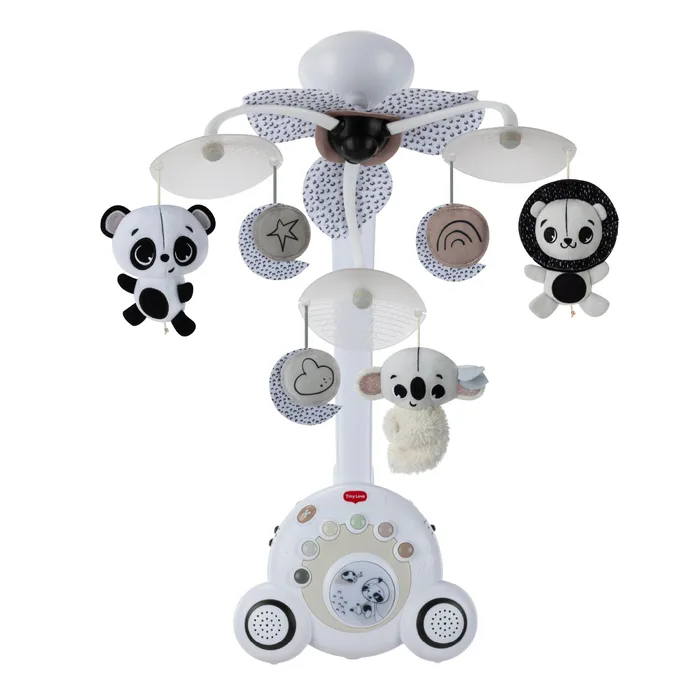
- Buy Tiny Love Black & White Decor Collection Soothe 'n Groove Mobile The rare mobile designed around what a newborn can actually resolve, with real volume control and a second life as a music box.
- Buy Skip Hop Moonlight & Melodies Projection Mobile (Safari) The only mobile here that turns above the mattress and projects a star field on the ceiling, with a remote so you never lean over the crib.
- It depends Baby Einstein Sea Dreams Soother Musical Crib Toy and Sound Machine Not a mobile at all: a rail mounted light and sound box that sidesteps the hanging hazard, if you can live without anything overhead. Amazon
- Skip Tiny Love Garden of Adventures Wooden Mobile A handsome piece of nursery decor that carries the same five month expiry as a full featured mobile and does much less inside it.
What actually matters
- Removal trigger - this is the single most important thing in the category, and it is developmental rather than purely age based. CPSC guidance points to taking hanging crib toys out when the baby begins to push up on hands and knees or reaches five months, whichever is first. It applies to anything that hangs, which is why rail mounted soothers and dresser-top projectors sidestep it entirely.
- Line of sight from the mattress - a mobile is viewed from directly underneath by someone who cannot yet turn their head far. Elements that face outward toward the room present edges and blank backs to the only viewer who counts.
- Contrast - newborn vision copes better with strong light and dark boundaries than with subtle colour, and colour vision develops over the following months. Black and white patterns are therefore easier for a very young baby to fixate on.
- Focal distance - a newborn focuses best at around eight to ten inches. A mobile arm sits within a workable range of that; a ceiling projection does not, which is why a projected star field is calming before it is interesting.
- Volume adjustment - many mobiles offer a single fixed level, which is a problem in a small room at night. A high and low switch, or a true volume dial, is worth more than extra tunes.
- Independent light, movement and sound - the better mobiles let you run any one without the others, so a daytime nap can be silent movement and a bedtime can be dark with sound only.
- Movement source - a motorised mobile turns on its own, while a decorative one relies on air currents or a parent. If a listing describes 'natural motion' with no motor, expect it to be still most of the time.
- Attachment and rail fit - rail clamps and straps are sized for particular rail thicknesses or circumferences, and a thick, square or upholstered rail can defeat them. Check the stated rail dimension before you buy, and treat the strap as a wear item once it is fitted.
- Second life - because the mobile phase is short, the products worth paying for are the ones that detach into a music box or nightlight, or that were never suspended over the mattress in the first place.
The specs, in plain English
Green flags vs red flags
Green flags
- The listing states a mobile specific age window, not just '0 months and up'.
- There are product photographs taken from below or from inside the crib.
- Volume is adjustable, and light, movement and sound can each be run without the others.
- The base detaches and keeps working as a music box or nightlight after removal day.
- Hanging elements are firmly fixed with no long strings, cords, loops or ribbons.
- The model number is printed somewhere findable, and the listing publishes dimensions and battery type.
Red flags
- No strangulation or removal warning anywhere on the packaging or listing.
- Long ribbons, cords or ties intended to be knotted across the crib rails.
- Every photograph is a styled nursery shot from adult eye height.
- Developmental claims that go beyond visual stimulation, such as promises about intelligence or sleeping through the night.
- Soft, detachable or loosely stitched parts that could end up on the mattress.
- A second hand mobile whose model number you cannot read, or which matches an open CPSC recall.
Who's who: the brands
- Tiny Love - Maker of the Soothe 'n Groove, whose listing states a mobile window of 0 to 5 months.
- Skip Hop - Still makes the Moonlight & Melodies Projection Mobile, which combines a rotating arm with a ceiling star projection, though the brand no longer appears to run its own storefront and an earlier model of that mobile was recalled by CPSC in 2015 over a crib-rail strap that could break.
- Baby Einstein - Best known in this corner of the nursery for the Sea Dreams Soother, a rail mounted light and sound box rather than a true mobile.
- Infantino - Makes nursery projectors such as the 3-in-1 Musical Soother & Night Light Projector, a format that stands on a dresser and leaves the crib alone, which sidesteps the hanging hazard.
- VTech - Lists mobiles including a Soothing Slumbers Sheep Mobile, but check whether any are actually in stock before you plan around one.
- Fisher-Price - A long standing name in projection mobiles. Its catalogued mobiles may be out of stock, so check before you set your heart on one.
- Manhattan Toy - Home of the Wimmer-Ferguson high contrast infant range, which appears to centre on mirrors, books and mats rather than a crib mobile.
- Lovevery - Has sold its black and white mobile as part of a Play Kit rather than as a standalone product, so check how it is sold.
- Mamas & Papas, Nattou and Done by Deer - European makers of attractive cot mobiles that, at the time of writing, did not appear to ship to US buyers; check before ordering.
How to read a listing without getting fooled
Read a crib mobile listing backwards. Start at the age line and look for a mobile specific window rather than a generic '0 months and up', because that tells you whether the maker is being straight with you about the removal rule. Then look at the photo set and find one shot from below or from inside the crib; if there isn't one, assume the underside is plain. Next go to the features list and separate the things that change your night from the things that pad the bullet points: volume adjustment, independent light and sound switches, a remote and the continuous run time are the first group, while tune counts and character names are the second. Check what the base becomes when the arm comes off. Then look for the boring lines at the bottom, the dimensions, the battery type and the rail fit, because those are the ones that decide whether it physically works on your crib and whether you can turn it on at two in the morning; if a listing does not publish them, that absence is itself information. Finally, find the model number and check it against CPSC's recall list, which takes a minute and is the step that catches a recalled unit.
How much should you spend?
Budget tier gets you a rail mounted soother or a dresser-top projector, which is why the safest recommendation in the category is often also the cheapest: nothing hangs, so nothing has to come down. Mid-range is where the real mobiles live, and it buys a deeper sound library, a projector in the arm, independent light and sound control, a remote, or genuine volume adjustment, though rarely all of them at once. It is also where decorative wooden and felt mobiles sit, so at this tier you are choosing between features and looks rather than getting both. Premium in this category usually means finish and styling rather than function, and given that the whole product comes down at around five months, it is the tier that is hardest to justify. Spending more on a convertible mid-range mobile beats spending more on a prettier one that becomes nothing.
Questions, answered
Can I use a crib mobile in a bassinet or playard instead?
Sometimes, but the fit is the problem rather than the principle. Rail clamps and wraps are designed for particular rail thicknesses and circumferences, and bassinet and playard rails are often padded or a different shape. The same removal rule applies wherever the toy is hung, and ASTM F963's crib toy section covers playpens as well as cribs. If a mobile does not clamp firmly, do not improvise with ties. A projector that stands on furniture nearby avoids the fit question altogether.
How high above the baby should a mobile hang?
Far enough that the baby cannot reach it as they grow, which in practice means following the manufacturer's assembly instructions exactly rather than adjusting the arm to look right. The reason CPSC ties removal to pushing up on hands and knees is that reach changes quickly and without warning. Re-check the clearance every few weeks rather than at set up only. Once the baby can get a hand near it, the mobile's life is over regardless of height.
Should I worry about buying a second hand crib mobile?
More than with most nursery gear, because this is a product that hangs over a sleeping baby and because recalls in the category are real. CPSC recalled about 3,500 Skip Hop projection mobiles in December 2015 when the crib-rail strap could break, and recalled items keep circulating on resale sites long after the notice closes. If you are given one, find the model number on the base, check it against CPSC's recall list, inspect the strap or clamp for wear and the stitching on every hanging element, and make sure the strangulation warning label is still attached. If you cannot read the model number, do not use it.
Are wind-up mobiles better or worse than battery ones?
Neither is safer, and the difference is mostly practical. A wind-up mechanism runs for a fixed short period and then stops, which some parents like and others find means constant winding over a settling baby. Battery mobiles run longer, often offer volume control and remote start, and add battery cost and the risk of running flat at the worst moment. Whichever you pick, check that any battery compartment is screw secured.
Why is it so hard to find a crib mobile now?
Because many of the big nursery brands appear to have moved away from the format, and some listed mobiles show as out of stock or ship only outside the United States. Check stock and shipping before you commit. What has replaced them is the projector and the tabletop soother, which do a similar job without hanging anything over the mattress.
Does a mobile help a baby sleep?
Treat that as unproven and buy it for calm rather than for sleep. Mobiles are visual and auditory stimulation, and the safe sleep advice from the American Academy of Pediatrics is about keeping the sleep surface bare, not about adding entertainment to it. Plenty of parents find the music and nightlight useful as part of a settling routine before sleep. If you have concerns about your baby's sleep or vision, speak to your paediatrician rather than to a product listing.
Or jump to the head-to-head: Tiny Love Black & White Decor Collection Soothe 'n Groove Mobile vs Skip Hop Moonlight & Melodies Projection Mobile (Safari).