Explained
Camp Lanterns, Explained
After reading, you'll know how to compare runtime properly, what CRI buys you, and when solar charging is a real feature.
In this guide
Most people buy a camp lantern on brightness, because brightness is the number on the box and often the number in the product name. It is the wrong specification to lead with. Above a fairly low threshold, extra lumens mostly buy you a flatter battery, and the figure that determines whether the lantern is any use on night three of a trip is one that many listings do not publish at all.
The 30-second version
- Runtime is the real specification, since every lantern above roughly 200 lumens is bright enough and they differ enormously in endurance.
- The name is often the lumen rating, which is useful shorthand and quietly trains you to compare on the least important number.
- Watt hours beat milliamp hours, because mAh without a voltage cannot be compared between products at all.
- CRI decides whether colours look right, and it matters for cooking and first aid far more than raw output does.
- Solar is a top-up, not a charger, generating so little current that a full charge means a full day of strong direct sun.
The products this guide is about
Our verdict on each, with the full reasoning on the companion review.
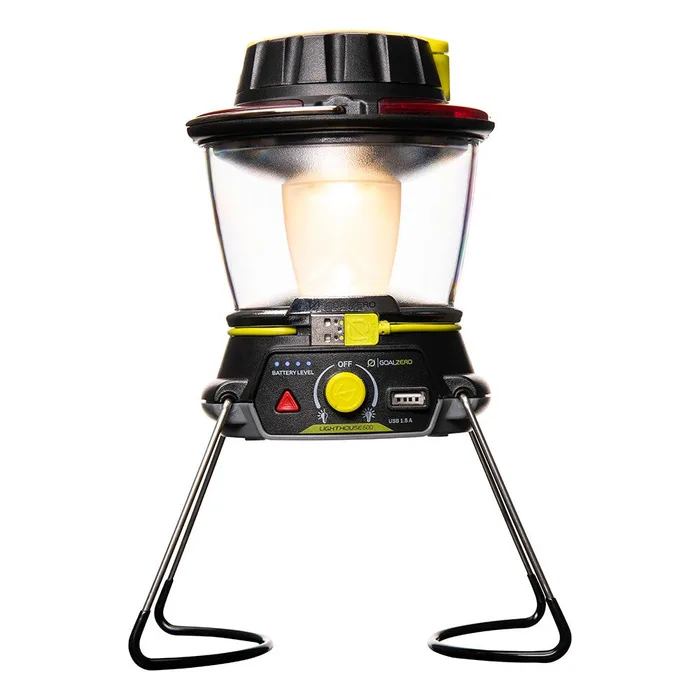
- Buy Goal Zero Lighthouse 600 Lantern & USB Power Hub The most completely documented lantern here, and the only one that works with no power source at all.
- Buy Black Diamond Orbiter 650 Lantern Brightest of the four, charges over USB-C, and states its runtime at both ends of the dial.
- It depends BioLite AlpenGlow 500 The largest battery and the only stated colour rendering figure, still charging over micro USB.
- Skip LuminAID PackLite Nova Solar Lantern Packs flat, runs on sun, and publishes neither a lumen figure nor a runtime nor a battery capacity.
What actually matters
- Runtime - how long the lantern lasts at a given setting, usually quoted at high and low. It is the specification that decides whether a lantern works for your trip, and the one that varies most between products that look identical.
- Lumens - total light output. Useful up to a point and misleading past it, because output and runtime trade directly and most camp tasks are satisfied well below the maximum any of these produce.
- Battery capacity - stated as mAh and ideally watt hours. Watt hours account for voltage and can be compared across products, while mAh on its own cannot, and a page giving both is maintaining real data.
- Charge input - USB-C, micro USB, solar or a crank. This decides what you have to carry and what happens when the battery dies somewhere without a socket.
- Ingress protection - the IP rating, where IPX4 means splash resistant from any direction. A lantern lives outdoors overnight, so a stated rating is the difference between tested and hoped for.
- Colour rendering - CRI, on a scale to 100. Rarely published in this category, and the practical gap between a typical 70 and a stated 90 is whether you can judge colour by the light.
- Directionality - whether the lantern throws light all round or can be limited to one side. Lighting one side is both more civilised at a table and a straightforward way to extend runtime.
The specs, in plain English
Green flags vs red flags
Green flags
- Runtime is published at more than one setting rather than as a single number.
- Battery capacity is given in both mAh and watt hours.
- An IP rating is stated explicitly rather than described as weather resistant.
- The charge input is named, and it is USB-C.
- Colour rendering is published at all, which almost no brand in this category does.
Red flags
- No lumen figure anywhere on the product page.
- A number of light levels offered in place of an output measurement.
- Runtime quoted without saying which setting it applies to.
- Solar charging presented as the primary charging method with no runtime figure to go with it.
- Colour modes and ambience given more space than the two numbers that describe the product.
Who's who: the brands
- Goal Zero - Portable power brand whose lanterns are built around battery capability, generally documented with the detail you would expect from a power company.
- Black Diamond - Climbing and headlamp specialist, so its lanterns tend to publish lumens, burn time and IP ratings in the same format as its headtorches.
- BioLite - Off-grid energy brand with a focus on light quality, and the rare manufacturer publishing a colour rendering figure.
- LuminAID - Known for packable inflatable solar lanterns originally developed for disaster relief, with listings that lead on portability rather than specification.
- Nitecore - Flashlight manufacturer whose lanterns typically carry the most detailed runtime tables in the category, in the style of enthusiast torch specs.
How to read a listing without getting fooled
Start by working out whether the number in the product name is the lumen rating, because in this category it usually is, then ignore it. Go to the specification block and find runtime, and check which setting each figure applies to, since a lantern quoting 200 hours is quoting its dimmest mode and one quoting 4 hours is quoting its brightest. Next find the battery, and prefer a page that gives watt hours as well as mAh, because that pairing indicates maintained product data rather than copied marketing. Check the charge input by name. Then look for two things most listings omit: an IP rating and a CRI figure. Their presence tells you the product was tested and the page is written by someone who knows what the numbers mean.
How much should you spend?
Lanterns are inexpensive and the useful range is narrow. Budget buys a solar or single-cell lantern that will light a tent, generally without published runtime or an IP rating, which is fine if your requirement is only that the dark goes away. Mid-range is where the category actually lives, buying a 5000 mAh class rechargeable with a stated output between 500 and 700 lumens, published runtimes at both ends, an IPX4 rating and a USB port. Almost every sensible choice sits here. Premium adds capability rather than brightness, meaning solar input, a hand crank, higher colour rendering or a larger battery that doubles as a power bank. Spending more rarely buys more light, so decide which capability you need and buy the cheapest lantern that documents it.
Questions, answered
How many lumens do I actually need for camping?
Less than the marketing suggests. Around 100 to 200 lumens comfortably lights a picnic table or the inside of a tent, which is why every lantern here spends most of its life well below maximum. Higher outputs are useful for short bursts, like finding something dropped in long grass or setting up in the dark, and they drain the battery quickly. Buy for the runtime at a moderate setting rather than for a maximum you will rarely select.
Will a lantern battery survive being stored all winter?
Lithium ion cells self-discharge slowly and degrade fastest when stored fully charged or fully flat, particularly in heat. For a lantern that lives in a cupboard between trips, storing it around half charged and somewhere cool will preserve capacity considerably better than leaving it on a charger. Check it every few months, because a cell that sits at zero for a long period can drop below the voltage at which it will accept a charge at all.
Can I take a lantern on a plane?
Usually yes in carry-on, and the figure that decides it is watt hours rather than mAh. Airlines generally permit lithium batteries under 100 Wh without special approval, and every lantern in this class sits far below that, typically under 25 Wh. Spare batteries and power banks must travel in the cabin rather than in checked baggage. This is one of the practical reasons to prefer a manufacturer that publishes watt hours.
Is a lantern better than a headtorch?
They solve different problems and most people end up with both. A headtorch points where you look, which is what you want for walking, finding things and any task using your hands. A lantern lights a space evenly so several people can share it without being blinded, which is what you want at a table or in a tent. A headtorch stood on end inside a water bottle is the classic improvisation, and it works, but it is dimmer and less even than a purpose-built lantern.
Or jump to the head-to-head: Goal Zero Lighthouse 600 Lantern & USB Power Hub vs Black Diamond Orbiter 650 Lantern.