Explained
Camp Chairs, Explained
After reading, you'll know which seat height suits you, why capacity figures disagree, and which specs are worth ignoring.
In this guide
Camp chairs look interchangeable in a product photograph and are not. The difference that matters is a number most listings bury or omit, and the difference that gets marketed, meaning padding and cup holders, is the one you will stop noticing within a week. First-time buyers usually pick on price and colour, then discover the chair sits them too low to stand up or too high to enjoy the fire.
The 30-second version
- Seat height decides the chair, setting your eye level at the fire, your sightline for everyone behind you, and how hard it is to stand.
- Capacity is the safety number, and it is the one most likely to appear twice on a page with two different values.
- Weight and packed size differ, so a light chair that folds long can be harder to travel with than a heavier compact one.
- Mesh and solid fabric split by climate, with mesh moving air in heat and polyester blocking wind and holding warmth in cold.
- Count the published specs, because a page listing seven numbers is maintained and a page listing two is telling you something too.
The products this guide is about
Our verdict on each, with the full reasoning on the companion review.
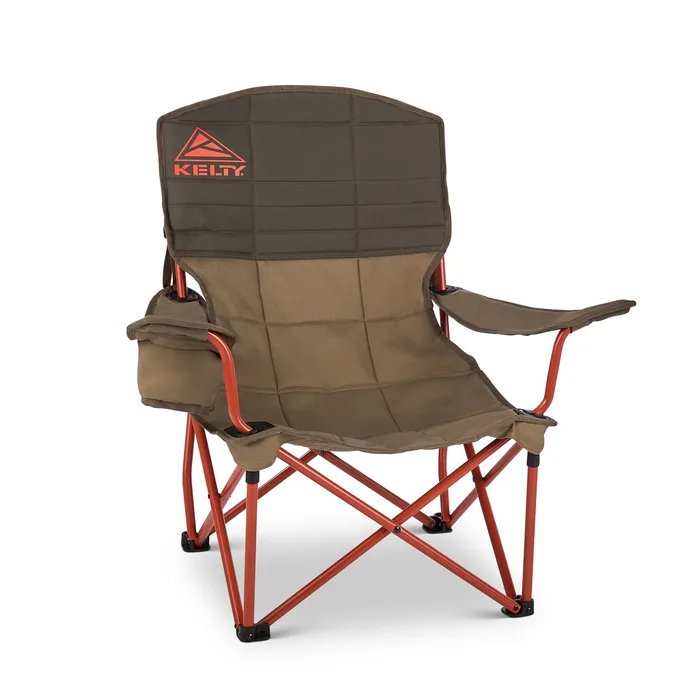
- Buy Kelty Lowdown Chair The only chair in the group whose published numbers are both complete and internally consistent.
- Buy GCI Outdoor Comfort Quad Chair Full dimensions, a tall seat and a mesh back, undercut by a capacity figure that appears twice at two values.
- It depends NEMO Equipment Stargaze EVO-X Folding Reclining Camp Chair Comfortably the nicest chair here to sit in, and the least willing to tell you its dimensions.
- Skip Big Agnes Big Six Camp Chair A lightweight packable chair that states its seat height and then no weight capacity at all.
What actually matters
- Seat height - the distance from ground to seat, typically 12 to 21 inches in this category. It determines whether you are level with a fire or above it, whether you block the view behind you, and whether standing up needs your hands.
- Weight capacity - the load the frame is rated to carry. It is the only figure here with a safety consequence, and it comes from frame geometry and tube diameter rather than from how heavy the chair is.
- Chair weight - what you carry from car to site. Relevant for repeated moves and for anyone carrying two chairs plus everything else, but rarely the deciding factor for car camping.
- Packed dimensions - the folded size, which decides whether the chair fits a boot alongside everything else. A tall chair often folds long, and folded length matters more than weight for packing.
- Seat fabric - usually mesh panels or a denier-rated polyester. Mesh breathes and suits heat, while solid fabric blocks wind, holds warmth and generally lasts longer against abrasion.
- Frame material - steel at almost every price below premium, aluminium on lightweight and backpacking designs. Steel is heavier and cheaper, aluminium is lighter and costs more for the same strength.
- Foot geometry - how the legs meet the ground. Flared feet and additional contact points spread load and stop the chair sinking into sand or soft grass, which narrow tubes will do.
The specs, in plain English
Green flags vs red flags
Green flags
- Seat height is stated as a number rather than described as low or tall.
- Weight capacity appears once, in one place, with one value.
- Packed dimensions are published alongside the chair weight.
- The fabric is specified with a denier rating rather than called durable.
- The listing carries a full specification block rather than feature copy alone.
Red flags
- Two different weight capacities on the same product page.
- No weight capacity published at all.
- Seat height described only in adjectives, so you cannot compare it to another chair.
- Comfort language doing the work that dimensions should do.
- A premium price attached to the least complete specification in its class.
Who's who: the brands
- Kelty - Long-standing camping brand whose product pages tend to carry complete specification blocks including seat and back heights.
- GCI Outdoor - Specialises in folding outdoor seating and publishes full open and folded dimensions, though its feature copy can disagree with its own specs.
- NEMO Equipment - Design-led brand known for reclining and swinging camp furniture, priced at a premium and lighter on published dimensions.
- Big Agnes - Backcountry brand better known for tents and sleeping systems, with camp furniture listings that lean on voice more than numbers.
- Helinox - Specialises in packable aluminium-framed chairs at low weights, a different class from the steel-framed car camping chairs above.
How to read a listing without getting fooled
Skip the first paragraph of any camp chair listing, because it is written to sell comfort and comfort is not comparable. Go to the specification block and look for two figures: seat height and weight capacity. If either is missing, that absence is your answer about how much else the page will tell you. If weight capacity appears in more than one place, read both and check they match, because in this category they often do not. Then check the folded dimensions rather than the weight, since folded length is what stops a chair fitting the car. Fabric described with a denier number is a maintained specification, while fabric described as heavy duty is copy.
How much should you spend?
Camp chairs are cheap relative to most outdoor gear and price correlates weakly with quality. Budget buys a steel-framed quad chair with a mesh back, a carry bag and a stated capacity, which is genuinely enough for most people. Mid-range buys better fabric, a published denier rating, a more considered seat height and usually a more complete specification block, which is where the value sits. Premium buys a mechanism, meaning a swinging or auto-reclining seat, padded headrests and a designed aesthetic. That premium is not buying you a higher weight capacity and in this comparison it bought less published information rather than more. Set your budget by the mechanism you want and then choose within it on seat height.
Questions, answered
Are aluminium-framed chairs worth the extra money?
Only if you carry the chair any distance. Aluminium gets you the same strength at meaningfully less weight, which matters for a packable chair you take to a festival or on a short walk in. For car camping, where the chair travels from boot to fire, steel is stronger per unit cost and the weight difference is irrelevant. Most of the chairs sold as camp chairs use steel for exactly that reason.
How long should a camp chair last?
Fabric usually fails before frames do, and it fails from ultraviolet exposure rather than from use. A chair left in the sun all summer degrades faster than one used just as often and stored in a bag, because ultraviolet light breaks down the polyester fibres regardless of load. Storing it dry and out of direct sun is worth more to its lifespan than anything about how it is built.
Do cup holders and pockets matter?
They are the features most heavily marketed and the least likely to change how you feel about the chair. An insulated holder is genuinely better than a mesh one in summer, and a phone pocket saves putting a phone in the grass. Neither should override seat height or a capacity figure you can rely on, which are the things you cannot fix later.
Can I use a camp chair on sand?
It depends entirely on the feet. Narrow tube legs concentrate your weight on four small points and will sink into sand or soft grass, tipping you as they go. Chairs with flared feet, wider foot pads or additional contact points spread the same load and stay level. If you camp on beaches, foot geometry is worth more attention than fabric, and it is one of the few features product photographs actually show clearly.
Or jump to the head-to-head: Kelty Lowdown Chair vs GCI Outdoor Comfort Quad Chair.