

Health & Wellness
The Best TENS Units for At-Home Pain Relief: 4 Compared (and One to Skip)
We compared four current TENS units on therapy modes, channel control, ease of use, and portability to find the best at-home pick.
The short version
TENS units help mask everyday aches with mild electrical pulses, and the best at-home choice comes down to how much control and mobility you want. The iReliev Wireless TENS + EMS system is our top pick for its cable-free pods and dual TENS/EMS programming, while the AUVON Dual Channel unit is the value standout with independent A/B channels for a fraction of the cost. The Omron Max Power Relief suits first-timers who want simple presets over flexibility, and the Compex Sport Elite 3.0 is a genuinely capable device that is overbuilt and overpriced for ordinary pain relief. Fit of the pads and ease of the controls tend to matter more day to day than raw feature counts. Best for: most people wanting flexible, everyday at-home pain relief, the iReliev is the safest all-round buy, with the AUVON as the budget alternative.
Our picks at a glance
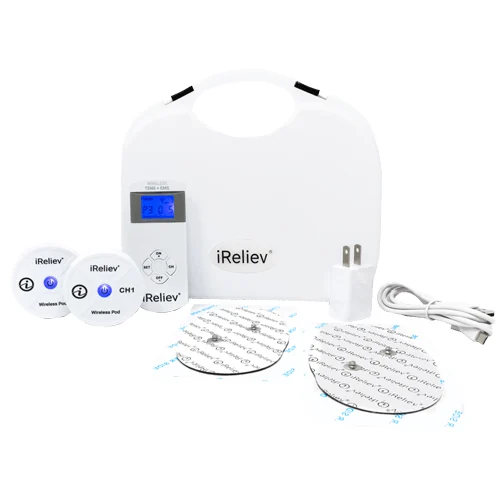
- iReliev Wireless TENS + EMS Therapeutic Wearable System (ET-5050) - Buy. Cable-free wearable pods and a full TENS-plus-EMS program suite make this the most flexible all-rounder for active households.
- AUVON Dual Channel TENS + EMS Unit (24 Modes) - Buy. A rechargeable dual-channel workhorse that delivers programmable, two-area therapy at an entry-level price.
- Omron Max Power Relief TENS Unit (PM500) - It depends. A pared-down, preset-driven TENS unit that trades flexibility for genuine grab-and-go simplicity.
- Compex Sport Elite 3.0 Muscle Stimulator with TENS Kit - Skip. A superb athletic muscle stimulator whose TENS pain mode is a sidecar to a training-focused feature set most home users will never touch.
The verdict in 30 seconds
What mattered most
- Therapy types
- Channels & independent control
- Preset programs / modes
- Intensity control
- Power source
- Portability
TENS (transcutaneous electrical nerve stimulation) units send gentle electrical pulses through skin-mounted pads to help mask everyday aches like lower-back tension and sore muscles. The market splits sharply between simple preset devices and programmable multi-channel systems, so the right choice depends heavily on whether you want plug-and-play spot relief or granular control. We landed on two clear buys, one that depends on your needs, and one capable device that is the wrong tool for most home pain-relief shoppers.
Cable-free wearable pods and a full TENS-plus-EMS program suite make this the most flexible all-rounder for active households.
Best for: Active users who want untethered, whole-body therapy and value both pain gating and muscle stimulation in one system.
- Fully wireless pods you can wear while moving around the house
- Preset programs spanning both pain relief (TENS) and muscle conditioning (EMS)
- Expandable to multiple independently controlled pods via one handheld remote
- Rechargeable remote and pods avoid the recurring cost of disposable batteries
- Pod battery life is shorter than a wired unit, so heavy users recharge often
- Costs meaningfully more than a basic wired TENS device
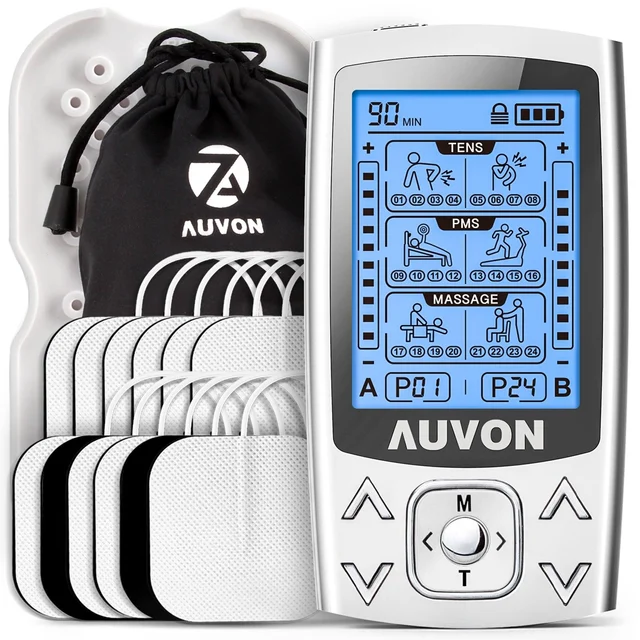
A rechargeable dual-channel workhorse that delivers programmable, two-area therapy at an entry-level price.
Best for: Budget-minded shoppers who want programmable dual-area relief without paying a premium.
- Independent A/B channels let you treat two body areas at once with different settings
- 24 modes covering TENS, muscle stimulation, and massage-style patterns
- Rechargeable lithium battery, rated by AUVON for up to 10 hours of continuous use
- Strong value that undercuts most name-brand units
- Wired leads limit mobility during a session
- Icon-driven menu has a modest learning curve for first-timers
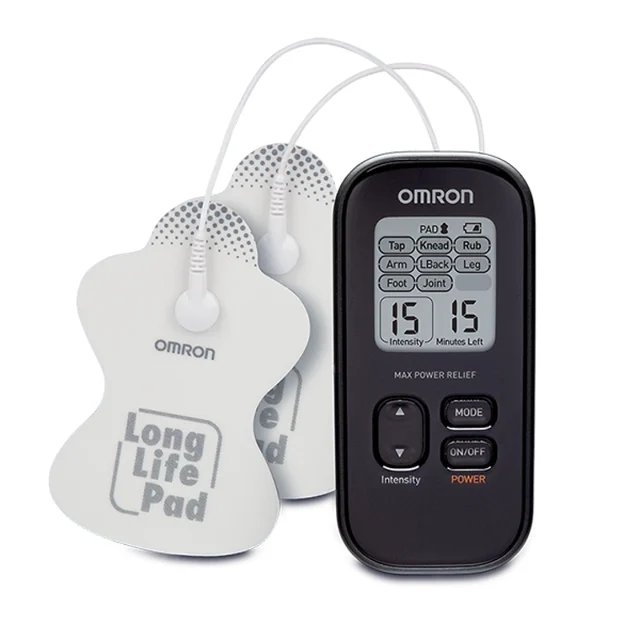
A pared-down, preset-driven TENS unit that trades flexibility for genuine grab-and-go simplicity.
Best for: First-time users and anyone who prioritizes a simple, no-menu device over programmable control.
- Six preset pain modes and three massage modes, with 15 intensity levels, remove the guesswork for beginners
- Widely available brand with reusable pads rated for up to 150 uses
- Compact and pocketable for spot treatment anywhere
- Omron says it has twice the power of its Pocket Pain Pro
- Single-channel design cannot run two areas independently
- TENS-only; no dedicated EMS muscle-conditioning programs
- Runs on disposable batteries rather than a rechargeable cell
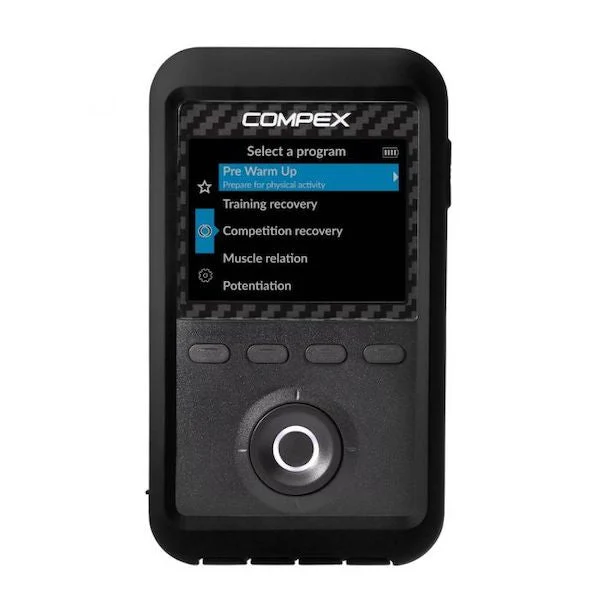
A superb athletic muscle stimulator whose TENS pain mode is a sidecar to a training-focused feature set most home users will never touch.
Best for: Serious athletes prioritizing muscle conditioning and recovery, for whom pain-relief TENS is a secondary consideration.
- Fine intensity control and a sturdy build
- Programs geared toward warm-up, recovery, and strength
- Long-standing reputation among athletes
- Priced far above what at-home pain relief requires
- Feature set is EMS-first; TENS is only one of many training programs
- Steeper learning curve aimed at athletes, not casual pain relief
| Criteria | iReliev Wireless TENS + EMS Therapeutic Wearable System (ET-5050) Top pick | AUVON Dual Channel TENS + EMS Unit (24 Modes) | Omron Max Power Relief TENS Unit (PM500) | Compex Sport Elite 3.0 Muscle Stimulator with TENS Kit |
|---|---|---|---|---|
| Verdict | Buy it | Buy it | It depends | Skip it |
| Best for | Active users who want untethered, whole-body therapy and value both pain gating and muscle stimulation in one system. | Budget-minded shoppers who want programmable dual-area relief without paying a premium. | First-time users and anyone who prioritizes a simple, no-menu device over programmable control. | Serious athletes prioritizing muscle conditioning and recovery, for whom pain-relief TENS is a secondary consideration. |
| Price tier | $$$ · premium | $ · budget | $$ · mid-range | $$$$ · flagship |
| Therapy types | TENS + EMS | TENS + EMS | TENS only | EMS-first, TENS included |
| Channels & independent control | Quad channel (CH1-CH4), wireless pods independently pairable | 2 channels, independent A/B | Single channel (one pad pair) | Multiple wired channels |
| Preset programs / modes | 14 TENS and EMS programs | 24 modes | 6 pain modes + 3 massage modes | Sport and recovery programs |
| Intensity control | Up to 80 mA output; step count not listed on the maker page | 20 levels | 15 levels | Multi-step scale |
| Power source | Rechargeable remote and pods (maker lists 3-5 hours of use per charge) | Rechargeable lithium | Disposable batteries | Rechargeable |
| Portability | Fully wireless, wearable pods | Wired leads | Wired, pocket-sized unit | Wired leads |
| Best use case | Cable-free whole-body therapy | Budget dual-area relief | Simple beginner spot relief | Athletic muscle conditioning |
| Price tier | $$$ · premium | $ · budget | $$ · mid-range | $$$$ · flagship |
Which one is right for you?
- Active users who want untethered, whole-body therapy and value both pain gating and muscle stimulation in one system. Buy it iReliev Wireless TENS + EMS Therapeutic Wearable System (ET-5050)
- Budget-minded shoppers who want programmable dual-area relief without paying a premium. Buy it AUVON Dual Channel TENS + EMS Unit (24 Modes)
- First-time users and anyone who prioritizes a simple, no-menu device over programmable control. It depends Omron Max Power Relief TENS Unit (PM500)
- Serious athletes prioritizing muscle conditioning and recovery, for whom pain-relief TENS is a secondary consideration. Skip it Compex Sport Elite 3.0 Muscle Stimulator with TENS Kit
How we judged the field
We do not run our own lab. We worked from maker product pages and manuals, then weighed them against the criteria that actually shape daily use.
The factors that mattered most:
- Therapy scope: whether the unit offers TENS pain relief alone or adds EMS muscle stimulation.
- Channel control: whether you can treat two areas independently, which matters for anyone managing more than one sore spot.
- Ease of use: how quickly a first-timer can start a sensible session without wading through menus.
- Portability and power: wireless versus wired operation, and rechargeable versus disposable batteries.
- Ongoing cost: pad longevity and replacement availability, since pads are a recurring expense on every unit.
Pad fit and control simplicity tend to matter more day to day than headline feature counts, so we weighted real-world usability heavily.
iReliev Wireless TENS + EMS Therapeutic Wearable System (ET-5050)
Buy itThe iReliev is the most versatile pick for a typical active household. The maker describes wireless pods controlled from a single handheld remote, with the system expandable to run several pods at once. Its preset programs cover both TENS pain gating and EMS muscle conditioning, and the whole system recharges rather than eating disposable batteries. The maker lists 14 programs, a quad channel layout (CH1-CH4, with each pod pairable as its own channel), up to 80 mA output, a 5-60 minute timer, and a 1 year warranty, sold as a 2-pod or 4-pod set. It lists 3-5 hours of use per pod charge and 3-5 hours to recharge each pod. Intensity step count, wireless range and FDA status are Not listed on the maker page. The likely trade-off is pod battery life, which is shorter than a plug-in wired unit, and a price above basic devices. For people who want to move freely during a session and treat different needs from one system, those compromises are easy to accept.
AUVON Dual Channel TENS + EMS Unit (24 Modes)
Buy itThe AUVON is the value standout. AUVON lists independent A/B channels that let you run two body areas with different settings simultaneously, 24 selectable modes, and a rechargeable lithium battery rated by AUVON for up to 10 hours of continuous use, all at a price that undercuts most name brands. It is wired, so mobility is limited, and the icon-driven interface takes a session or two to learn. But for programmable, dual-area relief on a budget, it is hard to beat and it is our runner-up overall.
Omron Max Power Relief TENS Unit (PM500)
It dependsThe Omron trades flexibility for simplicity. Its preset body-area modes mean a first-time user can start a reasonable session almost immediately, and it comes from a widely sold brand with reusable pads. But it is single-channel and TENS-only, with no dedicated EMS programs, and it runs on disposable batteries. Whether it is right for you depends entirely on your priorities: choose it if grab-and-go simplicity outweighs programmable control; look elsewhere if you want dual-area treatment or muscle stimulation.
Compex Sport Elite 3.0 Muscle Stimulator with TENS Kit
Skip itThe Compex is a genuinely excellent device pointed at the wrong buyer. Its build quality, fine intensity control, and training-oriented programs earn it a strong reputation among athletes. For at-home pain relief, though, it is overbuilt and priced at the flagship tier, and its TENS pain mode is just one entry in an EMS-first, training-focused feature set. Unless muscle conditioning and athletic recovery are your primary goals, you are paying a premium for capability you will not use.
iReliev Wireless System vs AUVON Dual Channel: which should you buy?
These two cover the same core need - programmable, multi-area TENS and EMS therapy - from opposite ends of the price spectrum. The iReliev’s advantage is freedom of movement: its wireless pods let you continue about your day mid-session, and one remote can drive several pods independently. The AUVON matches much of the underlying capability, with independent A/B channels and a broad mode list, but keeps you tethered by wired leads.
Choose the iReliev if untethered, whole-body flexibility is worth a premium, or if you want a single system that grows with you. Choose the AUVON if you want most of that programmable control for far less and do not mind sitting still while wired to the unit. Both are good buys; the decision is mobility versus price.
What to look for
- Match therapy type to your goal: TENS for pain masking, EMS for muscle conditioning, or a combination unit if you want both.
- Count the channels: dual or multi-channel units treat more than one area at once, which single-channel devices cannot.
- Weigh simplicity against control: preset devices are faster to start; programmable ones offer more fine-tuning but take longer to learn.
- Decide on power: rechargeable models cut recurring battery cost and hold steadier output; battery units are simple and travel-friendly.
- Budget for pads: gel pads wear out and are a repeat purchase, so confirm replacements are readily available.
- Check placement guidance: the manual should clearly explain safe pad positions and any areas to avoid.
Our final take
For most people seeking flexible everyday relief, the iReliev Wireless TENS + EMS system is the safest all-round buy, combining cable-free wearable pods with a full TENS-and-EMS program set. The AUVON Dual Channel unit is the value pick, delivering programmable dual-area therapy for a fraction of the price and giving up only wireless freedom. The Omron Max Power Relief is the right call only if you specifically want simple presets over control, and the Compex Sport Elite 3.0, though impressive, is the wrong tool for ordinary at-home pain relief. Whatever you choose, treat a TENS unit as a comfort aid: this is general product information, not medical advice, and persistent or serious pain warrants a conversation with a healthcare professional.
Questions, answered
Are TENS units safe to use at home?
For most healthy adults, over-the-counter TENS devices are designed for self-directed home use and follow the manufacturer's placement and intensity instructions in the manual. This article offers general product information, not medical advice; a TENS unit is a comfort tool rather than a treatment for the underlying cause of pain. If your pain is new, severe, or persistent, consult a qualified healthcare professional before relying on any device.
Who should not use a TENS unit?
Manufacturers generally advise that people with a pacemaker or other implanted electronic or metallic device, people who are pregnant, and those with epilepsy or certain heart conditions should not use a TENS unit without professional guidance. Pads should not be placed over the front of the neck, the eyes, broken or irritated skin, or areas of reduced sensation. Because individual circumstances vary, speak with a healthcare professional about whether TENS is appropriate for you.
What is the difference between TENS and EMS?
TENS (transcutaneous electrical nerve stimulation) targets sensory nerves to help mask or reduce the perception of pain, while EMS (electrical muscle stimulation) contracts the muscle itself to support conditioning and recovery. Combination units like the iReliev and AUVON offer both, whereas the Omron Max Power Relief is a TENS-only pain-relief device and the Compex is built primarily around EMS.
Do I need a rechargeable model or are batteries fine?
Both work. Rechargeable units such as the iReliev and AUVON avoid the ongoing cost and hassle of replacing cells which some owners prefer for longer sessions. Battery-powered units like the Omron are simple and travel well, but you will want spare batteries on hand. For occasional spot use, either is fine; for frequent or longer sessions, rechargeable is more convenient.
How long do the electrode pads last, and can I replace them?
Reusable gel pads are consumable and gradually lose their stickiness with use, skin oils, and time; Omron, for example, rates its pads for up to 150 uses, and AUVON rates its pads for 45 uses, so life varies by pad and how they are stored. Replacement pads are sold for most of these units, so check availability for yours, and keeping pads clean and re-covered with their backing film between uses noticeably extends their life. Budget for replacement pads as an ongoing cost regardless of which unit you choose.
Deciding between the top two? See our head-to-head: iReliev Wireless TENS + EMS Therapeutic Wearable System (ET-5050) vs AUVON Dual Channel TENS + EMS Unit (24 Modes).
More Health & Wellness reviews
 The Best Tourniquets: 4 Compared (and One to Skip)
  The Best Under-Desk Walking Treadmills: 4 Compared (and One to Skip)
  The Best Weighted Blankets: An Honest Comparison
  The Best Infrared Sauna Blankets: 4 Compared (and One to Skip)
  The Best Acupressure Mats: 4 Compared (and One to Skip)
  The Best Balance Boards: 4 Compared (and One to Skip)