

Health & Wellness
The Best Respirator Fit Test Kits: 4 Compared (and One to Skip)
We compared qualitative and quantitative fit test kits on which OSHA Appendix A protocol they actually run, what a pass proves, how many tests a kit yields, and how hazardous the test agent is.
The short version
The 3M FT-30 bitter kit is the one to buy. It runs the Bitrex Solution Aerosol protocol exactly as Appendix A writes it, ships with the hood, collar and two nebulizers, and 3M puts a set of solution bottles at approximately 150 fit tests. Allegro's 2041 bitter kit is the value pick and the smarter choice if the kit will sit in a drawer between projects, because its solutions arrive as sealed single-use glass ampules rather than bottles you keep reopening. The TSI PortaCount 8040 is the only product here that returns a number instead of a verdict, measuring fit factors from 1 to greater than 10,000, and it is right for an employer running a real program and oversized for anyone else. We would skip Allegro's 2050 smoke tube kit outside professional hands, because Allegro's own safety data sheet puts the stannic chloride tubes under the signal word Danger with hazard statements for severe skin burns and serious eye damage, and the pass signal is the wearer failing to cough. None of these work over stubble, and none of them replaces the user seal check you do every single time you put the mask on. Best for: anyone who owns a tight-fitting respirator and wants evidence that it seals rather than a feeling that it does.
Our picks at a glance
- 3M Qualitative Fit Test Apparatus FT-30, Bitter - Buy. The complete Bitrex kit, with enough solution to test a whole crew and the fewest ways to get the protocol wrong.
- Allegro Industries Bitter (Denatonium Benzoate) Fit Test Kit 2041 - Buy. The same OSHA protocol at a lower cost of entry, with sealed ampules that solve the problem of solution sitting half used in a bottle for a year.
- TSI PortaCount Respirator Fit Tester Model 8040 - It depends. The only product here that answers with a number, which is exactly what you need if you run a respiratory protection program and pointless if you do not.
- Allegro Industries Smoke Test Kit, Standard 2050 - Skip. A legitimate OSHA protocol in a kit that belongs with trained administrators, because the test agent is corrosive and the pass signal is the absence of a cough.
The verdict in 30 seconds
What mattered most
- Method
- OSHA Appendix A protocol
- What the result tells you
- Fit factor ceiling
- Respirators it can test
- Consumable format and yield
A fit test kit answers one question: does the respirator you own seal on your face, or is every breath finding a gap at your cheek. OSHA writes the rules for answering it in Appendix A of 29 CFR 1910.134, and they are far more specific than most buyers expect, down to how many times you squeeze the nebulizer and how long you wait between squeezes. What you are buying is not a certificate. It is a two-person procedure with a hood, a taste agent, a timer and a sensitivity screening you are not allowed to skip. We checked every protocol claim against Appendix A itself and every kit spec against the manufacturer's own sheet.
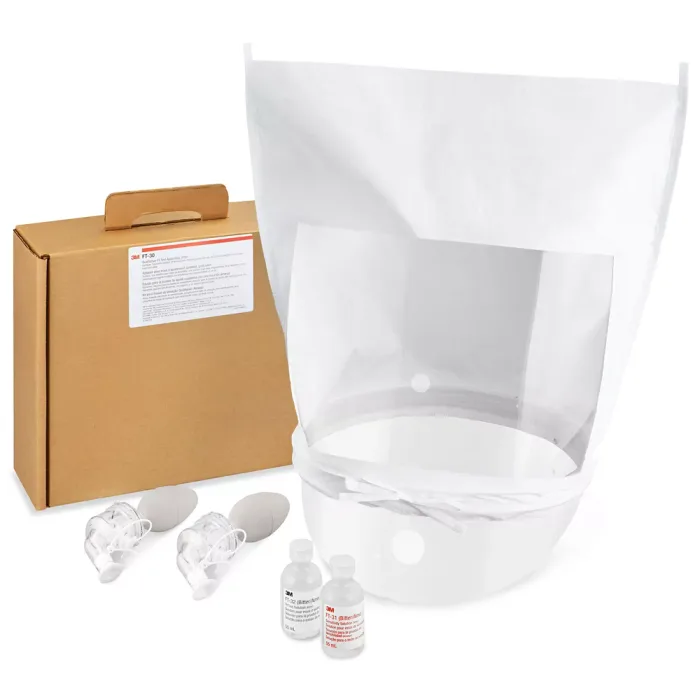
The complete Bitrex kit, with enough solution to test a whole crew and the fewest ways to get the protocol wrong.
Best for: Anyone testing more than one or two people, or a shop that wants a kit which will not run dry halfway through a session.
- Runs the Bitrex Solution Aerosol protocol named in OSHA Appendix A, using denatonium benzoate, the exact agent the regulation specifies.
- 3M puts one set of FT-31 sensitivity and FT-32 fit test solution at approximately 150 fit tests, several times what ampule kits deliver.
- The bitter agent avoids saccharin's habit of crystallising, which is why 3M tells saccharin users to empty and rinse the nebulizers at least every four hours.
- 3M states in its own data sheet that the FT-10 and FT-30 kits are not recommended for fit testing wearers who use a full facepiece respirator.
- 3M publishes no shelf life for the solutions, so a kit bought for one weekend project carries no stated expiry in either direction.
- A qualitative pass is worth a fit factor of 100 and no more, which under OSHA limits the respirator to ten times the exposure limit.
- It is a two-person job: one person injects aerosol into the hood every 30 seconds while the other works through seven one-minute exercises.
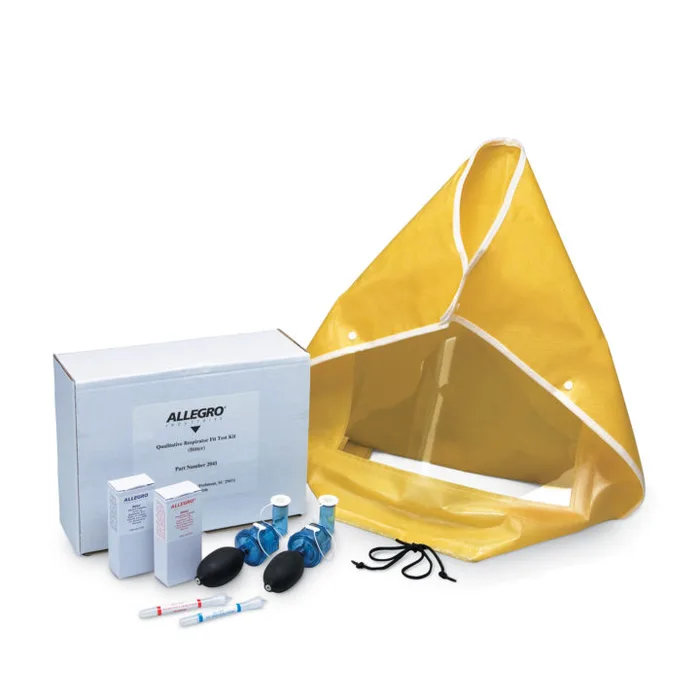
The same OSHA protocol at a lower cost of entry, with sealed ampules that solve the problem of solution sitting half used in a bottle for a year.
Best for: The homeowner or one-person shop checking two or three masks once, who would rather have fresh sealed solution than a large bottle that outlives the project.
- Sensitivity and fit test solutions come as one-time-use sealed glass ampules of 2.5 cc, so no opened bottle sits around collecting contamination.
- Allegro's spec sheet states the nebulizer converts 5 cc of liquid into an aerosol of 0.3 to 5.0 micron particle size, the range the protocol depends on.
- The kit includes a reusable poly-coated hood with a clear viewing window, both nebulizers, twelve ampules and the wire cleaner for the nebulizer's narrow passages.
- Allegro puts each ampule at an average of 3 to 5 fit tests, so a whole kit covers a fraction of what a bottle-based kit does.
- Allegro specifies the kit for disposable and reusable dust and mist respirators, not for full facepieces.
- The ampules are glass and meant to be snapped open, which is why the plastic sleeve is part of the design.
- Same ceiling as any qualitative method: pass or fail, no number, and nothing above a fit factor of 100.
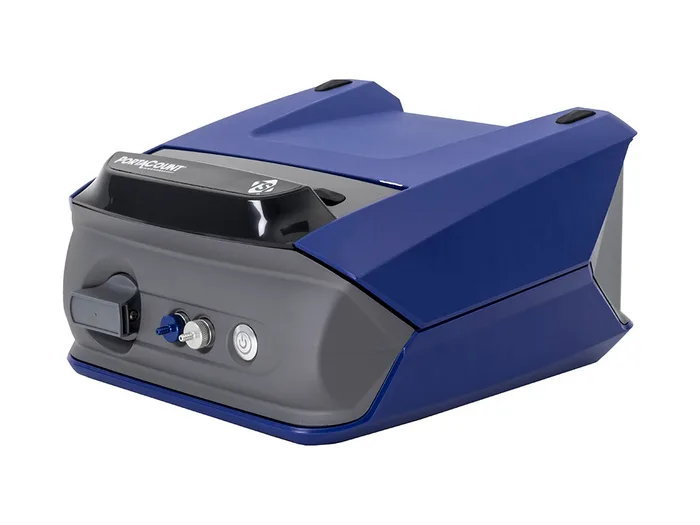
The only product here that answers with a number, which is exactly what you need if you run a respiratory protection program and pointless if you do not.
Best for: An employer, fire service, dental practice or contractor who has to record fit factors for other people and will use the instrument more than once a year.
- Measures fit factor directly from ambient particle counts across a range of 1 to greater than 10,000, so you learn how good the fit is, not just that it passed.
- TSI lists it as accepted for full facepiece and half facepiece tight-fitting elastomerics, and it runs the modified ambient aerosol CNC protocols OSHA added to Appendix A, which cut the exercise set from eight to four.
- It is the route in this group to demonstrating the fit factor of 500 that Appendix A requires before a full facepiece counts as passed.
- TSI's spec sheet lists a factory recalibration interval of one year, so this is an ongoing commitment rather than a purchase.
- The 8040 covers NIOSH Series-99 and Series-100 and EN FFP3 filter media. Fit testing an N95 filtering facepiece needs the 8048 with N95-Companion instead.
- It runs on 99.5 percent reagent grade isopropyl alcohol and needs a Windows laptop or tablet for the FitPro Ultra software.
- TSI lists 6.1 pounds for the unit and 14.45 pounds with standard accessories and case, so it is portable the way test equipment is portable.
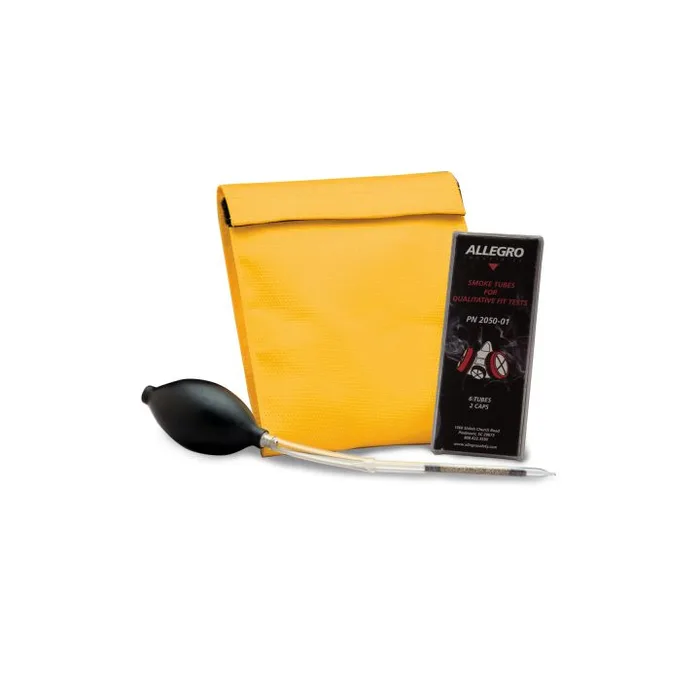
A legitimate OSHA protocol in a kit that belongs with trained administrators, because the test agent is corrosive and the pass signal is the absence of a cough.
Best for: Trained fit test administrators who already handle detector tubes and want a fast screen with no solutions to prepare, rather than anyone buying their first kit.
- Irritant Smoke (Stannic Chloride) is a named protocol in OSHA Appendix A, so this is a recognised method and not a novelty.
- It needs no hood, no nebulizer and no solutions to mix, and the whole kit lives in a vinyl pouch with an air bulb and six tubes.
- The response it looks for is involuntary, which removes the wearer's ability to talk themselves into a pass.
- Allegro's own safety data sheet classifies the tubes under the signal word Danger, with H314 causes severe skin burns and eye damage, H318 causes serious eye damage, and H335 may cause respiratory irritation.
- Allegro's spec sheet states the stannic chloride fumes strongly in moist air, forming white hydrochloric acid fume.
- Appendix A requires the subject to keep their eyes closed and the test conductor to minimise exposure to the smoke, so there is no sensible way to run it on yourself.
- It buys you the same fit factor 100 ceiling as a taste kit, from an agent that can injure you if a tube breaks or the aerosol is misdirected.
| Criteria | Qualitative Fit Test Apparatus FT-30, Bitter Top pick | Bitter (Denatonium Benzoate) Fit Test Kit 2041 | PortaCount Respirator Fit Tester Model 8040 | Smoke Test Kit, Standard 2050 |
|---|---|---|---|---|
| Verdict | Buy it | Buy it | It depends | Skip it |
| Best for | Anyone testing more than one or two people, or a shop that wants a kit which will not run dry halfway through a session. | The homeowner or one-person shop checking two or three masks once, who would rather have fresh sealed solution than a large bottle that outlives the project. | An employer, fire service, dental practice or contractor who has to record fit factors for other people and will use the instrument more than once a year. | Trained fit test administrators who already handle detector tubes and want a fast screen with no solutions to prepare, rather than anyone buying their first kit. |
| Price tier | $$ · mid-range | $ · budget | $$$ · premium | $ · budget |
| Method | Qualitative, taste response | Qualitative, taste response | Quantitative, ambient particle counting | Qualitative, involuntary irritation response |
| OSHA Appendix A protocol | Bitrex (denatonium benzoate) Solution Aerosol | Bitrex (denatonium benzoate) Solution Aerosol | Ambient aerosol CNC, plus both modified CNC protocols | Irritant Smoke (stannic chloride) |
| What the result tells you | Pass or fail | Pass or fail | A numeric fit factor, 1 to greater than 10,000 | Pass or fail |
| Fit factor ceiling | 100, the qualitative limit | 100, the qualitative limit | No practical ceiling; 500 is the full facepiece pass mark | 100, the qualitative limit |
| Respirators it can test | 3M says not recommended for full facepiece wearers | Allegro specifies disposable and reusable dust and mist respirators | Full and half facepiece elastomerics, Series-99, Series-100, EN FFP3 | Air-purifying respirators, subject to the qualitative ceiling |
| Consumable format and yield | Two solution bottles, approximately 150 fit tests per set | Twelve sealed 2.5 cc ampules, 3 to 5 tests each | Isopropanol supply rated for about 240 hours of operation | Six sealed glass smoke tubes |
| Published shelf life for the test agent | None published by 3M | None published by Allegro; ampules are single use | Not applicable, the consumable is alcohol | None published by Allegro |
| Agent hazard classification (manufacturer SDS) | Water, sodium chloride and denatonium benzoate | No pictogram, no signal word, no hazard statements | 99.5 percent reagent grade isopropyl alcohol | Danger. H314, H318, H335 |
Which one is right for you?
- Anyone testing more than one or two people, or a shop that wants a kit which will not run dry halfway through a session. Buy it 3M Qualitative Fit Test Apparatus FT-30, Bitter
- The homeowner or one-person shop checking two or three masks once, who would rather have fresh sealed solution than a large bottle that outlives the project. Buy it Allegro Industries Bitter (Denatonium Benzoate) Fit Test Kit 2041
- An employer, fire service, dental practice or contractor who has to record fit factors for other people and will use the instrument more than once a year. It depends TSI PortaCount Respirator Fit Tester Model 8040
- Trained fit test administrators who already handle detector tubes and want a fast screen with no solutions to prepare, rather than anyone buying their first kit. Skip it Allegro Industries Smoke Test Kit, Standard 2050
How we judged the field
Five things decide whether a fit test kit is worth owning. First is which Appendix A protocol it actually runs, because OSHA accepts a specific list and nothing outside it counts: four qualitative protocols (isoamyl acetate, saccharin solution aerosol, Bitrex solution aerosol and irritant smoke) and six quantitative ones (generated aerosol, ambient aerosol CNC, two modified ambient aerosol CNC protocols added by rulemaking in 2019, controlled negative pressure and CNP REDON). Second is what the result buys you, and this is where most buyers are surprised: a qualitative pass is worth a fit factor of 100, full stop, while a full facepiece needs a measured 500 before Appendix A calls it passed. Third is yield, meaning how many tests the consumables in the box will actually cover. Fourth is what happens to the test agent over time, since a kit that lives in a drawer between projects is a different proposition from one used weekly. Fifth is the hazard of the agent itself, which ranges from a sweetener to a substance the manufacturer labels with the signal word Danger.
The field splits cleanly along those lines. There are taste-based qualitative kits, which is what almost everyone means by a fit test kit: a hood, a nebulizer, a sensitivity solution and a fit test solution, sold either as bottles or as sealed ampules. There is one quantitative instrument in reach of a small organisation, which counts ambient particles inside and outside the mask and returns a real number. And there is the irritant smoke kit, which is a genuine OSHA protocol built on a corrosive test agent and an involuntary cough. We took one bottle-based taste kit, one ampule-based taste kit, the quantitative instrument and the smoke kit, and the honest verdict on the last one is that it works and still belongs in trained hands rather than a garage.
3M Qualitative Fit Test Apparatus FT-30, Bitter
Buy itThe FT-30 is the kit we would put in a shop that tests more than one person. It is 3M’s bitter kit, built on denatonium benzoate, and it runs the Bitrex Solution Aerosol protocol as Appendix A writes it: a sensitivity screening at 10, 20 or 30 squeezes, then that number halved and repeated every 30 seconds through seven one-minute exercises under the hood. The box holds the hood, the collar assembly, two nebulizers and the FT-31 sensitivity and FT-32 fit test solutions, and 3M’s own guidance puts one set of bottles at approximately 150 fit tests. That yield is the main argument for it. The bitter agent is the second, since 3M notes saccharin tends to clog and wants those nebulizers emptied and rinsed at least every four hours. Two limits matter before you buy. 3M states the kit is not recommended for people who wear full facepiece respirators, and 3M publishes no shelf life for the solutions at all. Buy it if you will test a crew, or test repeatedly.
Allegro Industries Bitter (Denatonium Benzoate) Fit Test Kit 2041
Buy itAllegro’s 2041 runs the identical protocol with a different consumable philosophy. Instead of bottles you keep reopening, the solutions arrive as sealed single-use glass ampules of 2.5 cc, six of sensitivity solution and six of fit test solution, each with a pre-drilled cap for pouring and a plastic sleeve so a snapped ampule does not cut you. That answers the quiet problem with a taste kit that lives in a drawer, which is a half-used bottle of concentrated solution nobody can date. The rest is straightforward and well specified: a reusable poly-coated hood with a clear window, a sensitivity nebulizer and a test nebulizer that Allegro says converts 5 cc into a 0.3 to 5.0 micron aerosol, and the wire cleaner for the narrow passages that crystals block. The price of the ampule format is yield. Allegro puts each ampule at an average of 3 to 5 fit tests, so the kit covers roughly twenty to thirty tests rather than a hundred and fifty. For one person checking two mask sizes once, that is the right end of the trade.
TSI PortaCount Respirator Fit Tester Model 8040
It dependsThe PortaCount 8040 is the only product here that stops guessing. It counts microscopic particles in ambient air inside and outside the facepiece simultaneously while the subject moves and breathes, and reports the ratio as a fit factor across a range TSI states as 1 to greater than 10,000. That changes the conversation. Instead of learning that a mask passed, you learn it scored 180 or 4,000, which tells you whether the fit is marginal or genuinely good, and it is the way in this group to demonstrate the 500 that Appendix A demands for a full facepiece. It also runs the shorter modified ambient aerosol CNC protocols that cut the exercise set from eight to four. The reasons this is a depends and not a buy are all in TSI’s own spec sheet. Factory recalibration is a one-year interval. The 8040 handles Series-99, Series-100 and EN FFP3 media, so an N95 filtering facepiece needs the 8048 instead. It wants isopropanol and a Windows machine. This is program equipment, not shop equipment.
Allegro Industries Smoke Test Kit, Standard 2050
Skip itThe 2050 smoke kit is a real protocol executed competently, and we would still steer most buyers away. Irritant smoke is one of the four qualitative methods Appendix A names, and Allegro’s kit is exactly what the method needs: a hand-operated air bulb, poly tubing, a breaker tool and six sealed stannic chloride tubes in a pouch. No solutions, no hood, no threshold screening. The problem is what you are handling. Allegro’s own safety data sheet classifies the tubes with the signal word Danger and the hazard statements H314 causes severe skin burns and eye damage, H318 causes serious eye damage and H335 may cause respiratory irritation, with stannic chloride at 10 to 12 percent. Allegro’s spec sheet adds that the agent fumes strongly in moist air, forming white hydrochloric acid fume. Appendix A has the subject keep their eyes closed while the conductor limits exposure, which rules out any self-administered version. For the same fit factor 100 ceiling, a taste kit does the job without the burn risk.
Sources
Specs in this review come from these pages.
- OSHA, 29 CFR 1910.134 Appendix A, Fit Testing Procedures (Mandatory) (osha.gov)
- OSHA, 29 CFR 1910.134, Respiratory Protection (osha.gov)
- Federal Register, Additional Ambient Aerosol CNC Quantitative Fit Testing Protocols: Respiratory Protection Standard (September 26, 2019) (federalregister.gov)
- 3M, Qualitative Fit Testing: Frequently Asked Questions (April 2024) (multimedia.3m.com)
- TSI, PortaCount Respirator Fit Tester Model 8040 specification sheet (tsi.com)
- Allegro Industries, Safety Data Sheet, Irritant Smoke Tube 2050 / 2050-01 / 2055 (allegrosafety.com)
3M Qualitative Fit Test Apparatus FT-30, Bitter vs Allegro Industries Bitter (Denatonium Benzoate) Fit Test Kit 2041: which should you buy?
The choice between the 3M FT-30 and the Allegro 2041 is not about accuracy, because they run the same OSHA protocol with the same agent and the same hood-and-nebulizer apparatus. It is about how many tests you need and how long the kit will sit idle. 3M sells solution in bottles and puts a set at approximately 150 fit tests, which is a serious amount of testing and the reason the FT-30 is the one to own if you are checking a work crew, a household of several people, or the same person every year for a decade. The cost of that format is the open bottle. 3M has no published shelf life for it, tells you to discard anything left in the nebulizer rather than pour it back, and tells you to bin the solution if it turns cloudy. That is a maintenance relationship, not a purchase.
Allegro takes the opposite position. Twelve sealed ampules of 2.5 cc, three to five tests each, nothing open until the moment you use it. You get somewhere in the region of twenty to thirty tests out of the box, which is far less, but every one of them starts with solution that has never met air. So: if fit testing is a recurring job, buy the FT-30 and accept the housekeeping. If you are buying a kit because you just bought a half mask and want to know which of two sizes actually seals, buy the 2041, snap one ampule and be done. Either way, budget for a second person, because neither test can be run alone in any way Appendix A would recognise.
What to look for
- Check the protocol by name: OSHA accepts four qualitative protocols and six quantitative ones in Appendix A, and a kit that does not map onto one of them by name is not running an accepted test no matter what the box says about compliance.
- Understand what a pass buys you: qualitative testing may only be used on negative pressure air-purifying respirators needing a fit factor of 100 or less, so a taste kit cannot sign off a full facepiece and 3M explicitly does not recommend its kits for full facepiece wearers.
- Count the tests, not the bottles: ampule kits average a handful of tests per ampule while bottle kits are quoted in the hundreds, and that single number decides which format is cheaper for the way you will actually use it.
- Look for a stated shelf life and expect not to find one: 3M states there is no published shelf life for its solutions and Allegro’s safety data sheets list no storage requirements, so sealed single-use ampules are the only format that removes the question.
- Read the safety data sheet on the test agent: taste solutions carry no signal word and no hazard statements, while irritant smoke tubes carry Danger with severe skin burns, serious eye damage and respiratory irritation, which is a real difference in what you are bringing home.
- Plan for two people and a clean shave: Appendix A is written around a test conductor separate from the subject, forbids adjusting the respirator once exercises begin, and bars the test entirely if any hair crosses the sealing surface.
Our final take
Buy the 3M FT-30 if fit testing is something you will do more than once, because the bitter agent behaves better than saccharin in a nebulizer and one set of bottles covers roughly 150 tests. Buy the Allegro 2041 if you want one honest answer about one mask, because sealed ampules make an idle kit a non-issue. Take the PortaCount 8040 only if you are documenting fit factors for other people and can live with annual recalibration. Leave the 2050 smoke kit to trained administrators. Then remember what none of these replace: a user seal check every single time you don the mask, and a clean sealing surface, which does more for your lungs than any certificate.
Questions, answered
Can I fit test myself at home?
Not properly, and it is worth being blunt about why. OSHA Appendix A is written around a test conductor who is a different person from the test subject: the conductor prepares the solutions, runs the sensitivity screening, injects aerosol into the hood every 30 seconds, watches for invalid tests and records the outcome. The subject spends seven minutes doing timed exercises under a hood and is not allowed to touch the respirator once those exercises start, because any adjustment voids the test. A taste test also rests entirely on the subject honestly reporting a taste they would rather not report. Run on yourself, with nobody timing you and nobody to say the run was invalid, a pass is closer to a hopeful guess than a measurement. Where a kit genuinely earns its keep at home is with a second person, comparing two sizes of the same mask to find which one leaks.
Why can't I skip the sensitivity screening and go straight to the fit test?
Because the screening is what lets the fit test mean anything. The whole logic of a taste protocol is negative evidence: you did not taste the agent, therefore it did not get past the seal. That inference only works if you have already proved you can taste the agent at all. Appendix A has the conductor deliver 10 squeezes, then 10 more, then 10 more, and if the subject still tastes nothing after 30 squeezes they may not perform that fit test. 3M's guidance is the same, and adds that you switch agents, from sweet to bitter or the reverse, rather than proceed. The number of squeezes that worked also sets the dose used during the actual test, halved and repeated every 30 seconds. Skip the screening and a clean pass and a person with no sensitivity to saccharin look identical.
What fit factor do I need, and what does a qualitative pass actually prove?
Appendix A sets two numbers for quantitative testing. A half mask or quarter facepiece passes at a minimum fit factor of 100, and a full facepiece passes at a minimum fit factor of 500. Qualitative testing does not produce a fit factor at all; it produces pass or fail, and 3M describes a qualitative pass as equivalent to a fit factor of 100. OSHA's rule follows from that: qualitative testing may only be used on negative pressure air-purifying respirators that need a fit factor of 100 or less, which in practice means atmospheres no worse than ten times the exposure limit. That is why a full facepiece cannot be signed off with a taste kit. If you need the higher protection a full facepiece is capable of, you need a quantitative test that can actually measure to 500.
Do the test solutions expire?
The honest answer is that the kits do not tell you. 3M's own fit testing FAQ states plainly that there is no published shelf life for the solutions, and Allegro's safety data sheets list no storage requirements or expiry either. What the manufacturers do say is about contamination rather than age. 3M says any solution left in a nebulizer at the end of a session should be discarded rather than poured back into the bottle, and that cloudy solution is likely contaminated and should be thrown out, while clear crystals at the bottom of a saccharin bottle can be redissolved under warm water. Allegro sidesteps the question by supplying single-use sealed ampules. If your kit is going to sit unused between projects, ampules are the format that removes the guesswork.
I have a beard. Will a fit test kit tell me whether my mask still works?
No, and OSHA does not let you run the test to find out. Appendix A states the test shall not be conducted if there is any hair growth between the skin and the facepiece sealing surface, including stubble, a beard, a moustache or sideburns crossing the seal. The standard itself bars employers from letting anyone wear a tight-fitting respirator with facial hair that comes between the sealing surface and the face. NIOSH is equally direct, noting that even a day or two of stubble can reduce protection and that people with beards fail fit testing, which makes tight-fitting respirators unsuitable for them. 3M says the same in its guidance. The genuine alternative is a loose-fitting powered air-purifying respirator, which supplies filtered air under a hood and does not rely on a face seal, so it does not need a fit test in the first place.
Deciding between the top two? See our head-to-head: 3M Qualitative Fit Test Apparatus FT-30, Bitter vs Allegro Industries Bitter (Denatonium Benzoate) Fit Test Kit 2041.
More Health & Wellness reviews
 The Best Reusable Respirators: 4 Compared (and One to Skip)
  The Best Seat Cushions for Office Chairs: 4 Compared (and One to Skip)
  The Best Silk and Satin Sleep Bonnets: 4 Compared (and One to Skip)
  The Best Sleep Masks: 4 Compared (and One to Skip)
  The Best Smart Rings: 4 Compared (and One to Skip)
  Best Smart Bathroom Scales for 2026