

Tools & DIY
The Best Pipe Heat Cables: 4 Compared (and One to Skip)
We compared four plug-in pipe heat cables on cable type, watts per foot, the safety listing and ground-fault rules in each maker's own documents, pipe material limits and whether the cable may overlap.
The short version
The Heat-Line Paladin for Pipe is the best overall pick: a self-regulating cable with a ground-fault interrupter built into the plug, cCSAus certification, wet location and direct burial approvals, permission to overlap and a 5 year limited warranty. The Raychem FrostGuard 120 V is the value pick, a preassembled self-regulating cable in lengths from 6 to 100 ft with a CSA mark and a lighted plug, but you must supply the ground-fault protected outlet yourself. The Wrap-On Pipe Heating Cable suits budget buyers with small pipes who will follow its strict rules: spiral wrap only, no touching or crossing, and fiberglass insulation only. Skip the Frost King HC series kit, whose maker documents name no safety listing, contradict each other on pipe size and carry a 1 year warranty. Whatever you buy, read the installation sheet before you cut insulation, and call an electrician if there is no ground-fault protected outlet near the pipe. Best for: crawl spaces, unheated garages and exposed supply lines where the pipe cannot be rerouted or the space heated.
Our picks at a glance
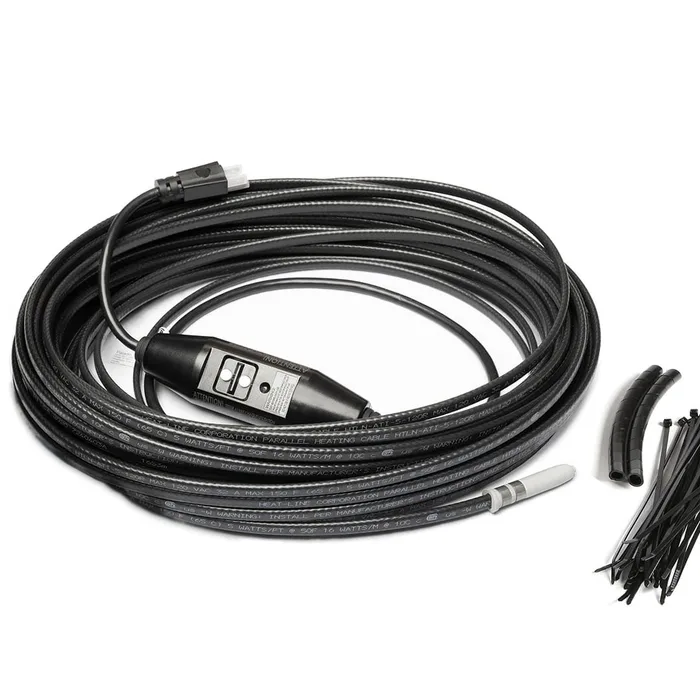
- Heat-Line Paladin for Pipe (120 V GFC) - Buy. A self-regulating pipe cable with a ground-fault interrupter built into the plug and the broadest approvals in this group.
- Raychem FrostGuard 120 V Preassembled Heating Cable - Buy. A preassembled self-regulating cable with a lighted plug, sold in eight lengths for metal or plastic pipes up to 2-1/2 inches.
- Wrap-On Pipe Heating Cable - It depends. A low-wattage thermostat cable rated at 2 watts per foot that only works if you follow its spiral-wrap and fiberglass-only rules.
- Frost King Automatic Electric Heat Cable Kit (HC series) - Skip. A common hardware-store thermostat cable whose own documents leave out a safety listing and disagree on what pipe it fits.
The verdict in 30 seconds
What mattered most
- Cable type
- Rated output
- Lengths (120 V)
- Safety mark in maker docs
- Ground-fault protection
- Overlap allowed
A plug-in heat cable is a cheap way to keep an exposed supply pipe from freezing, and an easy way to start a fire if it is installed against the maker's instructions. The field splits in two: self-regulating cables that turn their own output down as the pipe warms, and constant-wattage cables that put out a fixed heat whenever a built-in thermostat switches them on. We picked two self-regulating systems, one low-wattage thermostat cable and one popular thermostat cable whose documents leave too many gaps. Every spec and safety rule below comes from the maker's own page or installation sheet, and where a maker does not state something, we say so.
A self-regulating pipe cable with a ground-fault interrupter built into the plug and the broadest approvals in this group.
Best for: Owners who want the most forgiving installation rules and a ground-fault device in the box, and who can measure their pipe run accurately.
- The 120 V GFC models come with a 27 milliamp ground-fault circuit interrupter plug-in device, so protection does not depend on your outlet.
- Heat-Line states it can be used on plastic and metal pipes, on dry pipes, overlapped and fully insulated.
- It is cCSAus certified and approved for wet locations and direct earth burial, with a 5 year limited warranty and an optional 10 year extended warranty.
- It is built to order in 10 ft steps and Heat-Line says it can never be cut shorter or lengthened, so you must measure before ordering.
- On 120 V the standard lengths stop at 120 ft; longer runs need a 240 V system or the EXT-R series.
- It does not switch fully off on its own; Heat-Line says to unplug it or add a thermostat such as its HLA-120 plug-in unit.
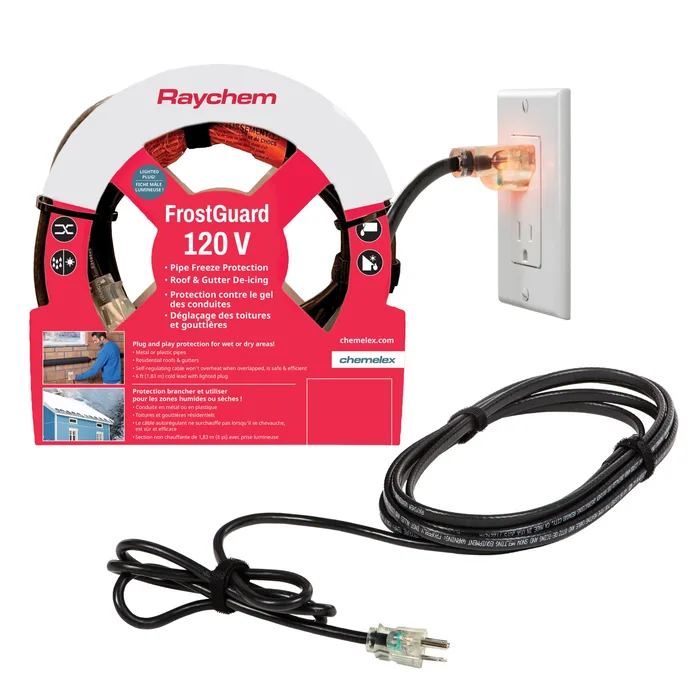
A preassembled self-regulating cable with a lighted plug, sold in eight lengths for metal or plastic pipes up to 2-1/2 inches.
Best for: Homeowners with a ground-fault protected outlet near the pipe who want a self-regulating cable they can buy off the shelf in a standard length.
- The 120 V version comes in 6, 12, 18, 24, 36, 50, 75 and 100 ft lengths, each with a 6 ft power cord and a lighted, grounded 3-prong plug.
- Chemelex states the self-regulating cable cannot overheat even when overlapped or closely spaced, and leftover cable can be spiraled or doubled back.
- The datasheet shows a CSA mark for Canada and the US, and the manual gives clear insulation rules, including 1 inch insulation for protection to -20 F.
- There is no ground-fault device on the cord; Chemelex requires 30 mA equipment or 5 mA personnel ground-fault protection on the circuit.
- Chemelex says not to use an extension cord, so you need a protected outlet within reach of the 6 ft lead.
- The minimum installation temperature is 5 F, and the manual says not to use it on flexible vinyl tubing such as garden hoses.
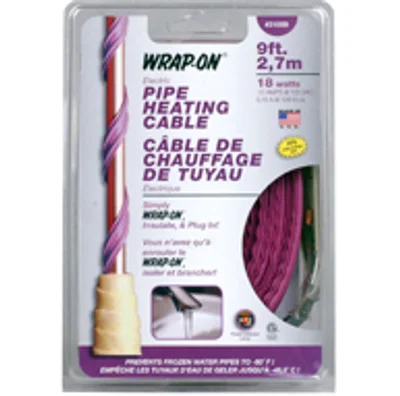
A low-wattage thermostat cable rated at 2 watts per foot that only works if you follow its spiral-wrap and fiberglass-only rules.
Best for: Budget buyers protecting a short run of small metal or rigid plastic pipe who are prepared to spiral the cable carefully and use fiberglass wrap.
- At 2 watts per foot it draws far less than the 7 watt per foot thermostat cables, and Wrap-On rates it to protect pipes to -50 F when properly insulated.
- The instruction sheet carries a c-UL-us Listed mark, and a Press-To-Test button lets you check the cable before installing.
- It comes in twelve lengths from 3 ft to 100 ft, with a 2 year limited warranty.
- The cable must be spiraled around the pipe with wraps 3 to 12 inches apart and must not touch, cross over or overlap itself.
- Wrap-On allows fiberglass pipe insulation only and warns that foam insulation may cause overheating or fire, so most hardware-store foam sleeves are out.
- Its Q&A says it is designed for water pipes 1 inch or less in diameter, and its sheet treats a GFCI as additional protection rather than a requirement.
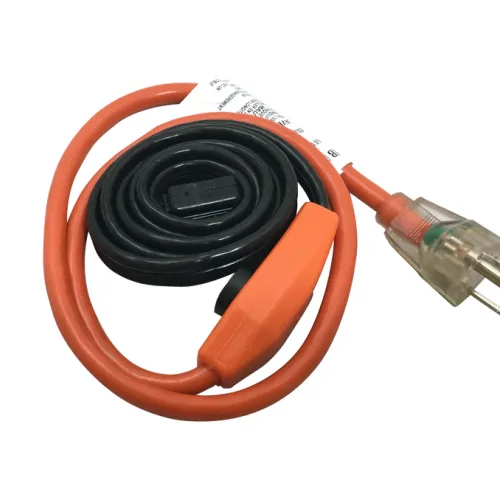
A common hardware-store thermostat cable whose own documents leave out a safety listing and disagree on what pipe it fits.
Best for: Nobody we would steer to it first; the Wrap-On or either self-regulating pick documents its safety basics more clearly.
- The built-in thermostat turns the cable on below 38 F and off above 45 F, and the plug has a power light.
- Frost King gives a clear selection chart and an ice-bag test for checking the thermostat.
- It is sold in seven lengths from 3 ft to 30 ft at 120 V and 7 watts per foot.
- Neither the product page nor the instruction sheet we loaded names a UL, ETL or CSA listing.
- The product page says it is for 2 in. pipes, while the FAQ and selection chart cover 3/8 in. to 1-1/2 in., and plastic pipe only if it is Schedule 40 primary supply pipe.
- It must never be overwrapped or doubled, the longest kit is 30 ft, and the warranty is twelve months.
| Criteria | Heat-Line Paladin for Pipe (120 V GFC) Top pick Buy it Buy | Raychem FrostGuard 120 V Preassembled Heating Cable Buy it Buy | Wrap-On Pipe Heating Cable It depends Buy | Frost King Automatic Electric Heat Cable Kit (HC series) Skip it Buy |
|---|---|---|---|---|
| Best for | Owners who want the most forgiving installation rules and a ground-fault device in the box, and who can measure their pipe run accurately. | Homeowners with a ground-fault protected outlet near the pipe who want a self-regulating cable they can buy off the shelf in a standard length. | Budget buyers protecting a short run of small metal or rigid plastic pipe who are prepared to spiral the cable carefully and use fiberglass wrap. | Nobody we would steer to it first; the Wrap-On or either self-regulating pick documents its safety basics more clearly. |
| Price tier | $$$ · premium | $$ · mid-range | $ · budget | $ · budget |
| Cable type | Self-regulating | Self-regulating | Constant wattage, thermostat | Constant wattage, thermostat |
| Rated output | 5 W/ft at 50 F | 6 W/ft on pipes at 40 F | 2 W/ft | 7 W/ft |
| Lengths (120 V) | 10 to 120 ft, 10 ft steps | 6 to 100 ft, 8 sizes | 3 to 100 ft, 12 sizes | 3 to 30 ft, 7 sizes |
| Safety mark in maker docs | cCSAus | CSA c-us | c-UL-us Listed | None stated |
| Ground-fault protection | 27 mA GFCI built into plug | 30 mA protection required, not included | Recommended, codes may require | Not stated in English text |
| Overlap allowed | Yes, per maker | Yes, per maker | No, must not touch or cross | No, never overwrap |
| Pipe limits stated | Plastic and metal, dry pipes OK | Metal or plastic up to 2-1/2 in. | Metal or rigid plastic rated 140 F+ | 3/8 to 1-1/2 in. per chart |
| Insulation rule | Optional, may fully insulate | At least 1/2 in. fire-resistant, waterproof | Fiberglass only, no foam | 1/2 in. fiberglass or non-combustible |
| Warranty | 5 yr limited, 10 yr extended option | 2 yr available | 2 yr limited | 12 months |
Which one is right for you?
- Owners who want the most forgiving installation rules and a ground-fault device in the box, and who can measure their pipe run accurately. Buy it Heat-Line Paladin for Pipe (120 V GFC)
- Homeowners with a ground-fault protected outlet near the pipe who want a self-regulating cable they can buy off the shelf in a standard length. Buy it Raychem FrostGuard 120 V Preassembled Heating Cable
- Budget buyers protecting a short run of small metal or rigid plastic pipe who are prepared to spiral the cable carefully and use fiberglass wrap. It depends Wrap-On Pipe Heating Cable
- Nobody we would steer to it first; the Wrap-On or either self-regulating pick documents its safety basics more clearly. Skip it Frost King Automatic Electric Heat Cable Kit (HC series)
How we judged the field
Five things decide whether a plug-in pipe cable is a good buy. The cable type comes first, because self-regulating and constant-wattage cables have different installation rules, especially about overlapping. Second is the safety listing and the ground-fault rule, which should be printed on the maker’s own page or sheet. Third is the pipe the maker allows: metal, rigid plastic, Schedule 40 only, or a maximum diameter. Fourth is the insulation the maker requires, because the wrong insulation can turn a freeze fix into a fire risk. Fifth is how the length works, whether you buy a fixed kit, order to length or need to cut and terminate a reel.
The field splits into premium self-regulating systems, mid-range preassembled self-regulating cables, and budget thermostat cables. We picked the self-regulating system with the most complete approvals, a widely sold preassembled self-regulating cable, a low-wattage thermostat cable with a documented UL listing, and a common thermostat kit whose documents fall short. Neighbouring reviews cover the tools around the job: our pipe wrench and tankless water heater comparisons for plumbing work, and smart thermostats for the house itself.
Heat-Line Paladin for Pipe (120 V GFC)
Buy itThe Heat-Line Paladin for Pipe is a self-regulating cable sold as a factory-finished system, and its 120 V GFC models plug into an ordinary receptacle through a 4 ft lead with a 27 milliamp ground-fault circuit interrupter plug-in device. That one detail removes the most common gap in a plug-in install. Heat-Line rates it at 5 W/ft at 50 F, and says it suits plastic and metal pipes, dry pipes, overlapping and full insulation. It is cCSAus certified, and its approvals include wet location and direct earth burial. The trade-off is ordering: Paladin comes in 10 ft steps up to 120 ft on 120 V, and Heat-Line says it can never be cut or lengthened, so a wrong measurement means looping the extra or buying again. It also idles rather than switching off, so Heat-Line suggests unplugging it in summer or adding its plug-in thermostat. The warranty is 5 years, with a 10 year extension available. It is the pick for anyone who wants the most forgiving rules and is willing to measure carefully first.
Raychem FrostGuard 120 V Preassembled Heating Cable
Buy itThe Raychem FrostGuard 120 V is the self-regulating cable most people can buy off a shelf. Chemelex sells it preassembled in 6, 12, 18, 24, 36, 50, 75 and 100 ft lengths, each with a 6 ft power cord and a lighted, grounded plug, for metal or plastic pipes up to 2-1/2 inches. Output is 6 W/ft on pipes at 40 F, and Chemelex states the cable will not overheat when overlapped or closely spaced, which is why its manual tells you to spiral or double back any extra length. The datasheet shows a CSA mark for Canada and the US. The catch is the outlet: the cord has no ground-fault device, and Chemelex requires 30 mA equipment or 5 mA personnel protection on the circuit, plus no extension cords. The manual also calls for at least 1/2 inch of fire-resistant, waterproof insulation, 1 inch for protection to -20 F, and a minimum installation temperature of 5 F. It is the value pick for anyone who already has a protected outlet close to the pipe.
Wrap-On Pipe Heating Cable
It dependsThe Wrap-On Pipe Heating Cable is a constant-wattage cable with a built-in thermostat that Wrap-On says turns on at about 38 F and off at about 45 F, sensing air rather than pipe temperature. Its strength is efficiency: 2 watts per foot, against 7 for the Frost King, with protection rated to -50 F when properly insulated. The instruction sheet carries a c-UL-us Listed mark and lists steel, copper, ABS, PVC, CPVC or other plastic pipe rated for at least 140 F. The rules are strict, though. The cable must be spiraled with wraps no more than 12 and no less than 3 inches apart, it must not touch, cross or overlap itself, and Wrap-On allows fiberglass insulation only, warning that foam may cause overheating or fire. Its Q&A recommends 1-1/2 inches of fiberglass and says the cable is designed for pipes 1 inch or less in diameter. Wrap-On calls a GFCI additional protection that some codes require. Buy it for a short, small pipe if you will follow every rule.
Frost King Automatic Electric Heat Cable Kit (HC series)
Skip itThe Frost King Automatic Electric Heat Cable Kit is easy to find and cheap, and on paper it does the basics: a thermostat that turns on below 38 F and off above 45 F, 7 watts per foot at 120 V, and lengths from 3 to 30 ft. The problem is the paperwork. The product page says it is for 2 in. metal and plastic water pipes, while the FAQ and the selection chart cover 3/8 to 1-1/2 inches, and plastic only if it is Schedule 40 primary supply pipe. Neither the product page nor the instruction sheet we loaded names a UL, ETL or CSA listing, and the English instructions do not spell out a ground-fault requirement. The cable must never be overwrapped, must be taped with tape rated to at least 176 F and must be covered with 1/2 inch fiberglass or equivalent non-combustible insulation. The warranty is twelve months. Not unsafe on its face, but for a product you leave plugged in all winter, the Wrap-On or either self-regulating pick documents far more.
Sources
Specs in this review come from these pages.
- Heat-Line: Paladin for Pipe product page (heatline.com)
- Chemelex: Raychem FrostGuard Freeze Protection Plug-in Kit (chemelex.com)
- Chemelex: FrostGuard 120 V installation manual (cdn.chemelex.com)
- Wrap-On: Pipe Heating Cable product page (wrap-on.com)
- Frost King: Automatic Electric Heat Cable Kits (frostking.com)
- Frost King: Heat Cable instruction sheet (frostking.com)
Heat-Line Paladin for Pipe (120 V GFC) vs Raychem FrostGuard 120 V Preassembled Heating Cable: which should you buy?
The Paladin and the FrostGuard are the same kind of cable, and both makers say their cable can be overlapped and insulated without overheating. The differences are in the box and the buying process. Paladin includes a 27 mA ground-fault interrupter at the plug, carries wet location and direct burial approvals, and comes with a 5 year limited warranty, but it is made to order in 10 ft steps and cannot be cut. FrostGuard comes in standard retail lengths, outputs 6 W/ft on pipes at 40 F against Paladin’s 5 W/ft at 50 F, and carries a CSA mark, but it relies on your circuit for ground-fault protection.
Choose by your outlet and your run. If the nearest outlet is not ground-fault protected, or the pipe runs somewhere damp, the Paladin’s built-in protection and wet location approval are worth the premium. If you already have a protected outlet within 6 ft and your pipe length fits one of FrostGuard’s eight sizes, the FrostGuard does the same job for less. Either way, if the outlet situation is unclear, have an electrician check it before installing.
What to look for
- Cable type: Self-regulating cables adjust their own output and the makers here allow overlap; constant-wattage cables need exact spacing and must never cross.
- A named listing: Look for UL, ETL or CSA printed on the maker’s page or instructions, not just on a retail listing.
- Ground-fault rule: Check whether the plug includes a GFCI or whether the maker requires one on the outlet, and do not use an extension cord where the maker forbids it.
- Pipe compatibility: Read the exact materials and diameters allowed; some cables exclude hoses, flexible tubing or plastic that is not Schedule 40.
- Insulation spec: Use the insulation type and thickness the cable maker names, because some forbid foam outright.
- Length logic: Know whether you are buying a fixed kit, an order-to-length system or a reel, and whether extra cable may be spiraled or doubled back.
Our final take
For most exposed supply pipes, buy a self-regulating cable. The Heat-Line Paladin for Pipe is the best overall choice because it puts ground-fault protection in the plug, carries the broadest approvals and allows overlap and full insulation, provided you measure your run before ordering. The Raychem FrostGuard 120 V is the value pick if your outlet is already ground-fault protected and a standard length fits. The Wrap-On cable is a careful budget choice for small pipes when you can spiral it and use fiberglass. Skip the Frost King kit. Whichever you choose, follow the installation sheet exactly, and bring in an electrician if the outlet or circuit is in doubt.
Questions, answered
What is the difference between self-regulating and constant-wattage heat cable?
A self-regulating cable has a conductive polymer core that puts out more heat where the pipe is cold and less where it is warm, along its whole length. A constant-wattage cable puts out the same heat per foot whenever its thermostat closes, so it relies on that thermostat and on correct spacing to avoid hot spots. That is why the two self-regulating picks here allow overlapping, while Wrap-On and Frost King forbid it. Self-regulating cables generally cost more up front. Neither type replaces insulation; every maker here pairs its cable with insulated pipe.
Do I need a GFCI outlet for a pipe heat cable?
It depends on the product, and the maker's sheet is the rule to follow. Chemelex requires 30 mA equipment or 5 mA personnel ground-fault protection for FrostGuard, and the Paladin GFC models build a 27 mA ground-fault interrupter into the plug. Wrap-On describes a GFCI as additional protection and notes that some codes require it. If the outlet near your pipe is not protected and the product calls for it, have an electrician add protection rather than running an extension cord.
Can I use a heat cable on PEX or PVC pipe?
Check the exact wording for your cable. Chemelex lists FrostGuard for metal or plastic water pipes but not flexible vinyl tubing such as garden hoses. Wrap-On lists steel, copper, ABS, PVC, CPVC or other plastic pipe rated for at least 140 F. Frost King limits plastic use to Schedule 40 primary supply pipe between 3/8 and 1-1/2 inches in outside diameter, and says not to use its kit on mobile home feed lines or hoses. Heat-Line states Paladin is suitable for plastic and metal pipes.
What insulation should go over the cable?
Follow the cable maker, not the insulation aisle. Chemelex calls for at least 1/2 inch of fire-resistant, waterproof insulation such as preformed foam or fiberglass, and 1 inch for protection to -20 F. Wrap-On allows fiberglass only and warns that foam may cause overheating. Frost King specifies 1/2 inch fiberglass or an equivalent non-combustible insulation with a vapor seal. Heat-Line says Paladin can be fully insulated.
Can I put a pipe heat cable inside a wall or ceiling?
None of these makers allows that for these products. Frost King says never to install its kits in walls, floors or ceilings, and Chemelex says to install FrostGuard only in accessible locations and not to run it through walls, ceilings or floors. Wrap-On says its cable should not pass through a wall, floor or roof or be enclosed in joist or stud spaces. A frozen pipe inside a wall is a job for a plumber or a heating fix, not a plug-in cable.
Deciding between the top two? See our head-to-head: Heat-Line Paladin for Pipe (120 V GFC) vs Raychem FrostGuard 120 V Preassembled Heating Cable.
More in Tools & DIY
Pipe Heat Cables, Explained Plain-English guide → Heat-Line Paladin for Pipe (120 V GFC) vs Raychem FrostGuard 120 V Preassembled Heating Cable Head-to-head →  The Best Pipe Wrenches: 4 Compared (and One to Skip)
 The Best Pocket Hole Jigs: 4 Compared (and One to Skip)
 The Best Precision Screwdriver Sets: 4 Compared (and One to Skip)
 The Best Random Orbital Sanders: 4 Compared (and One to Skip)