

Analysis
The Number in the Name
Three camp lanterns are named after their lumen rating. The fourth has no number in its name and publishes no output figure anywhere.
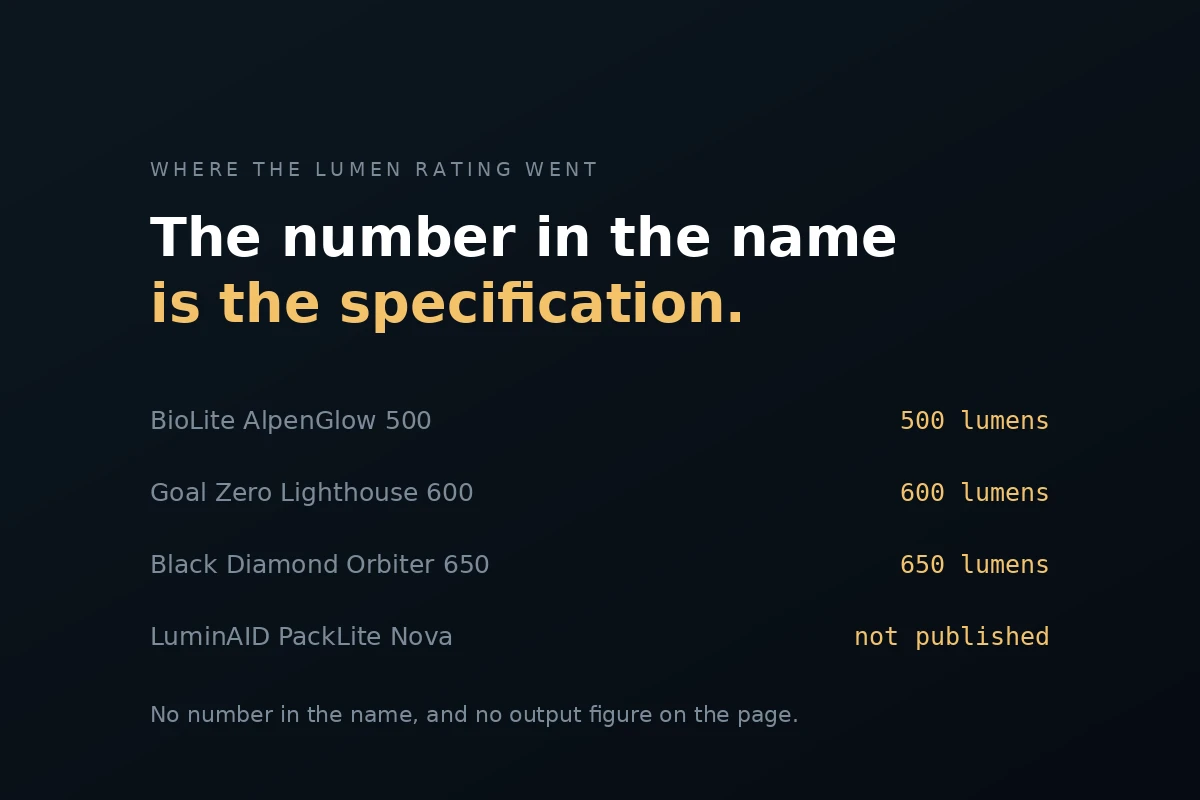
Line up four camp lanterns and read their names.
BioLite AlpenGlow 500. Goal Zero Lighthouse 600. Black Diamond Orbiter 650. LuminAID PackLite Nova.
Three of those numbers are the lumen rating. The naming convention in this category has quietly absorbed the headline specification, so the product tells you how bright it is before you have read anything about it. Genuinely useful, as conventions go. You can rank a shelf without opening a browser.
Then there is the fourth one.
The one without a number
The LuminAID PackLite Nova has no figure in its name, and its product page has no figure either. No lumens. No runtime. No battery capacity. What it offers instead is this:
Choose from two models: Nova Colors, 5 levels of white light plus 8 color modes with a Twist-to-Inflate design. Original Nova, 5 levels of white light.
Five levels of white light. Five levels of what maximum, lasting how long, from what battery, the page does not say.
That is not a specification. It is a count of settings, and a count of settings on an unstated range describes nothing. A lantern with a 50 lumen maximum and one with a 500 lumen maximum can both offer five levels.
The omission bites harder here than it would elsewhere, because the Nova is a solar lantern. Solar input is slow and depends on weather and latitude, so runtime and battery size are the two things that determine whether it is useful on the second night. Those are exactly the two figures missing.
What the convention costs
Naming a lantern after its lumen rating works, right up until you notice what it trains you to do.
It makes brightness the axis of comparison, and brightness is close to the least useful specification in the category. Output and runtime trade against each other directly. Every camp task these things exist for, lighting a table, finding a sock, cooking, sits comfortably under 200 lumens. Running at the maximum in the name is mostly a way to flatten the battery before bed.
The lanterns we compared were 150 lumens apart at the top. At the bottom of their range they were 120 hours apart: 200 hours on low for the AlpenGlow, 240 for the Orbiter, 320 for the Lighthouse. Nobody puts the runtime in the product name. It is the number that decides the purchase.
There is a nice irony in the ranking, too. The brightest lantern of the three, the Orbiter 650, has the shortest high-setting runtime at 4 hours. The number in its name is the reason.
The difference between a name and a measurement
A model number that encodes a real, stated specification is doing honest work. AlpenGlow 500 is a fair name for a lantern whose page says 500 lm high, 5 lm low, 5 hours high, 200 hours low, 6400 mAh, 23.6 Wh, IPX4, CRI 90. The name is a summary of a page that backs it up.
The test is whether the number survives contact with the specification block. When it does, the name is a shortcut. When there is no specification block, a number in the name would be branding, and no number at all is what happens when a brand opts out of the convention entirely without replacing it with anything.
We have written before about one category name covering unrelated products. This is the inverse failure. The naming is doing the work the specification should do, so the category looks better documented than it is, and the moment a product declines to play along there is nothing underneath.
The habit worth having
Read the name. Then go and find that number stated as a measurement on the page, with a unit attached. If it is there, the name earned it. If the page has no output figure at all, you are looking at a product that has decided not to be compared, and you should treat the absence as the answer rather than assuming an oversight.
For lanterns specifically, skip past the brightness once you have confirmed it exists, and go to runtime. Check which setting each figure refers to, because a lantern quoting 200 hours is quoting its dimmest mode and one quoting 4 hours is quoting its brightest. That is the number you will care about on night three, and no manufacturer has ever put it in a product name.
Real Buyer Experiences is reader-supported and independent. We synthesize independent testing and owner reports into one honest verdict - we never trade a recommendation for payment. How we review →