

Analysis
Everyone Omits the Same Number: When a Gap Is a Category Norm
In some categories not one manufacturer publishes the spec that would let you compare. That is not competition. It's a convention.
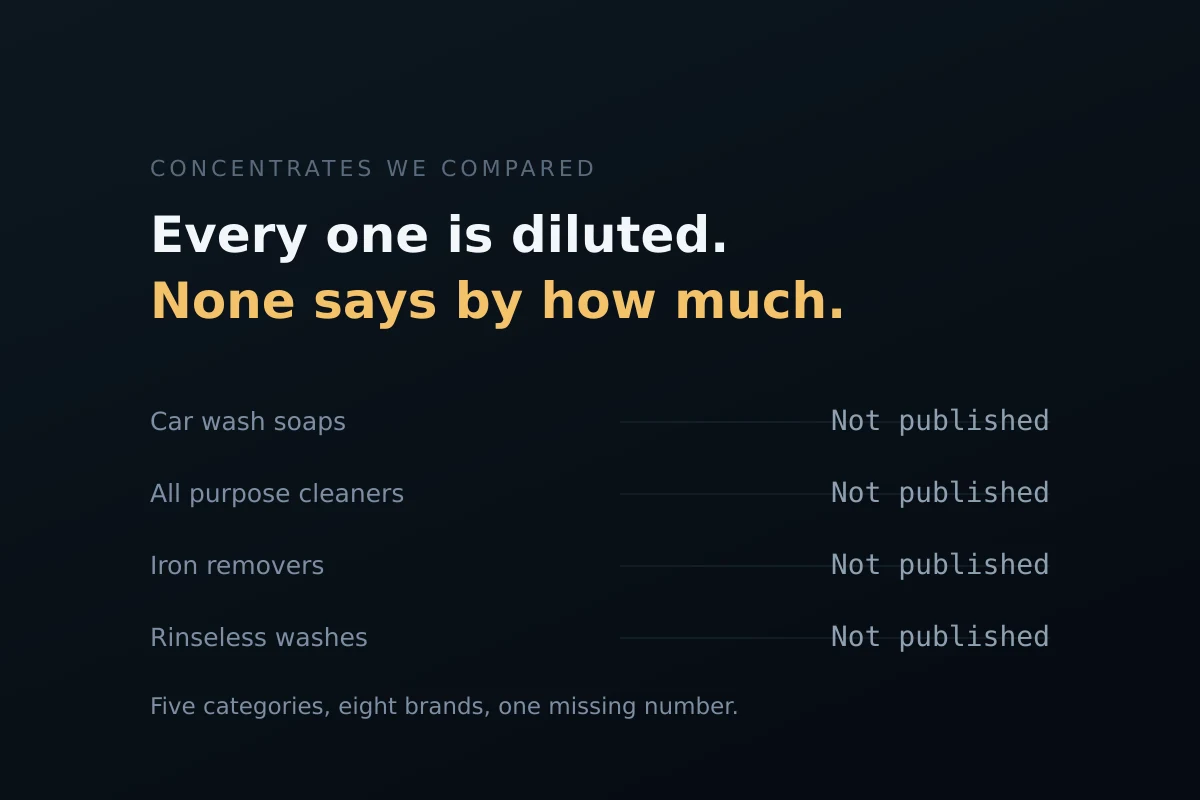
The most common entry in our comparison tables is not a number. It is the phrase Not published.
That started as an irritation and has become one of the more interesting things we track, because the gaps are not random. Within a category, the same specification tends to be missing from every product in it, including the expensive ones, including the ones from brands that publish generously about everything else. Which suggests the omission is not a competitive decision at all.
The clearest example
We have now compared car wash soaps, all purpose cleaners, iron removers, rinseless washes and bug removers. Every one of those products is sold as a concentrate. Not one of them publishes a dilution ratio.
Not one. Across five categories and roughly twenty products from eight manufacturers, spanning consumer brands and professional supply, the number that tells you how much water to add is absent everywhere.
It is not that these brands are shy about detail. The same pages carry biodegradability claims, pH language, surfactant descriptions and lists of cleared surfaces. One bottle advertises HIGHLY DILUTABLE on the label in capitals and still does not say by how much. Another describes being proportioned through a dilution device without naming a proportion.
The nearest anyone gets is Adam’s, which tells you a 16 ounce bottle makes up to sixteen rinseless washes, or over 250 ounces of spray at a thinner mix. That is a usage figure rather than a ratio, and it is the single most useful sentence we found in the entire chemical category.
Why it matters more than it sounds
A dilution ratio is not a nice-to-have on a concentrate. It is two things at once.
It is the price. A product that goes one ounce to a bucket and one that goes four differ by four times in cost per wash, and the number on the shelf tells you nothing about which you are holding. Comparing concentrates on bottle price is close to meaningless, and every brand in the category knows that.
And on some products it is a safety instruction. An all purpose cleaner at full strength strips grease from an engine bay and strips the plasticiser out of a dashboard, and the only thing standing between those two outcomes is how much water you added. The dilution is the control. Publishing everything except the control is a strange place to land.
The same shape, other categories
Iron removers are the second clearest case. All four we compared lean on a pH claim, because acid-free chemistry is the reason this category displaced acidic wheel cleaners. None publishes a pH figure. None names its active ingredient. None states a dwell time, which is the one variable the user controls and the one that decides whether the product works or dries on the paint and stains it.
Wheel brushes: the core is what scratches a wheel once the bristles flatten, and one of four mentions protecting it.
Detail brushes: shedding is the failure mode and the ferrule is the scratch risk, and of four pages, one names its bristle anchoring and one advertises being metal free.
Paint sealants: durability is the entire reason the category exists above wax, and three of four decline to quantify it.
Cordless ratchets and screwdrivers: torque is what tells you whether the tool will move a fastener. Craftsman publishes it. Makita publishes it. DeWalt publishes none, on either product.
That last one is different from the others, and the difference is the point.
One brand versus a whole field
When DeWalt omits torque and its competitors publish it, that is a competitive fact and we treat it as one. You can see the gap, you can weigh it, and the brand is choosing to be less informative than the shelf around it.
When every soap on the shelf omits its dilution ratio, nobody is being outcompeted on transparency, because there is nothing to be outcompeted by. The first brand to publish a ratio would be handing rivals a stick to measure it with and gaining nothing from customers who have never seen the number and do not know to want it. So nobody moves, and the convention holds.
That is not a conspiracy. It is an equilibrium, and it is remarkably stable. It also explains why the exceptions cluster in odd places: the brands that do publish tend to be professional supply houses selling to people who buy on cost per use, or consumer brands whose founders came from the trade.
What we do about it
We keep the empty cell. A comparison row reading Not published across all four columns looks like a failure of research and is actually the finding, so we leave it in and say what should have been there.
We give credit where a brand breaks ranks, because in a category where nobody publishes something, the one that does is taking a small commercial risk to be useful. Adam’s usage figures on rinseless wash, Makita’s runtime at each brightness on work lights, Detail Factory’s metal-free construction, P&S quoting the sanding grit its compound removes: those are the sentences that decide our picks more often than the headline specs do.
And we distinguish between the two kinds of gap. A brand quieter than its rivals has made a choice about you. A whole category that is quiet has made a choice about itself, and the useful response is not to punish one product but to tell you the number does not exist anywhere, so you can stop looking for it and buy on what is actually stated.
What you can do
When a spec seems suspiciously absent, check two or three competitors before concluding anything about the brand in front of you. If they all omit it, you have learned something about the category and you can stop comparing on a number nobody has. If only one omits it, you have learned something about the brand.
Then buy on what is published, and treat the brand that volunteered something awkward as more likely to be straight with you about the rest.
Real Buyer Experiences is reader-supported and independent. We synthesize independent testing and owner reports into one honest verdict - we never trade a recommendation for payment. How we review →