

Analysis
Read the Label, Not the Listing: Where the Spec Actually Lives
Over and over, the bottle in the product photo carries numbers the product page never mentions. Sometimes it contradicts them.
We compare products by reading their product pages. That is the obvious way to do it, and over the last few weeks it has been quietly failing. The pattern shows up often enough now that it has changed how we research: before writing anything, we zoom into the product photograph and read the bottle.
Because a surprising amount of the time, the bottle says more than the page does. And sometimes it says something different.
The clearest case
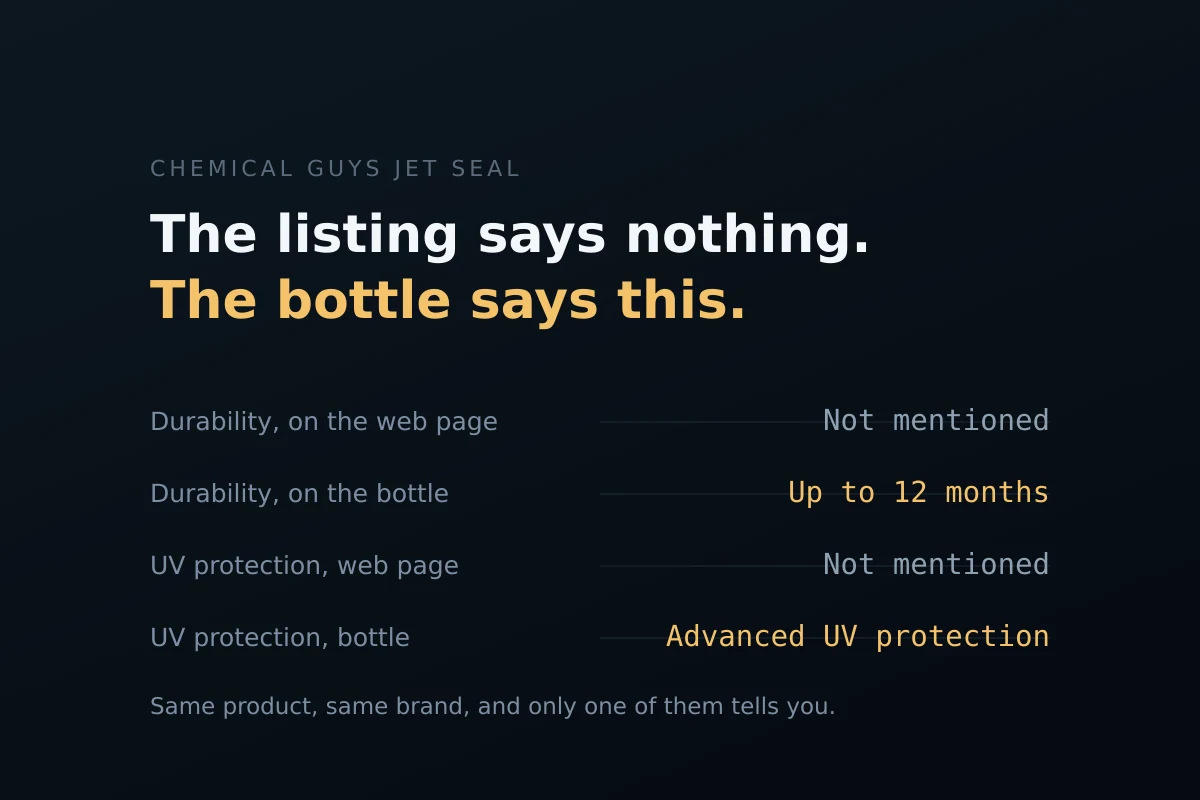
Chemical Guys sells a paint sealant called Jet Seal. Its online description runs to two sentences: a nano-tech polymer-based paint sealant developed for airplane exteriors, protecting against the harshest elements while leaving a brilliant glassy shine. That is the whole thing. No durability figure, which in a category that exists entirely because sealants last longer than wax is a strange omission.
Then look at the bottle in the product photo. Printed across the front, in capitals: UP TO 12 MONTHS OF PROTECTION. Under it, SHARP LUSTER FINISH and ADVANCED UV PROTECTION. Above those, a features box listing nano-tech polymers and hydrophobic properties.
Twelve months is the longest durability claim in its category. Advanced UV protection is the property that separates a sealant that preserves paint from one that only makes water bead. Neither appears anywhere in the text you would read if you were shopping from the website. We had written that product up as publishing no durability figure at all, which was wrong, and we only caught it because we look at the photographs before publishing.
The same brand, two different chemistries
Adam’s sells a professional spray sealant called Proline SHIELD. The product page describes fast, durable SiO2 protection from a ceramic-rich formula, and positions it as a coating topper or standalone protection.
The bottle says Polymer Based Spray Sealant.
Ceramic and polymer are not synonyms. They bond differently, age differently and carry different expectations, and the difference is precisely what a buyer choosing between a sealant and a coating is trying to establish. One of those two statements was written by someone who knew which it was.
The label filling a gap the page left
P&S sells a car wash concentrate called Pearl. Its description mentions being pH balanced, biodegradable, and proportionable through a dilution device, and gives no dilution ratio anywhere.
The bottle carries a bullet list: HIGHLY DILUTABLE, FOAM CANNON READY, SAFE ON ALL FINISHES, MILD ON HANDS. Still no ratio, but the label is at least advertising the property the page glosses over, which tells you the brand knows dilution is the selling point and has decided not to quantify it in either place.
Turtle Wax’s Luxe Leather works the other way round. The web copy positions it for sealed leather seats, door panels, dashboards and steering wheels. The bottle simply says LEATHER | VINYL | RUBBER. That reframes the product: not a leather specialist with a broad surface list, but a multi-surface interior cleaner with leather on the front. We had it ranked as the more leather-focused of two products, and the label is what corrected us.
It is not only chemicals
DeWalt’s 12V MAX brushless screwdriver lists an assembled product weight of 1.85 lbs in its specification table. Four bullet points further down the same page, it describes itself as lightweight at 2.0 lbs, tool only.
Craftsman’s 3 by 21 belt sander quotes 800 fpm in its marketing copy. The structured specification field on the same page reports the identical number as 800.0-opm, which is orbits per minute, a unit belonging to a completely different kind of sander.
And a wash product sold on The Rag Company’s own store turns out, from the vendor field and the bottle, to be an Armour Detail Supply formulation. Nothing improper about that, and it does change who you are actually buying from.
What we changed
We now treat the product photograph as a primary source rather than as decoration. Before a comparison goes out, we open the largest available image of each product and read the panels, and where the label and the listing disagree we quote both rather than picking the one we prefer. That practice has caught a wrong durability claim, a wrong chemistry, a wrong brand attribution and a wrong surface list in the last month alone, all in pieces that had otherwise been researched carefully.
There is a version of this article that treats the whole thing as deception. We do not think it mostly is. Packaging gets designed once and printed in tens of thousands; web copy gets rewritten, migrated, truncated into templates and trimmed by whoever is filling the CMS that quarter. Specific claims are the first casualty of a rewrite, because they are the hardest to reword safely. The result is not a lie so much as an erosion, and the bottle is simply the version that stopped changing.
What you can do with it
Open the biggest product image before you buy. Most retail photography is shot at two thousand pixels or better, which is more than enough to read a durability window, a dilution instruction or an ingredient family off a label. Look for the bullet list manufacturers print down the side of a bottle, because that is where the numbers hide. Compare it against the page.
If they agree, you have confirmed the claim. If the label says more, you have found the specification the listing left out. And if they disagree about something that matters, you have learned the most useful thing available about how carefully the rest of that page was written.
Real Buyer Experiences is reader-supported and independent. We synthesize independent testing and owner reports into one honest verdict - we never trade a recommendation for payment. How we review →