

Analysis
The Unit Problem: When Two Tools Publish the Same Number and Mean Different Things
Before you can argue about whether a spec matters, you have to know what it measures. On a surprising number of product pages, nobody will tell you.
There is a step before deciding whether a specification matters, and it gets skipped almost every time. You have to know what the number measures. Not whether it predicts real-world performance, not whether it was measured under generous conditions, just what physical quantity it is and in what unit. That sounds like the easy part. Working through four cordless impact wrenches and four belt sanders this week, it was the part that failed most often.
This is a different failure from the spec-sheet lie, where the number is real and simply doesn’t predict anything you care about. Here the number often is the right one to care about. You just cannot line it up against the tool next to it.
One word, two measurements
Impact wrenches are sold on torque, and torque in this category is two separate measurements that share a name in casual use.
Fastening torque is the sustained force the tool applies while running a bolt down. Breakaway torque, which Makita calls nut-busting torque, is the peak impulse available in reverse to get a seized fastener moving. The mechanism is a hammer striking an anvil, so a single blow can deliver far more than the tool can sustain, and breakaway is therefore always the larger figure.
How much larger is not a fixed ratio. On DeWalt’s DCF900B it is 1,030 ft-lbs of fastening against 1,400 ft-lbs of breakaway, a gap of about 36 percent. On the mid-range DCF892B it is 600 against 800, about 33 percent. On Makita’s XWT08Z it is 740 against 1,180, about 59 percent. Three tools, three different spreads. So if you compare one tool’s breakaway figure against another tool’s fastening figure, you don’t just get a slightly optimistic answer. You can get the ranking backwards.
The tools above all publish both numbers and name each one, which makes them comparable to each other. Craftsman’s CMCF900B publishes exactly one figure: 350 ft-lbs, labeled Maximum Torque. There is no indication of which measurement that is. If it is the breakaway figure, the fastening number behind it is probably somewhere near 250 ft-lbs, and the tool is a light-duty wrench wearing a heavy-duty anvil. If it is the fastening figure, it is still the weakest tool in its comparison by a wide margin. The buyer has no way to know which, and the ambiguity works in exactly one direction.
The right number, the wrong unit
Belt sanders should be easier. Belt speed is a surface speed: how far a point on the abrasive travels in a minute, stated in feet per minute. It is the single number that determines how fast the tool cuts.
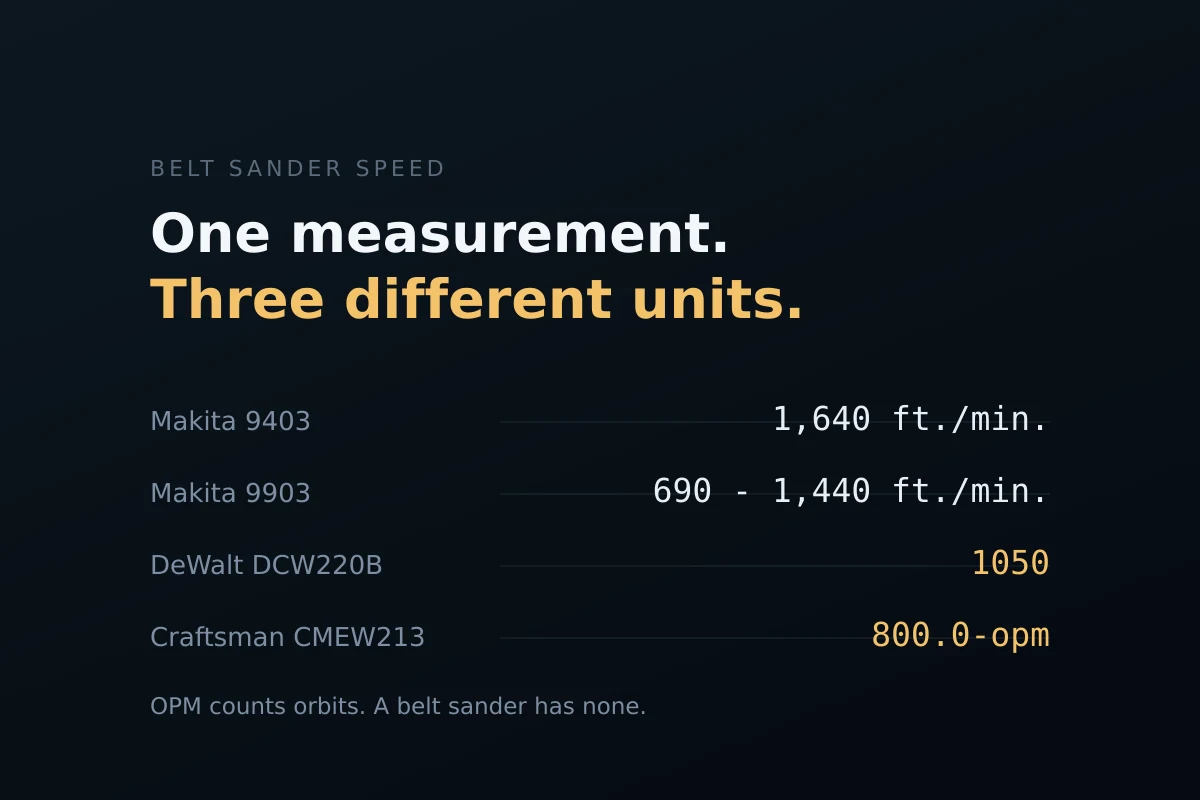
Makita publishes it that way. The 9403 runs at 1,640 ft/min. The 9903 runs a variable 690 to 1,440 ft/min. Both figures carry their unit and you can compare them to each other and to anything else quoted the same way.
Then it gets strange. Craftsman’s marketing copy for the CMEW213 says 800 fpm, which is a real belt speed and a low one. But the structured specification table on the same page labels that number opm. OPM is orbits per minute. It describes a random orbital sander, which spins an eccentric pad and has no belt at all. A belt sander has no orbits to count.
DeWalt’s DCW220B is worse in a quieter way. Its spec table shows a sanding speed of 1050 with no unit displayed next to it. Look at the underlying field name in DeWalt’s own product data and it reads sanding_speed_maximum_opm. Both brands are part of the same parent company and appear to share a product data schema in which belt sander speed lives in a field built for orbital sanders. The number is probably fine. The label around it is not, and a buyer looking at a bare 1050 has no way to know whether it is feet per minute, orbits per minute, or something else entirely.
When a page argues with itself
The DCW220B has a second problem, and it is the one that is hardest to explain away. Its product title, its meta description and its marketing copy all say the belt is 3 in. by 21 in. Its specification table says the size is 3 in. by 12 in. Those are not the same sander, and belts are not interchangeable between sizes. One of those two statements is wrong, and the page offers no way to tell which.
The same page carries a third kind of unusable claim: up to 22 percent more power than a corded version. More power than which corded version? A percentage against an unnamed baseline is not a specification, because the baseline is doing all the work and it has been left out.
Two quantities pretending to compete
The clearest version of this problem shows up between categories rather than inside one. Rotary hammers publish impact energy in joules, a measure of how much work each blow does, and the tools we compared ran from 1.4 to 2.9 joules. Hammer drills publish blows per minute, and the numbers are enormous: 52,700 is a normal figure to see on a box.
Fifty-two thousand beats 2.9 in the only way a shopper can read a box quickly. But joules and blows per minute are different physical quantities, and there is no conversion between them. A hammer drill generates its blows by riding two ridged plates against each other, which produces a very high rate of very small impacts. A rotary hammer uses a piston to drive a much heavier, much slower strike. The rotary hammer drills concrete several times faster, and its number is smaller. Nothing on either box tells you that.
What we do with it
None of this requires anyone to be lying. Some of it plainly is commercial, because publishing one torque figure without defining it lets the flattering reading stand. Some of it looks like a large product database quietly reusing a field across tool types it was never designed for. From where a buyer sits, the effect is identical: the comparison you are trying to make cannot be made from the information provided.
So our tables have a cell that says Not published, and we use it. A blank is honest. A number moved into a row where it doesn’t belong is not, and it is worse than the blank because it looks like an answer. When a manufacturer publishes two figures and names them, we print both. When a spec table contradicts the product title above it, we quote the contradiction rather than picking the version we like.
The practical habit for anyone reading a product page: before you weigh a number, find its unit and check that the unit belongs to the tool. If the unit is missing, treat the figure as unverified. If the unit belongs to a different kind of tool, treat it the same way. And if there is one number where every competitor publishes two, assume you are looking at the larger one.
That is a low bar. It is also the bar a surprising number of product pages fail.
Real Buyer Experiences is reader-supported and independent. We synthesize independent testing and owner reports into one honest verdict - we never trade a recommendation for payment. How we review →