

Analysis
One Name, Several Products: When a Category Isn't a Category
Trim restorer covers three mechanisms lasting from weeks to years. Smart glasses with displays covers two devices sharing almost nothing. The shelf label is not a specification.
There is a failure that happens before you compare any specification, and it is not about the numbers being wrong. It is that the two products in front of you were never the same kind of thing. They share a shelf, a search term and a price range, and they work by different mechanisms and last for different lengths of time.
We have now hit this in enough categories to treat it as the first question rather than a footnote: what is this, physically?
Trim restorer means three unrelated things
Faded grey plastic trim is one problem with three solutions, all sold as trim restorer.
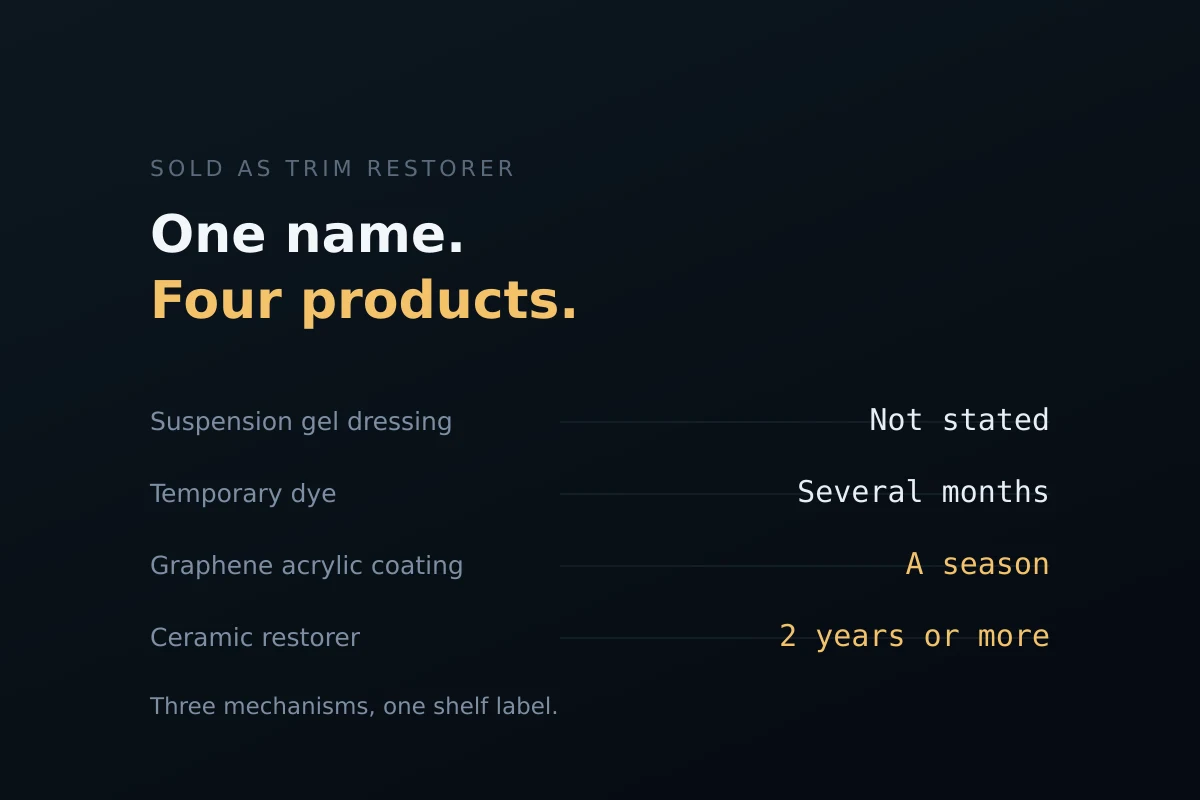
Adam’s Black Trim Restorer describes itself as a temporary dye colouring, and says it lasts several months per treatment. Turtle Wax’s Hybrid Solutions Graphene Acrylic Trim Restorer is a coating that the brand says does not wash off and will endure seasonal exposure. Adam’s Ceramic Black Trim Restorer restores pigment and ceramic coats in one step, claiming two years or more. Chemical Guys Rapid Black is a lightweight suspension gel, which is a dressing, and its page carries no durability claim at all.
So: a dye, two coatings and a dressing. Published durability runs from nothing stated, through several months, through a season, to two years, at broadly similar prices. The word restorer tells you which of those you are getting exactly none of the time.
The brands know. Adam’s own page for its ceramic product explains that a dressing can only dress plastics without truly replenishing the colour, which is a manufacturer telling you its cheaper category does not do the job. That sentence is more useful than the product name.
Two devices, one shelf label
Smart glasses with displays is the same problem in an expensive category.
One kind is a wearable monitor. The Xreal One Pro gives 57 degrees of field of view, 1080p per eye, around four million pixels, at 120Hz. It has no camera, no battery and no processor for running anything: you plug a phone or a console into it over USB-C and it shows you that device’s screen.
The other kind is a computer on your face. Rokid Glasses weighs 49 grams, carries a Snapdragon AR1, its own 210mAh battery, a 12MP camera, and a display of 480 by 400 pixels across 30 degrees, in a single green colour. RayNeo’s X3 Pro is the same idea in full colour at 640 by 480.
Nearly twice the field of view on one side, more than ten times the pixels, and no ability to do anything unplugged. A third of the field of view on the other, a fraction of the resolution, and complete independence. Two of the specifications, resolution and brightness, run in opposite directions between the two types, because a viewer works behind tinted lenses and a heads-up display has to stay legible against daylight. Comparing their nit ratings as though the bigger number were better gets you precisely the wrong answer.
Rokid, to its credit, sells both and labels them Glasses (With Display) and Ai Glasses Style (Non-Display). That is the whole fix, and almost nobody else does it.
The pattern keeps repeating
Quick detailer describes a spray bottle and a microfibre towel rather than a function. Chemical Guys states plainly that its Extreme Slick works without the use of waxes or sealants, so it adds nothing. Turtle Wax’s is ceramic and carnauba infused, so it deposits its own layer. Adam’s claims to extend an existing wax or sealant by up to two extra months per wipe, which requires you to already have one. P&S Pit Stop claims UV protection and matte-finish safety. Four bottles, four different answers to what does this leave on my paint.
All purpose cleaner covers detergent-based cleaners and citrus solvent degreasers, which behave very differently on interior plastics and leather, at a dilution none of them publish.
Rinseless wash and waterless wash sit side by side and are not interchangeable: one is a concentrate diluted into a bucket that can handle a genuinely dirty car, the other a ready-to-use spray for dust on a car that is already clean.
Even polishing pads, where you would expect colour coding to be the one reliable shortcut, turn out to be brand-private. Chemical Guys sells an orange pad it calls medium-heavy cutting. Turtle Wax sells an orange pad its own description calls light cutting, for light-duty jobs. Same colour, opposite ends of the range.
Why it survives
Nobody is being punished for it. A broad category name captures more search traffic and covers more shelf, and the brand selling a gel dressing gains from the word restorer because restoration is what the customer walked in wanting. Narrowing the name would mean competing in a smaller pool against products that genuinely do more.
There is also a real difficulty underneath the commercial one. Categories form around outcomes, because that is how people shop: I want my trim black again, I want a screen in my glasses. Mechanisms are what actually determine whether a product delivers that outcome and for how long, and mechanisms are invisible at the point of sale. So the name describes the wish, and the specification describes the thing, and nobody reconciles them.
The question to ask first
Before you compare a single number, work out what the product physically is.
For anything applied to a surface, ask whether it deposits pigment, cures into a film, or simply wets the surface. Those three give you months, years and weeks respectively, and they are usually distinguishable from one sentence in the description even when the title is useless.
For hardware, ask whether it has its own power and processing, or whether it needs a host. That single question separates a wearable monitor from a wearable computer, and everything else follows from it.
For anything sold as a concentrate, ask what it becomes at each dilution, because the same bottle can be two products.
Then compare specifications only against products that answered those questions the same way. A 30 degree field of view and a 57 degree one are not competing figures. Several months and two years are not competing durability claims. They are different products that happen to be filed together, and the filing is not evidence of anything.
Real Buyer Experiences is reader-supported and independent. We synthesize independent testing and owner reports into one honest verdict - we never trade a recommendation for payment. How we review →