

Analysis
The Hazard That Stays Off the Page
One water spot remover's product page describes a specially formulated gel. The bottle it ships in says DANGER: CORROSIVE, next to a skull.
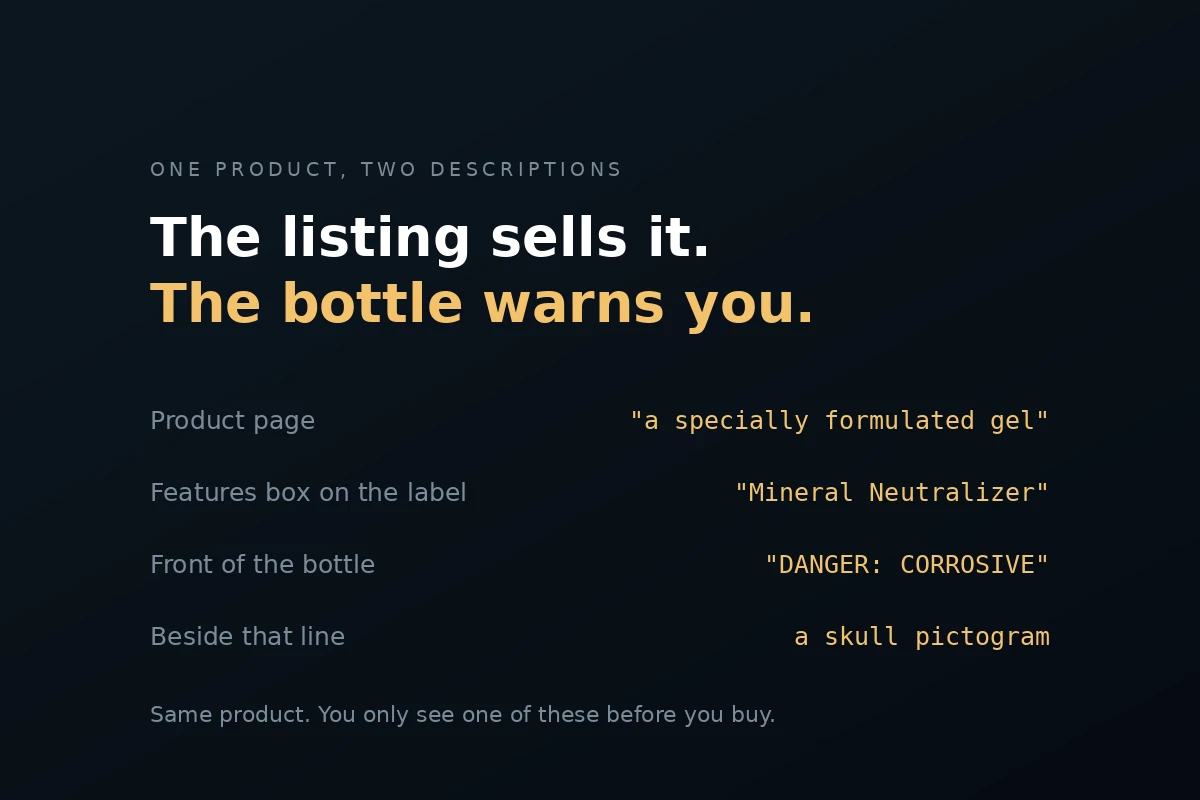
Here is the entire product description for Chemical Guys Heavy Duty Water Spot Remover, as published on the company’s own store:
Heavy Duty Water Spot Remover is a specially formulated gel that tackles tough water stains and hard water spots. Its easy application makes it perfect for various surfaces, ensuring a streak-free finish. Use Heavy Duty Water Spot Remover whenever you notice water stains or hard water spots on your vehicle’s paint, glass, or other surfaces.
Nothing in that paragraph is untrue. It is a gel, it does remove water spots, and its application is easy. Read it and you would picture something in the same family as a quick detailer.
Now look at the bottle in the product photograph. Below a features box listing Gel Based Formula and Mineral Neutralizer, and below three lines of capitals about removing stains and restoring appearance, the front label reads:
DANGER: CORROSIVE
Beneath it: keep out of reach of children, and read carefully the other cautions on the back panel. Beside the features box, a skull and crossbones.
Both statements are correct
This is not a case of a brand hiding something. Hazard communication rules apply to the container, because the container is what arrives in someone’s garage and gets opened by someone who may not have read anything at all. The signal word, the pictogram and the precautionary statements are printed there by design, and Chemical Guys has printed them.
Marketing copy on an ecommerce page carries no such duty. It exists to describe what the product does, and describing what a product does is not the same job as describing what it is. So the two texts diverge, legitimately, and the divergence happens to fall exactly across the moment of purchase. You choose from the page. You handle from the bottle.
The category makes the gap visible
What makes this worth writing about is not one product. It is that the same shelf holds three acids with three completely different disclosure postures.
Adam’s Water Spot Remover names its chemistry in the second sentence of its description: a heavy-duty formula that neutralizes and dissolves the minerals and salts in an alkaline water spot using a mild acid and specialty surfactants. It then lists the surfaces it is safe on, including ceramic and graphene coated paint.
Torque Detail’s Water Spot Remover goes further and publishes a procedure. It states an acid based formula, caps the dwell time at thirty seconds, requires a neutralising wash immediately afterwards, warns that it can damage glass with incorrect application, and recommends nitrile gloves.
Chemical Guys, holding a product classified corrosive, describes a gel.
Three products, one chemistry family, and the amount you learn before paying ranges from the full handling procedure to nothing at all. A buyer comparing the three on their web pages would reasonably conclude that the Chemical Guys product is the gentlest of the set. It is the one carrying the skull.
Why this is different from the usual gap
We have written before about labels carrying claims the listing omits, and mostly that gap runs in the buyer’s favour: a durability figure or a UV claim that the web copy dropped in a rewrite, which makes the product look worse online than it is. Finding it is a small win.
This one runs the other way. The omitted information is not a feature the brand forgot to boast about. It is the classification that tells you what to wear, and its absence makes the product look easier than it is. That asymmetry is worth naming, because the two gaps call for different habits. The first rewards zooming into a photograph to find a number. The second requires you to assume nothing from the absence of a warning.
What we do about it now
Reading the label before writing has been our standard practice for a while. We have added one step to it: on any product that could plausibly be classified, we look specifically at the bottom third of the front panel, where signal words live, and we treat what we find there as part of the specification rather than as fine print.
In the water spot remover comparison this changed a verdict. The Chemical Guys gel works, and it holds position on vertical glass better than a thin liquid does, which is a real advantage. It did not get a recommendation, because we could not recommend that someone buy it from the page that sells it.
The practical version for a buyer is short. Before ordering any chemical from a web page, find a photograph you can read and look for one of two words, DANGER or WARNING, and for a diamond-shaped symbol. If you cannot find a readable photograph, the manufacturer’s safety data sheet states the classification in section two and is usually a search away. It takes about a minute, and it is the only part of the purchase where the seller has no obligation to help you.
Real Buyer Experiences is reader-supported and independent. We synthesize independent testing and owner reports into one honest verdict - we never trade a recommendation for payment. How we review →