

Analysis
Sized to Pair
Camp chairs sit from 12 to 20.7 inches and camp tables stand from 15 to 24. One brand out of eight mentions that the two numbers have to agree.
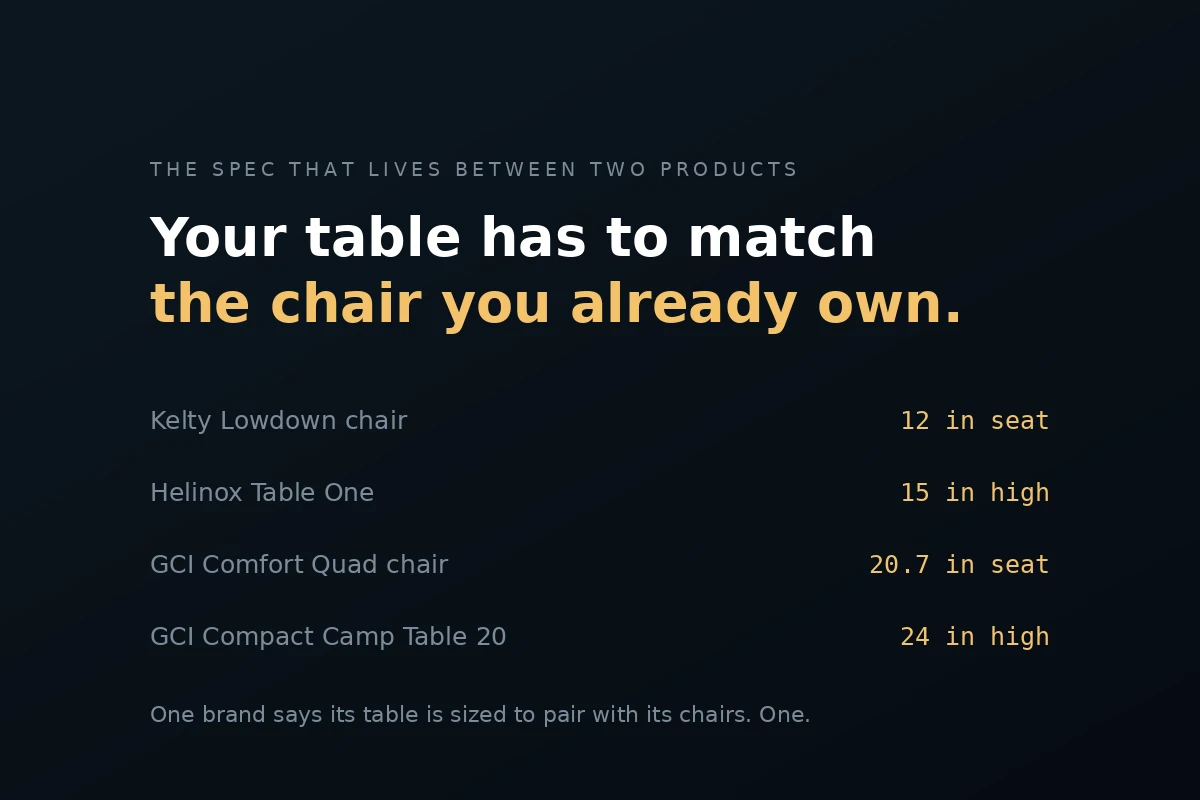
We compared four camp chairs and four camp tables in the same week. Here is what came out of the two specification tables, side by side.
The chairs seat you at 12 inches (Kelty Lowdown), 20 inches (Big Agnes Big Six) and 20.7 inches (GCI Comfort Quad). One of the four does not publish a seat height at all.
The tables stand at 15 inches (Helinox Table One), 15 inches (Kelty Rad-Arondack), 16 inches (NEMO Moonlander) and 24 inches (GCI Compact Camp Table 20).
Every one of those figures is correct. Every one is published on the right page in the right units. And a buyer can read all of them carefully, buy one chair and one table, and end up with a table at chest height or one they have to reach down past their knees to use.
The number that belongs to neither product
A camp table’s height is not really a property of the table. It is a property of the table plus the chair, because the table exists to put a drink within reach of a seated person. Twelve inches of chair and 24 inches of table is not a table with a bad specification. It is two correct specifications that do not go together.
The same is true in reverse. Buy the 24 inch GCI table because you want to prepare food standing up, then pair it with a 12 inch chair for the evening, and you have bought sensibly twice and still ended up reaching upward for your dinner.
Nobody publishes the fit, because the fit is not a product. It is the space between two catalogues, and product pages are written one product at a time.
The exception
Out of the eight products, one page addresses it. Helinox describes the Table One in its own FAQ as:
A light, packable camp table sized to pair perfectly with our chairs.
That single clause is the only acknowledgement in either comparison that furniture heights have to relate to each other. And Helinox goes further in a way that is quietly revealing: the specification block on the table page lists its height under the label Seat Height, which is a template artifact from the chair pages leaking into the furniture range. A table does not have a seat height. But the field exists because Helinox specifies both against the same measurement, which is what you would do if you were designing a set rather than a product.
It is also, obviously, a commercial position. Solving compatibility by telling you to buy the matching chair is not neutral advice. It is still more than anyone else offered.
Why this class of gap is hard to see
We spend a lot of time on numbers that are missing and numbers that contradict themselves. This one is harder, because nothing is missing and nothing is wrong. Every figure checks out. The failure only appears when you hold two correct pages next to each other, and nothing on either page prompts you to do that.
That makes it invisible to the ordinary way people shop, which is to decide on a category, compare within it, and buy the best one. Comparing within a category is exactly the process that hides a compatibility problem, because both products in front of you are tables.
The habit
Before buying anything that works alongside something you already own, write down the relevant number from the thing you own first, and treat it as a constraint rather than a preference. For camp furniture that number is your chair’s seat height, and the rule of thumb is a table within about three inches of it.
It costs nothing and it is the only defence, because no product page is going to do it for you. The table comparison sorted itself the moment we did it: three of the four tables were built for a low chair and one was built for standing, and that difference mattered far more than which was best.
Real Buyer Experiences is reader-supported and independent. We synthesize independent testing and owner reports into one honest verdict - we never trade a recommendation for payment. How we review →