

Analysis
Assembled From Parts
One cookset page serves its description in untranslated Swedish and its specifications in English. Another gives you a complete spec block and a one-sentence description.
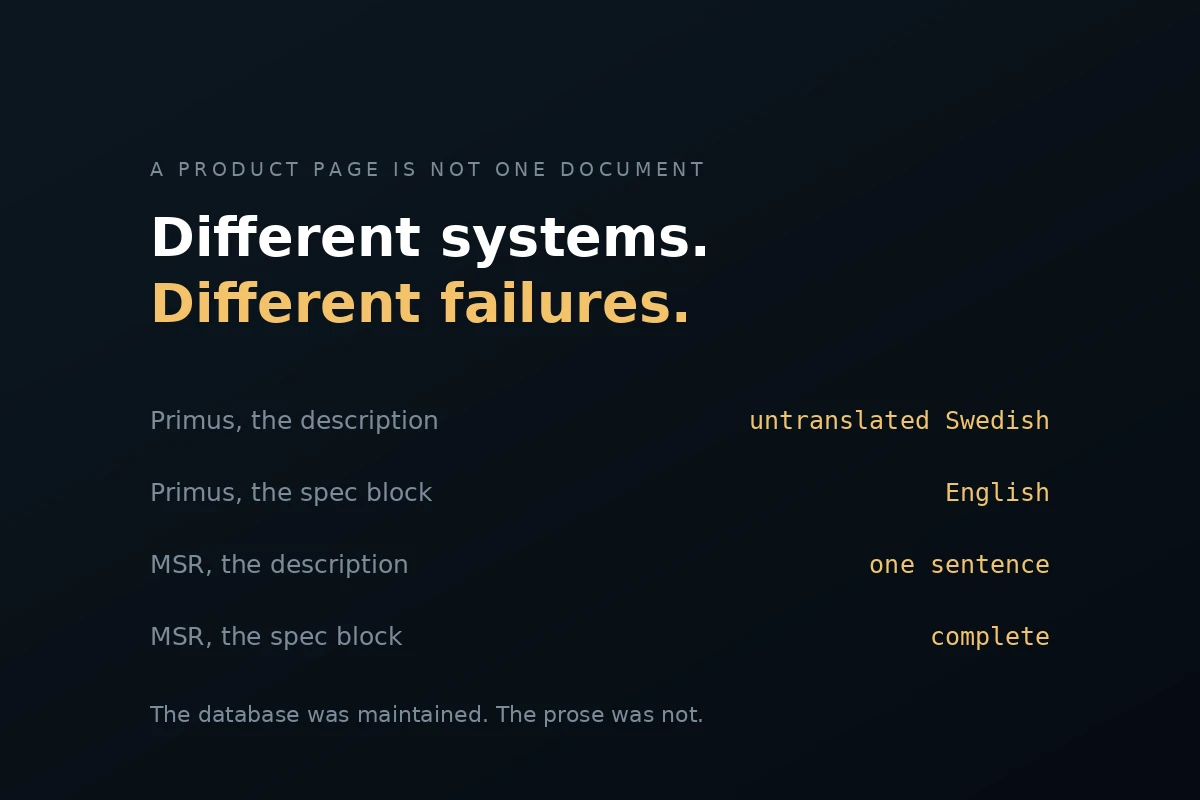
Open the Primus CampFire Cookset page on the English-language store. The specification block reads, in English:
Product weight (g) 1320. MATERIAL Stainless Steel.
Directly above it, the product description reads:
Slitstarkt kokkärlsset i rostfritt stål för matlagning över öppen eld.
That is Swedish, and it runs for a full paragraph. Primus is a Swedish company, so the sentence has an obvious origin. What is interesting is not that it exists but that it sits inches from a specification block that localised perfectly well.
The page is not one thing
We tend to read a product page as a single document written by someone. It almost never is. It is a template assembled at request time from separate systems: a product information database supplying structured fields, a content system supplying marketing prose, a media library supplying images, a review platform, a pricing service.
Each of those has a different owner, a different update cycle and a different failure mode. So pages do not fail all at once. They fail in sections.
The Primus page fails at the localisation layer, which touched the structured fields and missed the prose. That is a very specific and very ordinary kind of break, and it tells you something useful: the half of the page generated from data is being maintained, and the half written by a person is not.
The opposite failure, on the same shelf
Two products along, MSR sells the Alpinist 2 Cook Set. Here is the complete product description:
Single pot, 2-person cook system.
Six words. Underneath it sits one of the more thorough specification blocks in the category: 22.2 oz / 630 g, packed size 7.2 by 4.8 inches, hard-anodised aluminium, a full contents list down to the strainer lid and the removable pot handle, and the country of manufacture.
That is the mirror image of the Primus problem. Same category, same week, opposite half of the page doing the work.
And of the two, MSR’s version is the one that serves a buyer better. A six-word description and a complete spec block tells you what the thing is. A beautifully written paragraph and no dimensions does not, whatever language it is in.
Why it matters for reading a page
Once you see a product page as assembled rather than authored, some things that look like dishonesty resolve into plumbing.
A page that states a weight capacity twice with two different numbers is not lying to you. It has a spec field maintained by one team and a marketing paragraph maintained by another, and they have drifted. A bottle carrying a hazard word the listing never mentions is the packaging system and the web system diverging, since only one of them is legally obliged to say it.
The practical consequence is a hierarchy. For anything numerical, believe the structured field over the prose, because the structured field is data and the prose is writing. For anything about hazard, obligation or contents, believe the physical label over both, because that is the layer with rules attached.
Look for the panel before you judge
The other lesson from this batch was nearly a mistake of our own. Writing up a camp table, we were ready to say that the manufacturer published no dimensions, no packed size and no weight, because none of it appeared on the page. It turned out that all of it existed, in a collapsed specification panel rendered by script, which we only found by reading the page source.
So before concluding that a brand tells you nothing, check for an accordion labelled Specs, Tech Specs, Measurements or Details, and open it. The information is sometimes there and simply not shown, which is one more way a page assembled from parts can fail: by publishing the right data into a component that never renders.
Real Buyer Experiences is reader-supported and independent. We synthesize independent testing and owner reports into one honest verdict - we never trade a recommendation for payment. How we review →