

Ski & Snowboard
The Best Kids Snowsuits: 4 Compared (and One to Skip)
We compared four one-piece kids snowsuits on published waterproof rating, seam sealing, insulation, room-to-grow features and how much the maker actually discloses.
The short version
The Reima ReimaTec Winter Overall Stavanger is the best overall pick: Reima states a fabric water column over 10,000 mm, all seams taped, at least 7,000 g/m2/24h breathability and its top durability rating of over 80,000 Martindale cycles. The Burton Toddlers' 2L One Piece is the value pick for little ones, with 15,000 mm and 15,000 g ratings, fully taped seams, Room-to-Grow sleeves and inseam, and a lifetime warranty. The Obermeyer Quinn One-Piece depends: it has well-mapped insulation, glove clips and an I-Grow system covering suggested ages 1 to 8, but Obermeyer shows waterproofing only as a slider, seals only critical seams, and says it contains PFAS and cannot ship to California or New York. Skip the Arctix Kids Dancing Bear Insulated Snowsuit Coveralls for wet snow: Arctix calls it water and wind resistant, publishes no waterproof rating, and gives its temperature range without a unit. Best for: parents who want a child to stay dry through a full day of sledding, snow play or ski school.
Our picks at a glance
- Reima ReimaTec Winter Overall Stavanger - Buy. A heavy-duty Nordic play snowsuit with taped seams and Reima's highest durability rating.
- Burton Toddlers' 2L One Piece - Buy. A toddler ski suit with 15,000 mm waterproofing, fully taped seams and two inches of Room-to-Grow.
- Obermeyer Quinn One-Piece - It depends. A feature-rich kids ski suit with mapped insulation and I-Grow, but no published waterproof number.
- Arctix Kids Dancing Bear Insulated Snowsuit Coveralls - Skip. A cheap, warm coverall that its maker describes as water and wind resistant, not waterproof.
The verdict in 30 seconds
What mattered most
- Size range (maker listed)
- Waterproof rating
- Breathability
- Seams
- Insulation
- Growth system
A one-piece snowsuit is the easiest way to keep a small child warm and dry, because there is no gap at the waist for snow to get in. The hard part is that kids sit, kneel and roll in wet snow, so the fabric and seams matter more than they do on an adult jacket. We compared a Nordic play suit, a toddler ski suit, a kids ski suit with an extension system, and a widely sold budget coverall. Every spec here comes from the maker's own page, and where a maker does not publish a number we say so.
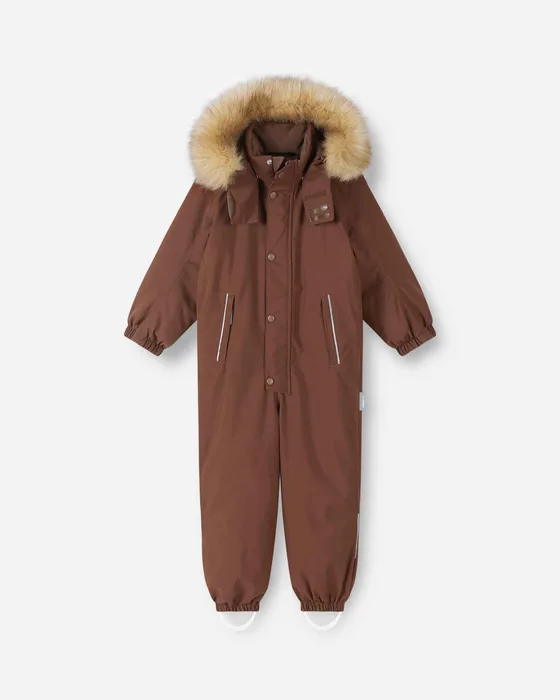
A heavy-duty Nordic play snowsuit with taped seams and Reima's highest durability rating.
Best for: Kids from preschool to about third grade who play outside every day in cold, wet snow and wear gear out fast.
- Reima states a fabric water column over 10,000 mm, with all seams taped, and calls the product waterproof.
- Its durability rating is Reima's top grade, over 80,000 Martindale abrasion cycles, which suits kids who kneel, crawl and slide.
- It has a detachable, adjustable hood with removable faux fur trim, an inside waist adjustment and detachable silicone foot loops.
- Reima rates the insulation for roughly 0 to -20 °C (35 to -5 °F), so it can run hot on mild days.
- The page lists no extendable sleeve or leg system.
- The faux fur trim has to come off before washing.
- The English store page lists sizes 92 to 140 and prices in euros, so non-European buyers need to convert sizes and check shipping.
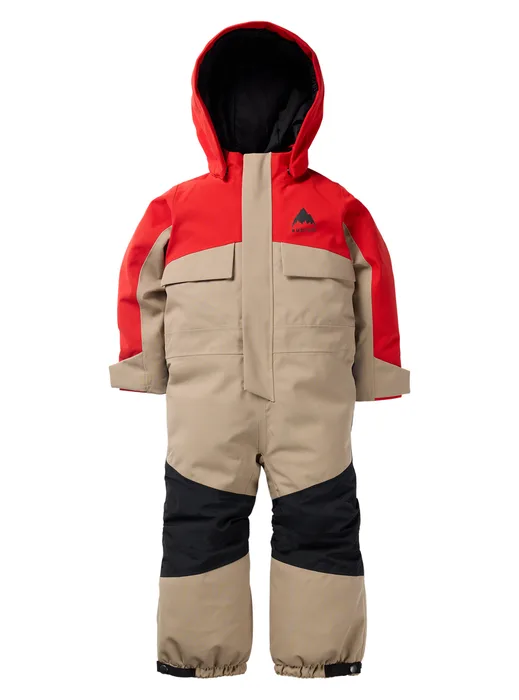
A toddler ski suit with 15,000 mm waterproofing, fully taped seams and two inches of Room-to-Grow.
Best for: Toddlers learning to ski or ride, or playing in snow, whose parents want published ratings and a suit that lasts an extra season.
- Burton lists 15,000 mm waterproofing and 15,000 g breathability on a two-layer DRYRIDE fabric with fully taped seams.
- Room-to-Grow extends the sleeves and inseam two inches, and jogger cuffs go over boots.
- A removable helmet compatible hood, reinforced seat and knees, glove attachment loops and a lifetime warranty are listed.
- Insulation is 100g ThermacoreECO, and Burton's own warmth rating for it is 2.85 out of 5, so plan on layers in deep cold.
- It is a toddler suit, so older kids need a different model.
- Popular sizes in some colors were listed as sold out when we checked.
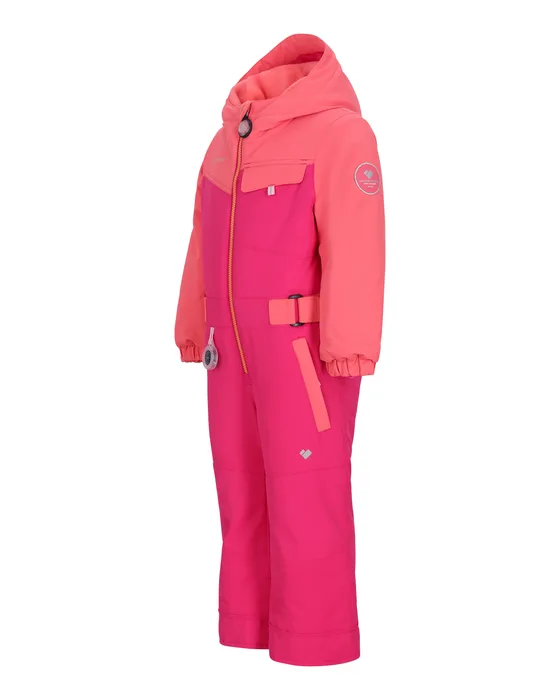
A feature-rich kids ski suit with mapped insulation and I-Grow, but no published waterproof number.
Best for: Families outside California and New York who want a warm resort ski suit with a growth system and accept a less documented shell.
- Insulation is mapped at 180g in the body, 100g in the sleeves and pants and 80g in the hood.
- The I-Grow system adds up to 1 1/2 inches in the sleeves and 2 inches in the inseam, across sizes 1 to 8.
- It lists glove clips, powder cuffs, reflective trim, reinforced inseams, an adjustable waist and a working compass.
- Obermeyer shows waterproofing and breathability as sliders only, with no mm or g figure.
- Seam sealing is listed as Skier Critical, meaning critical seams rather than fully taped.
- The page says the item contains PFAS and cannot be shipped to California or New York.
- The HydroBlock Sport fabric is listed for only some colorways, and the hood is attached rather than removable.
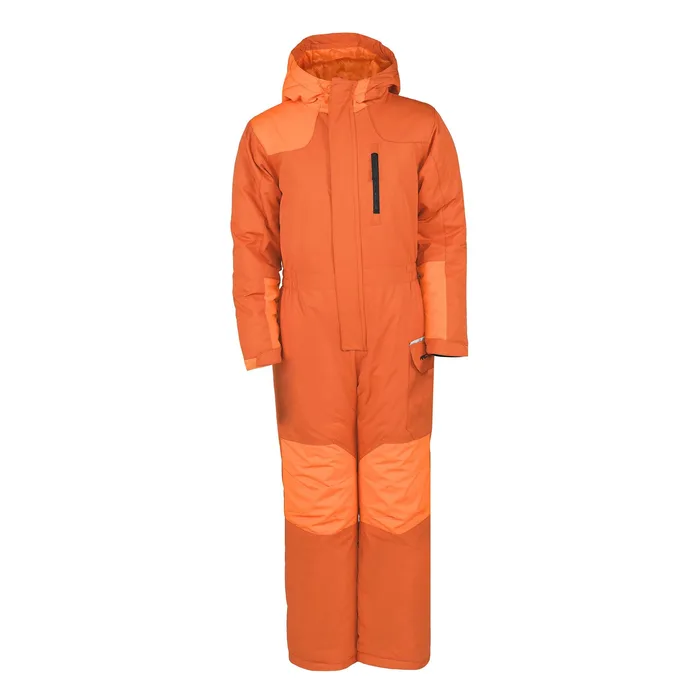
A cheap, warm coverall that its maker describes as water and wind resistant, not waterproof.
Best for: Dry, cold days and short outings, not a child who will sit in wet snow for an afternoon.
- Arctix lists 140 grams of ThermaTech insulation and a heavy-duty zipper with a wind flap.
- It has an adjustable attached hood, adjustable cuffs with thumbholes and several zip pockets.
- It is machine washable and comes in regular and husky fits.
- Arctix calls it water and wind resistant and publishes no waterproof or breathability rating.
- Its temperature claim of -20° to +35° is given without a unit, so it cannot be compared.
- The shell is 300T polyester with no growth system listed, so there is nothing to extend as your child grows.
- The same maker's adult snow pants and jacket are our skips in the ski pants and ski jackets reviews for the same water-resistance limit.
| Criteria | Reima ReimaTec Winter Overall Stavanger Top pick | Burton Toddlers' 2L One Piece | Obermeyer Quinn One-Piece | Arctix Kids Dancing Bear Insulated Snowsuit Coveralls |
|---|---|---|---|---|
| Verdict | Buy it | Buy it | It depends | Skip it |
| Best for | Kids from preschool to about third grade who play outside every day in cold, wet snow and wear gear out fast. | Toddlers learning to ski or ride, or playing in snow, whose parents want published ratings and a suit that lasts an extra season. | Families outside California and New York who want a warm resort ski suit with a growth system and accept a less documented shell. | Dry, cold days and short outings, not a child who will sit in wet snow for an afternoon. |
| Price tier | $$$ · premium | $$ · mid-range | $$$ · premium | $ · budget |
| Size range (maker listed) | 92 to 140 | Toddler sizes from 18M | 1 to 8 (suggested ages 1 to 8) | XS to XL, regular and husky |
| Waterproof rating | Over 10,000 mm | 15,000 mm | Not published (slider only) | Not published; water resistant |
| Breathability | At least 7,000 g/m2/24h | 15,000 g | Not published (slider only) | Not published |
| Seams | All seams taped | Fully taped | Skier Critical seam sealing | Reinforced, sealed seams |
| Insulation | 160 g recycled polyester | 100g ThermacoreECO | 180g body, 100g sleeve and pant, 80g hood | 140 g ThermaTech |
| Growth system | None listed | Room-to-Grow, 2 in sleeves and inseam | I-Grow, up to 1.5 in sleeves and 2 in inseam | None listed |
| Hood | Detachable, adjustable, removable faux fur | Removable, helmet compatible | Attached | Attached, adjustable |
| PFAS statement | Not clearly stated on product page | Made without intentionally added PFAS | Contains PFAS per maker | Not stated |
Which one is right for you?
- Kids from preschool to about third grade who play outside every day in cold, wet snow and wear gear out fast. Buy it Reima ReimaTec Winter Overall Stavanger
- Toddlers learning to ski or ride, or playing in snow, whose parents want published ratings and a suit that lasts an extra season. Buy it Burton Toddlers' 2L One Piece
- Families outside California and New York who want a warm resort ski suit with a growth system and accept a less documented shell. It depends Obermeyer Quinn One-Piece
- Dry, cold days and short outings, not a child who will sit in wet snow for an afternoon. Skip it Arctix Kids Dancing Bear Insulated Snowsuit Coveralls
How we judged the field
Five things decide whether a kids snowsuit keeps a child out longer. First is a published waterproof rating, because children sit and kneel in wet snow and that pressure drives water through weak fabric. Second is seam sealing: fully taped seams keep water out of stitch holes, while partial sealing covers only the most exposed seams. Third is insulation, which should suit your climate and your child’s activity level. Fourth is a growth system, since kids rarely fit the same size two winters running. Fifth is disclosure: a maker that publishes its ratings, materials and PFAS status lets you compare suits instead of guessing.
The field splits into Nordic play suits built for daily outdoor time, ski-brand suits built for resort days, and budget coveralls sold mainly on price. We picked the Reima Stavanger as the play suit with the strongest published spec, the Burton Toddlers’ 2L One Piece as the best-documented toddler ski suit, the Obermeyer Quinn as a feature-rich ski suit with gaps in its spec sheet, and the Arctix Dancing Bear as the widely sold budget option. Our ski pants and ski jackets reviews skip Arctix adult gear for a similar reason, and this review looks at what that limit means for a child.
The Reima ReimaTec Winter Overall Stavanger is built for kids who are outside every day, not just on ski weekends. Reima states a fabric water column over 10,000 mm and says all seams are taped, so it calls the suit waterproof. Breathability is at least 7,000 g/m2/24h, and the fabric carries Reima’s top durability grade at over 80,000 Martindale abrasion cycles, which is what you want on the seat and knees of a child who slides on everything. The details are practical: a detachable, adjustable hood with removable faux fur trim, elastic cuffs, an inside waist adjustment, two zip pockets and detachable silicone foot loops that keep the legs down over boots. Reima rates the insulation for roughly 0 to -20 °C, so it is a true winter suit that can run hot in mild, wet weather. There is no extendable sleeve or leg system on the page, and the English store lists sizes 92 to 140 with prices in euros. For daily cold-weather play, it is the strongest overall package here.
The Burton Toddlers’ 2L One Piece gives toddlers the most clearly documented protection in this group. Burton lists 15,000 mm waterproofing and 15,000 g breathability on its two-layer DRYRIDE fabric, with fully taped seams and a water repellent finish made without intentionally added PFAS. Room-to-Grow adds two inches to the sleeves and inseam, which can stretch a suit across a growth spurt, and jogger cuffs go over boots without dragging. Burton also lists a removable helmet compatible hood, reinforced seat and knees, hook-and-loop glove attachments, reflective details and a lifetime warranty. The trade-off is warmth. The insulation is 100g ThermacoreECO, and Burton’s own warmth rating is 2.85 out of 5, so on very cold days you will need a fleece layer underneath. It is also a toddler suit, in toddler sizes starting at 18M, so older kids need another option. For a toddler in ski school or the backyard, it is the best value here.
The Obermeyer Quinn One-Piece has more features than any suit in this group. Insulation is mapped, with 180g in the body, 100g in the sleeves and pants and 80g in the hood, and the I-Grow system adds up to 1 1/2 inches in the sleeves and 2 inches in the inseam. Obermeyer lists an adjustable waist, powder cuffs, fleece-lined cuffs, fleece earwarmers, reflective trim, reinforced inseams, YKK zippers, glove clips and a working compass, across sizes 1 to 8. The problem is documentation. Waterproofing and breathability appear only as sliders, with no mm or g figure. Seam sealing is Skier Critical, which covers the critical seams rather than every seam. The HydroBlock Sport fabric is listed for only some colorways, and the page states the item contains PFAS and cannot ship to California or New York. For resort skiing in dry cold it is a warm, well-thought-out suit; for wet snow play, or for families in those two states, the Reima or Burton is the safer choice.
The Arctix Kids Dancing Bear Insulated Snowsuit Coveralls sell on price, and they are warm enough for many cold, dry days. Arctix lists 140 grams of ThermaTech insulation, a 300T polyester shell, a heavy-duty zipper behind a wind flap, an adjustable hood, adjustable cuffs with thumbholes and several zip pockets, and it is machine washable in regular and husky fits. The problem is water. The product copy opens by saying it keeps out snow, rain and wind, but the feature list calls it water and wind resistant, and Arctix publishes no waterproof or breathability rating. Its temperature claim of -20° to +35° comes without a unit. For a child who will sit in wet snow, build forts or sled all afternoon, a water-resistant shell is the wrong tool, and there is no growth system listed to stretch the purchase. Our ski pants and ski jackets reviews skip the same maker’s adult gear for the same limit. Spend more once on the Burton or Reima instead.
Reima ReimaTec Winter Overall Stavanger vs Burton Toddlers’ 2L One Piece: which should you buy?
The Reima Stavanger and the Burton Toddlers’ 2L One Piece overlap only at the small end. The Burton is a toddler suit with higher published waterproof and breathability numbers, fully taped seams, a two-inch growth system and a lifetime warranty, but light insulation by Burton’s own rating. The Reima runs from size 92 to 140, uses a tougher fabric with Reima’s top abrasion grade, and is insulated for real cold, but lists no growth system.
For a toddler who skis or plays in mixed conditions, pick the Burton and add a fleece layer on the coldest days. For a preschooler or school-age child who plays outside daily in cold, wet snow and wears out knees and seats, pick the Reima. If your child is at the overlap and you live somewhere very cold, the Reima’s warmth tips the balance; if winters are milder and wetter, the Burton’s breathability does.
What to look for
- A published waterproof number: look for a water column in mm, because water resistant without a rating is not the same thing.
- Fully taped seams: stitch holes leak, and a suit with only critical seams sealed can let water in at the seat and knees.
- Reinforced seat and knees: kids wear through these areas first, and some makers publish abrasion ratings.
- A growth system: Room-to-Grow or I-Grow style extensions can get another season out of a suit.
- Cuffs and foot loops that seal: elastic or adjustable cuffs and foot loops or jogger cuffs keep snow out of sleeves and boots.
- A PFAS statement: some makers state their water repellent finish is made without PFAS, and Obermeyer says the Quinn contains PFAS.
Our final take
Buy the snowsuit with a published waterproof rating and taped seams, because wet snow is what ends a child’s day outside. The Reima Stavanger is the best overall pick for daily cold-weather play, with taped seams and Reima’s toughest fabric. The Burton Toddlers’ 2L One Piece is the value pick for toddlers, with the highest published ratings here and a growth system. The Obermeyer Quinn is warm and full of features but thin on published specs and cannot ship to California or New York. Skip the Arctix Dancing Bear for wet snow, since its maker calls it only water resistant. And whichever suit you buy, take it off before buckling a car seat.
Questions, answered
Can my child wear a snowsuit in the car seat?
No. The American Academy of Pediatrics says bulky clothing, including winter coats and snowsuits, should not be worn under a car seat harness. In a crash the padding flattens and leaves space under the straps, and a child can slip through. Take the snowsuit off before buckling, tighten the harness, and lay the suit or a blanket over the straps. Put it back on when you arrive.
What waterproof rating does a kids snowsuit need?
For snow play, the published water column matters because kids sit and kneel in wet snow, which pushes water through fabric. Reima states over 10,000 mm for the Stavanger and Burton states 15,000 mm for the toddler 2L One Piece. A suit described only as water resistant, like the Arctix, is a different class. Taped seams matter as much as the fabric number, because water also gets in through stitch holes.
One-piece or jacket and bib?
A one-piece has no waist gap, so snow cannot get in when a small child falls or rolls, and it is quicker to get on a toddler. A jacket and bib is more flexible as kids get older, because the jacket can be worn alone on milder days. For toddlers and preschoolers, most families find the one-piece simpler. Older kids in ski school often move to separates.
Should I size up so it lasts two winters?
Sizing up a little is common, but too big a suit can drag at the cuffs and get in the way. Growth systems help: Burton's Room-to-Grow adds two inches to the sleeves and inseam, and Obermeyer's I-Grow adds up to 1 1/2 inches in the sleeves and 2 inches in the inseam. Check the maker's size chart against your child's height first. Reima lists foot loops and an inside waist adjustment that help a slightly long suit stay in place.
How warm does a snowsuit need to be?
It depends on how active your child is and how cold it gets. Reima rates the Stavanger for roughly 0 to -20 °C, while Burton rates the warmth of its 100g toddler suit at 2.85 out of 5 and expects layers. A heavily insulated suit can make a running child sweat, and damp base layers make them colder later. Pair any suit with a wicking base layer and adjust the middle layer to the day.
Deciding between the top two? See our head-to-head: Reima ReimaTec Winter Overall Stavanger vs Burton Toddlers' 2L One Piece.
More Ski & Snowboard reviews
 The Best Ski Bags: 4 Compared (and One to Skip)
  The Best Ski Boot Bags: 4 Compared (and One to Skip)
  The Best Ski Boot Heaters: 4 Compared (and One to Skip)
  The Best Ski Boots: 4 Compared (and One to Skip)
  The Best Ski Gloves: 4 Compared (and One to Skip)
  The Best Ski Goggles: 4 Compared (and One to Skip)