

Audio
The Best Digital Pianos: 4 Compared (and One to Skip)
We compared four 88-key digital pianos on key action, piano sound, polyphony, speakers, Bluetooth and USB connectivity, outputs and weight, using each maker's published spec sheet.
The short version
The Roland FP-30X is the best overall portable digital piano: its PHA-4 Standard keyboard has escapement and an ivory-feel surface, it has 256-note polyphony and 11 W x 2 speakers, and it adds Bluetooth audio and MIDI plus USB audio. The Yamaha P-225 is the lighter, simpler buy at 11.5 kg, with Yamaha's CFX concert grand sound, a GHC weighted action and a built-in USB audio interface. The Kawai ES120 suits students who want Bluetooth MIDI for lesson apps and built-in Alfred and Burgmüller lesson songs, but it ships with a basic on/off switch pedal and its USB port is MIDI only. Skip the Alesis Recital Play, which uses non-weighted keys despite being sold as a piano for beginners. Best for: most home pianists (FP-30X), small spaces and carrying (P-225), and app-led learners (ES120).
Our picks at a glance
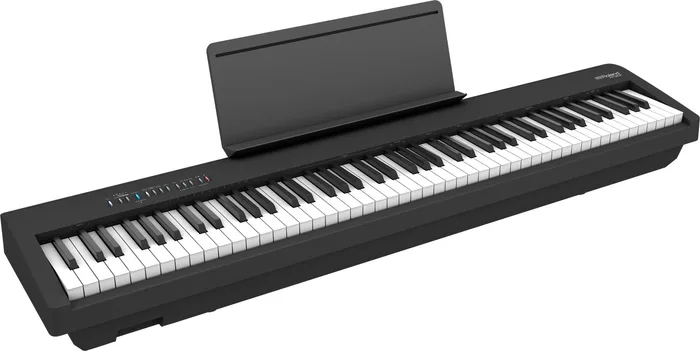
- Roland FP-30X - Buy. A portable digital piano with an escapement-equipped hammer action, strong speakers and full Bluetooth and USB connectivity, and the best all-rounder here.
- Yamaha P-225 - Buy. A slim, light weighted-key piano with Yamaha's CFX concert grand sound and a built-in USB audio interface, and the pick when portability matters.
- Kawai ES120 - It depends. A compact weighted piano with strong Bluetooth MIDI and lesson features for students, held back by its basic pedal and MIDI-only USB.
- Alesis Recital Play - Skip. A low-cost 88-key bundle marketed as a beginner piano, but its keys are non-weighted, which defeats the point of learning on a piano.
The verdict in 30 seconds
What mattered most
- Key action
- Piano sound
- Max polyphony
- Speakers
- Bluetooth
- USB
A digital piano lives or dies by its keys: a weighted hammer action is what lets practice at home carry over to an acoustic piano. Below that, the differences are sound engine, speakers, connectivity and how easy the instrument is to move. We compared four current 88-key models from Roland, Yamaha, Kawai and Alesis against the makers' own pages. Two are easy recommendations, one suits a specific kind of learner, and one popular beginner bundle is the one to skip. If you are pairing a piano with a computer or recording setup, our guides to MIDI keyboards, closed-back headphones and studio monitors cover the rest of the desk.
A portable digital piano with an escapement-equipped hammer action, strong speakers and full Bluetooth and USB connectivity, and the best all-rounder here.
Best for: Most home pianists who want the best key feel and the most connectivity in a portable body.
- The 88-key PHA-4 Standard keyboard has hammer action, escapement and ivory feel, the same keyboard Roland fits to its premium FP-60X.
- It has 256-note maximum polyphony, 321 tones (56 from the panel) and 12 cm x 2 speakers rated at 11 W x 2, the most power in this group.
- Bluetooth audio and MIDI, USB audio/MIDI to a computer, a USB memory port and 1/4 in. L/R outputs cover lessons, recording and external speakers.
- At 14.8 kg (32 lb 11 oz) with music rest it is the heaviest of the four.
- The included DP-2 is a pedal switch; continuous damper detection needs an optional pedal such as the DP-10.
- The dedicated KSC-70 stand and KPD-70 three-pedal unit are sold separately.
- All 321 tones are reachable only through the Roland Piano App, and Roland notes app support may end without notice.
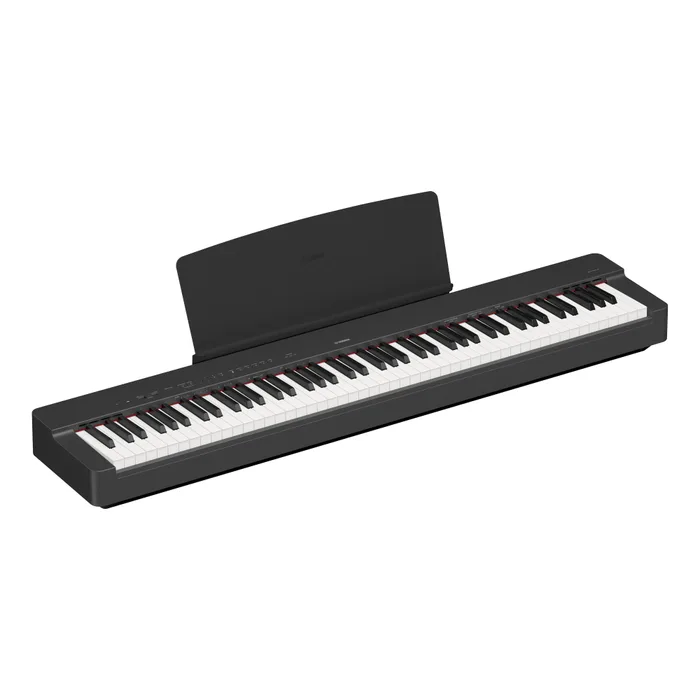
A slim, light weighted-key piano with Yamaha's CFX concert grand sound and a built-in USB audio interface, and the pick when portability matters.
Best for: Players who move their piano often or have little space and mostly want a good piano sound and feel.
- At 11.5 kg (25 lb 6 oz) and 129 mm tall without the music rest, it is the lightest and slimmest weighted piano here.
- It uses samples of Yamaha's CFX concert grand with VRM Lite resonance modeling and 192-note polyphony.
- USB to Host doubles as a 44.1 kHz, 24-bit stereo USB audio interface, and there are two headphone jacks and an AUX OUT.
- Bluetooth is audio only and varies by country; wireless MIDI to the Smart Pianist app needs the separately sold UD-BT01 adaptor, which is iOS only.
- Its amplifiers are rated at 7 W x 2, well below the Roland and Kawai.
- Only 24 preset voices, so it is a piano first and not much of a sound playground.
- The L-200 stand and LP-1 three-pedal unit are extras.
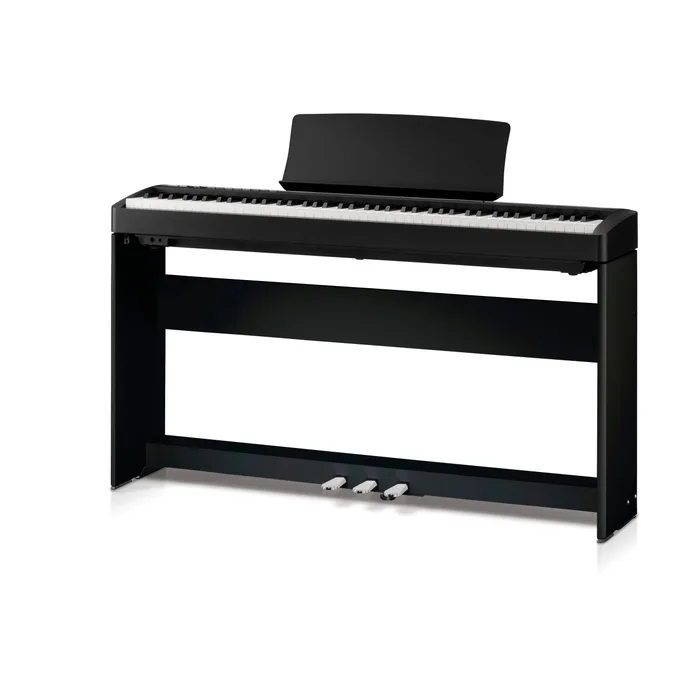
A compact weighted piano with strong Bluetooth MIDI and lesson features for students, held back by its basic pedal and MIDI-only USB.
Best for: Students who learn with apps and method books and want the piano to talk to a tablet wirelessly.
- The Responsive Hammer Compact action has 88 grade-weighted keys with matte key surfaces, and the damper input supports half-pedaling.
- Bluetooth MIDI (5.0) and Bluetooth audio (5.1) work with Kawai's PianoRemote and PiaBookPlayer apps, and Virtual Technician exposes 17 adjustable parameters.
- Built-in lesson songs from Alfred's Basic Piano Library Levels 1A and 1B and Burgmüller 25 support structured practice, with 100 drum rhythms in the metronome.
- The included F-1SP is an on/off switch pedal, so half-pedaling needs an optional F-10H or a pedal unit.
- The USB port is listed as USB to Host for MIDI, with no USB audio stated.
- Kawai does not list escapement for this action, unlike the Roland.
- The Alfred lesson books themselves are sold separately.
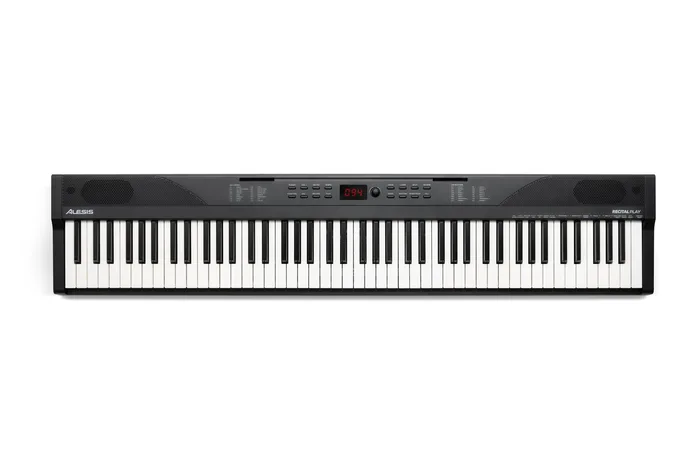
A low-cost 88-key bundle marketed as a beginner piano, but its keys are non-weighted, which defeats the point of learning on a piano.
Best for: Only a casual player who wants many sounds and accompaniment styles, not someone learning piano technique.
- It has 88 full-sized keys with adjustable touch response, 480 sounds and 160 accompaniment styles.
- Lesson Mode splits the keyboard into two zones at the same pitch so a student and teacher can play side by side.
- It can run from six AA batteries as well as the power adapter, and includes Skoove and Melodics lesson offers.
- Alesis lists the keys as non-weighted, so finger strength and control will not transfer well to an acoustic piano.
- Polyphony, speaker power and weight are not published on the product page.
- Audio out is shared with the single 1/8 in. headphone jack, and there is no Bluetooth listed.
- The page description promises a stand, case, pedal and headphones, but its Contents list names only the piano, power adapter, music rest and manuals, so check what the bundle you buy includes.
| Criteria | Roland FP-30X Top pick | Yamaha P-225 | Kawai ES120 | Alesis Recital Play |
|---|---|---|---|---|
| Verdict | Buy it | Buy it | It depends | Skip it |
| Best for | Most home pianists who want the best key feel and the most connectivity in a portable body. | Players who move their piano often or have little space and mostly want a good piano sound and feel. | Students who learn with apps and method books and want the piano to talk to a tablet wirelessly. | Only a casual player who wants many sounds and accompaniment styles, not someone learning piano technique. |
| Price tier | $$ · mid-range | $$ · mid-range | $$ · mid-range | $ · budget |
| Key action | PHA-4 Standard, escapement, ivory feel | GHC graded hammer, matte black keytops | RHC grade-weighted, matte keys | Non-weighted, adjustable touch |
| Piano sound | SuperNATURAL Piano | Yamaha CFX sample, VRM Lite | Harmonic Imaging, SK-EX and EX grands | Not specified (480 sounds) |
| Max polyphony | 256 | 192 | 192 | Not published |
| Speakers | 12 cm x 2, 11 W x 2 | 7 W x 2 | 12 cm x 2, 10 W + 10 W | Built in, power not published |
| Bluetooth | Audio and MIDI | Audio only (MIDI via UD-BT01 adaptor) | Audio and MIDI | None listed |
| USB | Audio/MIDI to computer, plus USB memory port | USB to Host with 24-bit audio interface | USB to Host (MIDI) | USB-MIDI |
| Outputs | 2 headphone jacks, 1/4 in. L/R out | 2 headphone jacks, AUX OUT L/R | 2 headphone jacks, 1/4 in. L/R line out | One 1/8 in. headphone/output jack |
| Weight | 14.8 kg (32 lb 11 oz) with music rest | 11.5 kg (25 lb 6 oz) | 12 kg (26.5 lb) without music rest | Not published |
Which one is right for you?
- Most home pianists who want the best key feel and the most connectivity in a portable body. Buy it Roland FP-30X
- Players who move their piano often or have little space and mostly want a good piano sound and feel. Buy it Yamaha P-225
- Students who learn with apps and method books and want the piano to talk to a tablet wirelessly. It depends Kawai ES120
- Only a casual player who wants many sounds and accompaniment styles, not someone learning piano technique. Skip it Alesis Recital Play
How we judged the field
Five things matter in a digital piano. The key action comes first: weighted, graded hammer keys are what make practice transfer to an acoustic piano, and details like escapement and key surface texture separate good actions from basic ones. Second is the piano sound and polyphony, which decide how natural sustained passages sound. Third is the speaker system, because a piano that sounds thin in the room is less inviting to practice on. Fourth is connectivity: Bluetooth MIDI for lesson apps, USB audio for recording, and line outputs for bigger speakers. Fifth is the practical side of size, weight and what is included, from the pedal to the stand.
The field splits into portable slab pianos with weighted keys, larger cabinet pianos with furniture stands, and budget keyboards with 88 keys but no real hammer action. We focused on portable 88-key models because they suit most homes. The Roland FP-30X and Yamaha P-225 are the two weighted-action picks, the Kawai ES120 is a student-friendly option with clear trade-offs, and the Alesis Recital Play shows what you give up with non-weighted keys.
The Roland FP-30X is the digital piano to buy for most homes. Its 88-key PHA-4 Standard keyboard is the strongest action here on paper: hammer action, escapement for the slight notch you feel on a grand, and an ivory-feel surface, the same keyboard Roland uses in its premium FP-60X. The SuperNATURAL Piano engine runs with 256-note polyphony, and 12 cm x 2 speakers rated at 11 W x 2 give it the most onboard power of the four. Connectivity is complete: Bluetooth audio for play-along tracks, Bluetooth MIDI for apps, USB audio and MIDI for a computer, a USB memory port for WAV and MP3 playback, twin headphone jacks and 1/4 in. outputs. The trade-offs are weight, at 14.8 kg with music rest, and the included DP-2 pedal switch, which you will want to upgrade. The KSC-70 stand and KPD-70 pedal unit cost extra. It suits anyone who wants one portable piano that does everything well.
The Yamaha P-225 is the lighter, simpler choice, and it gives up surprisingly little. It weighs 11.5 kg and stands 129 mm tall without the music rest, so it is easier to move and store than the Roland. The GHC (Graded Hammer Compact) action is Yamaha’s newer, more compact mechanism with matte black keytops, and the sound is sampled from Yamaha’s CFX concert grand with VRM Lite modeling the way strings resonate. Polyphony is 192 and there are 24 voices, plus Dual, Split and Duo modes. The USB to Host port doubles as a 44.1 kHz, 24-bit stereo audio interface, which is handy for recording. The compromises are 7 W x 2 amplifiers, Bluetooth that is audio only and varies by country, and wireless app control that needs the iOS-only UD-BT01 adaptor. Buy it if you move your piano often or want a clean, piano-first instrument.
The Kawai ES120 is the right piano for a certain kind of student. Its Responsive Hammer Compact action has 88 grade-weighted keys with matte surfaces, and the sound draws on Kawai’s SK-EX and EX concert grand recordings with 192-note polyphony. Where it stands out is learning: Bluetooth MIDI and audio work with Kawai’s PianoRemote and PiaBookPlayer apps, the Virtual Technician exposes 17 settings from touch curve to temperament, and the built-in lesson songs follow Alfred’s Basic Piano Library Levels 1A and 1B and Burgmüller 25, with the books sold separately. Speakers are 12 cm x 2 at 10 W + 10 W, and it weighs 12 kg. The weak spots are the included F-1SP on/off switch pedal, a USB port listed for MIDI only, and no escapement listed for the action. Choose it if your lessons run through apps and method books; choose the Roland if you also want to record audio over USB.
The Alesis Recital Play is sold as the best piano for beginners, and it is the one we would skip. The reason is in Alesis’s own feature list: 88 full-sized non-weighted keys with adjustable touch response. Non-weighted keys go down with very little effort and do not imitate a hammer action, so the finger control a beginner builds on them will not carry over to an acoustic piano or a weighted digital. The page also leaves out the figures that let you compare instruments, with no polyphony, speaker power or weight published. Its single 1/8 in. headphone jack doubles as the audio output, and no Bluetooth is listed. There is real value for casual players: 480 sounds, 160 accompaniment styles, Lesson Mode for side-by-side teaching, battery power and lesson offers. But note that the page’s Contents list names fewer accessories than its description, so check the bundle. It suits casual music-making, not learning piano.
Roland FP-30X vs Yamaha P-225: which should you buy?
The Roland FP-30X and Yamaha P-225 are both 88-key weighted portable pianos, so the choice comes down to what you do beyond playing. The FP-30X has the more detailed action on paper, with escapement and an ivory-feel surface, plus 256-note polyphony, louder 11 W x 2 speakers, built-in Bluetooth MIDI and a USB memory port. It is the more complete instrument for lessons through apps, recording and filling a room.
The P-225 counters with size and simplicity. It is about 3 kg lighter on the makers’ figures, slimmer, and still offers a CFX concert grand sample, a graded hammer action and a 24-bit USB audio interface. If your piano lives in one spot and you want the best feel and the most features, buy the Roland. If it moves between rooms, sits on a desk or travels to rehearsals, and you mostly play piano sounds through headphones or the built-in speakers, buy the Yamaha.
What to look for
- Weighted, graded hammer action: look for the words hammer action and graded or grade-weighted; non-weighted or semi-weighted keys will not build piano technique.
- Escapement and key surface: escapement imitates a grand’s let-off notch, and matte or ivory-feel keytops help with grip during long sessions.
- Polyphony of 128 or more: 192 or 256 notes gives comfortable headroom for pedalled passages and layered sounds.
- Bluetooth MIDI, not just audio: Bluetooth audio streams songs to the speakers, while Bluetooth MIDI is what lesson and notation apps need.
- USB audio for recording: a USB port that carries audio lets you record the piano’s own sound to a computer with one cable.
- A real sustain pedal: most portable pianos ship with a basic switch pedal, so check for half-pedal support and budget for an upgrade.
Our final take
For most people the Roland FP-30X is the digital piano to buy: an escapement-equipped PHA-4 Standard action, 256-note polyphony, the strongest speakers here and Bluetooth MIDI, Bluetooth audio and USB audio in one portable body. If weight and size matter more, the Yamaha P-225 keeps a graded hammer action and a CFX grand sample in an 11.5 kg body with a USB audio interface. The Kawai ES120 suits students who learn through apps and Alfred method books and will upgrade the pedal. Skip the Alesis Recital Play, because non-weighted keys teach the wrong touch, however many sounds come with them.
Questions, answered
Do I really need weighted keys to learn piano?
If the goal is to play acoustic piano, yes. Weighted hammer actions make low notes feel heavier than high notes and resist your fingers the way a real piano does, which builds the control you need. Non-weighted keys, like those on the Alesis Recital Play, press with very little effort, so habits formed on them do not transfer well. All three of our recommended models use 88 graded hammer-action keys. If you only want to try out music for fun, a non-weighted keyboard is fine, but call it a keyboard rather than a piano.
What does escapement mean, and does it matter?
On a grand piano, escapement is the small notch you feel near the bottom of a slow keystroke as the hammer releases. Some digital actions imitate it, and Roland lists escapement for the FP-30X's PHA-4 Standard keyboard. Yamaha and Kawai do not list it for the P-225 and ES120 actions. It matters most to players who already play grand pianos or who play soft, slow passages; many beginners will not notice it at first.
Is 192-note polyphony enough?
For most home playing, yes. Polyphony is the number of notes the piano can sound at once, and sustain pedal, layered sounds and backing tracks all use it up. The Yamaha and Kawai offer 192 and the Roland 256, so all three are comfortable for solo piano with the pedal down. Alesis does not publish a figure for the Recital Play, which is worth asking about if you plan to use layers and accompaniment.
Can I connect these pianos to an app or a computer?
Yes, but in different ways. The Roland FP-30X and Kawai ES120 have Bluetooth MIDI built in for apps like Roland Piano App or PianoRemote, and both also stream audio over Bluetooth. The Yamaha P-225 streams Bluetooth audio, but wireless MIDI needs the separately sold UD-BT01 adaptor, which is iOS only. For recording on a computer, the Roland and Yamaha can send audio over USB, while the Kawai's USB port is listed for MIDI.
Should I buy a stand and three-pedal unit?
None of these portable pianos includes a furniture stand or a three-pedal unit, and each maker sells its own: Roland's KSC-70 and KPD-70, Yamaha's L-200 and LP-1, and Kawai's HML-2 and F-351. A dedicated stand puts the keys at a steady height and keeps the instrument from wobbling. A three-pedal unit adds soft and sostenuto pedals alongside the sustain. If you are serious about lessons, budget for at least a better sustain pedal.
Deciding between the top two? See our head-to-head: Roland FP-30X vs Yamaha P-225.
More Audio reviews
 The Best DJ Headphones: 4 Compared (and One to Skip)
  The Best Premium Dolby Atmos Soundbars: 4 Compared (and One to Skip)
  The Best Replacement Earbud Tips: 4 Compared (and One to Skip)
  The Best Electronic Drum Kits: 4 Compared (and One to Skip)
  The Best Gaming Headsets in 2026 (and One to Skip)
  The Best Guitar Amps for Practice and Home: 4 Compared (and One to Skip)