

Baby & Family
The Best Diaper Caddies: 4 Compared (and One to Skip)
We compared four current diaper caddies on structure, one handed carrying, cleanup after spills, divider layout and real capacity.
The short version
Buy Lalo The Caddy if your caddy travels and takes abuse: the moulded ABS shell keeps its shape, the beech centre handle lifts one handed, and you can wipe the inside out with soap and a sponge instead of dabbing at stained felt. Buy the KeaBabies Original 2.0 Diaper Caddy if you want the most organization for the least money, with a roomier footprint, removable dividers and eight side pockets, accepting that felt is spot clean only and will soften over time. The Comfy Cubs Rope Diaper Caddy is the right call only for a stationary, good looking, high capacity setup, because the compartments are fixed and cotton rope absorbs whatever you spill on it. Skip the Bebe Bask Lily Diaper Caddy: it is the most beautiful object here and the weakest caddy, with a wipe only seagrass surface, a single divider, the heaviest empty weight and a premium tier price. The rule that decides this category is simple: buy the caddy you can actually clean. Best for: parents who want one caddy that survives the whole diapering run rather than one that photographs well for three months.
Our picks at a glance
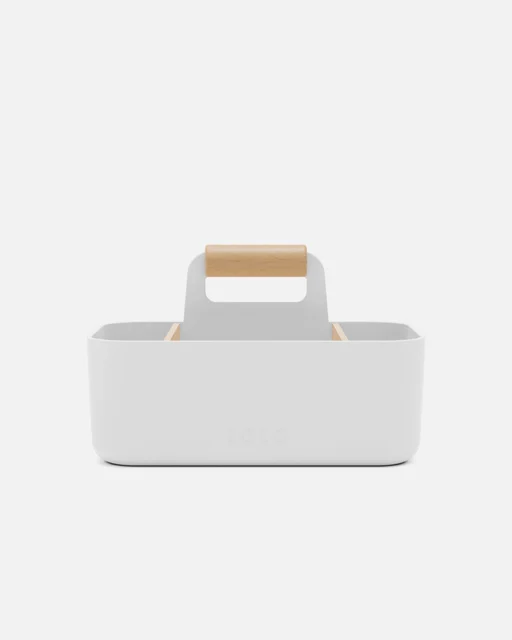
- Lalo The Caddy - Buy. A rigid, wipe clean shell with a solid wood handle and two removable dividers, which is exactly what the category has been missing.
- KeaBabies Original 2.0 Diaper Caddy - Buy. The value pick: structured felt, removable dividers and eight side pockets for a budget tier price.
- Comfy Cubs Rope Diaper Caddy - It depends. The roomiest and best looking fabric option, with fixed compartments and cotton rope that absorbs whatever you spill on it.
- Bebe Bask Lily Diaper Caddy - Skip. A gorgeous handwoven seagrass basket that fails at the one job a diaper caddy has to do, which is survive a mess.
The verdict in 30 seconds
What mattered most
- Material
- Holds shape when carried full
- Divider layout
- Exterior pockets
- Cleanup after a mess
- Footprint (approx.)
A diaper caddy looks like a solved problem until yours is sagging, stained and impossible to lift with one hand. The differences that matter are structure, whether you can actually clean it after a mess, and whether the interior layout matches what you store. We compared four current options across rigid plastic, structured felt, cotton rope and handwoven seagrass. Two are clear buys, one works only in a specific setup, and the most expensive one is the one to skip.
A rigid, wipe clean shell with a solid wood handle and two removable dividers, which is exactly what the category has been missing.
Best for: Parents whose caddy gets carried between rooms and to the car constantly and needs to survive real messes.
- Moulded ABS shell holds its shape when full and does not slump or bow
- Wipes out with a sponge and mild dish soap, so spills are recoverable
- Two removable beech dividers give three interior configurations
- Solid beech centre handle allows genuine one handed lifting
- Converts cleanly to craft, snack or toy storage after the diaper years
- Smallest footprint here at roughly 12 by 7.25 by 7.6 inches, so it holds a working supply rather than bulk stock
- No exterior pockets for creams, clippers or thermometers
- Manufacturer says do not submerge, so it is wipe clean rather than washable
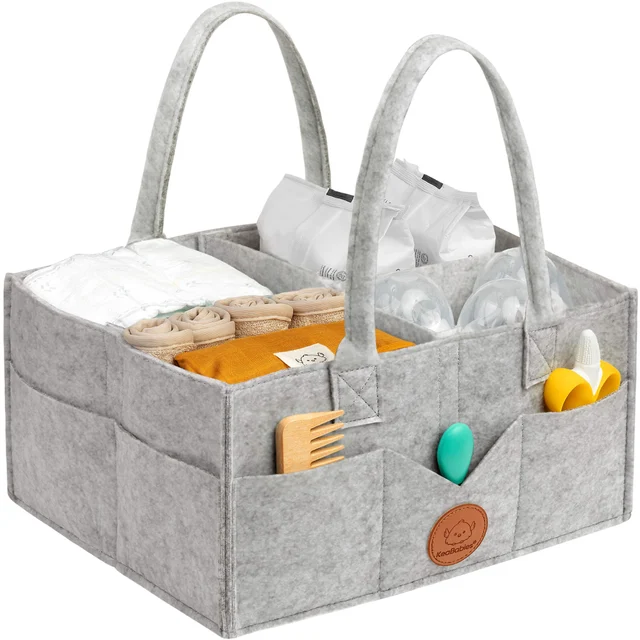
The value pick: structured felt, removable dividers and eight side pockets for a budget tier price.
Best for: First time parents who want maximum organization per dollar and a caddy that mostly stays in the nursery.
- Roughly 13.2 by 10.5 by 7.2 inches, noticeably roomier than the rigid options
- Removable dividers let you reconfigure the interior
- Eight side pockets keep small items visible instead of buried
- Light enough to move dozens of times a day without thinking about it
- Cheap enough to replace without regret when it wears out
- Hand wash or spot clean only, no machine wash and no dryer
- Felt walls soften and bow outward over time once overloaded
- Pale felt shows stains and picks up lint
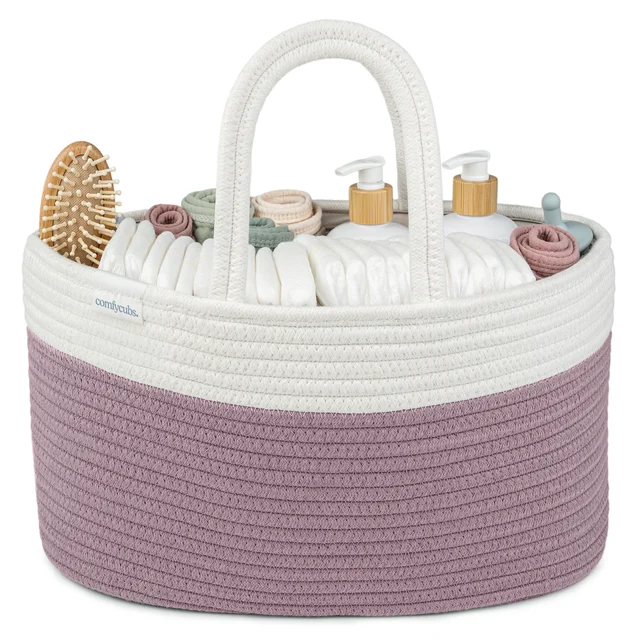
The roomiest and best looking fabric option, with fixed compartments and cotton rope that absorbs whatever you spill on it.
Best for: A mostly stationary changing table setup where capacity and appearance matter more than portability.
- Largest fabric footprint here at roughly 15 by 8.5 by 8 inches
- Woven cotton rope wears better over time than thin felt
- Three compartments cover the standard diapers, wipes and extras split
- Neutral colourways suit a decorated nursery without looking like gear
- Compartments are fixed, so you cannot retune the layout as needs change
- Rope walls flex noticeably when it is full and lifted
- Cotton absorbs spills and stains in pale rope stay visible
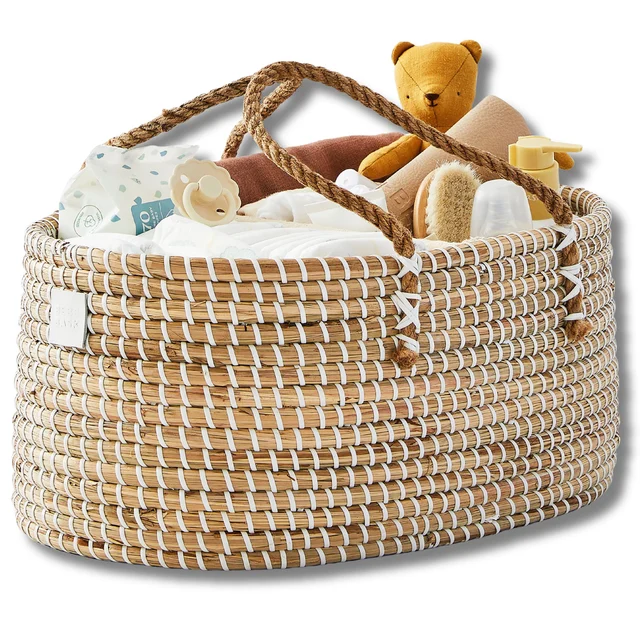
A gorgeous handwoven seagrass basket that fails at the one job a diaper caddy has to do, which is survive a mess.
Best for: Nursery styling and toy storage, not the caddy you grab one handed at 3am.
- Genuinely beautiful handwoven seagrass with rope handles
- Largest footprint in the group at roughly 16 by 11 by 7 inches
- Removable cotton canvas divider lets it convert to a toy or storage basket
- Will still look good in the room long after the diaper years
- Care instruction is wipe with a damp cloth only, so a real spill inside is not recoverable
- Open woven texture snags on wipes packs and fabric
- Heaviest here at about 2.6 pounds empty before you load it
- Only one divider, so the interior layout barely adapts
- Premium tier price for a basket that works better as decor than as equipment
| Criteria | Lalo The Caddy Top pick | KeaBabies Original 2.0 Diaper Caddy | Comfy Cubs Rope Diaper Caddy | Bebe Bask Lily Diaper Caddy |
|---|---|---|---|---|
| Verdict | Buy it | Buy it | It depends | Skip it |
| Best for | Parents whose caddy gets carried between rooms and to the car constantly and needs to survive real messes. | First time parents who want maximum organization per dollar and a caddy that mostly stays in the nursery. | A mostly stationary changing table setup where capacity and appearance matter more than portability. | Nursery styling and toy storage, not the caddy you grab one handed at 3am. |
| Price tier | $ · mid-range | $ · budget | $ · mid-range | $$ · premium |
| Material | Moulded ABS with solid beech handle and dividers | Structured felt | Woven cotton rope | Handwoven seagrass with recycled plastic weave |
| Holds shape when carried full | Yes, rigid shell | Mostly, softens and bows over time | Flexes noticeably | Rim holds, body is stiff but heavy |
| Divider layout | Two removable wood dividers, three configurations | Removable dividers | Three fixed compartments | One removable canvas divider |
| Exterior pockets | None | Eight | None | None |
| Cleanup after a mess | Wipe with sponge and mild soap, do not submerge | Hand wash or spot clean only | Spot clean only, cotton absorbs spills | Damp cloth on the surface only |
| Footprint (approx.) | 12 x 7.25 x 7.6 in | 13.2 x 10.5 x 7.2 in | 15 x 8.5 x 8 in | 16 x 11 x 7 in |
| Empty weight | About 2.5 lb | Light, well under 2 lb | Light | About 2.6 lb |
| Price tier | $ · mid-range | $ · budget | $ · mid-range | $$ · premium |
Which one is right for you?
- Parents whose caddy gets carried between rooms and to the car constantly and needs to survive real messes. Buy it Lalo The Caddy
- First time parents who want maximum organization per dollar and a caddy that mostly stays in the nursery. Buy it KeaBabies Original 2.0 Diaper Caddy
- A mostly stationary changing table setup where capacity and appearance matter more than portability. It depends Comfy Cubs Rope Diaper Caddy
- Nursery styling and toy storage, not the caddy you grab one handed at 3am. Skip it Bebe Bask Lily Diaper Caddy
How we judged the field
A diaper caddy is a simple object with a surprisingly high failure rate. It sits on a changing table or a couch arm, gets grabbed one handed while you hold a squirming baby, and eventually gets something unpleasant spilled inside it. Most of them look fine in a product photo and fall apart in exactly those three moments.
We do not run a lab. We synthesize what independent testing and long term owner reports converge on, plus the manufacturers’ own published specs on materials, dimensions and care instructions. Four things separated the good ones from the pretty ones.
Does it stay upright when it is full? Soft sided caddies bulge and slump once they are loaded with a stack of diapers, a wipes pack and a bottle of cream. The ones that hold their shape either have a rigid shell or a stiff structured wall.
Can you carry it with one hand? Owner reports repeatedly flag the same failure: dual handles that need two hands, or handles that pull the walls inward and dump the contents. A single centre handle or short reinforced grips work better than long floppy ones.
What happens after a mess? This is the criterion buyers underweight and then complain about within three months. Felt and cotton rope are spot clean only. A hard shell can be wiped with soap and water and go straight back into service.
Does the layout actually match what you store? Diapers need a tall bay, wipes need a wide flat one, and creams and thermometers need somewhere they will not tip over. Fixed compartments in the wrong proportions are worse than no compartments at all.
Price mattered less than expected. The most expensive caddy in this group is the one we would skip, and the cheapest is a genuinely good buy.
This is the one that solves the problems the category keeps ignoring. The body is moulded ABS with a solid beech handle and two removable beech dividers, which gives you three interior configurations: one open bay, two bays, or three. It is roughly 12 by 7.25 by 7.6 inches and weighs about two and a half pounds empty.
The rigid shell is the whole point. It does not sag, it does not tip when you lift it by the centre handle, and when something leaks inside you wipe it out with a sponge and mild dish soap rather than dabbing at felt with a stain pen. Lalo specifies not submerging it, so treat it as wipe clean rather than washable.
The trade off is capacity and pockets. The footprint is the smallest here, so it holds a working supply rather than a week of stock, and there are no external pockets for the small stuff. Owners who want a caddy that lives on a changing table and gets carried to the living room a few times a day tend to be happiest with it. Owners restocking a whole nursery from it are not.
It is also genuinely multipurpose. Lalo markets it for craft supplies and snacks too, which means it survives the transition out of the diaper years instead of going to the donation pile.
The value pick, and it is not close. The Original 2.0 is structured felt at roughly 13.2 by 10.5 by 7.2 inches, with removable interior dividers that give you a reconfigurable interior and eight side pockets running around the outside. For a budget tier product that is an unusually complete feature set.
Felt is the workhorse material of this category for a reason: it is stiff enough to stand up on its own, light enough to move constantly, and cheap enough that replacing it after two years is not painful. The exterior pockets are the underrated part. Thermometers, nail clippers, pacifiers and creams all live on the outside where you can see them, which keeps the interior free for diapers and wipes.
Two caveats. KeaBabies specifies hand wash or spot clean only, no machine and no dryer, so a real blowout inside it is a scrubbing job rather than a rinse. And like all felt caddies, the walls will soften over time and the sides will bow outward once it has been overloaded for a few months. Neither is a dealbreaker at this price, but expect a finite lifespan rather than an heirloom.
Cotton rope, roughly 15 by 8.5 by 8 inches, three compartments, and a look that photographs beautifully in a neutral nursery. It is the largest fabric option here and the one most people will find genuinely attractive.
The case for it: capacity. If your caddy lives permanently on a dresser and functions as bulk storage that occasionally moves to another room, the extra width is real and useful, and the woven rope wears better than thin felt over time.
The case against it: the compartments are fixed, so you get the layout the designer chose rather than the one your supplies need. The rope walls flex noticeably when it is full and lifted, and cotton rope absorbs anything spilled on it. Spot cleaning woven cotton is a slow job, and a stain in pale rope stays visible.
Buy it if you want a good looking, roomy, mostly stationary caddy and you accept that spills are a problem you will manage rather than solve. Choose something rigid if it is going to travel and take abuse.
The Lily is handwoven seagrass with a recycled plastic weave, rope handles, a single removable cotton canvas divider, and a footprint of about 16 by 11 by 7 inches. It is the best looking object in this comparison and the weakest diaper caddy.
Everything that makes it beautiful works against it in use. Woven seagrass has an open textured surface that catches on wipes packs and fabric, it cannot be scrubbed, and the care instruction is to wipe the surface with a damp cloth and air dry. A leaking cream or a genuine blowout inside a natural fibre basket is not a recoverable situation in the way it is with a plastic shell. It also weighs about 2.6 pounds empty, the heaviest here before you put anything in it, and a single divider means one large bay plus one smaller one rather than a layout you can tune.
Then there is the price. It sits at premium tier, several times what the KeaBabies costs, and handwoven pieces vary from unit to unit by design, so the one that arrives will not match the photo exactly.
None of that makes it a bad basket. As nursery decor, a toy basket or a shelf piece it is lovely and it will outlast the diaper years. As the thing you grab at 3am with one hand while a baby kicks on the changing pad, buy something you can wipe out.
Lalo The Caddy vs KeaBabies Original 2.0 Diaper Caddy: which should you buy?
These are the two we would actually put money on, and they answer different questions.
The KeaBabies wins on capacity, pockets and price. It is wider and deeper than the Lalo, the eight side pockets keep small items visible and reachable, and the removable dividers adapt to whatever you are storing. If you want one caddy that holds a lot, costs little, and can be replaced without a second thought, it is the correct answer.
The Lalo wins on durability and cleanup, which are the two things that decide whether a caddy is still in service after a year. A rigid ABS shell does not slump, does not bow at the sides, and can be washed out with soap and a sponge. Felt cannot. Owner reports across the category consistently show fabric caddies getting retired for staining and sagging rather than for breaking, and the Lalo is immune to both.
The practical split: if the caddy will mostly sit in one place and hold a lot, take the KeaBabies. If it will be carried constantly, taken to the car, and exposed to the messy end of infant care, take the Lalo and accept the smaller footprint. If budget is the binding constraint, the KeaBabies is not a compromise pick, it is a good product that happens to be cheap.
What to look for
- Wipeable beats washable beats neither. Rigid plastic can be cleaned properly. Felt and cotton rope are spot clean only, and manufacturers say so in the care instructions. Read them before you buy.
- Check the handle design, not just the handle count. A single centre handle or short reinforced grips let you lift one handed. Long soft dual handles pull the walls in and need two hands.
- Removable dividers over fixed compartments. Your storage needs change between newborn and toddler. Fixed bays lock you into one layout for the whole run.
- Exterior pockets earn their keep. Creams, clippers and thermometers belong on the outside where you can see them, not buried under a diaper stack.
- Match the footprint to the surface. Measure your changing table or dresser first. A caddy that overhangs the edge gets knocked off, and the widest options here are close to 16 inches.
- Weight when empty matters more than it sounds. You will lift it dozens of times a day. A heavy woven basket is noticeably more effort than a light felt one.
- Think past diapers. The caddies worth buying convert into craft, snack or toy storage later. That is real value, not marketing.
Our final take
The category rewards boring competence. Lalo The Caddy is our pick because a rigid shell, a solid wood centre handle and two removable dividers solve the three problems that retire most caddies: slumping, one handed carrying and cleanup. It holds less than the fabric options, and that is the price of admission.
The KeaBabies Original 2.0 Diaper Caddy is the value answer and a legitimately good product, with more space, eight side pockets and an adaptable interior for a budget tier price. Accept that felt is spot clean only and that it will soften with time.
The Comfy Cubs Rope Diaper Caddy is a reasonable buy for a stationary, good looking, high capacity setup, and a poor one if it needs to travel or survive spills. The Bebe Bask Lily Diaper Caddy is a beautiful basket that should be bought as nursery decor rather than as working equipment, at a premium price that buys looks rather than function.
Buy the caddy you can clean. Everything else is secondary.
Questions, answered
Do I actually need a diaper caddy?
You need one if changes happen anywhere other than the changing table, which for most families is every room in the house. A caddy is what stops you from running to the nursery mid change. If you have a single fixed changing station and a dresser with drawers, a caddy is a convenience rather than a necessity, and a couple of drawer organizers do the same job for less.
Felt, rope or rigid plastic: which holds up best?
Rigid plastic holds up best and cleans best, at the cost of capacity and exterior pockets. Structured felt is the value option and stands up on its own, but it softens, bows and stains, and manufacturers specify spot cleaning only. Woven cotton rope wears well but absorbs spills and its compartments are usually fixed. Natural fibre baskets such as seagrass and rattan look the best and clean the worst.
How many diapers should a caddy hold?
A working supply is roughly a day or two of changes plus a wipes pack, cream and a change of clothes, which most caddies in this size range handle comfortably. Do not buy for bulk storage. Caddies loaded to the brim are exactly what causes fabric walls to bow and handles to pull inward. Keep the box of diapers in a closet and treat the caddy as the daily loadout.
Can I put a diaper caddy in the washing machine?
Almost never, and this is where owners get caught out. KeaBabies specifies hand wash or spot clean with no machine and no dryer, Lalo says to wipe with a sponge and mild dish soap without submerging, and Bebe Bask says to wipe the seagrass with a damp cloth and air dry. Check the manufacturer's care instructions before you buy, because for most people the cleanup method is the single biggest long term difference between these products.
What can I use it for after the diaper years?
The ones worth buying convert. A rigid caddy with removable dividers becomes craft supply storage, a snack station or a cleaning caddy. Felt and rope caddies become toy, book or bathroom storage. Woven baskets become shelf or blanket storage. If a caddy has fixed compartments sized only for diapers and wipes, it has a shorter useful life than the spec sheet suggests.
Deciding between the top two? See our head-to-head: Lalo The Caddy vs KeaBabies Original 2.0 Diaper Caddy.
More Baby & Family reviews
 The Best Diaper Pails: 4 Compared (and One to Skip)
  The Best Double Strollers: 4 Compared (and One to Skip)
  The Best High Chairs of 2026: Easy Cleanup, Better Posture, and One to Skip
  The Best Kids Audio Players: 4 Compared (and One to Skip)
  The Best Kids' Bike Helmets: 4 Compared (and One to Skip)
  The Best Kids Cameras: 4 Compared (and One to Skip)