

Baby & Family
The Best Baby Play Mats: 4 Compared (and One to Skip)
We compared four current baby play mats on foam chemistry, seam count, real thickness, cleaning, and published safety testing.
The short version
The Toki Kids Poppy Organic Cotton Mat is our pick: a GOTS certified cotton cover that unzips and machine washes, over a full inch of natural latex, with published OEKO-TEX and contaminant testing. For covering an actual room, the Toddlekind Premium Foam Haven Playmat uses 24 inch tiles that halve the seam count of typical puzzle mats and publishes EN71, ASTM F963, and CPSIA compliance. The House of Noa Little Nomad Play Mat is the same format bought for its printed rug designs, so it depends on whether you value the look enough to accept a printed film as your wear surface. Skip cheap 12 inch alphabet puzzle tiles like the ProSource set: they publish no infant age rating or testing beyond a phthalate free statement, and turn loose letters into floor clutter. Remember that thickness buys joint comfort for tummy time, not fall protection. Best for: parents choosing between a soft washable island for a small baby and a wipe clean tile system for a whole play area.
Our picks at a glance
- Toki Kids Poppy Organic Cotton Mat - Buy. A GOTS organic cotton cover that unzips and machine washes, over a full inch of natural latex foam.
- Toddlekind Premium Foam Haven Playmat - Buy. Large 24 inch tiles with documented safety testing and a solid textured surface that ages better than print.
- House of Noa Little Nomad Play Mat - It depends. The same EVA tile format as our pick, bought for hand illustrated rug designs printed on a top film layer.
- ProSource Kids Puzzle Alphabet & Numbers Play Mat - Skip. Cheap 12 inch alphabet tiles with pop out letters and no infant age rating on the maker page.
The verdict in 30 seconds
What mattered most
- Surface material
- Core / construction
- Thickness
- Cleaning
- Published testing
- Largest size
Play mats look interchangeable and are not. The real decision is material chemistry (EVA and PVC versus XPE, TPU, latex, and cotton), how many seams the construction creates, and whether the surface wipes or washes. Thickness matters far less than the marketing suggests, and mostly for joint comfort during tummy time rather than fall protection. Two of these four are easy recommendations, one is a style call, and one is a registry staple we would leave off.
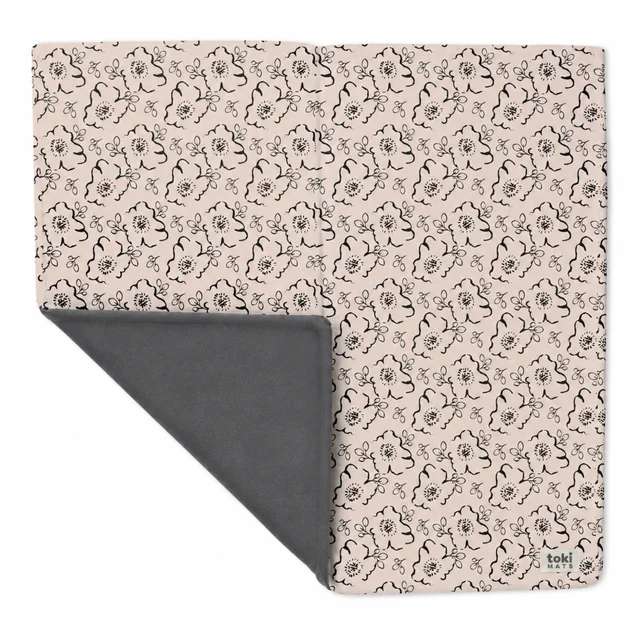
A GOTS organic cotton cover that unzips and machine washes, over a full inch of natural latex foam.
Best for: Parents of a rolling, sitting, or crawling baby who want the softest surface and would rather wash a cover than wipe plastic.
- Removable, machine washable organic cotton cover with zippers on two sides
- One inch natural latex core is the softest surface here for tummy time
- Sidesteps the EVA, PVC, and printed film chemistry question entirely
- Published GOTS and OEKO-TEX certification plus testing for phthalates, PFAS, BPA, and heavy metals
- Three sizes, the largest 84 by 60 inches, so it is a defined island rather than whole floor coverage
- Cotton absorbs spills, so cleanup means a wash cycle instead of a wipe
- Cover shrinks if dried with heat, and latex is worth considering if anyone is sensitive to it
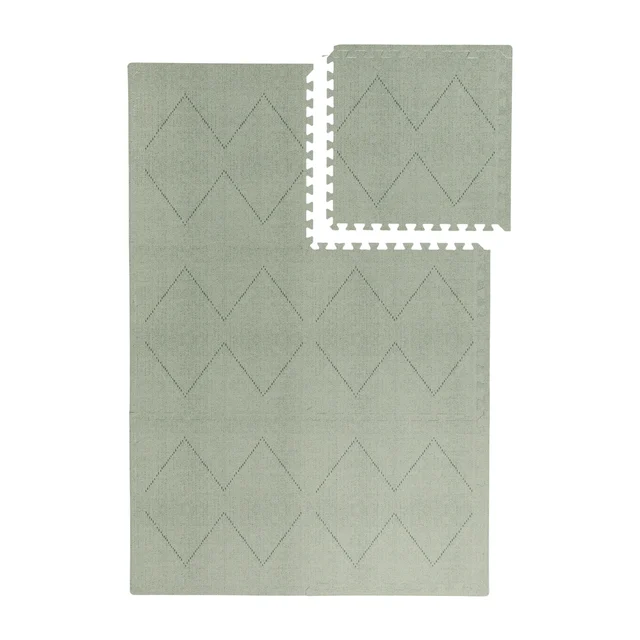
Large 24 inch tiles with documented safety testing and a solid textured surface that ages better than print.
Best for: Households protecting a whole play area on hard floors who want wipe clean speed and calm, non cartoon styling.
- 24 inch tiles cut seam length roughly in half versus the usual 12 inch puzzle tiles
- Scales from a small island up to 8 by 12 feet of coverage
- Publishes EN71, ASTM F963, and CPSIA compliance, and states the foam is free of lead, phthalates, formaldehyde, latex, and BPA
- Solid textured surface wipes clean and does not reveal a different colour when scuffed
- Seams still trap crumbs, so tiles come up periodically for sweeping
- About half an inch of firm foam is fine for crawling but flat for tummy time, and it is not fall protection
- Furniture legs dent it, and prolonged standing water can damage the material
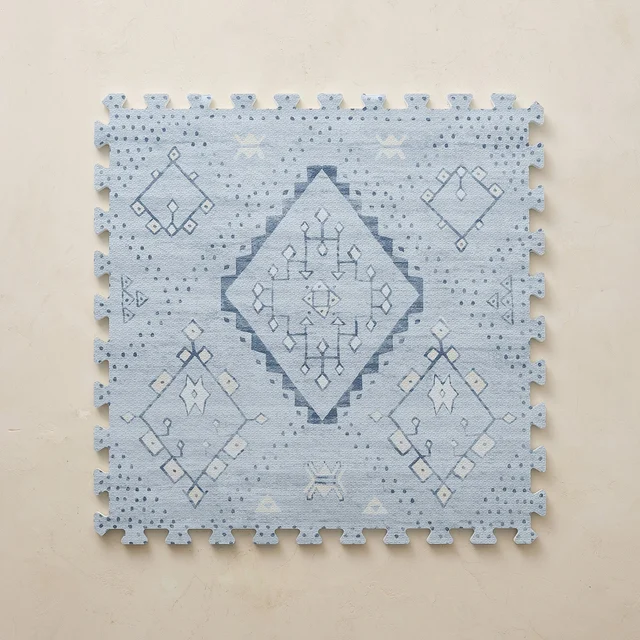
The same EVA tile format as our pick, bought for hand illustrated rug designs printed on a top film layer.
Best for: Design led homes where the mat has to live in the main living space and look like a rug.
- Hand illustrated rug style designs that genuinely read as decor rather than baby gear
- Widest size range here, from 4 by 6 up to 10 by 12 feet
- Tiles just under 25 inches square, so seam count stays low
- Tested for phthalates, lead, formaldehyde, and latex
- The pattern sits in a printed top film, so scuffs and edge wear show as damage rather than a mark
- Same modest thickness and the same seams as any tile system
- You are paying a design premium over functionally equivalent solid colour tiles
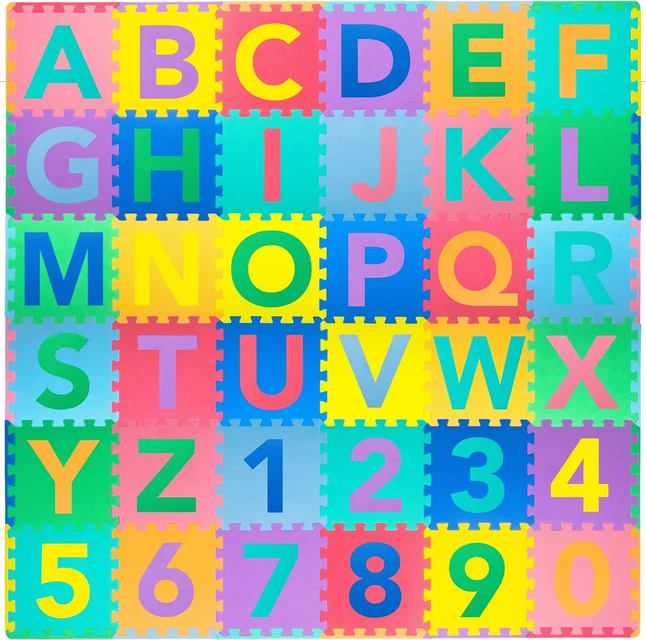
Cheap 12 inch alphabet tiles with pop out letters and no infant age rating on the maker page.
Best for: Cheap cushioning in an older child's playroom, not a nursery floor for an infant.
- Cheapest way to cover roughly 6 by 6 feet of hard floor
- Comes apart flat for storage and reconfigures to any shape
- Seller states the EVA foam is phthalate free
- The maker page lists no infant age rating, and pop out alphabet tiles are aimed at older children
- The only safety statement on the maker page is that the foam is phthalate free, with no other published testing
- 12 inch tiles roughly double the seam length, and toddlers pop them apart easily
- Pop out letters and numbers are loose small parts on the floor by design
| Criteria | Toki Kids Poppy Organic Cotton Mat Top pick | Toddlekind Premium Foam Haven Playmat | House of Noa Little Nomad Play Mat | ProSource Kids Puzzle Alphabet & Numbers Play Mat |
|---|---|---|---|---|
| Verdict | Buy it | Buy it | It depends | Skip it |
| Best for | Parents of a rolling, sitting, or crawling baby who want the softest surface and would rather wash a cover than wipe plastic. | Households protecting a whole play area on hard floors who want wipe clean speed and calm, non cartoon styling. | Design led homes where the mat has to live in the main living space and look like a rug. | Cheap cushioning in an older child's playroom, not a nursery floor for an infant. |
| Price tier | $$ · flagship | $$ · premium | $$ · premium | $ · budget |
| Surface material | GOTS organic cotton cover | Solid textured EVA foam | EVA foam with printed top film | Printed EVA foam |
| Core / construction | Zip-off cover over natural latex foam inserts | Interlocking tiles, 24 inch | Interlocking tiles, just under 25 inch | Interlocking tiles, 12 inch, plus border pieces |
| Thickness | About one inch | About half an inch | About half an inch | About three eighths of an inch |
| Cleaning | Cover unzips and machine washes | Wipe clean with mild soap and water | Wipe clean | Wipe clean, tiles lift out |
| Published testing | GOTS, OEKO-TEX, phthalates, PFAS, BPA, heavy metals | EN71, ASTM F963, CPSIA, free of lead, phthalates, formaldehyde, latex, BPA | Tested for phthalates, lead, formaldehyde, latex | Seller states phthalate free |
| Largest size | 84 by 60 inches | 8 by 12 feet | 10 by 12 feet | About 6 by 6 feet |
| Stated age suitability | Ages 0 and up, floor use only | Babies and toddlers | Babies and toddlers | No age rating on maker page |
| Price tier | $$ · flagship | $$ · premium | $$ · premium | $ · budget |
Which one is right for you?
- Parents of a rolling, sitting, or crawling baby who want the softest surface and would rather wash a cover than wipe plastic. Buy it Toki Kids Poppy Organic Cotton Mat
- Households protecting a whole play area on hard floors who want wipe clean speed and calm, non cartoon styling. Buy it Toddlekind Premium Foam Haven Playmat
- Design led homes where the mat has to live in the main living space and look like a rug. It depends House of Noa Little Nomad Play Mat
- Cheap cushioning in an older child's playroom, not a nursery floor for an infant. Skip it ProSource Kids Puzzle Alphabet & Numbers Play Mat
How we judged the field
We do not run a lab. We read the specification sheets the manufacturers publish, the independent safety testing they cite (EN71, ASTM F963, CPSIA, OEKO-TEX, GOTS), and the pattern of owner reports that pile up after a mat has been on someone’s floor for a year. Four things separated the good mats from the rest.
Material chemistry came first, because it is the question parents actually ask. Play mats are built from a short list of plastics: EVA foam (the cheap puzzle-tile default), XPE and PE foam (the Korean folding-mat standard), PVC or vinyl (increasingly avoided), TPU film (used as a wipeable skin over foam), and natural latex or polyurethane under a fabric cover. EVA has a documented history of trace formamide, which is why several European regulators forced reformulation of children’s foam tiles; reputable brands now test for it alongside phthalates, lead, and formaldehyde. The mats that earned a recommendation publish what they tested for. The one we skip publishes almost nothing beyond a phthalate free statement.
Construction came second. Interlocking tiles are the dominant format because they ship flat and scale to any room, but every seam is a crumb trap and a finger hold. Tile size is the variable nobody talks about: a mat built from 24 inch tiles has a fraction of the seam length of one built from 12 inch tiles covering the same floor, and big tiles are far harder for a toddler to lever up.
Third, thickness, which is widely misunderstood. Half an inch of closed cell foam is not fall protection. Real fall attenuation for a standing toddler needs playground grade depth, which no living room mat has. What thickness actually buys you is joint comfort during tummy time and crawling, plus a little sound damping on a hard floor. Judge it on knees and elbows, not on head injuries.
Fourth, cleaning. A mat gets yogurt on it in week one. Wipeable surfaces win on speed; a removable machine washable cover wins on anything that soaks in. Fabric mats without a removable cover are a trap.
This is the mat we would put in a nursery. The cover is GOTS certified organic cotton with zippers down two sides, so it comes off and goes in the machine, which is the single most useful feature in this whole category. Inside is a one inch natural latex foam insert derived from tree sap rather than a petrochemical foam, and the manufacturer publishes OEKO-TEX certification plus testing for phthalates, PFAS, BPA, and heavy metals.
That construction sidesteps the entire EVA and PVC debate. There is no printed vinyl film to scuff off, no formamide question, no airing-out period to plan for. Owners consistently describe it as the softest surface in the category, and a full inch of springy latex is meaningfully more comfortable for tummy time than the roughly half inch of firm closed cell foam that tile mats offer.
The limits are real. It comes in three sizes, Standard at 40 inches square, Mega at 55 inches square and Epic at 84 by 60 inches, and even the Epic is a defined island rather than wall to wall floor coverage. Cotton absorbs, so a spilled bottle means a wash cycle rather than a paper towel. The manufacturer warns to dry with no heat or the cover shrinks, and owners who ignored that found out. Latex is also worth a thought if anyone in the house has a latex sensitivity, even though the foam sits inside a sealed cover.
Best if you want one high quality mat for a baby who is rolling, sitting, and crawling in a defined corner, and you would rather wash a cover than wipe a plastic film.
If you need to cover actual floor area, this is the tile system we would buy. The tiles are 24 inches square at roughly 0.47 inches thick, and they configure from a small 4 by 6 foot island up to 8 by 12 feet. The foam is EVA, which we would normally hold against a mat, but Toddlekind publishes EN71, ASTM F963, and CPSIA compliance and states the foam is free of lead, phthalates, formaldehyde, latex, and BPA, with a biological additive intended to help it break down at end of life.
The 24 inch tile size matters more than the marketing does. Compared with the 12 inch tiles that dominate the budget end, you get roughly half the seam length over the same area, and a toddler needs real leverage to pop one loose. The surface is solid colour with a subtle textured texture rather than a printed film, so scuffs do not reveal a different colour underneath, and it wipes clean with mild soap and water.
The compromises are the ones every tile mat has. Seams still collect crumbs, and you will lift tiles occasionally to sweep underneath. Half an inch of firm foam is fine for crawling but it is not plush, and it is not fall protection. Heavy furniture legs will dent it. Prolonged standing water can damage the material, so this is not the mat for a sensory play station.
Best if you want a large, calm looking play surface that wipes clean, and you accept seams as the price of covering a whole room.
House of Noa builds essentially the same product as our tile pick: EVA foam, 0.47 inches thick, tiles just under 25 inches square, sizes from 4 by 6 up to 10 by 12 feet, tested for phthalates, lead, formaldehyde, and latex. What you are paying for is the look. These are hand illustrated designs printed to read as vintage rugs, and in a living room they genuinely do not announce themselves as baby gear.
That printed top film is also the reason this is a conditional recommendation. On a solid colour mat, a scuff is a scuff. On a printed mat, the pattern is a layer sitting on the foam, and owner reports about scraping, scuffing, and edge wear on printed foam mats are a recurring theme across the category, particularly where ride on toys and chair legs live. You are buying a wear surface that shows its wear.
Everything else about the format is identical to the tile mat we recommend, including the seams and the modest thickness. So the decision is narrow: if the rug aesthetic is what makes a play mat acceptable in your main living space, this delivers it better than anything else here. If you mainly want durability per dollar, a solid textured surface will age better.
Best for design led households where the mat has to live in the adult part of the house.
This is the classic cheap alphabet puzzle mat: 36 tiles at 12 inches square plus 24 border pieces, covering about 6 by 6 feet, in bright primary colours with pop out letters and numbers. It is inexpensive and it is everywhere on baby registries. We would not buy it for a baby, and the maker page shows it as sold out at the moment.
Start with the manufacturer’s own listing. It gives no age rating for infants, and the only safety statement is that the foam is phthalate free. There is no published testing to EN71, ASTM F963 or CPSIA, which is what the other mats here offer. For a product that will sit under a baby, that is a thin starting point.
Then the construction. Twelve inch tiles mean roughly twice the seam length of a 24 inch tile system over the same floor, so the crumb and gunk problem is doubled and the tiles are small enough that a determined toddler pops them apart as a game. The pop out letters and numbers are loose small parts by design, which is exactly the sort of thing you do not want on the floor beneath a child who mouths everything. The bright primary colour scheme also guarantees this mat will never blend into a room, which is a small thing until it is the largest object in your living space.
If you want cheap floor coverage for an older child’s playroom, fine. As a baby play mat, it is the wrong tool.
Toki Kids Poppy Organic Cotton Mat vs Toddlekind Premium Foam Haven Playmat: which should you buy?
These two answer different questions, and most households will know within a minute which one they are.
The Toki mat is a comfort product. One inch of natural latex under washable organic cotton is the softest, warmest surface in this comparison and the best thing here for a baby doing daily tummy time on a hard floor. It also removes the plastic chemistry question entirely, which for a lot of parents is the whole point. What it does not do is cover a room. You get a square island, and anything that soaks in means a wash cycle.
The Toddlekind system is a coverage product. It scales up to 8 by 12 feet, wipes clean in seconds, and its 24 inch tiles keep the seam count and the toddler tampering to a minimum. It is firmer and thinner, which is fine for crawling and cruising and unremarkable for tummy time, and you are accepting EVA foam, albeit EVA that is tested and documented rather than anonymous.
Buy the Toki mat if the baby is under a year old, plays in a defined corner, and washability matters more than square footage. Buy the Toddlekind if you are protecting a hard floor across a whole play area, or if wipe clean speed is what keeps you sane. Households with a big open plan room often end up with both: tiles for the floor, a soft mat on top for the baby.
What to look for
- Ask what the surface actually is. Fabric over latex or polyurethane, solid EVA, printed film on EVA, XPE or PE foam, or TPU coated foam all behave differently. A brand that will not name the material is telling you something.
- Look for published testing, not slogans. EN71, ASTM F963, CPSIA, OEKO-TEX, and GOTS are checkable. “Non toxic” on its own is not.
- Count the seams, not the tiles. For the same floor area, 24 inch tiles give you roughly half the seam length of 12 inch tiles, and they are much harder for a toddler to lift.
- Treat thickness as comfort, not safety. Around half an inch is fine for crawling. A full inch is noticeably better for tummy time. Neither is fall protection, and no living room mat is.
- Decide wipe versus wash before you buy. Wipeable surfaces handle spills fastest. A removable machine washable cover handles the things that soak in. Fabric with no removable cover handles neither.
- Take odour warnings literally. If the listing tells you to air the product out for days, that is off gassing, and a nursery is the wrong room to do it in.
- Check the age rating. Some popular foam tile sets carry no infant age rating or are aimed at older children, which quietly excludes the baby you bought them for.
- Measure the space first. Most regret in this category is about size, not quality. Mats always look larger online.
Our final take
The category has quietly split. On one side are modular EVA tile systems, which have got much better: bigger tiles, calmer designs, published safety testing. On the other are fabric covered mats with a soft natural core, which sidestep the plastic question altogether and are far nicer for a small baby.
The Toki Kids Poppy Organic Cotton Mat is our pick because it does the job a baby mat is actually for. A washable organic cotton cover over a full inch of natural latex is the most comfortable surface here and the easiest to keep genuinely clean, and its published certifications answer the material chemistry question directly rather than deflecting it. Its only real flaw is that it is an island, not a floor.
The Toddlekind Premium Foam Haven Playmat is the one to buy when you need to cover ground. Big tiles, documented testing, a solid textured surface that ages better than a printed one, and sizes up to 8 by 12 feet. The House of Noa Little Nomad Play Mat matches it on specification and beats it on looks, so buy it if the aesthetic is what gets a play mat into your living room, and accept that a printed top layer is a wear surface.
Skip the ProSource Kids Puzzle Alphabet & Numbers Play Mat, and cheap alphabet puzzle tiles generally. Small tiles multiply seams, pop out letters are loose small parts, and a listing with no infant age rating and no published testing has told you what you need to know.
Questions, answered
Is XPE, TPU, or latex foam actually safer than EVA or PVC?
The material matters less than the testing behind it. EVA has a real history of trace formamide in children's foam tiles, which is why European regulators pushed reformulation and why credible brands now test for it alongside phthalates, lead, and formaldehyde. XPE and PE foams (common in Korean folding mats) and TPU films are generally chosen to avoid PVC and plasticisers, and a fabric mat over natural latex or a certified polyurethane core avoids the vinyl question altogether. What separates a good mat from a bad one is whether the brand names the material and publishes checkable testing such as EN71, ASTM F963, CPSIA, OEKO-TEX, or GOTS. A mat that only says non toxic has told you nothing.
How thick does a baby play mat need to be?
Thicker than most people think for comfort, and thicker than any of these for safety. Around half an inch of closed cell foam is adequate for crawling and cruising on a hard floor. A full inch is noticeably better for tummy time, when a baby's elbows, knees, and cheek are pressed into the surface for long stretches. What no living room play mat provides is genuine fall attenuation for a standing toddler, which requires playground grade depth. Treat thickness as a joint comfort and sound damping spec, and keep furniture a baby can climb away from the mat.
Do interlocking foam tiles really come apart, and do the seams get gross?
Yes to both, and tile size is the variable that decides how bad it gets. Crumbs, milk, and sand migrate into every seam, so any tile mat needs periodic lifting and sweeping underneath. Toddlers also treat puzzle edges as a puzzle, and small tiles give them the leverage to win. A mat built from 24 inch tiles has roughly half the seam length of one built from 12 inch tiles over the same floor and is much harder to pull apart. If seams are a dealbreaker, buy a one piece mat and accept the smaller footprint.
Why does a new foam play mat smell, and what should I do about it?
That smell is residual solvents and processing agents off gassing from the foam. Some sellers state it outright and advise airing the product out for several days before use, which is useful disclosure but also a signal about what you are buying. If a mat arrives with a strong odour, unroll it in a ventilated room away from where the baby sleeps and give it several days, wipe the surface down, and do not put it into service while it still smells. A mat that still smells strongly after a week is worth returning.
Can my baby nap or sleep on a play mat?
No. Play mats are supervised playtime surfaces, not sleep surfaces. Safe sleep guidance is consistent that infants should sleep alone, on their back, on a firm flat surface in a crib, bassinet, or play yard with no soft bedding. Soft cushioned mats, fabric covered foam, and raised bumper edges are all the wrong environment for unsupervised sleep. Use the mat for tummy time and play while you are watching, and move the baby to a proper sleep space when they doze off.
Deciding between the top two? See our head-to-head: Toki Kids Poppy Organic Cotton Mat vs Toddlekind Premium Foam Haven Playmat.
More Baby & Family reviews
 The Best Baby Proofing Kits: 4 Compared (and One to Skip)
  The Best Baby Sleep Sacks: 4 Compared (and One to Skip)
  The Best Baby Strollers: 4 Popular Picks Compared
  The Best Baby Swaddles: 4 Compared (and One to Skip)
  The Best Baby Swings: 4 Compared (and One to Skip)
  The Best Baby Thermometers: 4 Compared (and One to Skip)