

Opinion
When a Brand Talks You Out of It: The Best Signal on a Product Page
A page that tells you where its own product is the wrong choice is doing something no marketing department wants. It is also the most reliable honesty signal we have found.
We have read several hundred product pages this year, and the single most reliable predictor of whether the rest of a page is accurate turns out to be something no marketing department would choose to put there.
It is a sentence telling you not to buy the product, or not to use it for the thing you were about to use it for.
Four examples that cost somebody a sale
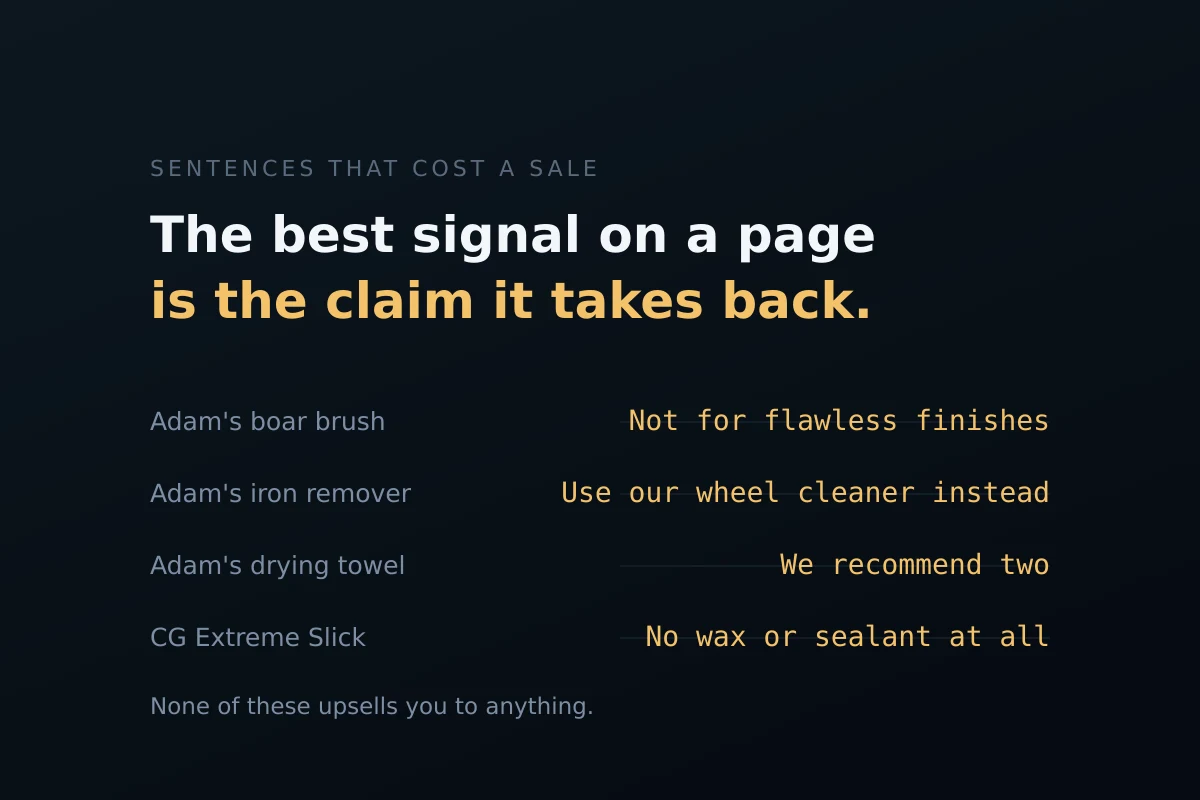
Adam’s sells a hand held boar’s hair brush. Its page states the brush is safe on all finishes, and then immediately adds that it is not recommended for flawless finishes, and points you at a microfibre wash mitt instead. That is a brush page recommending you use something that is not a brush.
The same brand sells an iron remover, and tells you that while it can be used on wheels, you should really use its thicker wheel cleaner there. It sells a ceramic trim restorer, and the page explains that a dressing, which is a cheaper category the brand also sells, can only dress plastics without truly replenishing colour. And it sells a drying towel at 370 GSM whose page says that although a single towel will dry most mid-size cars, they recommend two.
Chemical Guys does it differently and just as usefully. Its Extreme Slick quick detailer opens by saying it delivers gloss without the use of waxes or sealants. In a category where almost every competitor implies some kind of protection, that is a brand stating plainly that its product adds nothing, which is exactly the information a buyer needs and precisely the sentence that loses the sale to a rival claiming ceramic content.
Why we weight it so heavily
Because you cannot handle the product. Online, the page is the product, and everything you can check about it is a proxy for whether the person who wrote it knew what they were describing.
Marketing copy has an obvious failure mode: it is written to be true enough and flattering, by someone downstream of the people who made the thing. It produces pages that say soft, premium, ultra-absorbent, advanced, and give you no dimensions. We have compared brushes with no head diameter, applicator pads with no cell structure, sealants with no durability, wheel brushes with no length, and concentrates with no ratio.
A caveat cannot be written that way. To say a brush is wrong for a flawless finish, someone has to know what a flawless finish is, that a brush carries grit differently from a mitt, and that a customer with a show car will be unhappy. That knowledge does not appear in one sentence and vanish from the rest of the page. It is why the pages carrying caveats are, in our experience without exception, the pages that also carry real dimensions, named chemistry and honest durability windows.
The Adam’s brush page proves it in miniature. It is the only page in its comparison giving a length and a bristle length, and the only one naming epoxy set construction, which is the thing that determines whether a boar brush sheds. The caveat and the specifications came from the same person.
The counterfeit version
There is a fake form of this and it is worth learning to spot, because it is common.
A caveat that upsells is not a caveat. “For heavier defects, step up to our professional compound” is a sentence that costs the brand nothing and moves you up a price tier. So is a warning that a product is not suitable for professional use, on a page selling the consumer version of a professional product.
The real ones cost something. They point at a different product category, a cheaper item, a competitor, or nothing at all. When Adam’s says use a microfibre mitt, it is not selling you a more expensive brush. When Chemical Guys says its detailer contains no wax or sealant, it is not routing you to a premium detailer, it is telling you the product does less than you assumed.
The test is simple: after reading the caveat, is the brand better off? If yes, it is copy. If no, it is information.
What it does not tell you
It does not tell you the product is good. We have picked against products with excellent caveats, because a well-described tool can still be the wrong tool: the Adam’s brush is a block brush that will not reach a badge surround, and no amount of honesty on the page changes that.
And its absence is not proof of dishonesty. Plenty of good products sit behind thin pages written by someone with no access to the engineering, particularly in professional supply, where the assumption is that the buyer already knows the product. A blank page is usually indifference rather than deceit.
What the presence of a real caveat does is change how much weight the rest of the page can carry. On a page with one, we take the dimensions at face value. On a page without one, we check them against the label in the product photograph, and we have found enough contradictions doing that to make it standard practice.
What to do with it
When you are choosing between two products you cannot touch, read both pages looking for the sentence that narrows the claim. Which surfaces is this not for. What does it not contain. What should you buy instead for the other job. How many will you actually need.
The page that answers any of those has told you something the other one has not, and it has done it against its own interest. In a market where nearly everything is described as premium, ultra-soft and advanced, a brand willing to say not this, not here, not for that is handing you the only kind of information that is expensive to fake.
Real Buyer Experiences is reader-supported and independent. We synthesize independent testing and owner reports into one honest verdict - we never trade a recommendation for payment. How we review →