

Analysis
Permanent, or Thirty Days
Four interior cleaners all promise to deal with smells. One says permanently, one says thirty days, one says nothing measurable, and one says nothing at all.
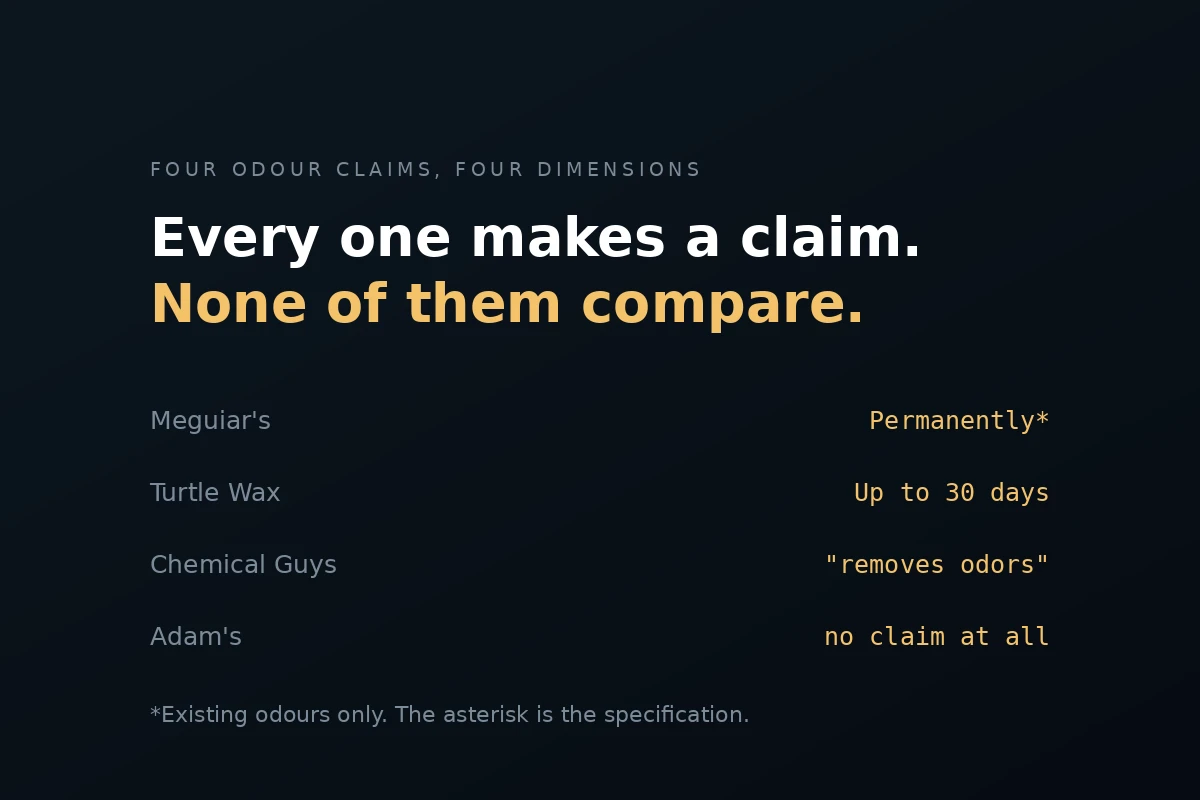
We compared four car interior cleaners this week. All four talk about smells. Here is the complete set of what they promise:
- Meguiar’s: permanently removes unwanted odours, with an asterisk
- Turtle Wax: eliminates odours for up to 30 days
- Chemical Guys: removes stains and odours
- Adam’s: nothing. The product is fragrance free and the page does not raise the subject
Four products in one category, and no two of those statements can be placed on the same scale. Permanent is not a longer version of thirty days. Removes odours is not a weaker version of either. And silence is not zero.
The asterisk is the specification
Meguiar’s claim is the strongest-looking one on the shelf, and it is also the most carefully written. The headline says its Re-Fresher technology permanently removes unwanted odours. The footnote says it permanently removes existing bad odours through chemical bonding at a molecular level.
That footnote does real work. Permanently removing an odour that is already in the fabric is a plausible chemical claim: you can bind a molecule and stop it volatilising, and that reaction does not run backwards. Permanently protecting a cabin against future odours would be a claim about the future of a product that is no longer in the bottle, and Meguiar’s does not make it.
So the honest reading of the strongest claim in the category is narrower than the word permanently suggests, and the narrowing is accurate. The company did the right thing and put it in small type, which is where the specification ended up living.
Thirty days measures a different thing
Turtle Wax’s up to 30 days is not a weaker version of permanent. It is a claim about a mechanism that depletes. Something is present in the fabric doing the work, and in a month there is not enough of it left to promise anything.
That describes a masking or neutralising agent with a service life, which is a genuinely different product philosophy from a one-off binding reaction. It also answers a question the Meguiar’s claim does not: what happens to smells that arrive after you cleaned. For a car carrying a dog or a toddler, that may be the more useful promise, and it is certainly the more testable one.
The two claims are not in competition. They are answers to different questions, printed in the same font on the same shelf.
Silence is a position
Adam’s says nothing about odour, and it is the only product of the four that is deliberately fragrance free and dye free.
Those two facts are connected. A product with no added scent cannot mask anything, which means the only way it improves how a cabin smells is by removing the material causing the smell. There is no claim to make because there is no agent left behind to make it about. The absence of an odour claim is, in that sense, more informative than a vague one: it tells you that whatever you smell after cleaning is what is actually still there.
It also carries a real cost, and we said so in the comparison. If you do not fully extract a spill, nothing covers the remainder, and the seat will keep telling you about it.
The pattern underneath
We have written about whole categories omitting the same number, where every manufacturer stays silent about the one specification that would let you compare them. This is the inverse case, and it is arguably harder to see through.
Here everybody speaks. Every product makes an odour claim of some kind, so the category looks well documented. It is only when you line the four claims up that you notice they are measured along four different axes: a permanence claim scoped to existing odours, a duration claim implying depletion, an unquantified capability claim, and a deliberate abstention. A shopper skimming four product pages comes away feeling informed, having learned nothing that supports a choice.
An omission at least announces itself. Four incompatible answers look like data.
What to do with it
The practical rule we now apply is that a claim only counts in a comparison if a second product in the same comparison states the same thing in the same units. Where that condition fails, and in this category it failed on every product, the claim goes in the write-up as description rather than as evidence, and the ranking gets decided on things that can actually be compared.
For interior cleaners that turned out to be simple. Whether the product foams predicts residue and headliner safety. What the front label names tells you which surfaces it was built for. Whether a brush is included tells you if you are buying a tool or an ingredient. Those are answerable questions with the same units on every bottle.
The odour claims made better reading. They just did not decide anything.
Real Buyer Experiences is reader-supported and independent. We synthesize independent testing and owner reports into one honest verdict - we never trade a recommendation for payment. How we review →