

Tech & Gadgets · Head-to-head
ChargerLAB POWER-Z KM003C vs FNIRSI FNB58
Which should you buy? Our verdict on both, pulled from our full The Best USB Power Meters: 4 Compared (and One to Skip) comparison.
The KM003C is the only meter here that both decodes the PD negotiation and triggers contracts up to EPR, and the only one whose manual states a measurement gain error instead of a resolution figure. The FNB58 covers most real testing for a lot less, as long as nothing you own negotiates above 28V.
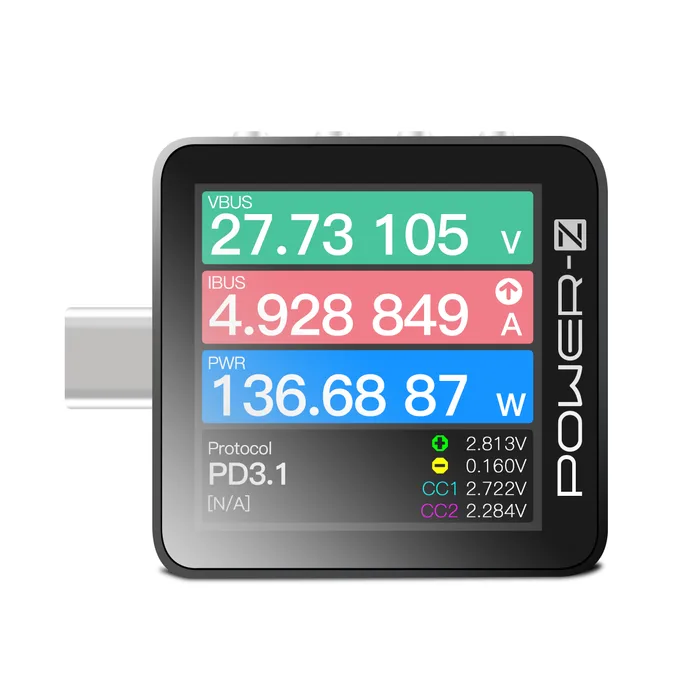
ChargerLAB POWER-Z KM003C
Buy itThe one meter here that both decodes the PD negotiation and forces a specific contract, with a published measurement tolerance behind it.
- Decodes USB PD traffic including SOP, SOP' and SOP'' packets, so you see the actual negotiation instead of inferring it from the voltage.
- Triggers PD 2.0, PPS and EPR contracts plus QC, AFC, FCP, SCP, UFCS and VOOC from the device itself, which is how you prove a charger delivers its rating.
- The manual states a voltage and current gain error of 0.05% typical and 0.25% maximum, a real tolerance rather than a resolution figure.
- Protocol analysis and firmware updates run through Windows PC software, with the Mac build still listed as a beta.
- Triggering a protocol needs a separate power source on the HID port, because a USB-C receptacle sits at 0V until something asks it to wake up.
- ChargerLAB's own manual says the built in cable simulation is not perfect and that protocol detection may not be completely accurate.
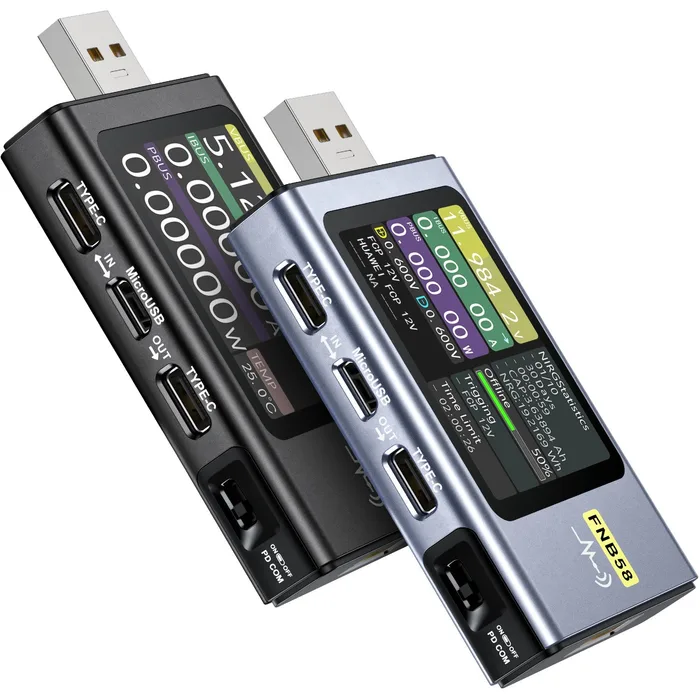
FNIRSI FNB58
Buy itA well equipped mid-range meter that reads E-marker chips, measures cable resistance and draws ripple, as long as nothing you test goes above 28V.
- Carries USB-A, Micro-USB and USB-C in one body, so it reaches older chargers and cables that USB-C only meters cannot.
- Reads USB-C E-marker chips and measures cable resistance, which answers the usual question of whether the cable is the bottleneck.
- Draws ripple at up to 4 million samples per second and slow curves from 2 to 100 samples per second, with 10 switchable record sets held on the device.
- FNIRSI rates it 4 to 28V, 0 to 7A and 0 to 140W, so the 36V and 48V EPR steps of PD 3.1 are out of range.
- The product page lists PD 2.0 and PD 3.0 only, with no PD 3.1 or PD 3.2 claim.
- No plus or minus accuracy tolerance is published on the product page, only a six digit display resolution.
Side by side
| ChargerLAB POWER-Z KM003C | FNIRSI FNB58 | |
|---|---|---|
| Our verdict | Buy | Buy |
| Best for | Anyone who needs to answer why a charger, cable or laptop is not negotiating the contract it should. | Someone testing phones, power banks, cables and chargers inside its 140W rating who also wants ripple and cable checks. |
| Price tier | $$$ · premium | $$ · mid-range |
The bottom line
Our overall pick is the ChargerLAB POWER-Z KM003C - The one meter here that both decodes the PD negotiation and forces a specific contract, with a published measurement tolerance behind it. Choose the FNIRSI FNB58 instead if someone testing phones, power banks, cables and chargers inside its 140W rating who also wants ripple and cable checks.
Want the full picture, including the other options we compared and the popular one we'd skip? Read the complete The Best USB Power Meters: 4 Compared (and One to Skip).