

Home & Kitchen
The Best Sous Vide Immersion Circulators: 4 Compared (and One to Skip)
We compared four current sous vide circulators on heat-up power, pump circulation, app vs manual control, clip fit and water-depth range.

The short version
For most home cooks the Anova Precision Cooker 3.0 is the safe, powerful choice: 1100W, dual-band Wi-Fi, and a real touchscreen so it works even when your phone doesn't. If you want the smallest unit, the quickest cooks, and the slickest app, the Breville Joule Turbo is worth the premium, but it is app-only with no physical buttons. The Inkbird ISV-100W is a smart budget pick with Wi-Fi and quiet operation if you accept a rougher app and smaller baths. We'd skip the 800W Instant Accu Slim, which is quiet and simple but underpowered and offline in a field that has moved on. Best for: pick the Anova for balance, the Breville for compact speed, the Inkbird to save money.
Our picks at a glance
- Anova Precision Cooker 3.0 - Buy. The all-rounder that finally gets connectivity right without abandoning physical buttons.
- Breville Joule Turbo - Buy. The smallest, smartest circulator here, with a Turbo mode that genuinely shortens cook times.
- Inkbird ISV-100W - It depends. A budget Wi-Fi circulator that punches above its price, if you can live with a rougher app.
- Instant Accu Slim Sous Vide (V2) - Skip. Quiet and simple, but 800W and no connectivity leave it behind the field.
The verdict in 30 seconds
What mattered most
- Heating power / heat-up
- Water circulation
- Control method
- Connectivity
- Clip & size
- Water-depth range
A sous vide circulator lives or dies on three unglamorous things: how fast it heats a full bath, how evenly it keeps that bath moving, and how little it fights you to set a temperature. We weighed four circulators you can actually buy in 2026 across those axes. Two are easy recommendations, one is a genuine 'it depends,' and one is a perfectly functional unit we still think most people should skip.
The all-rounder that finally gets connectivity right without abandoning physical buttons.
Best for: Anyone who wants strong power, real recipes, and the safety net of on-device controls.
- 1100W heats a mid-size bath quickly and holds temperature within a fraction of a degree
- Dual-band Wi-Fi (2.4/5GHz) plus Bluetooth fixed the connection drops that plagued older models
- Two-line touchscreen means you can cook fully offline if you never open the app
- Adjustable spring clip and clear MIN/MAX fill marks fit almost any pot
- Bulkier and heavier than the newest compact rivals
- The best recipe content is gated behind the app account
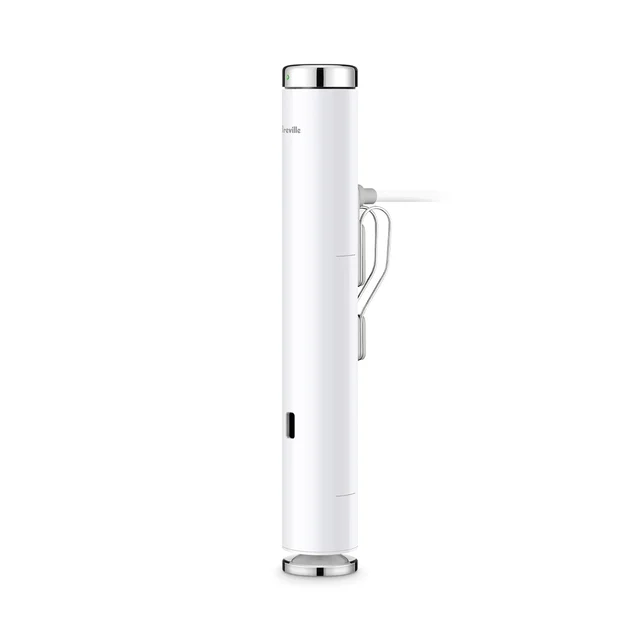
The smallest, smartest circulator here, with a Turbo mode that genuinely shortens cook times.
Best for: Phone-first cooks who value speed and a polished app over physical controls.
- 1100W plus a Turbo mode that owners report can reach doneness noticeably faster on many cuts
- Easily the most compact unit in this group; the magnetic foot and clip make it stable in shallow pots
- The app is the slickest in the category, with strong step-by-step visual guidance
- Handles large baths (rated to around 40L) despite its small footprint
- Completely app-dependent: there are no buttons or screen on the device itself
- Premium pricing, and a dead phone or dropped connection stops your workflow cold
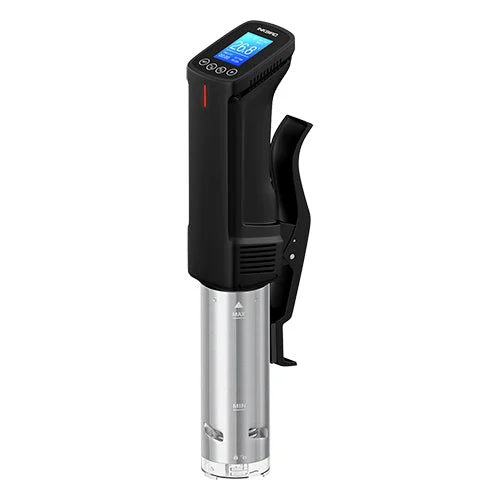
A budget Wi-Fi circulator that punches above its price, if you can live with a rougher app.
Best for: Value seekers who want app monitoring and quiet operation without paying premium money.
- 1000W with a strong 16 L/min directional pump for even circulation
- Wi-Fi plus a touchscreen, a rare combination at this price
- Runs notably quiet compared with older budget circulators
- Tight temperature control and an easy-clip design
- 2.4GHz-only Wi-Fi and an app that is functional but noticeably less refined
- Best suited to smaller baths (around 20L); it works harder than the premium units on big cooks
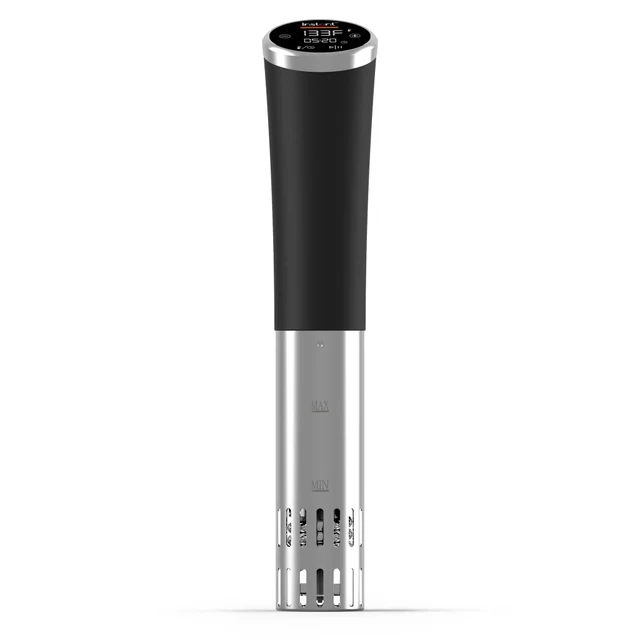
Quiet and simple, but 800W and no connectivity leave it behind the field.
Best for: A minimalist who cooks small single-pot batches and refuses to touch an app.
- Very quiet 12V DC motor and a fully waterproof body
- Simple one-touch touchscreen that anyone can operate
- Removable stainless skirt makes cleaning easy
- Only 800W, so heat-up is slower and it struggles with larger baths
- No Wi-Fi, no Bluetooth, and no app, so no remote monitoring or guided recipes
- Feature set now trails cheaper connected rivals like the Inkbird
| Criteria | Anova Precision Cooker 3.0 Top pick | Breville Joule Turbo | Inkbird ISV-100W | Instant Accu Slim Sous Vide (V2) |
|---|---|---|---|---|
| Verdict | Buy it | Buy it | It depends | Skip it |
| Best for | Anyone who wants strong power, real recipes, and the safety net of on-device controls. | Phone-first cooks who value speed and a polished app over physical controls. | Value seekers who want app monitoring and quiet operation without paying premium money. | A minimalist who cooks small single-pot batches and refuses to touch an app. |
| Price tier | $$ · mid-range | $$$ · premium | $ · budget | $ · budget |
| Heating power / heat-up | 1100W · fast | 1100W + Turbo · fastest | 1000W · fast | 800W · slower |
| Water circulation | Strong directional flow | Strong flow, compact impeller | 16 L/min directional pump | Modest flow |
| Control method | Touchscreen + app (Wi-Fi/BT) | App only (Wi-Fi/BT, no buttons) | Touchscreen + app (Wi-Fi) | Touchscreen only, no app |
| Connectivity | Dual-band Wi-Fi + Bluetooth | Wi-Fi + Bluetooth | 2.4GHz Wi-Fi | None |
| Clip & size | Adjustable clip, larger body | Clip + magnetic foot, most compact | Adjustable clip, slim | Fixed clip, slim |
| Water-depth range | Clear MIN/MAX, large baths | MIN/MAX, up to ~40L | MIN/MAX, best to ~20L | MIN/MAX, small-to-mid baths |
| App quality | Deep recipe library | Best-in-class guidance | Basic but usable | No app |
| Price tier | $$ · mid-range | $$$ · premium | $ · budget | $ · budget |
Which one is right for you?
- Anyone who wants strong power, real recipes, and the safety net of on-device controls. Buy it Anova Precision Cooker 3.0
- Phone-first cooks who value speed and a polished app over physical controls. Buy it Breville Joule Turbo
- Value seekers who want app monitoring and quiet operation without paying premium money. It depends Inkbird ISV-100W
- A minimalist who cooks small single-pot batches and refuses to touch an app. Skip it Instant Accu Slim Sous Vide (V2)
How we judged the field
We don’t run a lab. Instead we synthesize independent testing, published manufacturer specifications, and a large pool of owner reports to find where the marketing and the reality diverge. For immersion circulators, four things separate a great unit from a merely adequate one, so those are what we weighted.
First, heating power and heat-up speed — wattage largely determines how quickly a full bath reaches temperature and how fast it recovers after you drop cold food in. Second, circulation — a strong, well-directed pump is what keeps every corner of the bath at the same temperature, and it matters more than a spec sheet suggests. Third, control — whether you get Wi-Fi, Bluetooth, on-device buttons, or some combination, and how reliable and pleasant that control is in daily use. Fourth, the physical basics — clip design, overall size, and a sensible water-depth range with clear MIN/MAX marks. A circulator that nails power and circulation but drops its Wi-Fi or won’t clip to your pot is a frustrating buy.
The Anova is the unit we’d hand to someone who just wants it to work. Its 1100W element heats a mid-size bath briskly and, in independent testing, circulators in this class hold temperature within a fraction of a degree across long cooks. The headline improvement over older Anova models is connectivity: dual-band Wi-Fi plus Bluetooth has quieted the dropped-connection complaints that dogged earlier generations. Crucially, it keeps a two-line touchscreen, so you can set a temperature and walk away without ever opening an app — a reassurance the app-only competition can’t offer. It’s a bit bulkier than the newest compact rivals, and Anova pushes you toward an app account for the best recipe content, but as a do-everything circulator it’s hard to beat.
The Joule Turbo is the enthusiast’s pick and the most impressive piece of engineering here. It’s by far the most compact unit, yet its 1100W element and Turbo mode let owners reach doneness noticeably faster on many cuts, and it still drives enough flow to manage large baths rated to around 40 liters. The app is the best in the category, with genuinely helpful visual, step-by-step guidance. The catch is philosophical: the Joule is completely headless. There are no buttons and no screen on the device, so the app is the only way to run it. If your phone dies or the connection drops mid-cook, you’re stuck. For phone-first cooks who value size and speed, that trade-off is worth it — for others it’s a dealbreaker, which is exactly why the Anova edges it for the top spot.
The Inkbird is the value story. For budget money you get 1000W, a genuinely strong 16 L/min directional pump, Wi-Fi, and a touchscreen — a combination that used to cost far more. Owners also single it out as running quietly, which matters for overnight cooks. The compromises are real but honest: the Wi-Fi is 2.4GHz-only, the app is functional rather than refined, and it’s happiest in smaller baths of around 20 liters, working harder than the premium units on big cooks. If you want app monitoring and quiet operation without paying premium prices, it’s a smart buy. If you cook large batches or want a frustration-free app, spend more.
There’s nothing broken about the Accu Slim. It’s quiet, fully waterproof, dead simple to operate, and its removable skirt is easy to clean. But at 800W it heats more slowly and struggles with larger baths, and it has no Wi-Fi, no Bluetooth, and no app — so no remote monitoring and no guided recipes. That was fine a few years ago. Today the similarly priced Inkbird offers more power, stronger circulation, and connectivity for about the same outlay. Unless you specifically want an offline, no-app appliance for small single-pot cooks, the value simply isn’t here anymore.
Anova Precision Cooker 3.0 vs Breville Joule Turbo: which should you buy?
This is the real decision for anyone spending toward the top of the range. Both are powerful 1100W circulators with excellent temperature stability and strong apps, so the choice comes down to control and form factor. The Anova keeps physical buttons and a screen, uses more reliable dual-band Wi-Fi, and is the better “it just works” appliance — you are never dependent on a phone. The Breville counters with a dramatically smaller body, a Turbo mode that shortens many cooks, and the more polished app of the two.
Buy the Anova if you want maximum flexibility and a safety net of on-device control. Buy the Breville if counter and drawer space is precious, you cook phone-in-hand anyway, and you’ll pay a premium for the fastest, most guided experience. Neither is a wrong answer; they’re built for slightly different cooks.
What to look for
- Wattage: Aim for 1000W or more if you use large pots or cook often; 800W is workable only for small, single-pot batches.
- Circulation: A strong directional pump keeps the whole bath even. It’s easy to overlook on a spec sheet but you’ll notice uneven results without it.
- Control backup: Decide whether app-only is acceptable. On-device buttons mean you can still cook when your phone or Wi-Fi fails.
- Connectivity type: Wi-Fi allows remote monitoring of long cooks; Bluetooth-only keeps you tethered nearby.
- Clip and size: Make sure the clip opens wide enough for your deepest pot, and check the unit fits your storage.
- Water-depth range: Look for clear MIN/MAX marks and a pot deep enough to submerge the heater without wetting the electronics.
Our final take
Most people should buy the Anova Precision Cooker 3.0: it’s powerful, its connectivity is finally dependable, and its on-device controls mean it never leaves you stranded. Choose the Breville Joule Turbo instead if you want the smallest unit, the quickest cooks, and the best app, and you’re comfortable that it’s app-only. The Inkbird ISV-100W is the value winner for cooks who want Wi-Fi and quiet running on a budget and can accept a rougher app. And the Instant Accu Slim, while perfectly pleasant, is the one to skip — it’s simply been outrun by cheaper, more capable rivals.
Questions, answered
Does more wattage actually matter for sous vide?
Mostly for heat-up time and how well the unit holds temperature in a large bath. The 1100W Anova and Breville reach target temperature faster and cope better with big pots than the 800W Instant. Once the water is at temperature, a well-circulated bath holds steady regardless, but the extra power still helps recover heat every time you add cold food.
Is Wi-Fi worth it, or is Bluetooth or manual control enough?
Wi-Fi lets you monitor and adjust a long cook from another room or away from the kitchen, which is genuinely useful for 8-plus-hour cooks. Bluetooth-only means you must stay nearby. Manual controls matter as a backup: the Anova and Inkbird cook without a phone, while the Breville is app-only, so a dead phone or dropped connection is a bigger deal.
How deep does the water need to be?
Every unit here has printed MIN and MAX fill lines, and you must keep the water between them for safe, accurate cooking. In practice that means a pot deep enough to submerge the heating section without the water touching the electronics. Deeper containers also lose heat more slowly, which favors the higher-wattage models.
Will the clip fit my existing pots?
The Anova and Inkbird use adjustable clips that grip a wide range of pot walls, and the Breville adds a magnetic foot for extra stability in shallow or thin-walled pots. The Instant's clip is simpler and fixed. If you plan to use a tall stockpot or a plastic tub, check that the clip opens wide enough for that rim.
Are these loud during a long cook?
Circulator noise comes from the pump, not the heater. Owners consistently report the Inkbird and Instant run quietly, and the compact Breville is unobtrusive. None are silent, but for an overnight cook on a kitchen counter the noise is generally a low, steady hum rather than anything disruptive.
Deciding between the top two? See our head-to-head: Anova Precision Cooker 3.0 vs Breville Joule Turbo.
More Home & Kitchen reviews
 The Best Spice Racks: 4 Compared (and One to Skip)
  The Best Stainless Steel Cookware Sets: 4 Compared (and One to Skip)
  The Best Stand Mixers of 2026: Honest Picks for Real Kitchens
  The Best Steam Irons and Steam Stations: 4 Compared (and One to Skip)
  The Best Steam Mops of 2026: Which Ones Actually Scrub
  The Best Stovetop Kettles: 4 Compared (and One to Skip)