

Office & WFH
The Best Home Office Desks: 4 Compared (and One to Skip)
Four fixed height home office desks compared on surface material, edge banding, depth, cable provision, and what each warranty actually promises.
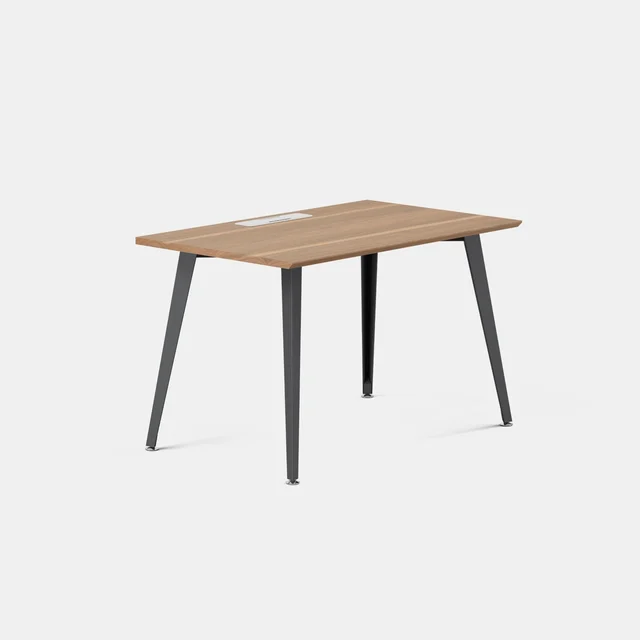
The short version
The Branch Office Desk is the pick: an impact and stain resistant laminate over an MDF core, a beveled front edge, a brushed grommet cut at the factory, a 60 by 30 inch option that puts a monitor at a sane distance, and a ten year warranty. The IKEA MITTZON Desk is the value answer, with a real walnut veneer top, the deepest configuration here at 31 1/2 inches, a designed-in cable tray, and leg height set to your body during assembly. The Thuma Studio Desk is what you buy when the desk lives in a room guests see, since solid wood sands out damage that would be permanent on laminate, but it comes in a single size. Skip the IKEA MICKE: at 19 5/8 inches deep it puts a monitor at reading distance, and a honeycomb paper core does not survive a stripped screw or a standing puddle. Best for: anyone buying one desk they intend to keep for a decade rather than replace after the next move.
Our picks at a glance
- Branch Office Desk - Buy. A contract-grade laminate over MDF top with a beveled edge, a grommet already cut, and a ten year warranty behind it.
- IKEA MITTZON Desk - Buy. IKEA's office range, not its home range: real walnut veneer, a designed-in cable tray, the deepest top here, and the same ten year warranty for less money.
- Thuma Studio Desk - It depends. Solid wood rather than board with a surface applied to it, which changes how it ages, but it comes in a single size.
- IKEA MICKE Desk - Skip. Too shallow to work at and built from honeycomb paper board that does not recover from the first spill or stripped screw.
The verdict in 30 seconds
What mattered most
- Surface material
- Edge treatment
- Deepest size offered
- Cable and power provision
- Height
- Stated warranty
A fixed height desk is a simple object, which is exactly why the differences between a good one and a bad one hide in places buyers do not check: what sits under the surface, how the front edge is sealed, how deep the top actually is, and whether cables have anywhere to go. We looked at four desks you can buy in 2026 across every price tier. Two are clear buys, one is worth it only for a specific room and a specific setup, and one is among the most popular home desks anywhere and the wrong purchase for almost everyone reading this.
A contract-grade laminate over MDF top with a beveled edge, a grommet already cut, and a ten year warranty behind it.
Best for: Anyone buying one desk to keep for a decade who wants cable routing solved out of the box.
- MDF core with an impact and stain resistant laminate, and a beveled front edge instead of a peel-prone banding strip
- Brushed grommet is standard, with an optional in-desk power module rather than a strip taped underneath
- The 60 by 30 inch configuration gives genuine monitor distance, which many desks in any tier do not
- Ten year warranty and contract-grade construction, with powder coated steel legs and leveling feet
- Assembly is a short single-person job
- Only two sizes, and the smaller 48 by 24 inch version gives up the depth that makes the big one worth buying
- Laminate cannot be refinished, so a deep gouge is permanent
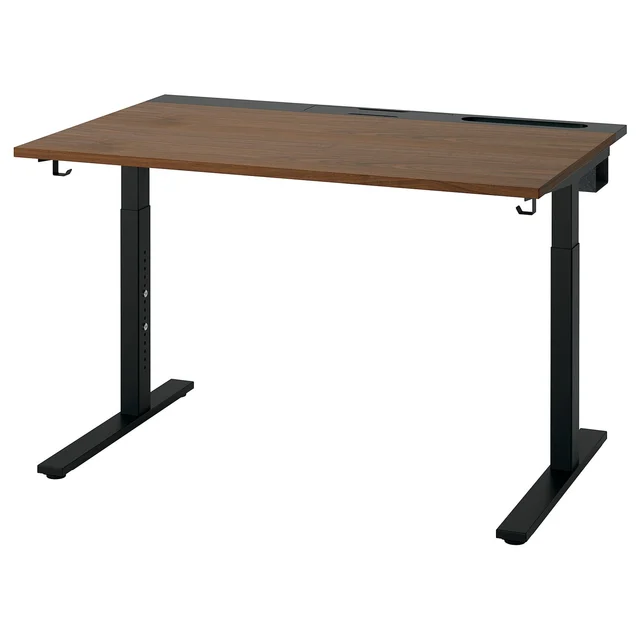
IKEA's office range, not its home range: real walnut veneer, a designed-in cable tray, the deepest top here, and the same ten year warranty for less money.
Best for: Dedicated work spaces, and anyone noticeably taller or shorter than average who wants the height dialed in without paying for a motor.
- Particleboard core with a real walnut veneer and clear lacquer, not a printed foil
- Deepest configuration in this group at 31 1/2 inches, which is where monitor distance stops being a problem
- Cable management tray with access from above and the sides, a lidded compartment, and an available plug-in power module
- Leg height is set during assembly anywhere from 25 5/8 to 33 1/2 inches, so the desk fits your body rather than the industry average
- Ten year limited warranty, which IKEA does not extend to its cheap home desks
- Changing the height later means unbolting and repositioning the legs, so treat it as a decision rather than a setting
- Veneer over particleboard is still particleboard, so a chip in the lacquer that stays wet will eventually swell
- Looks like office furniture, which is fine in a work room and less fine in a living space
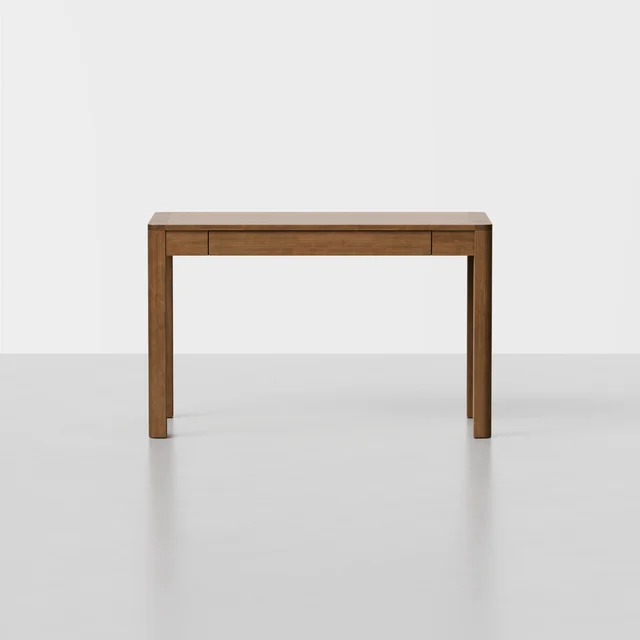
Solid wood rather than board with a surface applied to it, which changes how it ages, but it comes in a single size.
Best for: A desk that lives in a visible room and carries a laptop plus one monitor, not a full workstation.
- Solid wood construction, so scratches and water rings sand out and nothing swells
- Hidden joinery and tool-free assembly with hand-tightened screws, done in minutes
- GREENGUARD Gold certified for low emissions
- Soft-close drawer and discreet cord routing rather than an exposed grommet
- Reads as furniture in a room guests see, which no other desk here manages
- One size only, so check it fits a dual monitor setup before buying
- The drawer sits under the front edge and eats into knee clearance
- Costs several times what a competent laminate desk costs
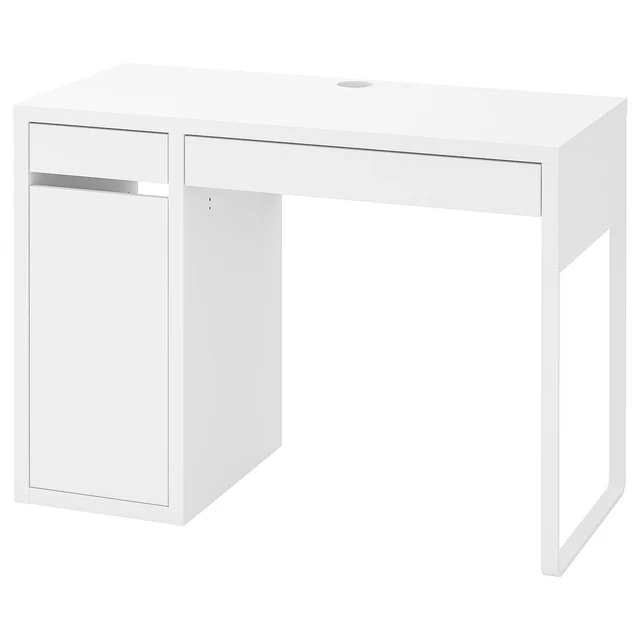
Too shallow to work at and built from honeycomb paper board that does not recover from the first spill or stripped screw.
Best for: A temporary laptop-only desk where price and portability outrank durability.
- Cheap, light, and easy to move or resell
- Includes a drawer and a cable hole at the back
- Small footprint suits a dorm room or a guest bedroom
- 19 5/8 inches deep across the entire range, which puts a monitor at reading distance rather than viewing distance
- Particleboard with honeycomb paper filling means little material left once a screw strips
- Painted board with a thin plastic edge strip swells permanently once moisture gets past it
- 110 pound total load rating, which a clamp-mounted arm plus a tower will test
- No stated warranty beyond the returns window
| Criteria | Branch Office Desk Top pick | IKEA MITTZON Desk | Thuma Studio Desk | IKEA MICKE Desk |
|---|---|---|---|---|
| Verdict | Buy it | Buy it | It depends | Skip it |
| Best for | Anyone buying one desk to keep for a decade who wants cable routing solved out of the box. | Dedicated work spaces, and anyone noticeably taller or shorter than average who wants the height dialed in without paying for a motor. | A desk that lives in a visible room and carries a laptop plus one monitor, not a full workstation. | A temporary laptop-only desk where price and portability outrank durability. |
| Price tier | $$ · premium | $ · mid-range | $$ · flagship | $ · budget |
| Surface material | MDF core, impact and stain resistant laminate | Particleboard core, real walnut veneer and clear lacquer | Solid wood with a protective finish | Particleboard with honeycomb paper filling, acrylic paint |
| Edge treatment | Beveled laminate front edge | Lacquered veneer edge | Solid wood, no applied edging to fail | Thin plastic edging strip |
| Deepest size offered | 30 inches (60 by 30 configuration) | 31 1/2 inches (63 by 31 1/2 configuration) | One size only, dimensions not published on the product page | 19 5/8 inches across the whole range |
| Cable and power provision | Brushed grommet standard, optional in-desk power module | Cable tray with lid, optional plug-in power module | Discreet cord routing, no grommet | Single cable hole at the back |
| Height | Fixed | Set at assembly, 25 5/8 to 33 1/2 inches | Fixed | Fixed at 29 1/2 inches |
| Stated warranty | 10 years | 10 years limited | Brand warranty, terms published separately from the spec sheet | No stated warranty, returns window only |
| Assembly | Short single-person job, leveling feet included | Heavier and fiddlier, height chosen during build | Tool-free, slides together in minutes | Long flat-pack build with cam locks |
| Price tier | $$ · premium | $ · mid-range | $$ · flagship | $ · budget |
Which one is right for you?
- Anyone buying one desk to keep for a decade who wants cable routing solved out of the box. Buy it Branch Office Desk
- Dedicated work spaces, and anyone noticeably taller or shorter than average who wants the height dialed in without paying for a motor. Buy it IKEA MITTZON Desk
- A desk that lives in a visible room and carries a laptop plus one monitor, not a full workstation. It depends Thuma Studio Desk
- A temporary laptop-only desk where price and portability outrank durability. Skip it IKEA MICKE Desk
How we judged the field
We do not run a furniture lab. What we do is read across independent testing, manufacturer spec sheets, and the pattern in owner reports that only shows up after a desk has been lived with for a year or two. Then we weight the things that actually decide whether a desk is still solid in five years.
Four criteria did most of the sorting.
The first is what the top is made of and how its edges are sealed. A desk almost never fails in the middle. It fails at the front lip where forearms rest and rub, and at the corner where a mug once tipped. Particleboard with a thin printed foil is the worst case: once moisture gets past the foil, the board swells, and swollen board never goes back down. A thicker MDF core under a proper laminate, a veneer with a lacquered edge, or solid wood all survive the same spill.
The second is depth, which buyers underrate constantly and regret later. Width is easy to judge in a showroom. Depth is what determines whether a 27 inch monitor sits at a comfortable arm’s length or roughly a foot from your face. Anything under about 24 inches forces you to either shove the screen to the back edge or live too close to it.
The third is cable and power provision. Most desks treat this as an afterthought and leave you solving it with adhesive clips and zip ties. A brushed grommet, a lidded cable tray, or a routed channel is a design decision the maker either made or did not.
The fourth is what the maker will promise in writing. A ten year warranty on a laminate top is a real signal, because it means the manufacturer expects that surface to still be intact a decade in.
We also held the field to fixed height desks. Sit to stand mechanisms are a separate buying decision with their own failure modes and their own price penalty, and mixing them in makes every other comparison mushy.
This is the desk that gets the boring parts right. The top is MDF under a laminate the maker specifies as impact and stain resistant, with a beveled front edge rather than a squared-off strip of banding waiting to peel. That combination is the reason owners of laminate over MDF desks tend to report the same thing after several years: scuffs, but no swelling and no delaminating lip.
Cable provision is built in rather than bolted on. A brushed metal grommet is standard, and there is an optional in-desk power module for people who want outlets at the surface instead of a strip taped underneath. That is a small thing until you have routed a monitor cable, a laptop charger, and a dock through a desk that has no hole in it.
Size is where it earns the pick. The larger configuration is 60 by 30 inches, and that 30 inch depth is the number that matters. It lets a large monitor sit far enough back that you are not craning, with room left in front for a keyboard and forearms. Powder coated steel legs with leveling feet handle uneven floors, assembly is a genuinely short job, and the maker backs it with a ten year warranty and describes the construction as contract grade, which is to say specified for offices where people use furniture hard.
The limits are real but narrow. There are only two sizes, and the smaller 48 by 24 inch version gives up the depth advantage that makes the big one worth buying. Laminate cannot be refinished, so a deep gouge is permanent in a way it would not be on solid wood.
MITTZON is IKEA’s office range rather than its home range, and the difference in construction is visible. The version worth buying has a particleboard core with a real walnut veneer and clear lacquer over it, not a printed foil pretending to be wood. IKEA backs the range with a ten year limited warranty, which it does not extend to its cheap home desks.
Two features make it punch above its tier. The deepest configuration is 63 by 31 1/2 inches, which is more depth than most desks at any tier offer, and a cable management tray is designed into the frame with access from above and from the sides, plus a compartment with a lid for the mess you do not want to look at. There is also a plug-in module with room for a power strip.
The height is set during assembly anywhere from 25 5/8 to 33 1/2 inches. That is not a sit to stand mechanism. It is a one-time fit adjustment, and it is genuinely useful, because standard 29 inch desks are too tall for a large share of adults and there is normally nothing you can do about it. Dial it to your seated elbow height once and the ergonomics problem is solved without paying for a motor.
The catches: changing that height later means unbolting and repositioning the legs, so treat it as a decision, not a setting. Veneer over particleboard is still particleboard underneath, so a chip in the lacquer that stays wet will eventually swell. And it looks like office furniture, because it is office furniture, which is fine in a dedicated room and less fine in a living room corner.
The Studio Desk is the only one here made of solid wood rather than board with a surface applied to it, and that changes the failure model entirely. A scratch sands out. A ring from a glass sands out. Nothing swells, because there is no compressed fiber core to swell. It is also GREENGUARD Gold certified for low emissions, assembles in minutes with hand-tightened screws and no tools, and has a soft-close drawer and discreet cord routing rather than an exposed grommet.
It is also the reason this is a depends rather than a buy. There is one size, sold as comfortably at home in a bedroom or living room as in an office, and a dual 27 inch monitor setup is likely to crowd it. The drawer sits under the front edge and takes a bite out of knee clearance that taller people will notice. And it costs several times what a competent laminate desk costs, which is a fair trade for solid wood and a bad trade if the desk is going in a spare room nobody sees.
Buy it if the desk has to read as furniture in a room you live in, and if your setup is a laptop plus one monitor. Do not buy it as a workstation.
MICKE is one of the most common home office desks around and one of the least suited to being a home office desk.
Start with depth: 19 5/8 inches. That is shallower than most laptops plus a mousepad, and it puts a 24 inch monitor roughly at reading distance rather than viewing distance. There is no configuration of MICKE that fixes this, because every size in the range shares that depth.
Then the construction. IKEA lists the top and panels as particleboard with honeycomb paper filling, fiberboard, acrylic paint, and plastic edging. Honeycomb paper is a hollow lattice inside the panel. It keeps the desk light and cheap, and it means that once a screw strips there is often no material left to bite into, and once water gets past the painted surface or the plastic edge strip there is nothing to stop it spreading. The total load rating is 110 pounds, which sounds generous until you add a heavy monitor on a clamp arm, a desktop tower, and someone leaning on the front edge. And unlike the office range, it carries no stated warranty beyond IKEA’s returns window.
It is cheap, it is light, and it has a cable hole at the back. As a temporary desk for a laptop, in a dorm or a guest room, it does the job. As the desk you work at forty hours a week for five years, it is the wrong purchase, and a swollen front edge is the typical way it fails.
Branch Office Desk vs IKEA MITTZON Desk: which should you buy?
These two are closer than their price tiers suggest, and the choice comes down to what you want the desk to be.
The Branch is the better object. The beveled laminate edge is more durable than a lacquered veneer edge in the specific place desks get abused, the grommet and optional in-desk power are cleaner than a tray you reach into, and assembly is quicker with fewer chances to get it wrong. It also looks like a piece of furniture rather than a workstation, which matters if the desk shares a room with the rest of your life.
The MITTZON wins on two hard numbers and one soft one. It offers more depth, 31 1/2 inches against 30, and depth is the single spec most people get wrong. It lets you set the height to your body during assembly instead of accepting the industry-standard 29 inches, which is a real ergonomic advantage the Branch does not offer. And it carries the same ten year warranty for meaningfully less money.
Buy the Branch if the desk is visible, if you want the cleanest cable solution available in this group, and if you would rather assemble something once and never think about it. Buy the MITTZON if the desk lives in a dedicated work space, if you are noticeably taller or shorter than average, or if the money saved is going toward a better chair, which it usually should be.
What to look for
- Depth before width. Aim for 27 inches or more if you run a monitor, 30 inches or more if you run a large one or two. Width is easy to add with a second surface. Depth is not.
- What the core actually is. Solid wood, MDF, and particleboard behave very differently when wet. Honeycomb paper filling is a warning sign, not a feature, no matter how the listing frames it.
- How the edges are finished. A thick lacquered edge, a beveled laminate lip, or solid wood all seal the front edge. A thin adhesive strip of plastic banding is the part that lifts first and lets moisture in.
- A grommet or a tray, decided before you buy. Retrofitting cable management means drilling a hole in a laminate top, which chips, or living with clips stuck to the underside. Check whether the desk has a route for cables and whether a power module is available.
- Stated warranty length. Ten years on a desktop surface is a genuine commitment. A returns window is not a warranty.
- Height, if you are not average. Most desks are fixed near 29 inches. If that is wrong for you, a desk whose legs set to your height at assembly solves the problem far more cheaply than a motorized one.
- Load rating against your real setup. A clamp-mounted monitor arm, a tower, and a person leaning on the edge add up faster than the spec sheet suggests.
Our final take
Fixed height desks are one of the few categories where the cheap option is genuinely a trap rather than a compromise. The difference between a desk that looks tired after twelve months and one that looks fine after five years is not brand and it is not price alone. It is whether there is real material under the surface and whether the edges are sealed properly.
The Branch Office Desk is the pick because it gets material, edge, depth, and cable routing right at once, and puts a ten year warranty behind the claim. The IKEA MITTZON Desk is the value answer and beats it on depth and on fitting the desk to your body. The Thuma Studio Desk is the right call only when the desk has to look like furniture and the workload is light. The IKEA MICKE is the one to walk past, not because it is cheap, but because it is too shallow to work at and built from a material that does not recover from the first accident.
Questions, answered
How deep does a home office desk actually need to be?
Aim for at least 27 inches if you use a monitor, and 30 inches or more for a large screen or two screens. Depth sets how far the display sits from your eyes, and once a desk is too shallow there is no accessory that fixes it. Width is the easier problem, because you can add a side surface or a return. This is the spec buyers most often get wrong, partly because showroom desks are usually shown empty.
Is particleboard always a bad sign?
No, but what is done with it matters enormously. Particleboard under a real veneer with a lacquered edge, as in IKEA's office range, holds up far better than particleboard with a honeycomb paper core and a painted surface. The failure mode is moisture reaching the fiber core, so the question is whether the surface and the edges are sealed well enough to keep it out. Solid wood and dense MDF both raise the floor, but a well-edged particleboard top from a maker willing to warrant it for ten years is a reasonable buy.
Do I need a grommet if I only use a laptop?
Probably not today, but setups grow. A charger, a dock, a monitor, and a desk lamp is four cables, and retrofitting a hole into a laminate top risks chipping the surface around the cut. If the desk you like has no route for cables, plan on an under-desk tray and adhesive clips from the start, and check that the underside is flat enough to mount them.
Should I just buy a standing desk instead?
That is a separate decision with its own trade-offs, which is why we kept this comparison to fixed height desks. A motorized frame adds cost, weight, moving parts, and a stability penalty at full height. If you know you will use the standing position, buy for that. If you are buying it as an option you might use someday, the money usually does more good spent on depth, surface quality, and a better chair.
What actually kills a desk within five years?
Three things, in order. Moisture reaching a fiber core through a lifted edge strip or a chipped surface, which causes swelling that never reverses. Fasteners stripping out of a hollow or low-density panel, which makes the desk wobble and cannot be properly repaired. And surface wear at the front lip where forearms rest, which is why beveled or solid edges outlast thin applied banding. Depth and cable routing decide whether you like the desk. Material and edge quality decide whether you still own it.
Deciding between the top two? See our head-to-head: Branch Office Desk vs IKEA MITTZON Desk.
More Office & WFH reviews
 The Best Office Headsets for Calls & Video Meetings: 4 Compared (and One to Skip)
  The Best Office Storage Carts: 4 Compared (and One to Skip)
  The Best Paper Shredders: 4 Compared (and One to Skip)
  The Best Photo Printers for Home: 4 Compared (and One to Skip)
  The Best 2027 Planners: 4 Compared (and One to Skip)
  The Best Ring Lights: 4 Compared (and One to Skip)