

Home & Kitchen
The Best Grow Lights: 4 Compared (and One to Skip)
We compared four LED grow lights on published light output (PPF and PPFD), wattage, efficiency, coverage, dimming, certifications and warranty.
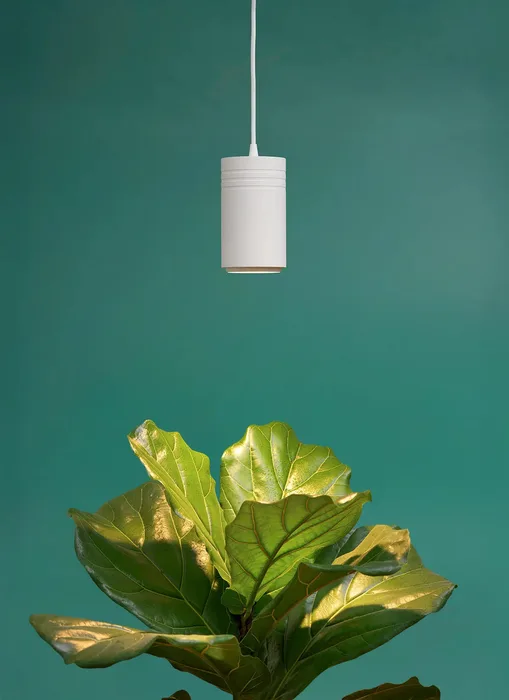
The short version
The Soltech Aspect Gen 2 is the pick for houseplants: a pendant light that publishes its output, 50 µmol/s from 36 W, with PPFD at 1 meter, 4 feet and 6 feet, plus a built-in 10% to 100% dimmer and an 18-foot fabric cord. The Mars Hydro TS 600 is the buy for grow tents and seedlings, with 190 µmol/s of PPF, 2.0 µmol/J efficiency, a 2 x 2 ft vegetative footprint, dimming and ETL certification. The Barrina T5 suits shelves and seed-starting on a budget, with linkable 10 W, 5000K strips and a switch on each light, but no PPF or PPFD is published. Skip the Sansi 40W 4-Head Clip-on Grow Light: it is sold on 4000 lumens and a claim of matching a 600-watt traditional bulb, not on any plant-light figure. Best for: houseplants, seedlings, herbs and winter gardening.
Our picks at a glance
- Soltech Aspect Gen 2 LED Growlight - Buy. A pendant grow light for living spaces that publishes its output at real distances.
- Mars Hydro TS 600 - Buy. An efficient 100 W panel for grow tents and seed trays, with published PPF.
- Barrina T5 10W LED Grow Lights 2FT 5000K - It depends. Cheap, linkable 5000K strips for shelves and seed trays, with no plant-light figures.
- Sansi 40W Adjustable 4-Head Clip-on LED Grow Light with Timer - Skip. A clip-on light sold on lumens and bulb-equivalent claims instead of plant-light output.
The verdict in 30 seconds
What mattered most
- Style
- Power
- PPF
- Efficiency
- PPFD published
- Dimming
Grow lights keep houseplants, seedlings and herbs growing through dark winters. The number that matters for plants is not lumens, which measure what human eyes see, but photon output: PPF from the fixture and PPFD at the plant. Efficiency, coverage, dimming and hanging height decide how well a light suits your space. Many listings skip the plant numbers entirely. We compared four popular lights.
A pendant grow light for living spaces that publishes its output at real distances.
Best for: Houseplant owners who want a light that looks good in a living room.
- 50 µmol/s from 36 W, with PPFD of about 50 at 1 meter, 34.9 at 4 feet and 15.5 at 6 feet.
- Built-in dimmer from 10% to 100%.
- 18-foot fabric cord and optional stands and wall mounts.
- Its output suits one plant or a small group, not a grow tent.
- The most expensive light per unit of output here.
- Mounts and stands are sold as separate sets.
- Coverage area is not given as a footprint.
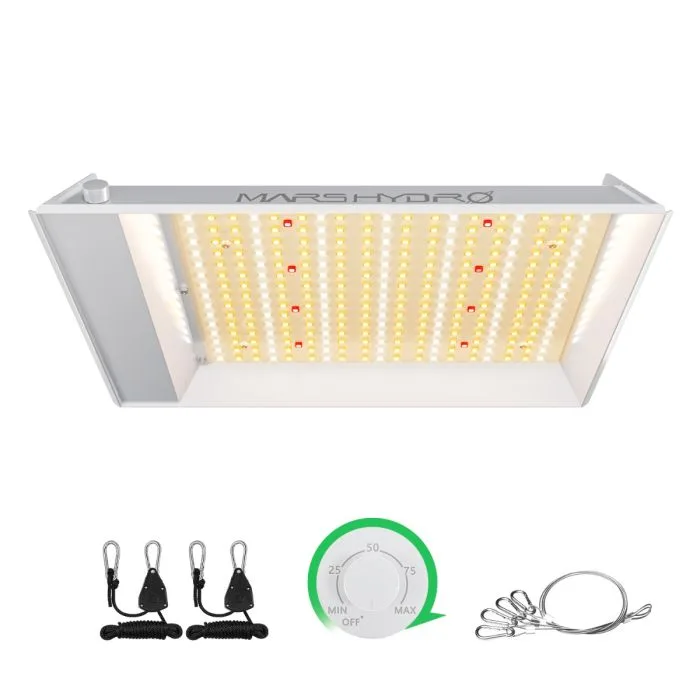
An efficient 100 W panel for grow tents and seed trays, with published PPF.
Best for: Seed starting, herbs and small grow tents.
- 190 µmol/s of PPF at 2.0 µmol/J, from 100 W.
- Dimmable, with a 2 x 2 ft vegetative and 1.5 x 1.5 ft flowering footprint.
- ETL, CE, RoHS and UKCA certifications and a rated 50,000-hour lifespan.
- An industrial panel that looks out of place in a living room.
- The page states a 5-year warranty in one place and up to 2 years in another.
- Needs hanging hardware and space above the plants.
- Overkill for a few houseplants.
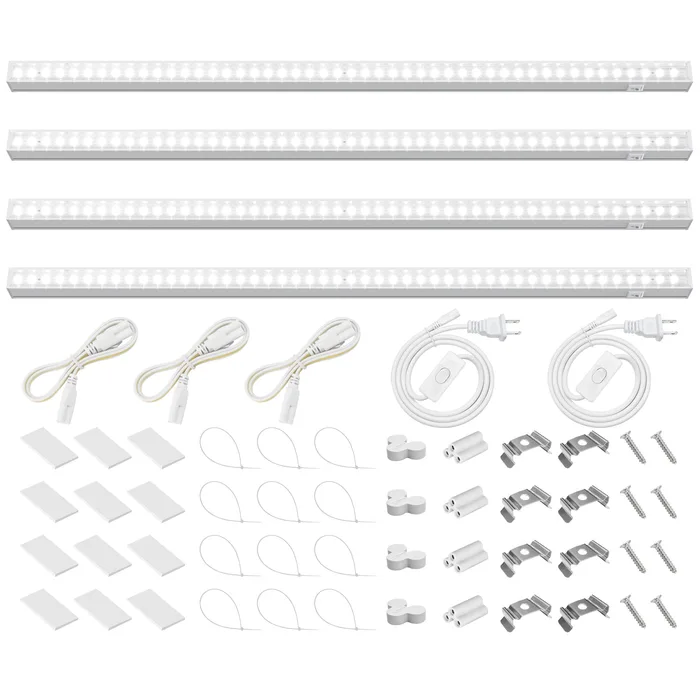
Cheap, linkable 5000K strips for shelves and seed trays, with no plant-light figures.
Best for: Shelf growers and seed starters who want wide, even light on a budget.
- 10 W per 2 ft light, 5000K full spectrum and a 120° beam.
- Link up to 16 lights in series, with an on/off switch on each.
- Sold in 4- and 8-packs with clips, tape and connecting cords.
- No PPF or PPFD figures are published, despite a "high PPFD" claim.
- Low output per strip, so they must sit close to plants.
- No dimming.
- Many cords and connectors to manage.
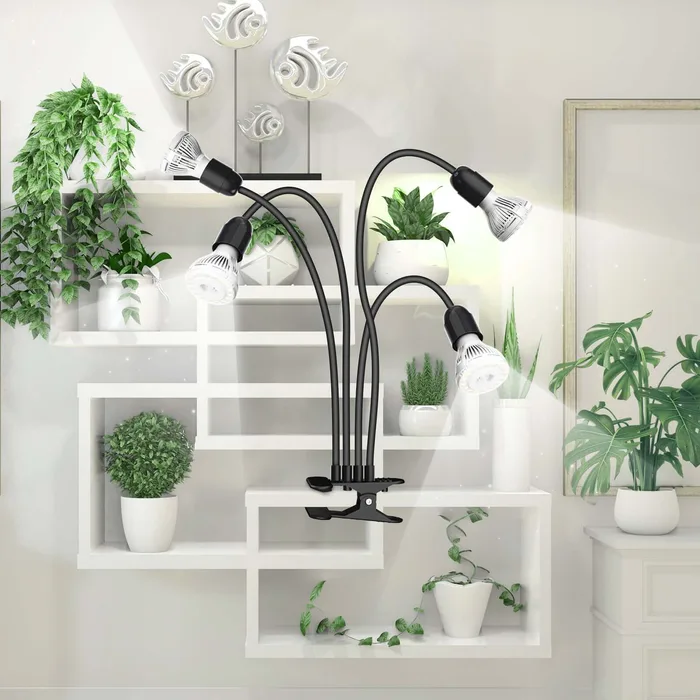
A clip-on light sold on lumens and bulb-equivalent claims instead of plant-light output.
Best for: Buyers who want a simple clip-on light and accept marketing figures.
- Four adjustable goosenecks with a clamp and an auto on/off timer.
- Ceramic LED bulbs in a 4000K full-spectrum tone.
- 2-year warranty.
- Sold on 4000 lumens, a measure of human-visible light, with no PPF on the page.
- Claims to match a 600-watt traditional bulb while using 40 watts, a comparison that says nothing about plant light.
- Sansi advises keeping the lights at least 1 foot from plants.
- The page also promises to save 90% on electricity bills, which depends entirely on what you replace.
| Criteria | Aspect Gen 2 LED Growlight Top pick | TS 600 | T5 10W LED Grow Lights 2FT 5000K | 40W Adjustable 4-Head Clip-on LED Grow Light with Timer |
|---|---|---|---|---|
| Verdict | Buy it | Buy it | It depends | Skip it |
| Best for | Houseplant owners who want a light that looks good in a living room. | Seed starting, herbs and small grow tents. | Shelf growers and seed starters who want wide, even light on a budget. | Buyers who want a simple clip-on light and accept marketing figures. |
| Price tier | $$$ · premium | $$ · mid-range | $ · budget | $ · budget |
| Style | Pendant | Panel | Linkable strips | Clip-on goosenecks |
| Power | 36 W | 100 W | 10 W per strip | 40 W (4 x 10 W) |
| PPF | 50 µmol/s | 190 µmol/s | Not published | Not published |
| Efficiency | Not stated | 2.0 µmol/J | Not published | Not published |
| PPFD published | Yes, at 1 m, 4 ft, 6 ft | Coverage by stage | No | No |
| Dimming | 10% to 100% | Yes | No (on/off per strip) | Timer |
| Colour | Full spectrum | 3000K + 5000K + red + far red | 5000K | 4000K |
| Warranty | Not stated on page | 5 years (also listed as 2) | See policy | 2 years |
Which one is right for you?
- Houseplant owners who want a light that looks good in a living room. Buy it Soltech Aspect Gen 2 LED Growlight
- Seed starting, herbs and small grow tents. Buy it Mars Hydro TS 600
- Shelf growers and seed starters who want wide, even light on a budget. It depends Barrina T5 10W LED Grow Lights 2FT 5000K
- Buyers who want a simple clip-on light and accept marketing figures. Skip it Sansi 40W Adjustable 4-Head Clip-on LED Grow Light with Timer
How we judged the field
Five things decide whether a grow light is worth buying. Plant-light output comes first: PPF from the fixture and PPFD at the plant, not lumens. Efficiency, in µmol/J, tells you how much light you get per watt. Coverage and hanging height decide how many plants it serves. Dimming and timers make it easier to live with. And certifications and warranty matter for a device that runs for hours every day.
The field splits into decorative pendants for houseplants, panels for tents and seed trays, linkable strips for shelves and clip-on lights. We picked one of each and compared them only on what each brand publishes.
The Soltech Aspect Gen 2 is the pick for houseplants because it is designed for living spaces and still publishes real plant-light numbers. Soltech lists 50 µmol/s of output from 36 W and gives PPFD at three hanging heights: about 50 µmol/m²/s at 1 meter, 34.9 at 4 feet and 15.5 at 6 feet. A built-in dimmer runs from 10% to 100%, the 18-foot fabric cord makes placement flexible, and Soltech sells stands and wall mounts to hang it. Soltech recommends 12 to 14 hours of light a day. The limits are scale and price. Its output suits a single large plant or a small group rather than a tent, mounts are sold separately, and it costs the most per unit of light here. For a fiddle-leaf fig in a dark corner, it is the one to buy.
The Mars Hydro TS 600 is the buy for anyone growing in a tent or starting seeds. Mars publishes 190 µmol/s of PPF from 100 W, an efficiency of 2.0 µmol/J, and a footprint of 2 x 2 ft for vegetative growth and 1.5 x 1.5 ft for flowering. It is dimmable, uses a spectrum with 3000K and 5000K white plus red and far-red diodes, and carries ETL, CE, RoHS and UKCA certifications with a rated 50,000-hour lifespan. Mars recommends hanging it about 12 inches above plants and dimming by growth stage. The cautions: it is an industrial-looking panel, it needs hanging hardware, and the page states a 5-year warranty in one place and up to 2 years in another. For seedlings, herbs and small tents, it delivers far more light per watt than the others.
The Barrina T5 strips are the budget choice for shelves, which is why they are our depends. Each 2 ft strip draws 10 W, gives 5000K full-spectrum white light with a 120° beam, and has its own on/off switch, and you can link up to 16 strips in series. They come in 4- and 8-packs with clips, tape and connecting cords, which makes them easy to fit under a shelf. What is missing are the plant numbers: Barrina says the strips have high PPFD but publishes no PPF or PPFD figures. Low output per strip means they must sit close to plants, there is no dimming, and a big setup means a lot of cords. For wide, even light over seed trays or a plant shelf on a budget, they work well.
The Sansi 40W 4-Head Clip-on Grow Light is easy to set up, and we would still skip it. It has four adjustable goosenecks on a clamp, ceramic LED bulbs in a 4000K tone, an auto on/off timer and a 2-year warranty, and Sansi’s listing says it is ETL listed. The problem is how it is sold. The page leads with 4000 lumens, a measure of how bright light looks to people, and says the light matches a 600-watt traditional bulb while using only 40 watts. Neither figure tells you how much usable light reaches your plants, and the page gives no PPF. It also promises to save 90% on electricity bills, which depends entirely on what you replace, and Sansi advises keeping the bulbs at least a foot from plants. A light with published PPF or PPFD, like the Soltech or Mars Hydro, is the better buy.
Soltech Aspect Gen 2 LED Growlight vs Mars Hydro TS 600: which should you buy?
The Soltech Aspect Gen 2 and the Mars Hydro TS 600 both publish real plant-light numbers, but they are built for different spaces. The Soltech is a 36 W pendant with 50 µmol/s of output and published PPFD at 1 meter to 6 feet, a 10% to 100% dimmer and a design meant to hang in a living room. The Mars Hydro is a 100 W panel with 190 µmol/s at 2.0 µmol/J, a 2 x 2 ft footprint and multiple certifications, meant for tents and seed trays.
Choose the Soltech for one or two statement houseplants in a room you live in. Choose the Mars Hydro if you start seeds, grow herbs or run a small tent, where output per watt matters more than looks.
What to look for
- PPF and PPFD: Photon output and light at the plant are the real measures; lumens are not.
- Efficiency: µmol/J shows how much plant light you get per watt.
- Coverage: A footprint or PPFD at stated distances tells you how many plants it serves.
- Dimming and timers: Dimming adapts light to growth stage; timers keep hours consistent.
- Certifications: ETL, UL or similar listings matter for lights that run all day.
- Marketing claims: Be wary of wattage-equivalent and percentage-savings claims with no plant figures.
Our final take
For houseplants, the Soltech Aspect Gen 2 is the grow light to buy. It looks good in a living space and publishes its output and PPFD at real hanging heights, with a built-in dimmer. For seed starting and grow tents, the Mars Hydro TS 600 is the better choice, with 190 µmol/s at 2.0 µmol/J. The Barrina T5 strips are a cheap way to light shelves if you accept missing figures. Skip the Sansi 40W clip-on: it is sold on lumens and a 600-watt-equivalent claim rather than any plant-light number.
Questions, answered
What is PPFD and why does it matter?
PPFD, photosynthetic photon flux density, is the amount of usable light reaching a spot on your plant each second, in µmol/m²/s. It is the number that tells you whether a light is strong enough at a given distance. Soltech publishes PPFD at 1 meter, 4 feet and 6 feet for the Aspect Gen 2. Lumens measure brightness to human eyes and do not tell you how well a light grows plants.
How far should a grow light be from plants?
It depends on the light's output and your plants. Low-power lights like strips sit a few inches to a foot away, while panels like the Mars Hydro TS 600 hang higher, and Mars recommends about 12 inches with dimming by growth stage. Pendants like the Soltech Aspect can hang several feet away at lower intensity. Watch for bleached or stretched leaves and adjust.
How many hours a day should grow lights be on?
Most houseplants and seedlings do well with 12 to 16 hours of light a day, and Soltech suggests 12 to 14 hours for the Aspect Gen 2. A timer makes it consistent. Plants also need darkness, so do not run lights around the clock. Flowering plants may need specific day lengths.
Do grow lights need to be purple?
No. Early LED grow lights used mostly red and blue, which looks purple, but modern full-spectrum white lights grow plants well and look natural in a home. Some add red and far-red diodes for flowering, like the Mars Hydro TS 600. White light also lets you see plant health properly.
Do grow lights use a lot of electricity?
LED grow lights are efficient. A 36 W pendant or a few 10 W strips use little power even over 14 hours a day, and a 100 W panel uses more but covers a tent. Efficiency, measured in µmol/J, tells you how much plant light you get per watt. Compare efficiency rather than energy-savings claims.
Deciding between the top two? See our head-to-head: Soltech Aspect Gen 2 LED Growlight vs Mars Hydro TS 600.
More Home & Kitchen reviews
 The Best Hand Mixers: 4 Compared (and One to Skip)
  The Best Handheld Vacuums (2026): Four Tested Picks and One to Skip
  The Best Cordless Hedge Trimmers: 4 Compared (and One to Skip)
  The Best Home Safes: 4 Compared (and One to Skip)
  The Best Honing Rods: 4 Compared (and One to Skip)
  The Best Garden Hose Reels: 4 Compared (and One to Skip)