

Home & Kitchen
The Best Garment Steamers: 4 Compared (and One to Skip)
We compared four garment steamers - two handhelds, a steamer-iron hybrid, and a standing unit - on power, speed, and reliability.
The short version
For most people, the Conair Turbo ExtremeSteam GS38 is the garment steamer to buy: it heats quickly, hits hard with a high-wattage element and a Turbo mode, and costs mid-range money. Heavy steamers - think dresses, drapes, and weekly loads - should step up to the Jiffy J-2000, a handcrafted standing unit with a brass-housed element and brass fittings that owners describe as long-lived. The Steamery Cirrus Icon is a legitimate luxury option whose ceramic-coated heated plate crisps collars and cuffs, but its 90 to 170 ml tanks make it a depends, not a default. The wildly popular HiLIFE handheld is the one to skip: low power, a slow heat-up, and owner reports of spitting when tilted. Review counts are not the same thing as quality. Best for: anyone tired of ironing - pick the Conair for everyday touch-ups, the Jiffy for volume, the Steamery for travel and delicates.
Our picks at a glance
- Conair Turbo ExtremeSteam GS38 - Buy. A powerful mid-range handheld that is quick and versatile enough for everyday use.
- Jiffy Steamer J-2000 - Buy. A handcrafted American standing steamer with a die-cast brass element housing and brass fittings, built for heavy use.
- Steamery Cirrus Icon Handheld Steamer - It depends. Steamery's updated take on the Cirrus 3, a design-forward handheld with a heated plate that earns its keep on delicates and travel, if you accept the premium.
- HiLIFE Handheld Steamer - Skip. A bestseller on review counts alone, but low power, slow heat-up, and a tilt-and-spit design are hard to forgive.
The verdict in 30 seconds
What mattered most
- Type
- Rated power
- Heat-up time
- Steam per fill
- Pressing capability
- Reliability reputation
A good garment steamer turns a wrinkled shirt into a wearable one in about two minutes, no ironing board required. The category splits into quick-hit handhelds and high-capacity standing units, and the gap between the best and worst is wider than the price tags suggest. We weighed maker specs and owner reports to land on two clear buys, one stylish maybe, and one wildly popular model we think most people should skip.
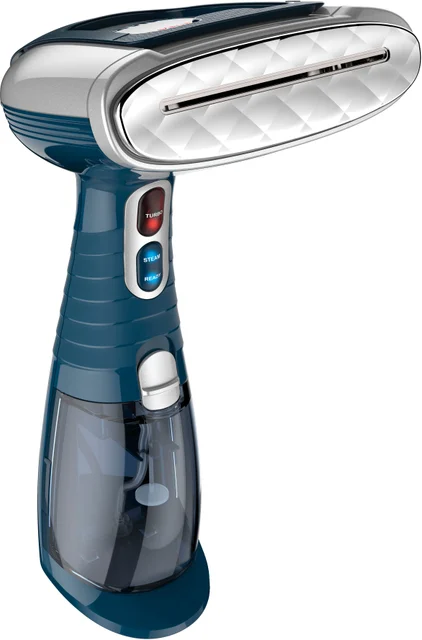
A powerful mid-range handheld that is quick and versatile enough for everyday use.
Best for: Most people who want one steamer that handles daily touch-ups and tougher fabrics alike
- High-wattage element with a Turbo mode aimed at stubborn wrinkles
- Owners describe quick heat-up and steady steam per fill
- Includes attachments such as a brush, a delicate-fabric spacer, and a crease tool
- Heavier than compact travel steamers, so long sessions can tire your wrist
- Tank is on the smaller side relative to its strong steam output, so big loads need refills
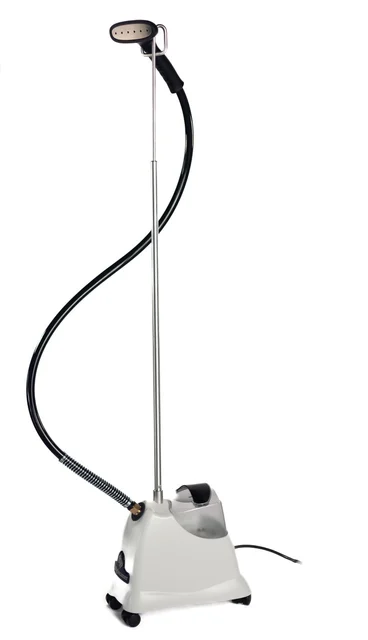
A handcrafted American standing steamer with a die-cast brass element housing and brass fittings, built for heavy use.
Best for: Households that steam in volume - dresses, drapes, linens - and want a machine that outlives trends
- 1300-watt stainless steel element in a die-cast brass housing, with all brass fittings; owners often describe long service lives
- 3/4-gallon (2.8 L) water caddy that can be refilled during the steam cycle for continuous use
- Handcrafted in Tennessee with a 3-year limited warranty, and the maker sells replacement parts
- Floor-standing unit that is too bulky to travel with
- Utilitarian looks and a flexible hose that needs a hanging garment to work at its best
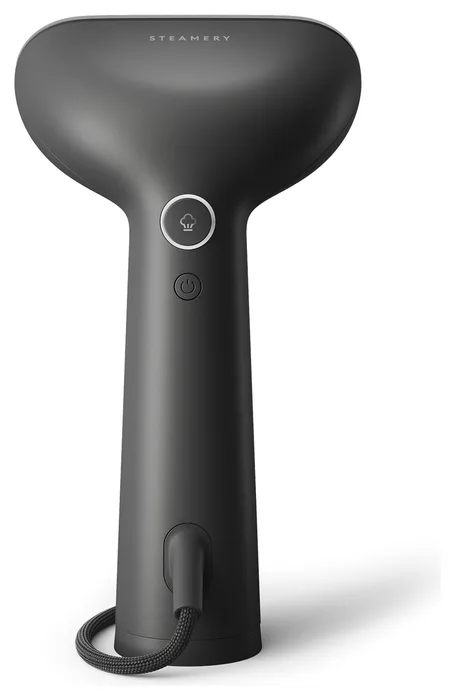
Steamery's updated take on the Cirrus 3, a design-forward handheld with a heated plate that earns its keep on delicates and travel, if you accept the premium.
Best for: Frequent travelers and design-conscious buyers who steam a few delicate pieces at a time
- Ceramic-coated heated front plate presses collars and cuffs as it steams, which plain steamers can't do
- Ready in 35 seconds with 26 g/min of Dry Steam, per Steamery
- Ships with a 170 ml Extra Large Water Tank alongside the 90 ml standard tank, plus a storage bag
- Self-cleaning function, a flat base it stands on, and auto shut-off 8 minutes after last use
- Even the large tank is 170 ml, a garment or two per fill against a standing unit's caddy
- At 660 g it is a handheld you hold at arm's length for every garment
- Steamery publishes no wattage
- Costs standing-steamer money for handheld capacity
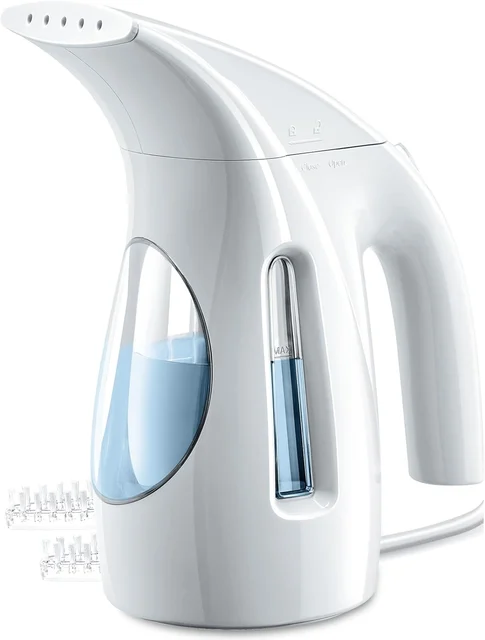
A bestseller on review counts alone, but low power, slow heat-up, and a tilt-and-spit design are hard to forgive.
Best for: Almost nobody; spend slightly more on the Conair, or accept slow results at your own risk
- Very cheap, light, and backed by an enormous number of owner reviews
- Small tank suited to short touch-ups
- Low wattage compared with modern handhelds, so owners report slow, inconsistent wrinkle removal
- Owners report spitting and leaking hot water when the unit is tilted
- Owners report a slow heat-up compared with higher-powered handhelds
| Criteria | Conair Turbo ExtremeSteam GS38 Top pick Buy it Buy | Jiffy Steamer J-2000 Buy it Buy | Steamery Cirrus Icon Handheld Steamer It depends Buy | HiLIFE Handheld Steamer Skip it Buy |
|---|---|---|---|---|
| Best for | Most people who want one steamer that handles daily touch-ups and tougher fabrics alike | Households that steam in volume - dresses, drapes, linens - and want a machine that outlives trends | Frequent travelers and design-conscious buyers who steam a few delicate pieces at a time | Almost nobody; spend slightly more on the Conair, or accept slow results at your own risk |
| Price tier | $$ · mid-range | $$$ · premium | $$$ · premium | $ · budget |
| Type | Handheld | Standing with hose | Handheld steamer-iron hybrid | Handheld |
| Rated power | High (check current listing) | 1300 W (stainless element, brass housing) | Not published (26 g/min steam output) | Low (listing-reported) |
| Heat-up time | Quick, per owner reports | About 1 minute (maker) | 35 seconds (maker) | Slow, per owner reports |
| Steam per fill | Roughly one tank per few garments | 3/4-gallon caddy, refillable mid-use | 90 ml, or 170 ml with the included large tank | Short, small tank |
| Pressing capability | Steam only, with crease attachment | Steam only | Ceramic-coated heated plate | Steam only |
| Reliability reputation | Strong owner track record | Strong owner reputation, 3-year warranty | Self-cleaning function, small tanks | Weak - spitting and leak complaints |
| Travel-friendliness | Packable but heavy | Not portable | Storage bag included, 660 g | Light but slow |
| Price tier | $$ · mid-range | $$$ · premium | $$$ · premium | $ · budget |
Which one is right for you?
- Most people who want one steamer that handles daily touch-ups and tougher fabrics alike Buy it Conair Turbo ExtremeSteam GS38
- Households that steam in volume - dresses, drapes, linens - and want a machine that outlives trends Buy it Jiffy Steamer J-2000
- Frequent travelers and design-conscious buyers who steam a few delicate pieces at a time It depends Steamery Cirrus Icon Handheld Steamer
- Almost nobody; spend slightly more on the Conair, or accept slow results at your own risk Skip it HiLIFE Handheld Steamer
How we judged the field
We don’t run a lab. Instead, we worked from maker specifications and aggregated owner reports - the long-term reviews where heating elements die, gaskets loosen, and cheap tanks start spitting. Four things mattered most: steam power and consistency (does it actually flatten wrinkles, or just humidify them?), speed (heat-up time and how much you can steam per fill), safe handling (no spitting hot water, no leaks at normal angles), and durability (what owners say after a year, not a week). We weighted the category’s known failure modes heavily. Hot-water spitting is a safety concern, so a design that owners describe as leak-prone is disqualifying no matter how cheap it is.
Conair Turbo ExtremeSteam GS38
Buy itThe GS38 is the handheld that closes most of the gap with an iron. Its high-wattage element heats quickly, and the Turbo setting pushes hotter steam aimed at thick cotton and blazers, fabrics that leave weaker handhelds steaming in place. The included attachments earn their spots: the bristle brush lifts pile on heavier fabric, the spacer protects delicates, and the crease attachment gets you closer to a pressed finish than a bare steam head ever will. Owners’ main gripes are honest ones: it’s heavier than travel-oriented rivals, and the modest tank means a full closet refresh needs a top-up. Neither undercuts the value. For mid-range money you get power, speed, and a good owner track record, the best overall package of the four.
Jiffy Steamer J-2000
Buy itThe J-2000 has been made in the USA since 1940, is handcrafted in Tennessee, and is the standing steamer owner reports treat as a long-term purchase. A 1300-watt stainless steel element in a die-cast brass housing makes steam in about a minute per the maker, and the 3/4-gallon water caddy can be refilled during the steam cycle for continuous use. Owners often describe long service lives, and when something does wear, the maker sells replacement parts. It comes with a 3-year limited warranty. The trade-offs are obvious: it’s bulky, it’s plain-looking, and the hose-and-hanger workflow suits batch steaming better than a quick morning touch-up. But if you steam regularly - gowns, suiting, table linens, curtains - this is the difference between owning a tool and renting a gadget.
Steamery Cirrus Icon Handheld Steamer
It dependsThe Cirrus Icon is Steamery’s updated take on the Cirrus 3, which it replaces in the current lineup, and the design is more than skin-deep. Steamery says a more powerful heater delivers faster Dry Steam, rated at 26 g/min and ready in 35 seconds, and its real trick is a ceramic-coated heated front plate that presses collars, cuffs, and plackets to a crispness plain steamers can’t reach. It ships with a 170 ml Extra Large Water Tank as well as the 90 ml standard one, a steaming pad, a heat-proof silicone cover and a storage bag, cleans itself, stands on a flat base, and shuts off 8 minutes after last use. So why isn’t it a straight buy? Capacity and price. Even the large tank is good for a garment or two before refilling, it weighs 660 g in the hand, Steamery publishes no wattage, and it costs as much as a serious standing unit while delivering handheld throughput. If you travel often, dress in delicates, and care what your tools look like, it’s a justifiable indulgence. If you just want maximum wrinkles removed per dollar, the Conair does more for less.
HiLIFE Handheld Steamer
Skip itThe HiLIFE is one of the best-selling steamers by review count, and we understand the appeal: it’s very cheap and light. But the fundamentals are weak. It has far less heating power than modern handhelds, so owners report a slow heat-up and slow wrinkle removal, passing over the same spot repeatedly. Worse is the handling constraint: owners report spitting, sputtering, and leaking hot water when the unit is tilted, which is the angle you reach steaming a shoulder or a hanging hem. Hot-water spitting is a safety concern, and that pattern matters more than any bargain price. Popularity is not performance. Spend a little more on the Conair, and if budget is truly fixed, at least keep this one bolt upright and away from your hands.
Conair Turbo ExtremeSteam GS38 vs Jiffy Steamer J-2000: which should you buy?
This comes down to how you steam. The Conair is the everyday tool: quick to heat, powerful enough for thick fabric on the Turbo setting, easy to stash in a drawer or a suitcase, and priced in the mid-range. Its limits show up on volume, since the modest tank and a wrist-borne weight make steaming eight garments a chore. The Jiffy is the volume machine: about a minute to make steam, then continuous steaming with a refillable 3/4-gallon caddy and a hose you can loop over anything hangable. It costs premium money and takes up real floor space, but owner reports treat it as a long-lived appliance with brass fittings and available spare parts. Buy the Conair if steaming is a two-minute morning fix. Buy the Jiffy if steaming is a weekly session, you maintain a wardrobe of dresses or suiting, or you’re simply done replacing appliances. Plenty of households would be well served owning both.
What to look for
- Wattage first. Lower-wattage handhelds tend to hiss more than they smooth; compare wattage across listings.
- Heat-up and steam time. Under a minute to ready and 12–15 minutes per fill is a good handheld benchmark; standing units should run an hour or more.
- Spit resistance. Read owner reports for tilting behavior. A steamer you can’t angle over a shoulder without hot droplets is a design failure, not a quirk.
- Pressing ability. If you wear collared shirts, a heated plate (or at least a crease attachment) gets you a finish plain steam can’t.
- Tank size vs. your habits. Small tanks suit travel and touch-ups; batch steamers need a reservoir measured in quarts, not milliliters.
- Serviceability. Brass fittings, real warranties, and available replacement parts separate decade appliances from disposable ones.
Our final take
The garment steamer market punishes shopping by review count and rewards shopping by design. The Conair Turbo ExtremeSteam GS38 is the right answer for most closets: powerful, fast, and fairly priced. The Jiffy J-2000 is the buy-it-once machine for anyone who steams in volume, with a strong durability reputation. The Steamery Cirrus Icon is a lovely, legitimate tool for travelers and delicate-wardrobe owners who accept boutique pricing for boutique polish. And the HiLIFE, the best-seller of the bunch, is the one we’d leave on the shelf: underpowered, slow to heat, and reported to spit hot water at the angles real steaming requires. Buy power and build quality, not review counts.
Questions, answered
Is a garment steamer better than an iron?
They solve different problems. A steamer is faster for quick touch-ups, safer on delicates like silk, wool, and embellished fabrics, and needs no board. An iron still wins for sharp creases and truly flat cotton dress shirts. Handhelds with a heated plate, like the Steamery Cirrus Icon, split the difference with a heated plate, and many households happily keep one of each.
Handheld or standing steamer - which should I get?
Get a handheld like the Conair GS38 if you steam a few items at a time and value speed and storage. Get a standing unit like the Jiffy J-2000 if you steam in batches - its large refillable tank supports long sessions and the hanging setup is far less tiring for big items like curtains and gowns.
Why do cheap steamers spit hot water?
Most budget handhelds boil water directly in the base, so tilting the unit lets unboiled water rush into the steam path and sputter out as hot droplets. Owner reports flag this on the HiLIFE when tilted. Better designs and stronger heating elements convert water to steam faster, which is a big part of what you pay for.
What kind of water should I use in a garment steamer?
Distilled or demineralized water is safest, especially in hard-water areas. Mineral scale is a common cause of weak steam, clogging, and spitting over time. If you use tap water, run a descaling rinse periodically and empty the tank between sessions so deposits don't build up.
Can a steamer replace dry cleaning?
Not entirely, but it stretches the interval. Steam relaxes wrinkles and helps release odors from wool suits, blazers, and dresses between professional cleanings, and it's gentler than repeated washing. Anything with stains, structured tailoring, or a care label that says dry-clean-only for cleaning still needs the professionals.
Deciding between the top two? See our head-to-head: Conair Turbo ExtremeSteam GS38 vs Jiffy Steamer J-2000.
More in Home & Kitchen
Garment Steamers, Explained Plain-English guide → Conair Turbo ExtremeSteam GS38 vs Jiffy Steamer J-2000 Head-to-head →  The Best Grow Lights: 4 Compared (and One to Skip)
  The Best Hand Mixers: 4 Compared (and One to Skip)
  The Best Handheld Vacuums (2026): Four Tested Picks and One to Skip
  The Best Home Safes: 4 Compared (and One to Skip)