

Outdoors & Fitness
The Best Putting Mats: 4 Compared (and One to Skip)
We compared PuttOut's large practice mat, BirdieBall's foam green, PrimePutt's tour turf and a $600 inflatable break trainer on roll quality, size and price.
The short version
PuttOut's Large mat is the pick - a marked practice area for $100. BirdieBall's foam green is the true-roll alternative at $162. PrimePutt's tour turf justifies $299 only for daily grinders. Skip the $600 AirBreak Max - inflatable breaks are a gimmick at golf-simulator prices.
Our picks at a glance
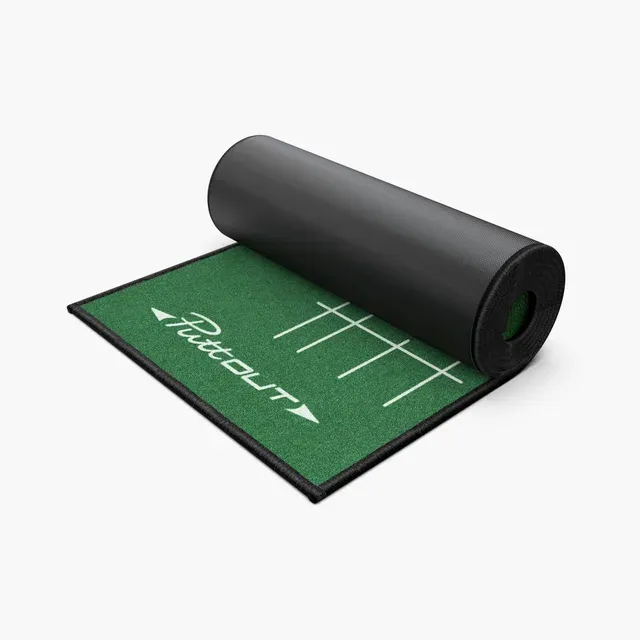
- PuttOut Large Putting Mat - Buy. The practice-area mat - printed alignment lines, rolls flat and fast - $100.
- BirdieBall 3' x 10' Standard Putting Mat - Buy. The foam green that rolls like bentgrass - grain, stimp and two holes - $162.
- PrimePutt The Essential Mat - It depends. Tour-grade turf reading 9-11 on the stimp, indoor or outdoor - $299.
- PuttOut AirBreak Max - Skip. An inflatable mat with adjustable breaks - $600 of clever most golfers won't calibrate - $600.
The verdict in 30 seconds
What mattered most
- Surface
- Stimp speed
- Size
- Use
- Price
A putting mat is the golfer gift that gets used in January - ten minutes a day on a true roll beats a bucket of range balls nobody hits. What separates the field is the surface: rolled carpet, aerated foam, or woven turf decides whether the ball rolls like a green or a hallway. We compared PuttOut's large mat, BirdieBall's foam green, PrimePutt's tour-grade turf and a $600 inflatable break trainer.
The practice-area mat - printed alignment lines, rolls flat and fast - $100.
Best for: The golfer who will actually practice - daily reps with alignment feedback built in.
- Sized for real work: the largest mat in PuttOut's range is a practice area, not a hallway strip - room to stand on the mat and putt.
- Printed distance and alignment markings give every putt a target - the feedback structure most mats leave out.
- Rolls out flat with no memory curls and packs back into a carry roll - storage is the whole design.
- Pair with the famous PuttOut pressure trainer or just use the printed hole - it is built for both.
- No cup in the surface - the target is a printed hole or a separate trainer.
- Carpet-style surface rolls true but reads faster than most muni greens.
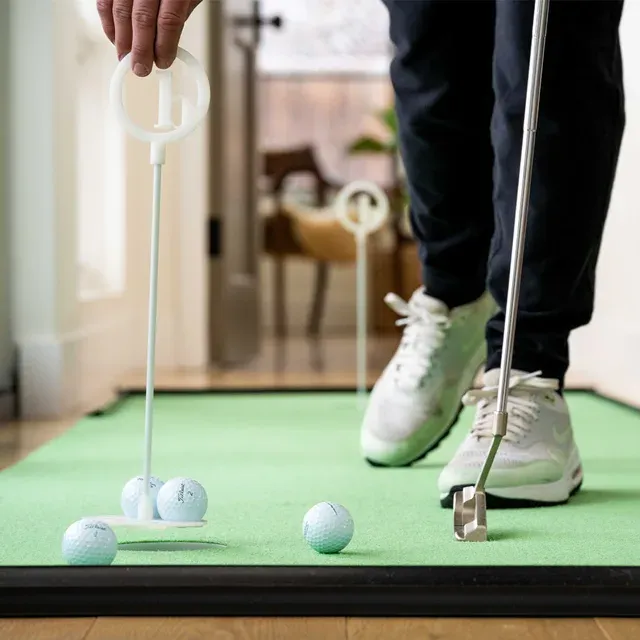
The foam green that rolls like bentgrass - grain, stimp and two holes - $162.
Best for: The purist gift - for the golfer who wants the closest roll to a real green indoors.
- Real green physics: patented aerated foam creates authentic grain - putts break and check like natural turf, with realistic stimp speeds.
- Actual cups cut into the surface, not printed targets - the ball drops and stays.
- 3 by 10 feet of green in a mat that rolls up; indoor use only.
- Indoor-only - the foam degrades outdoors.
- $162 for a mat that still ships without a ball return; bumps in the floor telegraph through the foam.
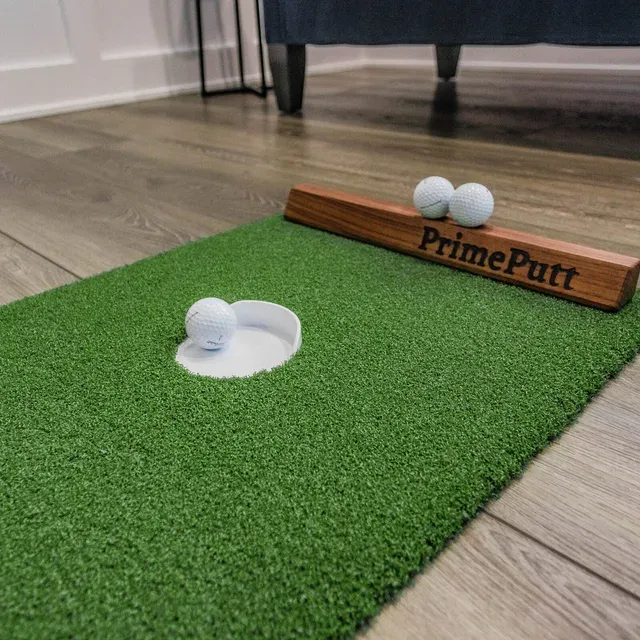
Tour-grade turf reading 9-11 on the stimp, indoor or outdoor - $299.
Best for: The serious player's splurge gift - for someone who practices daily and wants tour speed.
- Tour-grade woven turf rolling a stated 9-11 on the Stimpmeter - the speed of a fast country club green.
- Rated for indoor AND outdoor use - the only mat here that can live on a patio.
- Lies flat like a real green and takes a ball cleanly off the turf - premium turf feel.
- $299 is real money for a putting mat - twice the PuttOut for the committed only.
- The premium tier invites the question: a $100 mat plus a $15 pressure trainer does 90% of this.
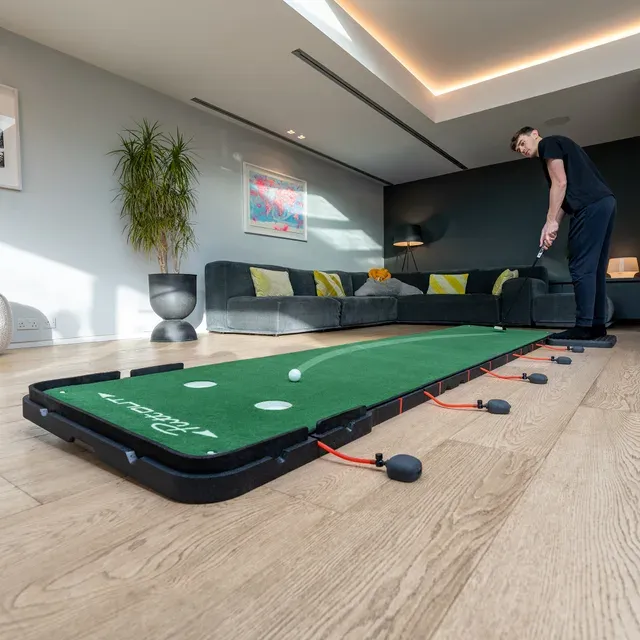
An inflatable mat with adjustable breaks - $600 of clever most golfers won't calibrate - $600.
Best for: The teaching pro or simulator-room owner - not the person being gifted a putting mat.
- The idea is clever: inflatable bladders tilt the surface to simulate breaking putts on a 10ft dual-hole mat.
- Longer and wider than the original AirBreak, with proper training markings.
- $600 for a putting surface is simulator money - the same spend buys a premium mat, a trainer, and a new putter.
- Inflatable break adjustment is a setup chore - most owners will inflate it once and never re-calibrate.
- Air-filled floors are not green speeds - the roll is a compromise the premium mats beat flat-out.
| Criteria | Large Putting Mat Top pick | 3' x 10' Standard Putting Mat | The Essential Mat | AirBreak Max |
|---|---|---|---|---|
| Verdict | Buy it | Buy it | It depends | Skip it |
| Best for | The golfer who will actually practice - daily reps with alignment feedback built in. | The purist gift - for the golfer who wants the closest roll to a real green indoors. | The serious player's splurge gift - for someone who practices daily and wants tour speed. | The teaching pro or simulator-room owner - not the person being gifted a putting mat. |
| Price tier | $$ · mid-range | $$$ · premium | $$$ · premium | $$$$ · flagship |
| Surface | Flat carpet-style, printed lines | Aerated foam w/ true grain | Tour-grade woven turf | Inflatable, tilting |
| Stimp speed | Fast (~10) | Realistic variable | 9-11 (tour speed) | Adjustable + break |
| Size | Large practice area | 3 x 10 ft | Essential size | 10 ft dual-hole |
| Use | Indoor, rolls up | Indoor only | Indoor + outdoor | Indoor, needs inflating |
| Price | $100 | $162 | $299 | $600 |
Which one is right for you?
- The golfer who will actually practice - daily reps with alignment feedback built in. Buy it PuttOut Large Putting Mat
- The purist gift - for the golfer who wants the closest roll to a real green indoors. Buy it BirdieBall 3' x 10' Standard Putting Mat
- The serious player's splurge gift - for someone who practices daily and wants tour speed. It depends PrimePutt The Essential Mat
- The teaching pro or simulator-room owner - not the person being gifted a putting mat. Skip it PuttOut AirBreak Max
How we judged the field
A putting mat is judged on one thing above all: whether the ball rolls like it does on grass. Surface technology is the divider - carpet-style mats, aerated foam and woven turf each behave differently under the putter - and everything else (size, markings, gimmicks) is secondary. We ranked the field on roll truth, practice value, size and price.
The PuttOut Large is the working golfer’s mat: a real practice area you can stand on, printed with distance and alignment markings that turn every putt into a rep with feedback. It rolls out dead flat from its carry tube - no curled edges, no foam creases - and packs away just as easily, which matters in a shared house.
The surface is carpet-style and honest: fast, true, unforgiving of a wobbly face. There is no cup in the surface - the printed hole is the target, or pair it with the brand’s pressure trainer. At $100 it hits the value peak: enough mat to improve on, priced so the gift does not need a justification memo.
BirdieBall builds a putting green out of aerated foam, and the physics show it: the surface has real grain, takes the ball’s speed like turf, and lets putts break and check the way they do on a maintained green. With cups cut into the surface, made putts actually drop and stay - a small thing that matters at 10pm.
The trade-offs are honest ones. Foam means indoor use only - this mat does not go on the deck - and imperfections in the floor beneath telegraph through the surface. At $162 it costs more than the PuttOut; what it buys is the closest indoor roll to a real green anywhere in this field.
PrimePutt’s Essential is the premium tier made real: woven tour-grade turf reading a stated 9-11 on the Stimpmeter - fast-country-club speed - that lies flat and lets the ball release like a green. It is the only mat here rated for both indoor and outdoor use, and it feels expensive because it is.
The dependency is the golfer: at $299, this is for someone who practices daily and can tell a 10 stimp from an 8 by feel. For the occasional putter, a $100 mat plus a pressure trainer delivers most of the training at a third of the price.
The AirBreak Max is genuinely clever - an inflatable mat whose bladders tilt the surface to simulate breaking putts over 10 feet, with two holes and training markings. It is also $600. At that money the question stops being “is it good” and becomes “what else does $600 buy” - the answer being a premium mat, a pressure trainer and a new putter, with change.
The deeper problem is physics: an air-filled floor does not roll like a green, and the break calibration is a setup chore most owners will never redo. A clever training aid for a teaching room; a bad gift for a golfer who wants to putt.
PuttOut Large vs BirdieBall Standard: which should you buy?
Buy the PuttOut if the goal is structured practice - alignment lines, roll-flat convenience, and a price that leaves room for the pressure trainer. Buy the BirdieBall if the goal is realism - foam with true grain and cups that hold the ball, for the purist who wants a green in the living room. Feedback versus fidelity.
What to look for
Surface technology first: carpet-style for value and flatness, foam for green-like grain, woven turf for tour speed - each trades price against realism. Stimp speed matters more than marketing: 9-11 is real green pace. Length decides what you can practice; 10 feet covers the useful distances. Check whether you stand on the mat or next to it, and whether it lies flat after storage - a curled mat teaches bad reads.
Our final take
PuttOut’s Large mat is the pick - the best practice value at $100, marked for real training. BirdieBall’s foam green is the true-roll alternative for the purist at $162. PrimePutt’s tour turf earns $299 only for the daily grinder. And skip the AirBreak Max - $600 buys clever that a $15 drill replaces.
Questions, answered
Do putting mats roll true?
Depends on the surface. Carpet-style mats like PuttOut roll flat and fast; foam greens like BirdieBall simulate real grain and break; woven turf like PrimePutt reads 9-11 on the stimp. Cheap mats ship rolled and keep a curl - all three here lie flat.
Printed lines or holes - what matters more?
Feedback beats a cup. Printed alignment and distance markings (PuttOut) turn random rolls into practice. A real cut cup (BirdieBall) gives the satisfying drop; a pressure trainer is the best $15 add-on either way.
How much space do you actually need?
Ten feet of length covers the most useful practice distances - anything shorter trains only the knee-knockers. Width matters less than the ability to stand on the mat itself, which the wider 3ft mats give you.
Are break-adjustable mats worth it?
For a coach or a sim room, adjustable breaks add real training value. For everyone else, they are an inflatable floor you will set up once - the $600 buys technology a $30 wedge-and-coin drill replaces.
Indoor or outdoor - can a mat do both?
Most cannot - foam degrades outdoors. PrimePutt's turf is the exception, rated for both, which is part of its premium. Plan for indoor use and a rolled-up storage spot.
Deciding between the top two? See our head-to-head: PuttOut Large Putting Mat vs BirdieBall 3' x 10' Standard Putting Mat.
More Outdoors & Fitness reviews
 The Best Rain Boots: 4 Compared (and One to Skip)
  The Best Rain Jackets: 4 Compared (and One to Skip)
  The Best Rechargeable Hand Warmers: 4 Compared (and One to Skip)
  The Best Robot Lawn Mowers: 4 Compared (and One to Skip)
  The Best Robotic Pool Cleaners: 4 Compared (and One to Skip)
  Best Running Shoes for Beginners: Daily Trainers Compared