

Pets
The Best Hamster and Small Animal Exercise Wheels: 4 Compared (and One to Skip)
We judged small animal wheels against the two things veterinary and welfare sources actually agree on: a solid running surface and a diameter big enough that the animal's spine stays straight. Then we checked bearings, mounting and materials.

The short version
The Niteangel Super-Silent is our overall pick because it is the rare range that goes from 8.2 in for a dwarf up to 12.6 in for a Syrian, on a solid drum with dual ball bearings and a single centre stand with no cross bar. The Trixie Wooden Exercise Wheel is the value pick: untreated wood, a cork running track, a ball bearing, and a 33 cm size that clears the figure PDSA gives for Syrian hamsters. The Exotic Nutrition Silent Runner 12 in is the 'depends' pick, since its enclosed drum with bean-shaped side openings suits sugar gliders and Syrians but Exotic Nutrition itself limits it to female rats, and the stand is easy to shove around unless you buy the cage attachment. Skip the Kaytee Comfort Exercise Wheel in its widely stocked Large size: the surface is solid, but Kaytee lists it at 8.5 in diameter and 'best for hamsters and rats', and that is below the diameters PDSA and the MSD Veterinary Manual give for either. Match the size to the species before you look at anything else, and ask an exotics vet if your animal is limping, sore-footed or refusing the wheel. Best for: anyone buying a first wheel for a hamster, gerbil, mouse or rat who wants to get the size right the first time.
Our picks at a glance
- Niteangel Super-Silent Hamster Exercise Wheel - Buy. A solid plastic running drum on dual ball bearings and a height-adjustable acrylic stand, offered in four diameters from 8.2 in up to 12.6 in.
- Trixie Wooden Exercise Wheel (60922 / 60923 / 60924) - Buy. An untreated wood drum with a cork running track and a ball bearing, in 21 cm, 28 cm and 33 cm, mounted on a single post on a flat wooden base.
- Exotic Nutrition Silent Runner 12 in (Regular) - It depends. A 12 in axle-free drum with a solid rear wall, three bean-shaped side openings and a 3.5 in wide textured track on dual ball bearings.
- Kaytee Comfort Exercise Wheel (Large) - Skip. A solid-surface plastic wheel on a wire stand that Kaytee sizes at 8.5 in and markets as best for hamsters and rats, which is under the published minimum for both.
The verdict in 30 seconds
What mattered most
- Running surface
- Diameters offered
- Largest size vs 30 cm Syrian minimum
- Species the maker states
- Bearing
- Axle and cross bar
Most wheels on a pet shop shelf fail one of two basic tests, and both are welfare problems rather than preferences. The first is the running surface: the MSD Veterinary Manual notes that broken bones in hamsters most often happen when a leg gets trapped in a wire exercise wheel or wire and mesh caging, and recommends solid-surface wheels for that reason. The second is diameter, because a wheel that is too small makes the animal run with its back curved. We picked four wheels that are easy to buy, checked each maker's own stated diameter, surface, species and mounting, and set them against published welfare figures.
A solid plastic running drum on dual ball bearings and a height-adjustable acrylic stand, offered in four diameters from 8.2 in up to 12.6 in.
Best for: Someone who wants one wheel design that scales from a dwarf hamster to a Syrian without changing the safety basics.
- Solid running drum with no rungs, slats or mesh anywhere in the running path.
- The XL at 12.6 in and the L at 11 in give you a real option for a Syrian rather than forcing you down to a 10 in wheel.
- Dual ball bearings and a single centre-mounted stand, so nothing crosses the drum for the animal to hit.
- The running drum is PS plastic and the base is acrylic, so a determined chewer will mark it up.
- Free-standing only, which means it needs floor space and a level surface inside the enclosure.
- Niteangel does not publish a size-to-species table, so you have to match the diameter to published welfare figures yourself.
- The XL 12.6 in sits in a noticeably higher price bracket than the three smaller sizes.
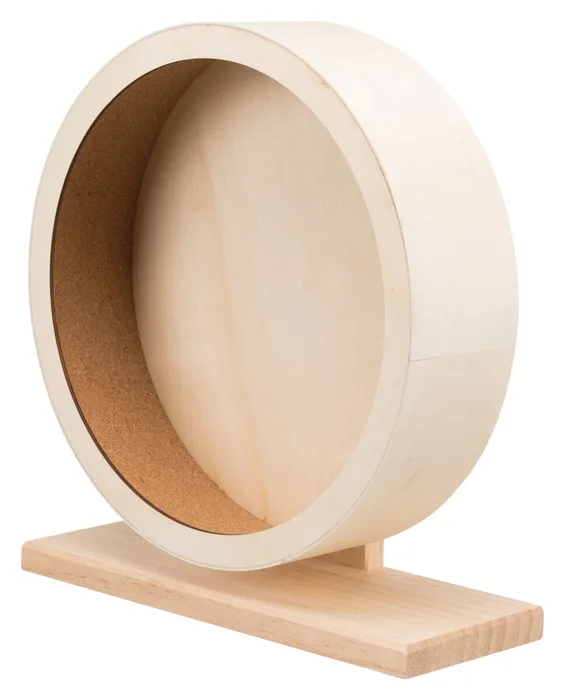
An untreated wood drum with a cork running track and a ball bearing, in 21 cm, 28 cm and 33 cm, mounted on a single post on a flat wooden base.
Best for: Owners who want a big, solid, quiet wheel in a material their animal can safely gnaw, and who do not mind replacing it eventually.
- Trixie lists a solid running surface, a cork track and ball-bearing motion, and says the range is tested by an independent expert body for animal welfare and animal protection.
- The 33 cm size clears the 30 cm figure PDSA gives as a minimum for Syrian hamsters.
- Untreated wood and cork are far less of a worry than plastic when the animal gnaws the rim.
- Wood and cork absorb urine, so this is harder to properly sanitise than a plastic drum you can take apart and wash.
- The cork track is a wear part and will need replacing on a heavy runner.
- Trixie maps 28 cm to 'hamsters', which is under the 30 cm PDSA gives for Syrians, so read the item number rather than the label.
- It is a free-standing wooden base with no cage-attachment option listed.
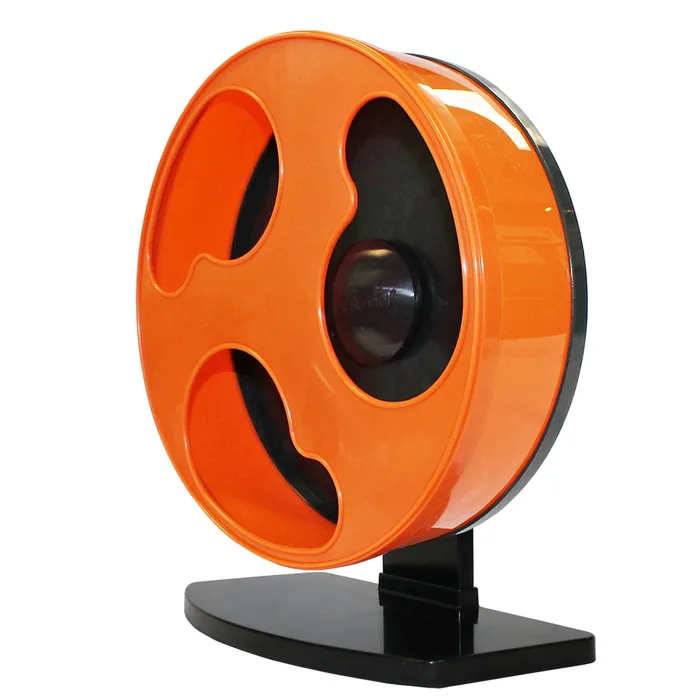
A 12 in axle-free drum with a solid rear wall, three bean-shaped side openings and a 3.5 in wide textured track on dual ball bearings.
Best for: Sugar glider and Syrian hamster owners who want an enclosed drum with side entry, and who will buy the cage attachment with it.
- Exotic Nutrition states no axle, which removes the fur and tail entanglement risk that a centre bar creates.
- 12 in diameter with dual ball bearings, and the whole wheel disassembles for washing.
- The maker names the species it is for, listing sugar gliders, Syrian hamsters and female rats, which is more honesty about fit than most brands offer.
- The 3.5 in track is narrower than the 4 in track on the Wide version, and Exotic Nutrition steers larger animals to the Wide model.
- It ships on a stand, and the cage attachment that stops it sliding is sold separately.
- Exotic Nutrition's own note on the PRO version says some pets have feet prone to bumblefoot and suggests flipping the track to the smooth side, so the textured surface is not right for every animal.
- It is plastic, so a determined chewer can damage it.
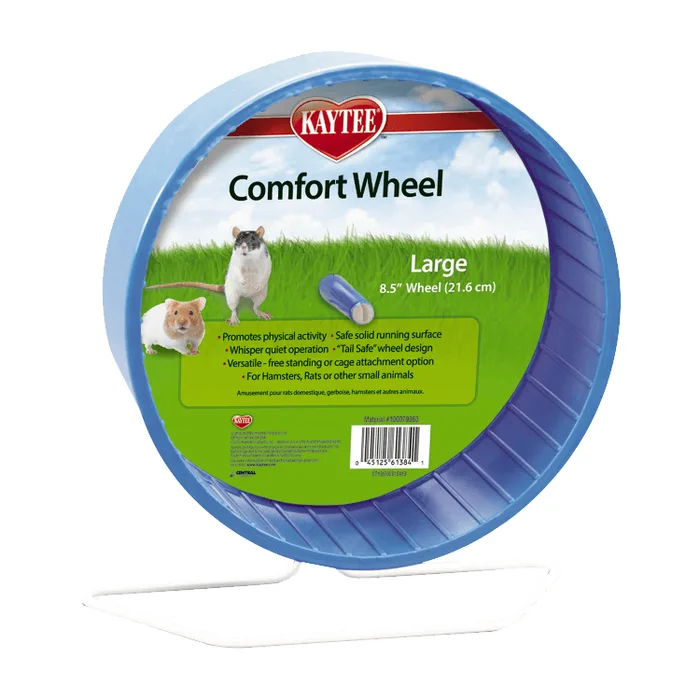
A solid-surface plastic wheel on a wire stand that Kaytee sizes at 8.5 in and markets as best for hamsters and rats, which is under the published minimum for both.
Best for: Almost nobody at this size; if you want this design, buy the Giant version and check it against your animal's species.
- The running surface is solid plastic, so it avoids the rung and mesh trapping problem entirely.
- It can free-stand on its wire base or clip to a wire cage, which is useful in a cage with little floor space.
- Kaytee also sells a Giant version listed at 12 in, so the right size does exist in the same range.
- At 8.5 in it is below the 30 cm (12 in) PDSA gives for Syrian hamsters and below the 12 to 14 in the MSD Veterinary Manual gives for rats, yet Kaytee lists it as best for hamsters and rats.
- There is no bearing mentioned; Kaytee's own care tip is to put a few drops of vegetable oil on the hub to keep it quiet, which tells you how it is mounted.
- The wire stand is light and tips or slides easily under a heavy runner.
- It is sold in assorted colours, so you cannot choose what arrives.
| Criteria | Super-Silent Hamster Exercise Wheel Top pick | Wooden Exercise Wheel (60922 / 60923 / 60924) | Silent Runner 12 in (Regular) | Comfort Exercise Wheel (Large) |
|---|---|---|---|---|
| Verdict | Buy it | Buy it | It depends | Skip it |
| Best for | Someone who wants one wheel design that scales from a dwarf hamster to a Syrian without changing the safety basics. | Owners who want a big, solid, quiet wheel in a material their animal can safely gnaw, and who do not mind replacing it eventually. | Sugar glider and Syrian hamster owners who want an enclosed drum with side entry, and who will buy the cage attachment with it. | Almost nobody at this size; if you want this design, buy the Giant version and check it against your animal's species. |
| Price tier | $$ · mid-range | $ · budget | $$ · mid-range | $ · budget |
| Running surface | Solid PS plastic drum | Solid wood drum with cork track | Solid plastic track, textured side | Solid plastic |
| Diameters offered | 8.2, 10, 11 and 12.6 in | 21, 28 and 33 cm | 12 in | 8.5 in (Large), 12 in (Giant) |
| Largest size vs 30 cm Syrian minimum | Clears it (12.6 in) | Clears it (33 cm) | Meets it (12 in) | Large falls short (8.5 in) |
| Species the maker states | Hamsters; no per-size species list | Dwarf hamsters and mice, hamsters, large hamsters and degus | Sugar gliders, Syrian hamsters, female rats | Hamsters and rats (Large) |
| Bearing | Dual ball bearings | Ball bearing | Dual ball bearings | Plain hub; maker suggests oiling it |
| Axle and cross bar | Single centre stand, no cross bar | Single centre post on a base | Axle-free, single centre stand | Hub on a wire stand |
| Mounting | Free-standing, height-adjustable base | Free-standing wooden base | Free-standing stand; cage clip sold separately | Free-standing or clips to a wire cage |
| Material if chewed | PS plastic drum, acrylic base | Untreated wood and cork | Plastic; a hard chewer can damage it | Plastic drum, wire stand |
Which one is right for you?
- Someone who wants one wheel design that scales from a dwarf hamster to a Syrian without changing the safety basics. Buy it Niteangel Super-Silent Hamster Exercise Wheel
- Owners who want a big, solid, quiet wheel in a material their animal can safely gnaw, and who do not mind replacing it eventually. Buy it Trixie Wooden Exercise Wheel (60922 / 60923 / 60924)
- Sugar glider and Syrian hamster owners who want an enclosed drum with side entry, and who will buy the cage attachment with it. It depends Exotic Nutrition Silent Runner 12 in (Regular)
- Almost nobody at this size; if you want this design, buy the Giant version and check it against your animal's species. Skip it Kaytee Comfort Exercise Wheel (Large)
How we judged the field
Five things decide whether a wheel is safe rather than merely cheerful. Running surface comes first: the MSD Veterinary Manual says broken bones in hamsters most often occur when a leg becomes trapped in a wire exercise wheel or wire and mesh caging, and recommends solid-surface wheels, and its gerbil guidance warns that slats can catch a gerbil’s feet or delicate tail. Diameter comes second, because a wheel that is too small makes the animal run with an arched spine; PDSA gives at least 20 cm (8 in) for dwarf hamsters and at least 30 cm (12 in) for Syrians, and the MSD manual gives 12 to 14 inches for rats. Third is the axle: the RSPCA says wheels should be a solid structure and axle-free, so nothing crosses the drum. Fourth is how quietly and smoothly it turns, which comes down to whether it runs on sealed bearings or a plain hub. Fifth is material, because everything in a rodent enclosure eventually gets chewed.
The field splits cleanly along those lines. At the bottom, big-box plastic wheels get the surface right and the diameter wrong, sizing an 8.5 in wheel for animals that published guidance says need 12 in or more. In the middle sit European wood-and-cork wheels that are large, bearing-mounted and chew-friendly but harder to sanitise. At the top sit purpose-built acrylic and plastic drums with dual bearings and adjustable stands. We picked one from each band plus one specialist enclosed drum aimed at sugar gliders and Syrians, checked every diameter, surface, species claim and mounting method against the maker’s own page, and let the welfare figures decide the verdicts.
Niteangel Super-Silent Hamster Exercise Wheel
Buy itNiteangel’s Super-Silent is the wheel that makes size a non-issue. Niteangel lists it in S at 8.2 in, M at 10 in, L at 11 in and an XL at 12.6 in, which means the same design covers a Russian dwarf and a full-grown Syrian without either one having to compromise. The running drum is solid PS plastic with no rungs or perforations, it turns on dual ball bearings, and the acrylic base carries it from a single centre post so there is no bar for the animal to strike. The base height adjusts between roughly 1 in and 4 in, which sounds trivial until you are running deep bedding and the drum starts dragging. The catch is that it is plastic and acrylic, so a hard chewer will scuff it, and it free-stands only, so you need level floor space. The XL also costs meaningfully more than the three smaller sizes. For a first-time buyer who wants to get the diameter right and stop thinking about it, this is the one.
Trixie Wooden Exercise Wheel (60922 / 60923 / 60924)
Buy itTrixie’s wooden wheel is the quiet argument for spending less. Trixie’s own product page lists a solid running surface, a paw-friendly cork running track, smooth and quiet motion from a ball bearing, untreated wood, and testing by an independent expert body for animal welfare and animal protection. It comes as three item numbers: 60922 at 21 cm for dwarf hamsters and mice, 60923 at 28 cm, and 60924 at 33 cm for large hamsters and degus. Buy by item number, not by label, because 28 cm sits under the 30 cm PDSA gives for Syrians and Trixie still calls it a hamster size. The drum is closed at the back with one open face, sitting on a single post on a flat wooden base, so there is no cross bar. Wood and cork are the honest weakness: they soak up urine and cannot be scrubbed like plastic, and the cork track wears. For an animal that gnaws everything, that is a fair trade.
Exotic Nutrition Silent Runner 12 in (Regular)
It dependsThe Silent Runner 12 in is a different shape of solution: an enclosed drum with a solid black rear wall and three bean-shaped openings in the front plate, rather than a wheel with one open side. Exotic Nutrition lists 12 in diameter, a 3.5 in wide textured track, 4 in openings and 13.5 in tall on its stand, running on dual ball bearings with no axle, and it disassembles completely for washing. It also names its species, listing sugar gliders, Syrian hamsters and female rats, and points larger animals at the 4 in track on the Wide version instead. Two things make this a ‘depends’. The stand ships loose and the cage attachment that stops it sliding is a separate purchase. And Exotic Nutrition’s own note on the PRO version tells owners with animals prone to bumblefoot to flip the track to the smooth side, so the textured surface is not universally right. Good wheel, specific buyer.
Kaytee Comfort Exercise Wheel (Large)
Skip itThe Comfort Wheel is the wheel most people actually bring home, and the Large size is where it goes wrong. Kaytee gets the important part right: the packaging and the product page both describe a safe, solid running surface with a tail-safe design, and it either free-stands on its wire base or clips to a wire cage. But Kaytee lists the Large at 8.5 in diameter and describes it as best for hamsters and rats. PDSA puts the Syrian hamster minimum at 30 cm, roughly 12 in, and the MSD Veterinary Manual puts rats at 12 to 14 in. An 8.5 in wheel is not close to either, and the consequence is the arched-back running posture PDSA links to long-term pain. There is no bearing in the spec, and Kaytee’s own tip is to drip vegetable oil on the hub to keep it quiet. The light wire stand slides under a determined runner. Kaytee’s Giant at 12 in is the version to buy instead.
Sources
Specs in this review come from these pages.
- RSPCA - Understanding hamster behaviour and enrichment (rspca.org.uk)
- PDSA - Hamsters as pets: housing, toys and enrichment (pdsa.org.uk)
- MSD Veterinary Manual - Disorders and Diseases of Hamsters (msdvetmanual.com)
- MSD Veterinary Manual - Providing a Home for a Rat (msdvetmanual.com)
- MSD Veterinary Manual - Providing a Home for a Gerbil (msdvetmanual.com)
- RSPCA - The ideal environment for mice (rspca.org.uk)
Niteangel Super-Silent Hamster Exercise Wheel vs Trixie Wooden Exercise Wheel (60922 / 60923 / 60924): which should you buy?
The Niteangel and the Trixie agree on everything that matters and differ on everything else. Both give you a solid running surface, a large top-end diameter, a ball bearing and a single centre mount with nothing crossing the drum. Niteangel’s advantage is range and precision: four diameters up to 12.6 in, a height-adjustable base for deep bedding, and a transparent drum that lets you actually watch the animal. Trixie’s advantage is material and price: untreated wood with a cork track, a size that reaches 33 cm, a welfare test mark on the packaging, and no anxiety about what happens when the animal starts gnawing the rim.
Choose on two questions. First, what is your enclosure? If you run deep bedding in a tank or a bin, Niteangel’s adjustable base solves a real problem that a fixed wooden base does not. Second, how much does your animal chew, and how much do you want to clean? A plastic drum wipes down in seconds and survives repeated washing; wood and cork do not, but they are a far more forgiving thing to have teeth on. Gerbils and degus, which chew constantly, lean towards the Trixie. Syrians in a bedroom, where silence and a big diameter matter most, lean towards the Niteangel XL.
What to look for
- Solid surface, always: the MSD Veterinary Manual recommends solid-surface wheels because a leg trapped in a wire wheel is the most common cause of broken bones it lists for hamsters.
- Diameter by species, not by label: PDSA gives at least 20 cm (8 in) for dwarf hamsters and at least 30 cm (12 in) for Syrians, and the MSD manual gives 12 to 14 in for rats, so read the number rather than the word on the box.
- Axle-free construction: the RSPCA says wheels should be a solid structure and axle-free, which rules out anything with a bar or spokes crossing the running space.
- A named bearing: dual ball bearings stay quiet for years, while a plain hub spinning on a post gets louder as it wears, and a maker that tells you to oil the hub is telling you which one you bought.
- A stand that will not walk: a light wire base slides across bedding under a heavy runner, so look for a wide flat base, a weighted stand or a proper cage attachment.
- Chew-tolerant materials: untreated wood and cork are more forgiving than thin plastic, and makers that state what the wheel is made of are worth preferring for animals that gnaw.
Our final take
Buy on diameter and surface, then worry about everything else. The Niteangel Super-Silent is our pick because one product line takes you from an 8.2 in dwarf wheel to a 12.6 in Syrian wheel on a solid drum, dual bearings and a clean centre mount. The Trixie wooden wheel does the same job in cork and untreated wood for less, and its 33 cm size is genuinely large. The Silent Runner suits sugar gliders and Syrians if you buy the cage attachment with it. The Kaytee Comfort Wheel in Large is solid-surfaced and cheap, but 8.5 in is under the published minimum for the animals it names. This is general guidance, not veterinary advice: if your animal is limping, sore-footed or avoiding the wheel, see an exotics vet.
Questions, answered
What size wheel does my animal actually need?
PDSA gives at least 20 cm (8 in) for dwarf hamsters and at least 30 cm (12 in) for Syrian hamsters, and says a lot of hamster wheels are too small, forcing the hamster to run with a curve in their back which can cause long-term pain. For rats, the MSD Veterinary Manual says a wheel should be at least 12 to 14 inches in diameter. The RSPCA takes a similar line for hamsters, saying wheels must be good quality with a large diameter, such as one intended for rats. For gerbils and mice, neither source gives a hard number, so use the same test: the animal's back should stay roughly level while it runs. If the spine is visibly arched, the wheel is too small.
Why does a wire or mesh running surface matter so much?
It is a limb-trapping problem first. The MSD Veterinary Manual says broken bones in hamsters most often occur when a hamster's leg becomes trapped in a wire exercise wheel or wire or mesh caging materials, and recommends solid-surface wheels and cage materials for that reason. Its gerbil guidance is blunter still, noting that the slats in a traditional hamster wheel can catch a gerbil's feet or delicate tail. There is a foot-health angle too: the RSPCA says a wheel should ideally have a non-slip running surface and tells owners to ask a vet if their hamster develops sore feet while using the wheel. Sore, ulcerated feet in rodents are also linked to standing on wire flooring, which is why rodent health references recommend covering wire surfaces. A solid track sidesteps all of it.
What is an axle-free wheel and does it matter?
In an axle-free design nothing passes through the middle of the drum. The wheel is carried from behind or from one side, so the animal runs in a clear tube. The RSPCA specifically says hamster wheels need to be a solid structure and axle-free, and repeats the same wording for gerbils and mice. It matters most for animals with long tails, because a centre bar or a spoked support gives a tail somewhere to wrap. Exotic Nutrition makes the same point about its Silent Runner, saying there is no axle so there is no risk of fur or tail entanglement. Every wheel in this comparison carries the drum from behind or below rather than through the middle.
Should the wheel free-stand or clip to the cage?
Both work, and the right answer depends on your enclosure. A clip-on wheel saves floor space and is the usual choice in a wire cage, which is why Kaytee sells both its Comfort Wheel and Silent Spinner as free-standing or attachable to any wire cage. A free-standing wheel is the only option in a glass tank or a bin-style enclosure with no bars to clip to. The trade-off is stability: a light stand can slide or tip under a heavy runner, and Exotic Nutrition sells a cage attachment for the Silent Runner separately for exactly that reason. Niteangel's stand is height-adjustable between roughly 1 in and 4 in of base clearance so you can set the drum above deep bedding.
Is a silent wheel worth paying for?
If the cage is in a bedroom, yes, because these animals are largely nocturnal and will run for hours. The mechanism is what makes the difference: sealed ball bearings run quietly for a long time, while a plain plastic hub spinning on a post gets louder as it wears. You can read this straight off the product pages. Niteangel and Exotic Nutrition both specify dual ball bearings and Trixie specifies ball-bearing motion, whereas Kaytee's care tip for the Comfort Wheel is to put a few drops of vegetable oil on the hub to keep it running quiet. A wobbling wheel also transmits noise into a wire cage, so a stable base helps as much as the bearing does.
Deciding between the top two? See our head-to-head: Niteangel Super-Silent Hamster Exercise Wheel vs Trixie Wooden Exercise Wheel (60922 / 60923 / 60924).
More Pets reviews
 The Best Heated Pet Beds: 4 Compared (and One to Skip)
  The Best Pet Cameras in 2026: Treat-Tossers and Monitors We'd Actually Trust at Home
  The Best Pet Carriers: 4 Compared (and One to Skip)
  The Best Pet Grooming Vacuum Kits: 4 Compared (and One to Skip)
  The Best Pet Playpens: 4 Compared (and One to Skip)
  The Best Pet Stain and Odor Removers: 4 Compared (and One to Skip)