

Outdoors & Fitness
The Best Emergency Weather Radios: 4 Compared (and One to Skip)
We compared four NOAA weather and crank radios on NOAA alert support, SAME county filtering, power sources, stated battery capacity and the build claims the makers actually print.
The short version
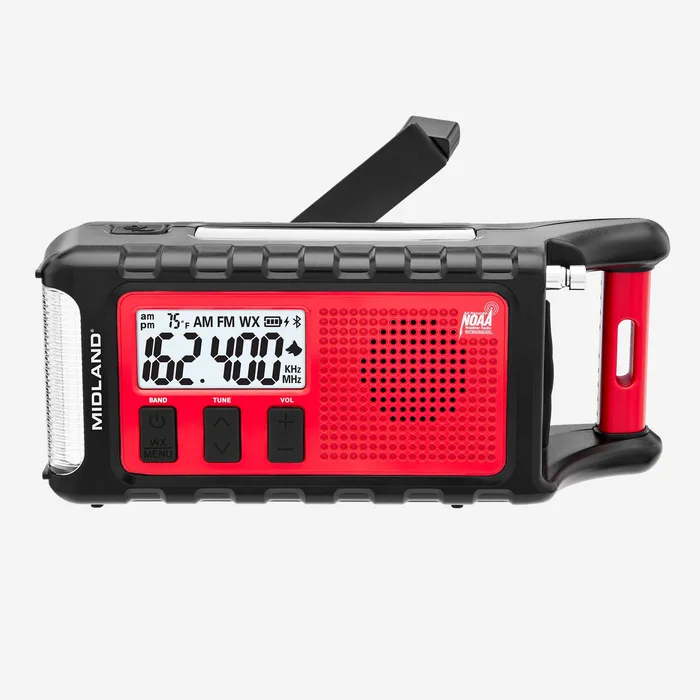
The Midland ER310PRO is our top pick because it pairs NOAA alerts with a stated 10,000 mAh battery, a 200+ hour radio runtime claim, and crank, solar and USB-C charging. The FosPower Model D8 is the value pick: it states the same 10,000 mAh capacity and an IPX3 rating at a lower tier. The Midland WR120B suits a bedside table because it is the only one here that states SAME county programming, but it has no crank or solar, so it is not a grab-and-go radio. The Kaito KA336 is the one to skip: it is a real crank radio, but it states only a 1200 mAh battery and says nothing about USB output, water resistance or size. None of the portable models states SAME support, so if county-level alerts matter most, put a SAME radio on your counter and add a portable one for the go-bag. Best for: a household that wants one radio that survives a multi-day outage and charges a phone.
Our picks at a glance
- Midland ER310PRO Portable Emergency Crank Radio with Power Bank - Buy. The best-documented crank radio in the field: NOAA alerts, a 10,000 mAh battery with a stated 200+ hours of radio use, and three ways to charge it.
- FosPower Model D8 10,000mAh Emergency Solar Crank NOAA Weather Radio - Buy. The only portable radio here that states both a 10,000 mAh battery and an IP rating, at a lower tier than the Midland.
- Midland WR120B NOAA Weather and Emergency Alert Radio - It depends. A plug-in bedside alert radio with SAME county programming, which none of the portable crank radios here state.
- Kaito KA336 Emergency AM FM NOAA Weather Alert Radio with Solar and Crank - Skip. A real, cheap crank radio, but the spec sheet is thin where it matters: 1200 mAh, no output rating, no water claim, no dimensions.
The verdict in 30 seconds
What mattered most
- Type
- NOAA weather alerts
- SAME county filtering
- Power sources
- Battery capacity stated
- Runtime claim
A weather radio is the one emergency item that has to work when the phone network does not, so the spec sheet matters more here than in most categories. The catch is that makers print big numbers for batteries and flashlights while staying silent on SAME county filtering and water resistance. We read the maker page for each model and kept only what is stated there, so every blank in our table is a blank on the maker's own page. The field is two portable crank-and-solar radios, one plug-in SAME alert radio, and one cheap crank radio we would pass on. For a car, see our best car emergency kits, and for powering gear in an outage, see our best portable power stations and best portable power banks.
The best-documented crank radio in the field: NOAA alerts, a 10,000 mAh battery with a stated 200+ hours of radio use, and three ways to charge it.
Best for: Households that want one portable radio that doubles as a phone power bank during a multi-day outage.
- Midland lists a 10,000 mAh lithium-ion battery and says it lasts 200+ hours of radio operation, tied for the largest battery here and the only stated runtime of the portable radios.
- It charges three ways (USB-C, solar panel, hand crank) and the FAQ gives the USB-A output as 5 V DC at 2.1 A, so the phone-charging claim has a number behind it.
- The WX band receives National Weather Service alerts, and the page lists 60+ alerts, plus a Cree LED flashlight with SOS strobe and AM/FM with a clock and temperature display.
- The page does not say whether it supports SAME, so we cannot tell you it filters alerts to your county.
- No water resistance or IP rating is stated anywhere on the page, so do not count on it surviving a soaking.
- Solar is described only as maintenance charging in direct sunlight, and no crank or solar charge times are given.
- It is the most expensive portable radio in this comparison.
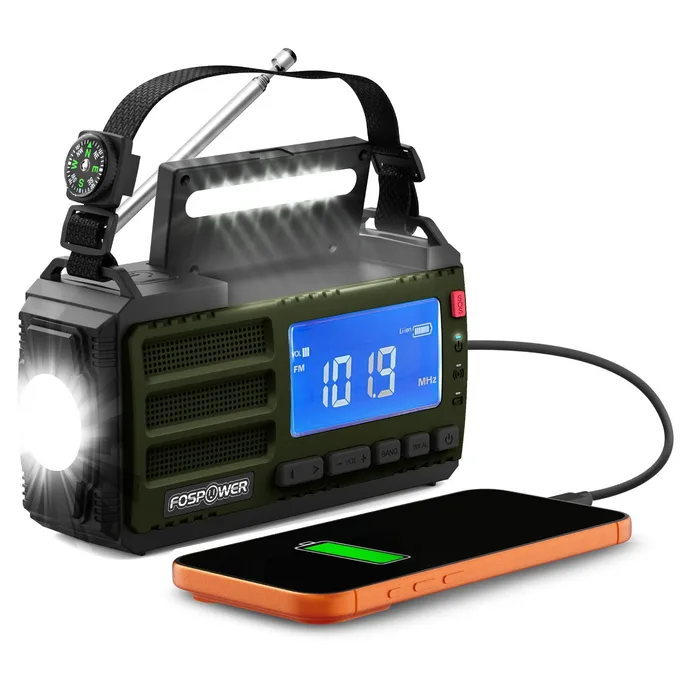
The only portable radio here that states both a 10,000 mAh battery and an IP rating, at a lower tier than the Midland.
Best for: Buyers who want big stated battery capacity and a stated water rating without paying for the top tier.
- FosPower lists a 10,000 mAh battery at 3.7 V and a 5 V / 2 A USB-C input, so the stated capacity matches the Midland for less.
- The page gives an IP rating (IPX3) and an operating battery voltage, which makes this the most complete build-claims sheet of the portable radios.
- The ALERT function monitors your local NOAA channel and sounds a siren on a warning, and the page lists all seven weather frequencies from 162.400 to 162.550 MHz.
- SAME is not mentioned, and the page says nothing about how the alert function decides which warnings to sound for.
- USB output is described only as powering most USB devices; no output voltage or current is given.
- The page does not explain what IPX3 covers, and it never calls the radio waterproof.
- Stock status on the page is contradictory: it shows both in stock and a sold-out notify button.
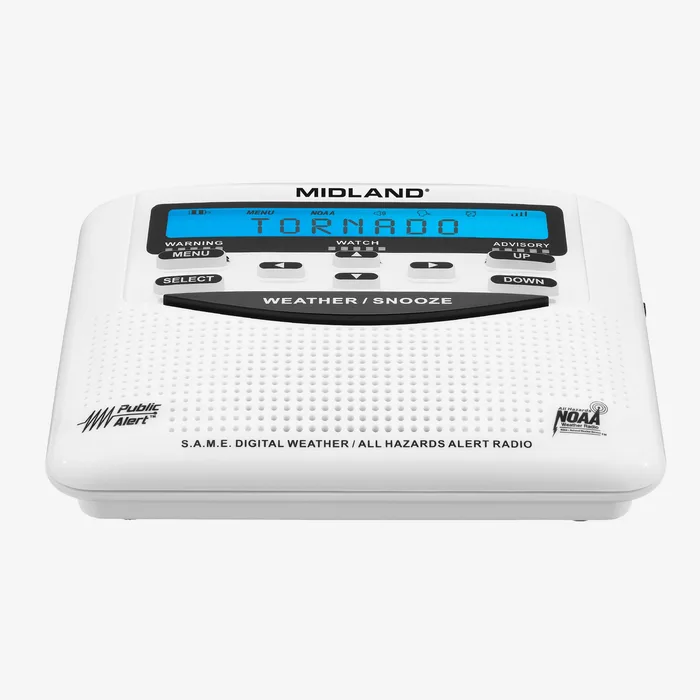
A plug-in bedside alert radio with SAME county programming, which none of the portable crank radios here state.
Best for: A bedroom or kitchen counter where you want the warning to wake you for your county and the power is usually on.
- Midland lists S.A.M.E. digital technology with 25 programmable locations, so it can be set to alert for your county rather than the whole broadcast area.
- The page claims a 90 dB siren with selectable tone, color-coded alert level indicators, and a clock with alarm.
- It runs from an included AC adapter and falls back to 3 AA alkaline batteries (not included) during an outage.
- It has no crank, no solar, and no USB charging listed, so it is useless as a standalone grab-and-go radio once the AA batteries run out.
- The page gives battery life for the AA backup nowhere, so you cannot plan around how long it will keep listening.
- The maker's own page says both 85+ alerts and over 60 alerts, and does not explain which is right.
- No water resistance, dimensions, or weight are stated.
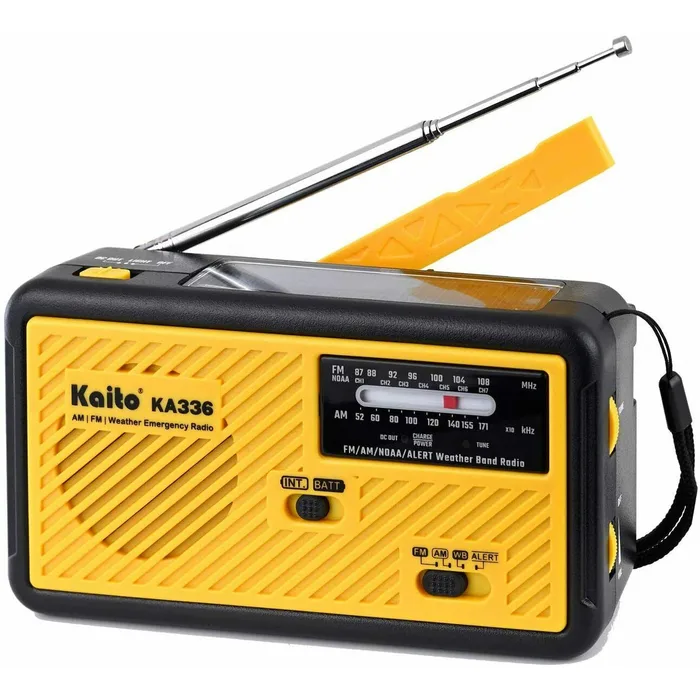
A real, cheap crank radio, but the spec sheet is thin where it matters: 1200 mAh, no output rating, no water claim, no dimensions.
Best for: Someone who wants a basic crank-and-solar AM/FM/NOAA radio in a drawer and does not care about charging a phone.
- It does receive the NOAA weather band and Kaito says it can alert for severe weather, with crank, solar, an internal rechargeable battery, 3 AAA batteries (not included), and USB as power options.
- The page lists a 1200 mAh internal rechargeable battery, so the capacity is at least stated.
- It sits at the budget tier and the page links a 1 year limited warranty.
- The 1200 mAh battery is the smallest stated in this comparison, a fraction of the 10,000 mAh models, so do not expect it to meaningfully recharge a modern phone.
- The page says you can crank to charge phones through the USB port but gives no output voltage, current, or wattage.
- No water resistance, IP rating, flashlight brightness, dimensions, or weight are stated.
- SAME is not mentioned, and tuning is analog with 7 weather presets, which is slower to set up in a stressful moment than a digital display.
| Criteria | ER310PRO Portable Emergency Crank Radio with Power Bank Top pick | Model D8 10,000mAh Emergency Solar Crank NOAA Weather Radio | WR120B NOAA Weather and Emergency Alert Radio | KA336 Emergency AM FM NOAA Weather Alert Radio with Solar and Crank |
|---|---|---|---|---|
| Verdict | Buy it | Buy it | It depends | Skip it |
| Best for | Households that want one portable radio that doubles as a phone power bank during a multi-day outage. | Buyers who want big stated battery capacity and a stated water rating without paying for the top tier. | A bedroom or kitchen counter where you want the warning to wake you for your county and the power is usually on. | Someone who wants a basic crank-and-solar AM/FM/NOAA radio in a drawer and does not care about charging a phone. |
| Price tier | $$$ · premium | $$ · mid-range | $ · budget | $ · budget |
| Type | Portable crank, solar, USB-C | Portable crank, solar, USB-C | Plug-in tabletop alert radio | Portable crank, solar |
| NOAA weather alerts | Yes, WX band, 60+ alerts listed | Yes, ALERT function with siren | Yes, 85+ or over 60 alerts (page says both) | Yes, NOAA band with alert |
| SAME county filtering | Not stated | Not stated | Yes, 25 programmable locations | Not stated |
| Power sources | Hand crank, solar, USB-C | Crank, solar, USB-C | AC adapter, 3 AA backup (not included) | Crank, solar, internal battery, 3 AAA (not included), USB |
| Battery capacity stated | 10,000 mAh | 10,000 mAh | None (AA only) | 1200 mAh |
| Runtime claim | 200+ hours of radio operation | Not stated | Not stated | Not stated |
| USB charging claim | USB-A out 5 V / 2.1 A (FAQ) | Powers USB devices, rating not stated | None stated | Crank to charge via USB, rating not stated |
| Water resistance stated | Not stated | IPX3 | Not stated | Not stated |
Which one is right for you?
- Households that want one portable radio that doubles as a phone power bank during a multi-day outage. Buy it Midland ER310PRO Portable Emergency Crank Radio with Power Bank
- Buyers who want big stated battery capacity and a stated water rating without paying for the top tier. Buy it FosPower Model D8 10,000mAh Emergency Solar Crank NOAA Weather Radio
- A bedroom or kitchen counter where you want the warning to wake you for your county and the power is usually on. It depends Midland WR120B NOAA Weather and Emergency Alert Radio
- Someone who wants a basic crank-and-solar AM/FM/NOAA radio in a drawer and does not care about charging a phone. Skip it Kaito KA336 Emergency AM FM NOAA Weather Alert Radio with Solar and Crank
How we judged the field
Five things matter in an emergency weather radio. First, whether it receives the NOAA weather band and sounds an alert on its own. Second, whether it supports SAME, which limits alerts to the county you choose. Third, how it is powered when the grid is down: crank, solar, battery, USB-C. Fourth, battery capacity and any stated runtime, because that decides how long it keeps listening. Fifth, build claims such as an IP rating, which only count when the maker prints them. This is a life-safety product, so we used only what is written on the maker’s page and left a blank wherever the maker is silent.
The field splits into portable crank-and-solar radios that double as a power bank, and plug-in alert radios built to sit on a counter and wake you up. We picked the two best-documented portable radios, one SAME tabletop radio because it covers a job the portables do not state, and one cheap crank radio whose spec page is thin. Eton and Sangean both make weather radios, but the two Eton radios we could load (the FRX2 and the Journey) showed as unavailable on the maker’s site and the Sangean DT-800 is a pocket AM/FM/WX radio with no crank, so none made the cut.
The Midland ER310PRO is the most fully specified portable radio we found. Midland lists a 10,000 mAh lithium-ion battery and claims 200+ hours of radio operation, and it charges by USB-C, solar panel or hand crank. The FAQ states the USB-A output as 5 V DC at 2.1 A and says a full charge can power most smartphones 2 to 3 times, which is a concrete claim you can plan around. The WX band brings in National Weather Service alerts and the page lists 60+ alerts. You also get a Cree LED flashlight with SOS strobe, AM/FM, Bluetooth streaming and a clock with temperature. What it leaves blank matters: there is no SAME statement, no IP or water rating, and no crank or solar charge times. Solar is described as maintenance charging, not a way to refill a dead battery. It costs the most of the four. Pick it if you want one radio to listen, light the room and keep a phone alive for days.
The FosPower Model D8 matches the Midland on stated battery capacity, 10,000 mAh at 3.7 V, and lists a 5 V / 2 A USB-C input. It also prints an IP rating of IPX3 and an operating voltage range, so its build claims are more complete than the Midland’s. The ALERT function monitors your local NOAA channel and sounds a siren on a warning, and the page lists all seven weather frequencies from 162.400 to 162.550 MHz. The flashlight is rated 200 lm max at 2 W, and there is a separate reading lamp. The weak spots are details. SAME is not mentioned, USB output has no number, runtimes are not given, and the page does not say what IPX3 protects against or call the radio waterproof. The stock status on the page is also contradictory, showing both in stock and a notify-me button. If it is available, it is the value pick for people who want the big battery without the premium tier.
The Midland WR120B is a different tool. It is a plug-in alert radio that Midland says supports S.A.M.E. with 25 programmable locations, a 90 dB siren with a selectable tone, color-coded alert level indicators and a clock with alarm. It runs from an included AC adapter and falls back to 3 AA alkaline batteries during an outage, though the batteries are not included and no battery life is stated. The page also says tornado and hurricane warnings cannot be disabled, which is a sensible default for a bedside unit. There is no crank, no solar and no USB charging, so it is not something you grab and carry. The page lists both 85+ alerts and over 60 alerts, and does not reconcile them. Buy it if a SAME-filtered alarm in the bedroom is what you are missing, and pair it with a portable radio for the go-bag.
Kaito KA336 Emergency AM FM NOAA Weather Alert Radio with Solar and Crank
Skip itCheck price on AmazonThe Kaito KA336 is a genuine crank-and-solar radio with a maker page, which is why it is worth warning about. Kaito lists a 1200 mAh internal rechargeable battery, AM, FM and the NOAA weather band with seven presets, and says it can alert for severe weather. It also lists 3 AAA batteries as an option (not included) and USB. After that, the page goes quiet. There is no USB output voltage or current, no IP rating, no flashlight brightness, and no dimensions or weight. SAME is not stated. At 1200 mAh it has a fraction of the capacity of the two buy picks, so cranking to top up a phone is unlikely to be worth the effort, and analog tuning is slower to use than a digital display. If you only want a basic radio in a drawer it will work, but the Model D8 gives you far more stated capacity and an IP rating for one tier up.
Midland ER310PRO Portable Emergency Crank Radio with Power Bank vs FosPower Model D8 10,000mAh Emergency Solar Crank NOAA Weather Radio: which should you buy?
The Midland ER310PRO and the FosPower Model D8 both state a 10,000 mAh battery, both charge by crank, solar and USB-C, and both receive the NOAA band with an alert. Midland adds what the FosPower lacks: a stated 200+ hour runtime, a stated USB-A output of 5 V at 2.1 A, and a stated alert count of 60+. FosPower adds what Midland lacks: a stated IP rating of IPX3, an operating voltage, and a lower tier. Neither states SAME.
Pick the Midland if you plan around numbers, such as how long the radio listens and how fast it can charge a phone. Pick the FosPower if the radio will live in a truck, boat or tent where a stated water rating matters more, and you can accept less detail on alerts and output. If you are choosing for a home with a bedroom full of people, add the WR120B regardless.
What to look for
- NOAA and alert function: The radio should receive the weather band and sound an alert on its own, not just let you tune to it. Check that the maker names the alert function.
- SAME support: This limits alerts to the county you program. If the maker page does not say SAME, assume you do not have it.
- Battery capacity in mAh: Bigger numbers mean more listening time and more phone charging. Be wary of a page that lists crank and solar but no capacity.
- Charging routes: USB-C or a wall adapter is the reliable way to fill the battery, with the crank and solar panel as backup. Look for stated charge times, which most makers skip.
- USB output rating: A claim that it charges phones should come with a voltage and current. 5 V at 2 A is a real figure, while “charges USB devices” is not.
- Water and build claims: Only trust an IP rating the maker prints. If there is none, treat the radio as not rated for rain.
Our final take
For a household that wants one radio to ride out a long outage, the Midland ER310PRO is the one we would buy, because the battery, runtime and USB output are all stated rather than implied. The FosPower Model D8 is the smart value buy if you want the same stated capacity and an IP rating for less. Add the Midland WR120B beside the bed if SAME county alerts matter to you, since none of the portables state it. Skip the Kaito KA336 unless a basic radio is all you want, because its thin spec page is a poor fit for a life-safety purchase. Whichever you buy, charge it from the wall before the storm.
Questions, answered
Do I need a radio with SAME support?
SAME lets a radio respond only to alerts for the county or counties you program. The National Weather Service says SAME receivers respond only to alerts issued for the area you have selected. Without it, a radio can sound for alerts that apply to the wider broadcast area rather than your street. Of our four, only the Midland WR120B states SAME on the maker page. The ER310PRO, Model D8 and KA336 do not mention it, so we cannot say whether they filter by county.
Can a hand crank really charge my phone?
Treat it as a last resort. Midland's own FAQ for the ER310 describes its USB port as meant for an emergency-only charge and warns that newer phones and tablets may stop charging because the radio protects its own battery. The better plan is to charge from the radio's built-in battery rather than crank in real time. A bigger stated battery, like the 10,000 mAh in the ER310PRO and Model D8, gives you something to draw on before you ever touch the crank.
Does solar charging make a weather radio self-sufficient?
Not on the claims we could verify. Midland's FAQ for the ER310 says its solar panel is meant to extend the charge of a fully charged battery, not to charge it from a low state. The ER310PRO page calls its solar function maintenance charging in direct sunlight. The FosPower page says USB-C is the most efficient way to recharge the Model D8. Keep the radio topped up from a wall or power bank before storms rather than counting on a panel.
How far away can I be from the NOAA transmitter?
The National Weather Service says service to a county depends on reliable signal reception and that reception typically extends about 40 miles from the transmitter on level terrain. Mountainous areas may not have reliable reception. A radio with a longer or external antenna helps at the edges, but none of our four makers states a reception range. Check coverage for your county on the weather.gov NOAA Weather Radio site before buying.
Why does the flashlight number matter less than the battery number?
A flashlight shares the same small battery as the radio, so a high lumen figure with no runtime tells you little. FosPower states 200 lm max on the Model D8 and Midland states 1400 lux on the ER310, but neither gives a runtime for the Model D8 or the ER310PRO at that brightness. Spend your attention on battery capacity, how it charges, and whether the radio has a stated alert function.
Deciding between the top two? See our head-to-head: Midland ER310PRO Portable Emergency Crank Radio with Power Bank vs FosPower Model D8 10,000mAh Emergency Solar Crank NOAA Weather Radio.
More Outdoors & Fitness reviews
 The Best Fire Starters: 4 Compared (and One to Skip)
  The Best Castable Fish Finders: 4 Compared (and One to Skip)
  The Best Fishing Reels: 4 Compared (and One to Skip)
  The Best Fishing Rods (Spinning Combos): 4 Compared (and One to Skip)
  The Best Budget Fitness Trackers (and the One to Skip)
  The Best Fixed Blade Knives: 4 Compared (and One to Skip)