

Baby & Family
The Best Changing Tables: 4 Compared (and One to Skip)
We compared two changer dressers, a universal topper, and a standalone changing table on safety, storage, and what happens after diapers.
The short version
A dedicated changing table works for about two and a half years and then converts into nothing, which is why a dresser with a removable changing top is the better buy for almost everyone. The Delta Children Classic 4 Drawer Dresser wins on the safety engineering that matters most here: ASTM F2057 tip-over testing, an included wall anchor, and interlocking drawers that stop a toddler building a ladder out of the furniture. The Babyletto Hudson is the premium pick if your wall is shallow, at about 19 inches deep with a cabinet instead of a fourth drawer. If you already own a wide six-drawer dresser, the Storkcraft Universal Changing Topper solves this for the least money, as long as your dresser top clears roughly 17 by 46 inches and is anchored to the wall. Skip the standalone Graco Storage Changing Table unless it is a second changing spot that was never meant to last. Best for: parents who want one purchase that handles diapers now and clothing storage for the next decade.
Our picks at a glance
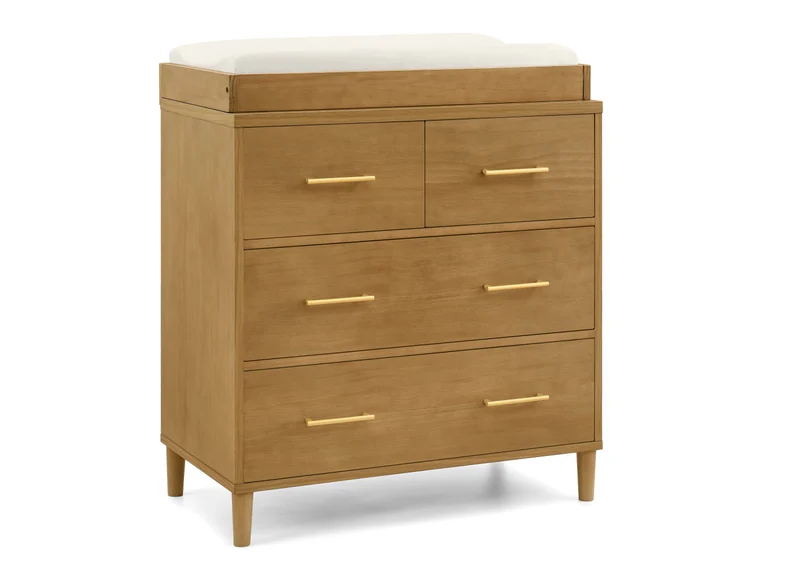
- Delta Children Classic 4 Drawer Dresser with Changing Top and Interlocking Drawers - Buy. Four real drawers, a changing top that lifts off, and an interlocking drawer system that treats tip-over as an engineering problem instead of a warning label.
- Babyletto Hudson 3-Drawer Compact Changer Dresser with Removable Changing Tray - Buy. The premium take on the same idea, and the one to get if your nursery wall is short on depth rather than width.
- Storkcraft Universal Changing Topper for 6 Drawer Dressers - It depends. The cheapest sane answer in the category, provided you already own a wide dresser it actually fits and you anchor that dresser first.
- Graco Storage Changing Table - Skip. A tidy, inexpensive, dedicated changing table that converts into nothing the month your child stops needing it.
The verdict in 30 seconds
What mattered most
- Form factor
- Life after diapers
- Tip-over protection
- Changing surface
- Storage
- Footprint
Diapers last roughly two and a half to three years, which means a dedicated changing table has a short career and a long retirement in your garage. The pieces that hold up are dressers first and changing stations second, with a top that lifts off when the job is done. We compared four current options on tip-over engineering, the changing surface itself, and what the furniture is worth to you five years from now. Two earn a buy, one works only under specific conditions, and one is easy to walk past.
Four real drawers, a changing top that lifts off, and an interlocking drawer system that treats tip-over as an engineering problem instead of a warning label.
Best for: Most nurseries. It covers changing, storage, and the years after diapers without premium pricing.
- Interlocking drawers limit how many open at once, removing the stack a toddler climbs to tip furniture
- Tested to ASTM F2057, the mandatory federal tip-over standard for clothing storage units, with a wall anchor in the box
- GREENGUARD Gold certified, built from New Zealand pine and engineered wood
- Changing top is removable, so it becomes an ordinary bedroom dresser later
- Five finishes, which makes matching a crib or a future room easy
- Changing pad is sold separately, so the sticker is not the whole cost
- Delta does not list soft-close glides
- Near 120 pounds assembled and a long two-person build
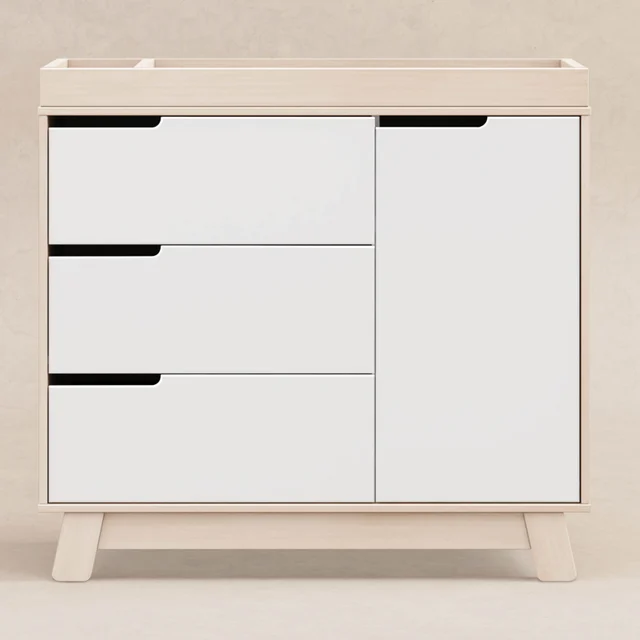
The premium take on the same idea, and the one to get if your nursery wall is short on depth rather than width.
Best for: Small or shallow nurseries where the furniture has to look right in a shared room later.
- About 19 inches deep, so it fits walls a standard dresser cannot
- Three drawers plus a cabinet with an adjustable shelf, which suits diaper-era supplies better than a fourth drawer
- Removable changing tray with an interior area around 31 by 17 inches, Babyletto says it fits a 31 by 16 inch pad
- GREENGUARD Gold certified with an anti-tip kit included
- Hidden hardware and smooth-glide drawers that owners rate above mass-market pieces
- Costs several times what a standalone changing table does
- Well over 100 pounds assembled and awkward for one person to build
- Sold in a single washed natural and white finish direct from the brand
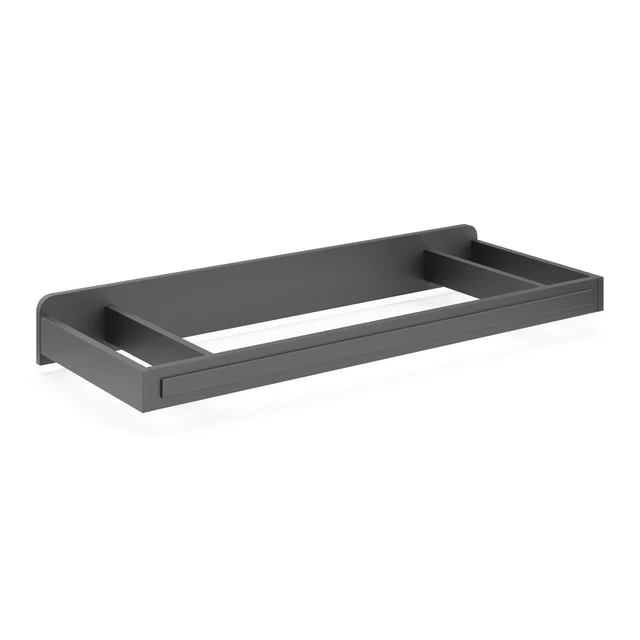
The cheapest sane answer in the category, provided you already own a wide dresser it actually fits and you anchor that dresser first.
Best for: Second-time parents and anyone with a wide six-drawer dresser already in the room.
- Converts a dresser you already own instead of adding a second piece of furniture
- Screws to the back of the dresser rather than just resting on top
- Three compartments keep a standard pad, wipes, and cream in reach
- GREENGUARD Gold certified, felt-lined underside so it will not mark the dresser
- Light at about 12.5 pounds and roughly a 30 minute assembly
- Needs a dresser top of at least about 17 by 46 inches, which rules out compact and three-drawer dressers
- No changing pad, and Storkcraft does not mention a restraint strap, so the pad has to bring the strap
- Adds nothing to the dresser's stability and raises its center of gravity, so an unanchored or older dresser gets less safe, not more
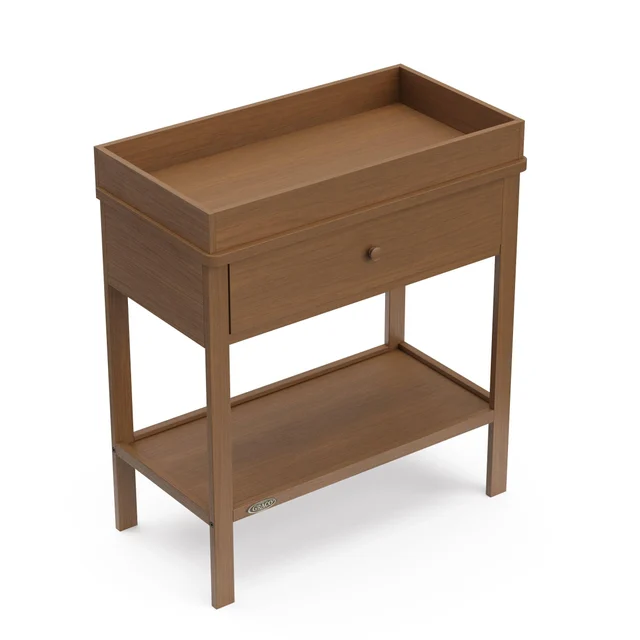
A tidy, inexpensive, dedicated changing table that converts into nothing the month your child stops needing it.
Best for: A grandparent's spare room or a second changing spot where long-term use was never the point.
- Low cost and compact enough for a second changing spot
- A raised changing surface, easier on your back than a low dresser
- Side barriers on the changing surface, plus a drawer and an open shelf
- Stand-alone design with storage under the changing surface
- No conversion path: when diapers end you are left with a narrow open shelf unit
- Compact open-shelf design, too small to serve as real clothing storage
- Changing pad is sold separately by most makers, so the real cost is higher than it looks
- You will still need to buy a dresser, which is the purchase that would have covered both jobs
| Criteria | Delta Children Classic 4 Drawer Dresser with Changing Top and Interlocking Drawers Top pick | Babyletto Hudson 3-Drawer Compact Changer Dresser with Removable Changing Tray | Storkcraft Universal Changing Topper for 6 Drawer Dressers | Graco Storage Changing Table |
|---|---|---|---|---|
| Verdict | Buy it | Buy it | It depends | Skip it |
| Best for | Most nurseries. It covers changing, storage, and the years after diapers without premium pricing. | Small or shallow nurseries where the furniture has to look right in a shared room later. | Second-time parents and anyone with a wide six-drawer dresser already in the room. | A grandparent's spare room or a second changing spot where long-term use was never the point. |
| Price tier | $ · mid-range | $$ · premium | $ · budget | $ · budget |
| Form factor | 4-drawer dresser with removable changing top | 3-drawer changer dresser with storage cabinet | Topper only, dresser not included | Standalone changing table |
| Life after diapers | Full four-drawer bedroom dresser | Full dresser plus cabinet | Depends entirely on the dresser under it | Narrow open shelf unit |
| Tip-over protection | Interlocking drawers, ASTM F2057 tested, wall anchor included | Anti-tip kit included | None of its own, inherits the dresser's | Not confirmed, anchor separately |
| Changing surface | Removable top, check Delta's recommended pad size | Removable tray, about 31 by 17 inches inside (fits a 31 by 16 inch pad) | Screw-in topper with three compartments | Fixed raised surface with side barriers |
| Storage | 4 drawers, two wide and two small | 3 drawers plus cabinet with adjustable shelf | None of its own | A drawer and an open shelf |
| Footprint | About 34 inches wide | About 40 inches wide, 19 deep | About 45 inches wide, needs a 46 inch dresser top | Compact; dimensions not confirmed |
| Changing pad included | No | No | No | No |
| Price tier | $ · mid-range | $$ · premium | $ · budget | $ · budget |
Which one is right for you?
- Most nurseries. It covers changing, storage, and the years after diapers without premium pricing. Buy it Delta Children Classic 4 Drawer Dresser with Changing Top and Interlocking Drawers
- Small or shallow nurseries where the furniture has to look right in a shared room later. Buy it Babyletto Hudson 3-Drawer Compact Changer Dresser with Removable Changing Tray
- Second-time parents and anyone with a wide six-drawer dresser already in the room. It depends Storkcraft Universal Changing Topper for 6 Drawer Dressers
- A grandparent's spare room or a second changing spot where long-term use was never the point. Skip it Graco Storage Changing Table
How we judged the field
We do not run a lab. We synthesize independent testing, manufacturer specifications and safety documentation, and aggregated owner reports, then weight the factors that keep surfacing in real nurseries rather than the ones that photograph well.
Four things did most of the sorting.
Life after diapers. Diapers last roughly two and a half to three years. A dedicated changing table’s entire job ends there. A dresser with a removable changing top keeps working for a decade. That single difference decides more of this category than any feature list, and it is why the strongest options here are dressers first and changing stations second.
Tip-over engineering. Dressers sold as clothing storage units in the US must meet ASTM F2057, the federal stability standard, and good ones ship with a wall anchor. Some go further with interlocking drawers that prevent a toddler from opening several drawers at once and climbing them. Standalone changing tables and toppers sit outside that dresser standard, so their stability depends entirely on what they are attached to.
The changing surface. Barriers on all four sides, a restraint strap, and a contoured pad that stops a baby rolling sideways. Federal rules for baby changing products require side barriers and a restraint, and they require a warning label telling you never to leave a child unattended. Note that the pad is usually sold separately in this category. Budget for it separately.
Assembly and real-world weight. Owners consistently report these pieces as two-person, hour-plus builds. The good ones weigh well over a hundred pounds assembled, which is a feature for stability and a problem for anyone planning to move it alone.
Delta Children Classic 4 Drawer Dresser with Changing Top and Interlocking Drawers
Buy itCheck price on AmazonThis is the most sensible version of the idea for most people. Four real drawers, two wide and two small, with a changing top that lifts off when you are done with it. Underneath the styling it is an ordinary chest of drawers that will sit in a bedroom for years without looking like nursery furniture.
The safety story is the reason it takes the top spot rather than just the value spot. Delta tests it to ASTM F2057, the mandatory CPSC tip-over standard for clothing storage units, includes a wall anchor, and adds an interlocking drawer system that limits how many drawers open at once. That last part matters more than it sounds: an open stack of drawers is the ladder a toddler climbs, and removing the ladder is better engineering than warning a parent about it. It is also GREENGUARD Gold certified and built from New Zealand pine with engineered wood.
The compromises are ordinary. The changing pad is sold separately. Delta does not list soft-close glides. It is about 34 inches wide and near 120 pounds assembled, so the build is a long evening with a second pair of hands. None of that changes the calculation: you get changing-station duty now and a dresser you would still keep at ten years old.
Babyletto Hudson 3-Drawer Compact Changer Dresser with Removable Changing Tray
Buy itCheck price on AmazonThe premium answer, and the better one if your nursery is short on depth rather than width. The Hudson runs around 40 inches wide but only about 19 inches deep, which lets it sit on a wall that will not take a standard dresser. Inside it is three drawers plus a storage cabinet with an adjustable shelf, which is genuinely more useful for diaper-era supplies than a fourth drawer.
The changing tray is removable, the interior changing area is roughly 31 by 17 inches (Babyletto says it fits a 31 by 16 inch pad), and an anti-tip kit is in the box. Babyletto lists it as GREENGUARD Gold certified. Owners consistently describe the finish and hardware as a step above the mass-market pieces, with hidden hardware and smooth-glide drawers.
What you pay for that is real. It costs several times what a standalone changing table does, it weighs well north of 100 pounds assembled, and the brand currently sells it in a single washed natural and white finish, so matching an existing nursery may mean shopping the wider retail channel. If the budget is there and the wall is shallow, it is the nicer piece of furniture. If not, the Delta does the same job.
Not a piece of furniture. A wooden topper, roughly 45 inches wide and 17.6 deep, that screws to the back of a dresser you already own and turns it into a changing station. Three compartments hold a standard pad plus wipes and creams. The underside is felt-lined so it does not mark the dresser top. It is GREENGUARD Gold certified and weighs about 12.5 pounds.
For second-time parents, or anyone who already has a wide six-drawer dresser in the room, this is the cheapest sane answer in the whole category and it produces zero extra furniture to get rid of later.
The conditions are strict, which is why it is not a straight buy. It needs a dresser top of at least about 17 by 46 inches, which rules out compact and three-drawer dressers outright. Measure before you order. It does not include a changing pad, and Storkcraft does not mention a restraint strap, so the pad you buy has to bring the strap. Most importantly, a topper does nothing for the stability of what is under it. If your dresser is older than the current tip-over standard, or is not anchored to the wall, bolting a changing station on top raises the center of gravity and makes the problem worse. Anchor first, then add the topper.
There is nothing wrong with it as an object. It is a tidy standalone changing table: compact, with a raised changing surface, side barriers and a drawer and open shelf for storage. A raised surface is easier on your back than changing a baby on a low dresser.
The problem is arithmetic. The changing pad is typically sold separately, so the sticker is not the real cost. And when diapers end, this converts into nothing. You are left with a narrow open shelf unit that no adult room wants, in a house that now needs somewhere to put a toddler’s clothes. Buy it and you will buy a dresser too. Buy the dresser first and you were done.
There is a version of this that makes sense: a second changing spot at a grandparent’s house, a small rental where the furniture is not staying, a second floor where carrying a baby downstairs at 3am is the thing you are actually solving. Outside those cases, the money is better spent once.
Delta Children Classic 4 Drawer Dresser vs Babyletto Hudson Changer Dresser: which should you buy?
They are the same idea executed at two price points, and both are correct choices.
Take the Delta if you want the safety engineering and the finish options. The interlocking drawer system is the single most useful feature in this comparison, because it addresses tip-over the way an engineer would rather than the way a warning label does. Five finishes means it can match a crib now or read as plain bedroom furniture later. At about 34 inches wide it is the narrower of the two.
Take the Babyletto if your wall is shallow or your standards for the object itself are higher. Nineteen inches of depth is a meaningful advantage in a small room, the cabinet with an adjustable shelf beats a fourth drawer for diaper-era storage, and the build quality shows in the hardware and the drawer action. It costs considerably more and comes in one finish from the brand directly.
Neither ships with a changing pad. Both need anchoring. Both take two people and most of an evening to assemble. If you are torn, the deciding question is your wall depth, not your taste.
What to look for
- Buy the dresser, not the changing table. The changing function is a two-to-three year job. The storage function is a ten year job. Anything that only does the first one is a temporary purchase.
- Check the tip-over standard. For a dresser, look for testing to ASTM F2057 and an included wall anchor. Interlocking drawers are a genuine upgrade on top of that.
- Anchor it to the wall. Every time. This is not optional and it is not a step you skip because the piece feels heavy. The anchor is part of the safety design, not an accessory.
- A strap and rails are a delay, not a stop. Federal rules require side barriers and a restraint on changing products, and they require the warning that goes with them. Keep a hand on the baby for the entire change and put wipes, a fresh diaper, and cream within arm’s reach before you start.
- Measure for a topper before you buy one. Universal toppers typically need a dresser top around 17 by 46 inches. Compact and three-drawer dressers will not take one.
- Budget for the pad separately. It is usually sold separately in this category. Get a contoured four-sided pad with a working restraint strap, and check the pad size the maker recommends.
- Watch the working height. Around 36 to 38 inches suits most adults. Much lower and you will feel it in your back after a few weeks.
- Plan the assembly. Two people, an evening, and a spot to build it in the room where it will live. These pieces are too heavy to build in a hallway and carry.
Our final take
The real decision in this category is not which changing table. It is whether to buy a changing table at all. A dresser with a removable top does both jobs, costs less over five years than a changing table plus a dresser bought separately, and leaves you with furniture instead of a shelf unit to sell.
The Delta Children Classic is the pick for most nurseries: tip-over tested, wall anchor included, interlocking drawers, removable top, five finishes, mid-range money. The Babyletto Hudson is the upgrade if your wall is shallow or you want the nicer object. If you already own a wide six-drawer dresser, the Storkcraft topper solves this for the least money and the least clutter, provided you measure first and anchor the dresser. The standalone Graco changing table is the one to walk past unless it is a second changing spot that was never meant to last.
Whatever you buy, anchor it and keep a hand on the baby. Those two habits do more for safety than any feature on this page.
Questions, answered
Do I actually need a changing table?
No. You need a safe surface at a comfortable height with everything within arm's reach. A dresser with a contoured pad and a removable top does that job and keeps working long after diapers end. A dedicated changing table does the same job for two or three years and then becomes furniture nobody wants. Plenty of parents also change babies on the floor, which removes the fall risk because there is nowhere to fall from.
Is putting a changing topper on a regular dresser safe?
It can be, with three conditions. The dresser has to be anchored to the wall, it should meet the current ASTM F2057 tip-over standard for clothing storage units, and the topper has to fit properly and attach rather than sit loose. Adding a topper raises the center of gravity, so an old or unanchored dresser becomes less stable, not more. Anchor first, then add the topper, and use a four-sided contoured pad with a working restraint strap.
Does the safety strap mean I can turn away for a second?
No. A restraint strap and side rails slow a determined roll, they do not stop one, and babies get stronger faster than parents expect. Federal rules for baby changing products require barriers and a restraint precisely because falls from changing surfaces are a known injury source, and the same rules require a warning telling you never to leave a child unattended. Keep a hand on the baby the whole time and set out the diaper, wipes, and cream before you start.
How long will I really use it as a changing station?
Roughly two and a half to three years, and often less. Many parents stop using the raised surface earlier than that, once a toddler starts fighting the change and the floor becomes easier and safer. Buy on the assumption that the changing function is short and the storage function is long.
What changing pad should I get, and is one included?
Assume it is not included. None of the four options here is listed as including a pad. Get a contoured pad with raised sides on all four edges and a restraint strap, in the size the manufacturer recommends for that piece (a standard contour pad is around 32 by 16 inches, but check, because a pad that overhangs is a hazard). A waterproof surface or a washable cover you can strip quickly matters more day to day than any other feature.
Deciding between the top two? See our head-to-head: Delta Children Classic 4 Drawer Dresser with Changing Top and Interlocking Drawers vs Babyletto Hudson 3-Drawer Compact Changer Dresser with Removable Changing Tray.
More Baby & Family reviews
 The Best Crib Mattresses: 4 Compared (and One to Skip)
  The Best Crib Mobiles: 4 Compared (and One to Skip)
  The Best Cribs: 4 Compared (and One to Skip)
  The Best Diaper Bags: 4 Compared (and One to Skip)
  The Best Diaper Caddies: 4 Compared (and One to Skip)
  The Best Diaper Pails: 4 Compared (and One to Skip)